


SWE225E-3H Medium-sized Excavator: A Practical Choice for Daily Excavation Work
When I talk with customers about a medium-sized Excavator, I usually avoid starting with the biggest number on the specification sheet. Engine power matters, of course, but it is only one part of the machine. I want to know what the excavator will actually do every day. Will it dig foundations? Will it work on roads? Will it handle drainage, farm projects, municipal work, or general earthmoving? Once I understand the job, choosing the machine becomes much easier.
The SWE225E-3H Medium-sized Excavator is a crawler excavator positioned in the 22-ton class. Current Sunward product information lists the machine at around 22.4 tonnes, with a standard bucket capacity of 1.1 m³, while other technical material gives a working weight of about 22.3 tonnes and a bucket range of 1.0–1.1 m³. The rated engine power is listed as 124 kW at 2,050 rpm.
That small difference in published figures is worth mentioning because construction machinery is often sold in different configurations and markets. I always recommend confirming the final machine specification before an order is placed. The actual bucket, operating weight, engine configuration, attachments and other details should match the quotation and final order documents.
From my experience working with construction machinery buyers, the SWE225E-3H sits in a useful position. It is considerably more capable than a Compact Excavator, but it does not move into the size of heavy machines intended mainly for very large earthmoving or mining projects. For contractors looking for a 22 ton excavator, medium crawler excavator or Sunward medium excavator, this is a model worth examining.
At Ganglong Heavy Industry Technology (Hefei) Co., Ltd., our role is to help customers source and arrange construction machinery. We are not presenting ourselves as the manufacturer of Sunward-branded machines. Instead, we work as a machinery supplier and international trade partner, supporting customers with model selection, configuration confirmation, inspection, export documentation, transportation and related equipment services.
The SWE225E-3H is designed as a medium excavator for regular construction and earthmoving work. Sunward's medium excavator information places the model alongside other machines in the company's medium crawler excavator range. The published range covers machines from around 13 tonnes to approximately 30 tonnes, giving contractors several sizes to choose from depending on the job.
The SWE225E-3H has the kind of size that many contractors find practical. At roughly 22 tonnes, it has enough machine mass for stable digging while still being much easier to move between projects than a very Large Excavator. Sunward's published product listing gives a total length of about 9,570 mm and a total width of about 2,990 mm, with a 600 mm track shoe width.
For the engine, the available technical information lists a Cummins QSB7 four-stroke, water-cooled, direct-injection diesel engine. Rated power is listed as 124 kW at 2,050 rpm, with maximum torque of 658 N·m at 1,200 rpm and a 6.7-liter displacement.
I like to look at these figures together rather than separately. A 124 kW engine on a roughly 22-ton machine gives us a useful picture of the intended working class. The machine is not built simply to move itself around the site. Its hydraulic system, digging equipment, tracks and upper structure all have to work together to turn engine power into useful digging force.
| Item | SWE225E-3H Published Data | Source |
|---|---|---|
| Excavator class | Medium Excavator | Sunward |
| Operating / overall weight | Approx. 22.3–22.4 t | Sunward product information |
| Standard bucket capacity | Approx. 1.0–1.2 m³ depending on source/configuration | Sunward product information |
| Engine | Cummins QSB7 | Sunward technical data |
| Rated power | 124 kW / 2050 rpm | Sunward technical data |
| Maximum torque | 658 N·m / 1200 rpm | Sunward technical data |
| Engine displacement | 6.7 L | Sunward technical data |
Source: Sunward product information and technical product data. Published parameters can change with product updates and configuration, so the final specification should be confirmed before purchase.
If you have never operated an excavator, the basic working principle is actually easy to understand. The engine creates the main power. The hydraulic system sends that power to different parts of the machine. The operator then controls the boom, arm, bucket, swing and travel functions from the cab.
During digging, the boom first puts the arm and bucket into the correct position. The arm moves the bucket toward the machine, while the bucket cylinder provides the force needed to cut and collect material. Once the bucket is full, the operator raises the boom and swings the upper structure toward the dumping location.
After the material is released, the upper structure swings back toward the digging area and the cycle begins again.
It sounds simple, but this cycle happens hundreds of times during a long working day. That is why hydraulic response, machine balance and operator control can have a bigger effect on actual productivity than a single headline specification.
The SWE225E-3H uses a dual-tandem variable-displacement plunger pump arrangement. Published technical information gives a maximum main-pump flow of 2 × 240 L/min and system pressure values of 31.4/34.3 MPa. The pilot pump is listed as a gear pump with a maximum flow of 21 L/min and pilot pressure of 3.9 MPa.
In everyday language, these numbers describe how the hydraulic system delivers oil to the machine's working functions. The exact result depends on the complete hydraulic design, engine output, control system and jobsite conditions. A good hydraulic system is not simply about having high pressure. It is about delivering the right flow and pressure when the operator needs it.
Fuel is a daily operating cost, so I always pay attention to how the engine is matched to the excavator. The published SWE225E-3H information describes an energy-efficient engine setup, including specially configured engine components and an optimized fuel map intended to reduce fuel usage under working conditions. It also describes increased torque for faster response.
I would not promise a fixed fuel-saving percentage because real fuel consumption changes from one site to another. Soil type, digging depth, operator habits, idle time, attachment choice and working cycle all make a difference. A machine working in loose soil for eight hours will not use fuel in the same way as one digging hard ground all day.
The dual-tandem variable-displacement pump arrangement is designed to supply hydraulic flow for the machine's main working functions. With two main pumps and a maximum flow listed at 2 × 240 L/min, the system has the hydraulic capacity expected from a machine in this working class.
For me, the important point is not simply the pump number. What matters is how the excavator behaves during repeated boom, arm, bucket and swing movements. A machine that feels predictable is easier for the operator to work with over a long shift.
The published SWE225E-3H specifications give a bucket digging force of 155 kN and an arm digging force of 110 kN under the stated ISO supercharging condition. These figures help explain why the machine is suitable for normal construction and earthmoving work.
Of course, digging force is not the only thing that determines whether an excavator can handle a particular material. If a customer plans to work mainly in hard rock, we need to look at the bucket, attachment, ground conditions and working method rather than relying on the digging-force figure alone.
The SWE225E-3H uses a crawler undercarriage with 600 mm track links. The published ground-specific pressure is 46 kPa. Its maximum gradeability is listed as 35 degrees, although actual safe operation on slopes must always follow the machine's operating manual and site safety requirements.
This type of crawler arrangement makes the excavator suitable for many uneven construction environments. Still, I always tell customers that a specification sheet cannot replace a site survey. Soft ground, steep slopes, mud, loose fill and restricted access can change what is practical.
Sunward's current SWE225E-3H product information highlights a maintenance space designed to make access to service parts easier. That sounds like a small detail, but it matters. Construction machines spend a lot of time working, and maintenance is part of the ownership cycle, not an optional extra.
Before delivery, I also recommend that buyers confirm the maintenance schedule, consumable parts, filters, hydraulic oil requirements and spare-parts supply route for their destination country.
Working range is one of the first things I check when a customer gives me a project description. If someone tells me they need to dig a trench six meters deep, for example, I do not want to recommend a machine based only on operating weight. I need to check digging depth, reach, dumping height and the attachment configuration.
For the standard working arrangement, published SWE225E-3H information gives a boom length of 5,700 mm and an arm length of 2,920 mm. The same source lists a maximum digging height of 9,750 mm, maximum unloading height of 6,980 mm, maximum digging depth of 6,750 mm and maximum digging distance of 9,940 mm.
| Working Parameter | Published Value | Why It Matters |
|---|---|---|
| Boom length | 5700 mm | Defines the main front working geometry |
| Arm length | 2920 mm | Affects digging reach and depth |
| Maximum digging height | 9750 mm | Useful when working at higher positions |
| Maximum unloading height | 6980 mm | Important for truck loading and stockpiles |
| Maximum digging depth | 6750 mm | Useful for trenches and deeper excavation |
| Maximum digging distance | 9940 mm | Shows the overall horizontal working range |
| Maximum ground digging distance | 9775 mm | Useful for ground-level excavation |
| Minimum front swing radius | 3560 mm | Helps when planning working space |
Source: Sunward SWE225E-3H technical information. Values are reference specifications and should be confirmed for the final machine configuration.
The machine's published dimensions are approximately 9,570 mm overall length, 2,945–2,970 mm overall height depending on the source/configuration, and 2,990 mm overall width. The current Sunward international listing gives 9,570 mm length, 2,970 mm height and 2,990 mm width.
These dimensions matter when the machine needs to travel through a gate, enter a construction site or be loaded for overseas transportation. Before arranging a trailer or shipping method, I always recommend checking the exact machine dimensions with the selected configuration rather than relying on a general model page.
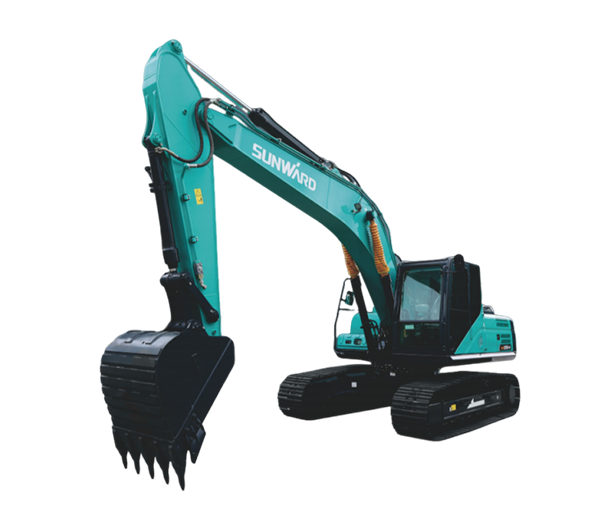
The biggest advantage of a medium excavator is flexibility. A contractor may use the same machine on several types of projects during the year. That is especially useful for businesses that do not want a machine sitting idle because it is too specialized.
For general building construction, the SWE225E-3H can be used for site preparation, foundation excavation, soil removal, trenching and material handling. Its working range gives the operator room to work without moving the machine every few seconds.
Road projects often involve excavation, drainage channels, shoulder work and preparation of different sections of the road. A medium crawler excavator can be a practical machine for these jobs because it provides more digging capacity than a compact excavator while remaining easier to transport than very large equipment.
Municipal work can include drainage, utility trenches, landscaping, pipeline preparation and other earthmoving tasks. These projects can vary a lot from one location to another, so the final attachment and bucket choice should be matched to the actual work.
A crawler excavator in this class can also be used for agricultural land preparation, irrigation channels, pond excavation, farm road work and general soil handling. On soft or wet ground, however, the site condition should be checked carefully before deciding whether the standard undercarriage is suitable.
For larger landscaping jobs, the SWE225E-3H can provide useful digging and material-handling capability. With the correct attachment, an excavator can do much more than simply dig soil. Attachment selection should be based on the actual task, hydraulic requirements and expected working hours.
The machine may also be considered for selected mining-support and quarry-related tasks, but I would not treat every mining application in the same way. Continuous hard-rock excavation can require a different machine class, reinforced configuration or specialized attachment. When a customer sends us a mining project, we review the ground conditions and working cycle before discussing the machine.
| Application | Typical Work | Important Selection Point |
|---|---|---|
| Construction | Foundations, site preparation, earthmoving | Bucket and working range |
| Road Work | Drainage, trenching, soil removal | Ground condition and transport |
| Municipal Work | Utilities, drainage, landscaping | Working space and attachments |
| Agriculture | Irrigation, ponds, farm roads | Ground condition and access |
| Landscaping | Soil handling and site shaping | Attachment selection |
| Mining Support | Selected excavation and material handling | Rock condition and machine configuration |
Source: Application recommendations are based on the published medium excavator positioning and technical characteristics of the SWE225E-3H. Actual suitability depends on site conditions, attachment choice and local operating requirements. Sunward describes its medium excavator range as suitable for earthmoving and construction applications.
When customers ask me about the SWE225E-3H, I usually compare the models immediately above and below it. This helps avoid a common mistake: buying a machine that is either too small for the job or larger than necessary.
Sunward's current medium excavator information lists the SWE215E-3H at 21.1 tonnes with a 1.0 m³ bucket and 124 kW engine power. The SWE225E-3H is listed at approximately 22.3 tonnes, with a 1.0–1.1 m³ bucket and 124 kW. The SWE265F moves up to approximately 27.3 tonnes with a 1.6 m³ bucket.
| Model | Published Weight | Bucket Capacity | Rated / Engine Power | Source |
|---|---|---|---|---|
| SWE215E-3H | 21.1 t | 1.0 m³ | 124 kW / 2050 rpm | Sunward |
| SWE225E-3H | 22.3–22.4 t | 1.0–1.2 m³ | 124 kW / 2050 rpm | Sunward |
| SWE235E-3H | 23.3 t | 1.2 m³ | 140 kW / 2050 rpm | Sunward |
| SWE265F | 27.3 t | 1.6 m³ | Configuration dependent | Sunward |
Source: Sunward medium excavator product listings and model-specific technical information. The table is intended for model-range reference; final specifications should be checked against the latest machine documentation.
Looking at the table, the SWE225E-3H is not simply a smaller version of a larger excavator. It occupies its own useful space. If a contractor needs around 22 tonnes of machine weight and a bucket around the 1.0–1.1 m³ class, it can be a practical fit. If the work requires noticeably more bucket capacity and machine mass, moving up to a larger model may make more sense.
On the other hand, if transportation cost, jobsite access or project size is the main concern, a lighter excavator may be easier to manage. This is why I prefer to compare the whole working situation instead of recommending a machine based on weight alone.
Buying an excavator for an overseas project involves much more than sending a quotation. The machine has to be correctly specified, inspected, documented, loaded and shipped. If one part of that chain is unclear, the buyer can face unnecessary delays.
Our company was founded in 2013. Together with Hefei Ganglong International Trade Co., Ltd., we operate within a broader construction machinery business structure affiliated with China Construction Machinery (Group) Co., Ltd. Our business covers equipment sourcing, manufacturing-related activities, testing, customization coordination and global sales, while our international trade team focuses on overseas machinery transactions.
We supply our own HKLOONG excavators, loaders, Backhoe loaders and swamp excavators. At the same time, we provide complete machine sales and leasing services involving a number of domestic and international brands, including Hitachi, SANY, Lonking, Hyundai, XCMG, SHANMON and LOVOL.
For Sunward equipment, our role is to source and supply the equipment rather than claim that we manufacture Sunward machines. This is an important distinction for customers who are comparing suppliers. We want the commercial relationship, product origin and service responsibility to be clear from the beginning.
We first ask about the application, working environment, destination country, required machine quantity and expected delivery schedule. If the machine will work in a special environment, such as high altitude, very soft ground or hard rock, we want to know that early.
We check the exact model, bucket, arm arrangement, engine configuration, attachments and other requirements. This step is particularly important because published specifications can differ between versions and markets.
Before shipment, machines are inspected according to the order requirements. Our normal inspection scope includes appearance, main functions, hydraulic systems, electrical systems and basic operating performance. Accessories and standard documents are also checked against the order.
For international delivery, we arrange the shipping plan according to the destination and route. Complete machines can be transported by sea, while suitable spare parts and accessories may be sent by air or express.
The machine is normally protected with film, securely fixed and packed according to shipping requirements. Loose parts and accessories can be packed separately in suitable cartons or wooden cases.
Payment is commonly arranged by T/T, such as a deposit before production or preparation and the balance before shipment. Exact payment terms are confirmed between both parties according to the order.
Published Sunward information gives slightly different figures depending on the source. One Sunward product listing gives 22,400 kg, while another technical product page lists 22.3 tonnes. I recommend using approximately 22.3–22.4 tonnes as a reference and confirming the exact operating weight on the final specification sheet.
The available Sunward information gives a standard bucket range of approximately 1.0–1.1 m³ on one technical page, while the current international product page lists 1.1–1.2 m³. This difference shows why buyers should confirm the exact bucket configuration before ordering.
The technical product information lists a Cummins QSB7 engine with four-stroke, water-cooling and direct-injection design. Rated power is 124 kW at 2,050 rpm, with 658 N·m maximum torque at 1,200 rpm.
The published SWE225E-3H technical data gives a maximum digging depth of 6,750 mm. It also lists a maximum digging distance of 9,940 mm and a maximum ground digging distance of 9,775 mm. These figures are reference values for the stated configuration.
The published maximum unloading height is 6,980 mm. Actual working performance depends on arm and bucket configuration, machine position and the material being handled.
Yes. Its medium excavator configuration is suitable for many road construction tasks, including excavation, drainage, trenching and general earthmoving. The exact attachment and bucket should be selected according to the material and working conditions.
It can be considered for agricultural earthmoving, irrigation channels, pond work, farm roads and related projects. However, ground conditions should be checked carefully, especially where the machine will operate on very soft or wet soil.
Yes. Hefei Ganglong International Trade Co., Ltd. serves as our professional international trade arm. Our team has experience with construction machinery, mining machinery and agricultural machinery for customers across Asia, Africa, America and other markets.
There is no fixed preparation period for every order. Timing depends on machine availability, model, configuration, quantity and customization requirements. We confirm the delivery schedule before the order is finalized.
Complete machines can generally be transported by sea for international orders. Spare parts and suitable accessories may be sent by air or express. The final transportation method depends on destination, shipping route, machine configuration and customer requirements.
Yes. We can discuss matching attachments and spare parts as part of the machinery supply plan. I recommend confirming these items before shipment so that hydraulic requirements, dimensions, packing and transport can all be arranged together.
When I look at the SWE225E-3H Medium-sized Excavator, I see a machine aimed at a very practical part of the construction market. It is large enough to handle serious excavation work, but it remains within a medium excavator class that can be moved between projects more easily than much larger equipment.
The published specifications give us a machine of roughly 22.3–22.4 tonnes, with 124 kW engine power, a standard bucket around the 1.0–1.2 m³ range, a 5.7 m boom and a working reach close to 10 meters. The hydraulic system uses dual-tandem variable-displacement pumps, while the published digging force reaches 155 kN at the bucket under the stated testing condition.
For me, however, specifications are only the starting point. The more important question is whether the machine matches the actual project. A contractor working on road construction may care about transport and trenching. A municipal contractor may care more about working space and attachment flexibility. An agricultural customer may focus on ground conditions. A mining customer may need a stronger configuration altogether.
That is where our role at Ganglong comes in. We help customers look at the complete equipment package instead of simply forwarding a model name. We can discuss the application, confirm the machine configuration, arrange inspection, prepare the required documents and organize transportation based on the destination.
If you are looking for a SWE225E-3H Medium-sized Excavator Supplier, a Sunward medium excavator, a 22 ton crawler excavator, or a medium excavator for construction and earthmoving, I recommend confirming the working conditions first and then checking the latest machine configuration.
One final point is worth keeping in mind: construction machinery specifications can change with product upgrades, regional versions and attachments. The data on this page is intended as practical reference information. Before purchase, we recommend confirming the latest specification sheet, engine, bucket capacity, operating weight, working range, emissions configuration, attachments and shipping dimensions for the exact SWE225E-3H machine being supplied.
2435092534@qq.com
86 158 5511 9567


©2026 HKLOONG Heavy Industry Technology (Hefei) Co., Ltd. All Rights Reserved.

This website uses cookies to ensure you get the best experience on our website.
 Español
 Pусский
 Français
 العربية
 WhatsApp
 Phone
Phone E-mail
 Message