

Introduction to Amphibious Wetland Excavators (Pontoon Excavators)
Amphibious excavators—also known as swamp or Wetland excavators—are specialized pieces of heavy construction machinery.
Core Structural Features
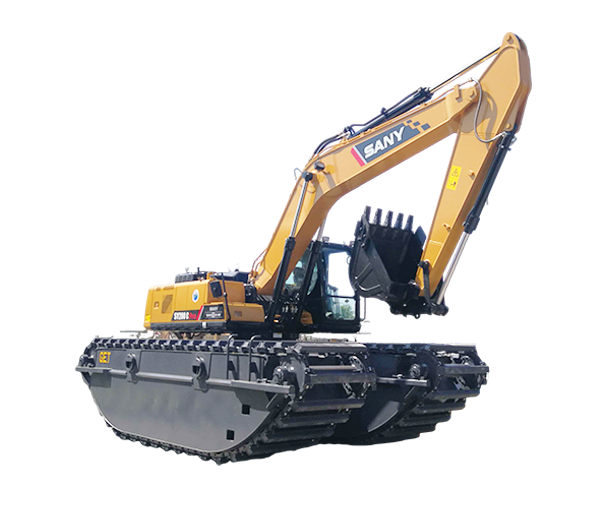
The upper structure consists of a standard Hydraulic Excavator unit, while the undercarriage is replaced by sealed pontoon floats and widened tracks. The pontoons provide buoyancy, and the tracks allow the machine to traverse silt and shallow water without sinking like a conventional excavator; this enables seamless operation across land, swamps, and shallow water zones.
Key Functions
River Dredging and Desilting
Clearing silt and weeds from riverbeds and ditches, as well as widening and deepening waterways (e.g., excavating silt directly from the river channel); this is the most common application in inland waterway management.
Wetland and Tidal Flat Ecological Restoration
Wetland rehabilitation, swamp excavation, tidal flat development, and reed pond management, helping to preserve wetland water systems.
Hydraulic Embankment Construction
River levee reinforcement, cofferdam excavation, flood control and emergency response, and flood defense operations in low-lying areas.
Pond and Fish Farm Modification
Excavating fish ponds, desilting shrimp ponds, and removing sediment from reservoirs.
Soft-Ground Earthworks
Excavation in swamps and low-lying soft-soil areas; capable of operating on muddy terrain inaccessible to standard excavators.
Advantages
Moves freely through shallow water and silty swamps without the need for support vessels;
Versatile functionality; supports interchangeable attachments such as buckets and Hydraulic Breakers;
Suitable for operations in narrow rivers and wetlands where large dredging vessels cannot enter.
Applicable Scenarios
River management, wetland restoration, hydraulic engineering, tidal flat development, fish pond modification, and flood control/emergency response.
Amphibious wetland excavators utilize a pontoon-track undercarriage to operate in swamps, shallows, and silty river zones. They are primarily used for river dredging, wetland restoration, pond excavation, and embankment construction, making them ideal for soft, water-logged environments where standard excavators cannot operate.
Sany 200 Wetland excavator for Soft Ground, Dredging and Wetland Projects
When a normal Excavator enters soft ground, the problem often starts before the bucket touches the soil. The machine may sink, lose traction, or become difficult to move. This is why I usually recommend looking at the whole working environment before choosing an excavator. For muddy land, marshes, riverbanks, ponds, drainage areas, and other waterlogged sites, a Wetland excavator needs to be configured differently from a standard construction machine.
The Sany 200 Wetland excavator is the product name we use for customers looking for a SANY 200-class excavator suitable for wetland and soft-ground work. In practical projects, the exact machine model and configuration need to be confirmed according to the required working conditions. SANY's official product range includes medium Excavators around the 20–24 ton class, such as the SY215C, SY215C LC and related models. The official SANY specifications show that these machines are built for serious earthmoving work, with bucket capacities around 0.83–1.2 m³ depending on model and configuration.
For wetland applications, however, the standard machine specification is only part of the answer. I pay much more attention to ground pressure, crawler width, machine balance, working equipment, hydraulic condition, transport requirements, and the actual soil or water environment. A machine that works well on a dry construction site may need a different undercarriage or working arrangement before it can work efficiently on soft and wet ground.
Through Ganglong Heavy Industry Technology (Hefei) Co., Ltd. and Hefei Ganglong International Trade Co., Ltd., we can help customers source suitable construction machinery, including SANY equipment, and discuss wetland-oriented configurations according to project requirements. We are not presenting ourselves as the original SANY manufacturer. Instead, we work as a machinery supplier and international trading partner, helping customers select, inspect, prepare, and arrange transportation for suitable equipment.
In simple terms, a wetland excavator is an excavator prepared for places where the ground is too soft, wet, muddy, or unstable for a normal crawler excavator to work comfortably.
I have found that many buyers first focus on engine power or bucket size. Those numbers are important, but they are not enough. When the machine is working beside a river, in a marsh, on reclaimed land, or around a drainage project, the machine must also stay stable while moving across ground that may not provide much support.
A typical wetland excavator can therefore use a wider or specially arranged undercarriage to spread the machine's weight over a larger area. The basic idea is easy to understand: instead of putting the machine's weight onto a small contact area, we try to distribute the load more evenly across the ground.
This is particularly useful when working on:
Wetlands and marshes
Soft agricultural land
Riverbanks and flood-control areas
Ponds and water channels
Dredging sites
Drainage and irrigation projects
Land reclamation projects
Environmental restoration sites
Municipal water projects
Mining areas with soft or wet ground
The SANY medium excavator range currently includes machines in the 20–24 ton operating-weight class. For example, SANY lists the SY215C at 21.9 tons and the SY215C LC at 23.55 tons, while the SY215C LC has a listed bucket capacity of 1.2 m³ and engine power of 129 kW.
These figures give us a useful reference point when discussing a “200-class” wetland excavator. They should not, however, be treated as the final specification of every Sany 200 Wetland excavator we supply. The final machine depends on the actual SANY model, market, year, attachments, undercarriage, and requested wetland configuration.
The working principle is not complicated. The excavator still uses the same basic combination of engine power, hydraulic system, boom, arm, bucket, swing system, and crawler travel system. The important difference is how the machine is prepared to deal with the ground underneath it.
When I look at a wetland project, I normally think about three things first: ground pressure, stability, and mobility.
Ground pressure describes how much load is applied to the soil. Soft ground can deform easily. If the pressure is too high, the crawler may sink. Once the crawler sinks deeply, travel resistance increases and the machine may have trouble climbing out.
Wider tracks can help distribute the machine's weight. SANY's published specifications for its standard medium excavators show track widths such as 600 mm on several models. The older SY215C specification, for example, lists a 600 mm standard track shoe width and 47 track shoes per side.
For a wetland configuration, the final crawler arrangement may be different from the standard machine. That is why I do not simply copy a standard excavator specification and call it a wetland specification. Instead, I check what type of crawler system, track width, extension arrangement, and ground-contact design the project actually needs.
The second issue is stability. Digging in soft soil creates changing forces. When the bucket enters the ground, the excavator is not only moving soil; the boom, arm, bucket, and upper structure are also creating forces that affect the machine's balance.
The third issue is mobility. A wetland excavator must be able to move from one work position to another without wasting too much time recovering from soft ground. Good machine balance, proper track configuration, suitable operating technique, and an appropriate working attachment all matter.
In other words, a wetland excavator is not simply an ordinary excavator with a larger track. The complete working setup needs to match the ground conditions.
The crawler is one of the first parts I check for wetland work. A wider track can increase the contact area with the ground and help reduce the pressure applied to soft soil. The exact result depends on machine weight, track dimensions, soil condition, and configuration, so I prefer to discuss the actual site rather than promise a fixed ground-pressure figure without testing.
For comparison, SANY's official SY215C documentation lists a 600 mm standard track shoe width and a ground pressure of 47.4 kPa. The figure belongs to the published standard machine configuration, not automatically to a modified wetland machine.
Stability is important when digging beside water. The operator may need to place the bucket deep into mud, lift wet material, swing to the side, and place the material into a truck, barge, stockpile, or nearby area.
A stable undercarriage helps the operator maintain smoother movements. It also makes the machine easier to control when the ground surface is uneven.
The hydraulic system transfers engine power into movement at the boom, arm, bucket, swing system, and travel motors. For wetland excavation, smooth hydraulic control is especially useful because sudden movement can make the machine less stable on soft ground.
SANY's published SY205C/SY215C documentation describes a positive-control hydraulic system with variable-capacity piston pumps and separate hydraulic motors for travel and swing.
Wet soil can look easy to dig, but anyone who has worked around clay, roots, compacted riverbank material, or mixed sediment knows that it can become surprisingly tough.
For reference, SANY lists the SY215C with a bucket digging force of 138 kN and an arm digging force of 103 kN in one published specification. Newer SANY configurations can have different values, so I always check the exact model before confirming technical data to a buyer.
Wet areas often contain mud, roots, stones, branches, and other debris. The undercarriage therefore needs regular cleaning and inspection. A suitable machine arrangement can make it easier to move through difficult areas, but it does not mean the excavator can drive through unlimited water or deep mud.
I always recommend that customers provide photographs, ground-condition information, expected water depth, soil type, working depth, and required travel distance before final configuration.
Because “Sany 200 Wetland excavator” is commonly used as a search and purchasing description rather than a single universally published SANY model number, I prefer to show the source data separately. This avoids mixing standard SANY specifications with wetland modifications.
| Reference Model | Operating Weight | Engine Power | Bucket Capacity |
|---|---|---|---|
| SANY SY215C | 21.9 t | 118 kW | 0.93 m³ |
| SANY SY215C LC | 23.55 t | 129 kW | 1.2 m³ |
| SANY SY215HS | 21.5 t | 133 kW | 1.0 m³ |
| SANY SY215E | 23.2 t | 150 kW | 1.1 m³ |
Source: SANY official medium excavator product pages and specifications.
These numbers show why I avoid using one fixed specification for every “200” excavator. Even within SANY's 20–24 ton class, operating weight, engine power, and bucket capacity can change depending on the model.
For a wetland project, the buyer should also consider the final attachment and undercarriage configuration. A wider crawler may affect transport dimensions and shipping arrangements. A longer boom or special bucket may change operating range and machine balance. These details need to be checked before the order is confirmed.
Wetland construction is one of the clearest applications. The excavator can be used for earthmoving, channel preparation, vegetation-area work, material handling, and other site-development tasks where the ground is too soft for standard equipment.
The machine's job is not simply to dig. It may need to travel between work points, position itself near water, remove wet material, and move spoil without repeatedly becoming stuck.
Dredging is another common application. A suitable excavator can remove mud, sediment, and accumulated material from ponds, drainage channels, canals, and other water-related areas.
For deeper water or long-distance reach, a standard arm may not be enough. In such cases, we discuss long-reach equipment or other specialized configurations instead of forcing one machine to do every job.
SANY itself offers Long-Reach Excavator configurations. Its official SY215C long-reach model, for example, is listed with an 8.5 m boom, 6 m stick, 0.35 m³ bucket, and 24.15 ton operating weight.
When land is being reclaimed or prepared for future construction, the working area can be muddy and uneven. A properly configured wetland excavator can help move soil, shape ground levels, clear channels, and prepare access areas.
Agricultural drainage is another practical use. Farmers and contractors may need to clean ditches, deepen drainage channels, clear sediment, or reshape wet land. The machine can be paired with different buckets or attachments depending on the task.
Environmental work often requires careful material removal rather than simply digging as quickly as possible. Wetland restoration, pond cleaning, riverbank maintenance, and ecological construction may all require controlled excavation.
Municipal contractors may use wetland excavators around drainage systems, flood-control projects, canals, reservoirs, and river improvement work. In these situations, machine mobility and transport planning can be just as important as digging power.
One question I often hear is: “Can I just buy a normal 20-ton excavator and use it in wetlands?” Sometimes yes, but it depends heavily on the ground.
If the site is only slightly soft and has good access, a standard crawler excavator may be enough. If the machine will spend long periods on very soft soil, deep mud, marshland, or waterlogged ground, a dedicated wetland-oriented configuration can make more sense.
| Item | Standard Excavator | Wetland-Oriented Excavator |
|---|---|---|
| Normal Ground | Suitable | Suitable |
| Soft Soil | Depends on conditions | Better suited when correctly configured |
| Deep Mud | Higher risk of sinking | Designed around lower ground pressure and stability |
| Wetland Travel | Project dependent | Better suited to planned wet-ground operation |
| Wide Crawler Requirement | Usually standard | May use wider or extended configuration |
| Transport | Usually simpler | May require additional transport planning |
This table is a practical configuration comparison rather than a manufacturer-certified performance test. Actual performance depends on soil bearing capacity, water depth, machine weight, track arrangement, operator technique, and site conditions.
I would rather tell a customer this honestly than promise that a machine will “never sink.” Heavy machinery always has physical limits.
SANY has a bRoad Excavator product range, from compact machines to very large Mining Excavators. Its current official medium excavator range covers approximately 20–35 ton operating weights, while the 20–21.5 ton group includes several models around 20–24 tons.
| SANY Reference | Operating Weight | Power | Bucket | Typical Direction |
|---|---|---|---|---|
| SY215C | 21.9 t | 118 kW | 0.93 m³ | General earthmoving |
| SY215C LC | 23.55 t | 129 kW | 1.2 m³ | Higher-capacity medium excavation |
| SY215HS | 21.5 t | 133 kW | 1.0 m³ | Medium excavation |
| SY215E | 23.2 t | 150 kW | 1.1 m³ | Electric medium excavator |
| SY215C Long-reach | 24.15 t | 114 kW | 0.35 m³ | Long-reach work |
Source: SANY official product pages.
The table also shows why I do not choose a machine based only on the word “200.” A customer working on a shallow marsh may need a different setup from a contractor cleaning a deep river channel. The right machine is the one that matches the real job.
At Ganglong, we treat machine preparation as a practical process, not just paperwork.
After confirming the excavator model, configuration, attachments, and customer requirements, we arrange the machine according to the agreed order. Production or preparation time depends on the selected model, configuration, order quantity, and customization requirements. We confirm the expected delivery schedule before production or preparation begins.
Before shipment, our inspection process focuses on the parts that matter during real operation.
Overall machine appearance
Engine condition and basic operation
Hydraulic system
Boom, arm, and bucket
Crawler and undercarriage
Travel and swing functions
Basic operating functions
Attachments and accessories
Operation manuals and required documents
Spare parts included in the order
For a wetland excavator, I pay special attention to the undercarriage and working equipment because these parts are directly related to the customer's working environment.
If the customer needs a special bucket, long-reach equipment, wider crawler arrangement, or other attachment, the configuration should be confirmed before the order is finalized. This helps prevent the common problem of buying the machine first and trying to solve the working-condition problem later.
For international orders, payment is commonly arranged by T/T. A deposit is normally paid before production or preparation, with the balance arranged before shipment according to the agreed commercial terms.
Complete wetland excavators are generally transported by sea because of their size and weight. Smaller accessories and spare parts may be shipped by air or express when suitable.
Before loading, we protect the machine according to transportation requirements. Exposed areas can be protected with film or other suitable materials, and the machine is secured properly for transportation. Loose accessories and spare parts are packed separately in cartons or wooden cases when required.
For overseas buyers, transport planning is especially important. A wider wetland crawler can change the shipping dimensions compared with the original standard machine. Therefore, I recommend checking the final transport width, length, height, and weight before booking the vessel.
Ganglong Heavy Industry Technology (Hefei) Co., Ltd. was founded in 2013. Together with Hefei Ganglong International Trade Co., Ltd., we operate as part of a broader construction machinery business structure covering equipment R&D, manufacturing, testing, customization, sales, and international trade.
Our own product range includes HKLOONG excavators, loaders, Backhoe loaders, and swamp excavators. At the same time, we provide complete-machine sales and leasing services involving domestic and international brands, including SANY, Hitachi, Lonking, Hyundai, XCMG, SHANMON, and LOVOL.
That matters when a customer is searching for a Sany 200 Wetland excavator. We do not need to force every customer into one machine. We can first understand the working condition and then discuss a suitable model and configuration.
Our international trade team has experience in construction machinery, mining machinery, agricultural machinery, and attachments. We have served customers across Asia, Africa, America, and other international markets.
For me, a good machinery supplier should answer more than “yes, we have an excavator.” The useful questions are:
What kind of ground will the excavator work on?
How soft is the soil?
How deep is the water?
How far must the machine travel?
What is the required digging depth?
What material will the bucket handle?
Is dredging required?
What attachments are needed?
What are the local transport restrictions?
What port will receive the machine?
Once these points are clear, we can discuss the machine more accurately.
Not necessarily. “Sany 200 Wetland excavator” is used here as the target product and search phrase for a SANY 200-class excavator configured for wetland work. SANY's official product pages use specific model names such as SY215C, SY215C LC, SY215HS and others.
It depends on the exact model. For example, SANY lists the SY215C at 21.9 tons and the SY215C LC at 23.55 tons. A wetland configuration may have a different final weight depending on the undercarriage and attachments.
It can be configured for soft and muddy ground, but there is no universal “deep mud” limit. Soil bearing capacity, water depth, machine weight, crawler configuration, and site conditions all affect whether the machine can work safely. We recommend checking the actual site conditions before selecting the final configuration.
Yes, excavators can be used for dredging ponds, drainage channels, riverbanks, and similar work. The correct boom, arm, bucket, and working reach depend on the dredging depth and distance. For deeper or longer-reach work, a long-reach configuration may be more suitable.
A wider or extended crawler configuration can be discussed for suitable wetland applications. However, it affects machine dimensions, weight distribution, ground pressure, and transportation. We confirm the final configuration according to the machine model and project conditions.
There is no single bucket for every wetland project. A standard digging bucket may be suitable for soil, while a different bucket may be preferred for mud, sediment, drainage, or other materials. We normally recommend the bucket after understanding the material and working depth.
Production or preparation time depends on the excavator model, configuration, order quantity, and customization requirements. We confirm the delivery schedule before production or preparation.
Complete excavators are generally shipped by sea. Spare parts and smaller accessories can be shipped by air or express when practical. The final shipping method depends on machine dimensions, destination, and customer requirements.
Standard operation manuals, machine documents, accessories, spare parts, and required certification or shipping documents are prepared according to the order and destination requirements.
Yes. Because Ganglong supplies a range of construction machinery and works with multiple domestic and international brands, we can discuss the machine according to the job rather than looking at one brand in isolation. If you send us the working depth, ground condition, required bucket, expected daily workload, and destination, we can help narrow down the suitable configuration.
A wetland excavator is one of those machines where the working environment matters as much as the machine itself. A powerful engine cannot solve every soft-ground problem. A large bucket is not automatically better. Even a strong excavator can struggle if its crawler arrangement does not match the soil.
That is why I look at the complete working picture first: ground condition, water level, required digging depth, travel distance, material type, working reach, bucket selection, undercarriage, transport dimensions, and maintenance requirements.
The SANY 200-class excavator platform provides a useful starting point for many medium and heavy earthmoving jobs. SANY's official specifications show several machines around the 20–24 ton class, with different engine powers, bucket capacities, and configurations.
When the project moves into wetlands, marshes, riverbanks, ponds, drainage channels, or other soft-ground areas, the next step is to adapt the machine to the job rather than simply selecting a standard excavator by tonnage.
At Ganglong Heavy Industry Technology and Hefei Ganglong International Trade, we can support the process from machine selection and configuration discussion to inspection, accessories, documentation, payment arrangement, packing, and international transportation.
If you are looking for a Sany 200 Wetland Excavator for Sale, a SANY 20 ton wetland excavator, a SANY excavator for soft ground, or a wetland excavator for dredging and drainage projects, send us your working conditions first. The more clearly we understand the site, the easier it is to match the excavator with the real job.
 RELATED
2435092534@qq.com
86 158 5511 9567


©2026 HKLOONG Heavy Industry Technology (Hefei) Co., Ltd. All Rights Reserved.

This website uses cookies to ensure you get the best experience on our website.
 Español
 Pусский
 Français
 العربية
 WhatsApp
 Phone
Phone E-mail
 Message