
 Español
 Pусский
 Français
 العربية

When I look at a road roller, I do not see it as simply a heavy machine with a steel drum. I see it as the machine that gives a road its final strength and stability. A good compaction job can make the difference between a surface that stays firm for years and one that develops ruts, cracks, settlement or uneven areas much earlier than expected.
At HKLOONG Heavy Industry Technology (Hefei) Co., Ltd., we develop and manufacture heavy construction equipment for demanding working conditions. Our business covers equipment R&D, precision manufacturing, quality testing, customized modification and global distribution. Under our HKLOONG brand, our product range includes crawler excavators, Wheel loaders, Backhoe loaders and amphibious wetland Excavators. We apply the same practical engineering approach when developing compact construction equipment such as the 1–3 Ton Road Roller.
I designed this product category around a simple idea: a compact roller should be small enough to work comfortably in tight areas, but strong enough to deliver useful compaction force. It is a practical choice for road repair, parking areas, sidewalks, residential projects, small foundations, landscaping and other jobs where a large road roller would be difficult or inefficient to use.
In this product page, I will explain how a 1–3 Ton Road Roller works, where I recommend using it, what affects compaction performance, how we approach manufacturing and quality control, and what buyers should check before selecting a compact vibratory road roller.
1. What Is a 1–3 Ton Road Roller?
A 1–3 Ton Road Roller is a compact compaction machine designed to press and vibrate soil, gravel, aggregate and asphalt so that loose particles become more tightly packed. Depending on the configuration, the machine can use one steel drum, two steel drums or another compaction arrangement suited to the intended material and working area.
The basic idea is easy to understand. Imagine a bucket of loose sand. There are many small gaps between the particles. If you simply press the sand with a flat object, some of those gaps become smaller. If you add vibration while applying pressure, the particles can move and settle into a denser arrangement. A road roller uses the same basic principle on a much larger scale.
Weight provides static pressure. The vibrating drum adds dynamic compaction energy. The operator controls travel speed, vibration mode and the number of passes according to the material and project requirements. These factors work together. A heavier roller is not automatically better for every job, and more vibration is not automatically better either.
This is why I consider a 1–3 ton roller a useful middle ground for many small and medium construction applications. It is considerably more capable than hand-guided compaction equipment, while remaining easier to transport and maneuver than a large highway roller.
For example, a compact roller can be used for residential road construction, parking lots, narrow access roads, patching work, trench restoration, bicycle paths, sidewalks and small asphalt areas. It can also be used for compacting aggregate bases before a surface layer is installed.
The actual machine specification should always be matched to the material, layer thickness, required density and project specification. I do not recommend selecting equipment based on operating weight alone.
| Typical Compaction Factor | Why It Matters | Operator Consideration |
|---|---|---|
| Operating weight | Creates static pressure on the material | Match machine weight to the working surface |
| Vibration frequency | Controls how often dynamic energy is applied | Use a suitable setting for the material |
| Amplitude | Controls the movement of the vibrating drum | Avoid excessive vibration on thin or sensitive layers |
| Travel speed | Affects how much compaction energy is delivered per area | Maintain a steady working speed |
| Number of passes | Determines the total compaction effort | Establish the pass pattern through field testing |
Source note: FHWA guidance identifies machine weight, size, compaction energy, operating speed, vibration amplitude and frequency, material properties and ground conditions as factors that influence compaction performance. :contentReference[oaicite:0]{index=0}
2. How Our Compact Road Roller Works
When I explain the working principle to a new operator, I usually keep it simple. The roller moves across the material while the drum applies pressure. When vibration is activated, the drum moves rapidly up and down while the machine continues traveling forward. This vibration helps rearrange particles and improves the compaction effect.
The process normally starts with preparation. Before rolling, I check the surface condition, material thickness, moisture condition and working area. Soil that is too wet or too dry may not compact properly, even if the roller itself is working correctly.
After preparation, I establish a suitable rolling pattern. The first pass is usually controlled and steady. Depending on the material and site requirements, the operator may then increase the compaction effort through additional passes or a different vibration setting.
For asphalt, the timing of rolling is especially important. Asphalt temperature changes while the material cools, so the roller must work within the suitable temperature window specified for the project. Vibration, speed and pass count should also be adjusted according to the asphalt mix and layer thickness.
FHWA explains that vibratory roller performance depends on factors such as amplitude, frequency, machine speed, material temperature and lift thickness. Its training material also notes that vibration should be used while the roller is moving rather than allowing a vibrating drum to remain stationary on the pavement. :contentReference[oaicite:1]{index=1}
For this reason, I do not describe a roller simply as a machine that “presses the road.” It is more accurate to say that it applies controlled mechanical energy to the material. Good compaction comes from the right combination of machine, material and operating method.
Static Compaction and Vibratory Compaction
Static compaction mainly relies on the machine's weight. Vibratory compaction adds repeated mechanical movement. A compact vibratory road roller can therefore achieve a useful compaction effect without needing the same machine mass as a much larger static roller.
That does not mean vibration should be used in every situation. Thin asphalt layers, sensitive materials and certain finishing operations may require static operation or a different compaction method. The correct choice depends on the project specification.
FHWA documentation also emphasizes that amplitude selection should be matched to the asphalt mix, layer thickness, temperature and other material conditions. :contentReference[oaicite:2]{index=2}
3. Main Features I Focus On in a 1–3 Ton Road Roller
When I work on a compact road roller, I pay attention to several areas instead of focusing only on engine power. A road roller is a system. The engine, hydraulic or mechanical drive system, vibration system, drum, frame and operator controls all need to work together.
Compact Size for Restricted Work Areas
The main advantage of the 1–3 ton class is its size. Small roads, parking lots, sidewalks and repair areas often do not have enough room for a large tandem roller. A compact roller can enter these locations more easily and turn within a smaller working area.
This makes it useful for contractors handling municipal maintenance, landscaping, residential construction and localized pavement repair. It is also easier to move between small jobs than a heavy highway compactor.
Useful Drum Pressure and Vibration
The steel drum provides direct contact with the material. When vibration is engaged, the machine adds dynamic force to the surface. This combination allows the roller to compact granular material and suitable asphalt layers efficiently when the operating parameters are correctly selected.
Simple Operator Control
I prefer controls that are straightforward. The operator should be able to understand forward and reverse travel, steering, vibration activation and basic machine status without spending unnecessary time learning complicated controls.
Simple controls are particularly useful for contractors who use the machine across several small projects. A machine that is easy to understand can reduce operating mistakes and make daily work more comfortable.
Service-Friendly Design
Construction machines work in dusty, wet and sometimes very hot environments. Maintenance therefore matters. I pay attention to access to service points, lubrication locations, filters, hydraulic components, electrical connections and other routine inspection areas.
A road roller is an investment, so I believe its design should consider the entire working life of the machine rather than only the first day of operation.
Water Spray for Asphalt Work
For asphalt applications, a water spray system can help reduce asphalt sticking to the steel drum. The actual tank capacity and spray arrangement depend on the machine configuration. Operators should keep the spray system clean and make sure water is distributed evenly across the drum.
| Reference Compact Roller | Operating Weight | Compaction Width | Engine Power | Max. Travel Speed |
|---|---|---|---|---|
| Cat CB1.7 | 1,605 kg | 900 mm | 18.4 kW | Not listed in comparison source |
| Cat CB1.8 | 1,735 kg | 1,000 mm | 18.7 kW | 8.6 km/h |
| Cat CB2.5 | 2,521 kg | 1,000 mm | 36 kW | Not listed in comparison source |
Source: Caterpillar official product specifications and utility compactor lineup. The figures are reference data from Cat products and are not claimed as HKLOONG specifications. :contentReference[oaicite:3]{index=3}
The table gives buyers a useful point of reference. A machine around 1.6–2.5 tons can still have a compact footprint while providing meaningful working force. Actual performance depends on the complete vibration system and job conditions, not just the operating weight.
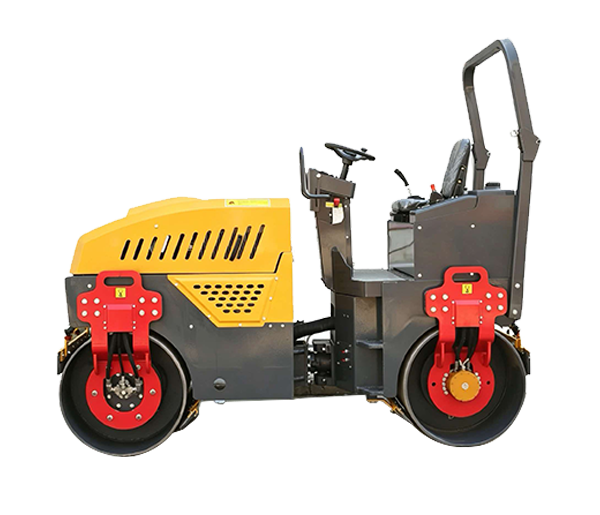
4. Where I Recommend Using a 1–3 Ton Road Roller
I see the 1–3 ton class as particularly useful when the project requires controlled compaction but does not justify a large road roller. Typical applications include small road construction, asphalt repair, parking areas, driveways, sidewalks, cycling paths, residential developments, landscaping projects, trench restoration and foundation preparation.
Road and Asphalt Repair
For small road repair projects, the working area can be narrow and irregular. A compact road roller can move through these areas without taking up the space required by a larger machine. It is suitable for compacting repaired asphalt and granular base materials when the project specification calls for this type of equipment.
Parking Lots and Driveways
Parking areas often contain edges, corners and access restrictions. A compact tandem roller or single-drum roller can be useful for preparing aggregate bases and compacting suitable asphalt surfaces.
Residential and Commercial Development
New construction sites may require compaction around buildings, access roads, small parking areas and landscape structures. The 1–3 ton class offers a practical size for many of these jobs.
Trench and Utility Restoration
After underground utility work, the surface often needs to be restored. A compact roller can work on the restored base or pavement where access is limited. The exact compaction method should follow the project specification and the requirements for the material being placed.
Landscaping and Path Construction
For walkways, garden paths, recreational areas and other landscape construction, a small roller can provide more controlled compaction than larger equipment. Its compact dimensions also reduce the risk of interfering with nearby structures.
FHWA construction guidance describes control-strip procedures in which the field team evaluates moisture, determines the number and sequence of passes, and selects static or vibratory modes for the specific earthwork material. :contentReference[oaicite:4]{index=4} This is a good reminder that the roller is only one part of the compaction process.
| Application | Typical Reason for Choosing a Compact Roller | Important Operating Point |
|---|---|---|
| Asphalt repair | Compact size and controlled rolling | Control temperature, speed and vibration |
| Parking lots | Good maneuverability in limited areas | Follow the required rolling pattern |
| Driveways | Suitable for smaller pavement sections | Check layer thickness and material condition |
| Aggregate base | Efficient particle rearrangement and densification | Moisture and pass count are important |
| Sidewalks and paths | Easy access to narrower working zones | Use suitable amplitude and operating speed |
| Trench restoration | Useful where access is restricted | Compact each suitable layer correctly |
Source note: Application guidance is based on FHWA pavement and earthwork references covering soil, aggregate base and asphalt compaction. :contentReference[oaicite:5]{index=5}
5. Technical Advantages: What Makes the Machine Practical on Site?
From my engineering perspective, the biggest advantage of a 1–3 Ton Road Roller is not simply that it is smaller. It is that its size can be matched to the real working environment.
A large roller may deliver much higher total force, but that force is not always useful on a small job. If the machine cannot enter a narrow area, cannot turn comfortably or takes too much time to transport, its theoretical capacity does not solve the contractor's problem.
A compact road roller offers a different balance: enough mass for useful static loading, a vibration system for dynamic compaction, a relatively narrow working width and better maneuverability.
Balanced Compaction Energy
Compaction energy should be controlled rather than simply increased. Excessive vibration can damage a thin asphalt layer or disturb material that is already sufficiently compacted. I therefore consider frequency and amplitude adjustment important features when selecting a vibratory roller.
FHWA research explains that intelligent compaction measurements are affected by machine weight, machine size, compacting energy, operating speed, amplitude, frequency, material properties and ground conditions. :contentReference[oaicite:6]{index=6} This supports a point I often make to buyers: there is no single machine setting that is perfect for every job.
Controlled Travel Speed
The roller should move at a steady and appropriate speed. If the machine travels too quickly, there may not be enough effective compaction energy applied to each area. If it travels too slowly, productivity may fall and the material can receive unnecessary energy.
FHWA asphalt guidance uses roller speed as one of the factors that should be controlled during compaction. Its inspection guidance also highlights the importance of an accurate speed indicator and appropriate speed control for vibratory rollers. :contentReference[oaicite:7]{index=7}
Compact Turning and Site Mobility
For small projects, maneuverability can be just as important as compaction force. A compact roller can work close to buildings, curbs and other structures with less space required for turning.
Transport and Fleet Flexibility
Contractors often need to move machines between several projects in one day. A smaller roller can make transportation and job-site handling easier, depending on local transport rules and the selected machine configuration.
Practical Maintenance
I also prefer a design that makes routine inspection easy. Daily checks should cover engine oil, hydraulic oil, coolant where applicable, fuel, water spray, drum condition, vibration components, tires or drum surfaces, fasteners and safety equipment. Preventive maintenance is much cheaper than discovering a problem in the middle of a paving job.
6. How We Approach Manufacturing and Quality Control at HKLOONG
At HKLOONG, I believe the quality of a construction machine starts long before final assembly. It begins with the selection of materials, component design, machining accuracy and process control.
Our company integrates equipment R&D, precision manufacturing, quality testing, customized modification and global distribution. This integrated structure allows us to consider the complete machine instead of treating each component as an isolated product.
Frame and Structural Parts
The frame must handle repeated loading and vibration. During manufacturing, structural components need accurate dimensions, controlled welding and proper inspection. Small errors in alignment can become more noticeable after long periods of vibration.
Drum Manufacturing
The drum is the part that directly contacts the working material. Its surface condition, roundness, alignment and connection with the supporting structure all influence machine behavior. We therefore treat drum manufacturing and assembly as important quality-control steps.
Vibration System
The vibration system must produce controlled mechanical movement. Bearings, eccentric components, shafts, housings and related parts need to work together under repeated dynamic loading. Proper assembly is essential because vibration naturally exposes weaknesses that may not appear during static testing.
Hydraulic and Drive Components
Travel and vibration functions may involve hydraulic systems depending on the machine configuration. We pay attention to hose routing, connection quality, leakage checks and component protection. A hydraulic leak is not just an inconvenience; it can stop a machine and create a safety or environmental problem on site.
Final Machine Testing
Before delivery, I want the machine to be tested as a complete system. Basic checks can include engine operation, travel function, steering, braking, vibration function, control response, hydraulic performance and abnormal noise inspection.
Our approach is not to make a machine look impressive only in a product photograph. The goal is to produce equipment that behaves predictably when it reaches a real construction site.
For international buyers, we also understand that the machine may operate thousands of kilometers away from our factory. That makes documentation, component identification, spare-parts support and communication important parts of the supply process.
7. Why Choose HKLOONG for a 1–3 Ton Road Roller?
When a customer asks me why they should choose HKLOONG, I do not think the answer should be a list of exaggerated claims. A construction machine should be judged by its working requirements, machine configuration, manufacturing quality and support after delivery.
Our first advantage is engineering integration. HKLOONG is not focused on one isolated machine component. We work across heavy equipment R&D, manufacturing, quality testing, customized modification and global distribution. Our broader product experience includes crawler Excavators, wheel loaders, backhoe loaders and amphibious Wetland excavators.
That background gives us a practical understanding of machines that work in demanding outdoor environments. We know that equipment has to deal with dust, vibration, changing weather, uneven ground, transport requirements and regular maintenance.
Customization for Different Markets
Construction equipment buyers do not all need exactly the same configuration. Engine requirements, emissions rules, working width, operator protection, tires, hydraulic components, electrical systems and other details can vary by market and application.
We can discuss customization according to the customer's intended working conditions and local requirements rather than forcing every customer into one fixed configuration.
Quality Testing Before Shipment
We understand that a machine failure after export can cost much more than a repair at the factory. It can delay a construction schedule, increase labor costs and create transportation problems. For that reason, functional testing and inspection before shipment are important parts of our production process.
Global Distribution Support
Our location in Hefei, China, allows us to combine manufacturing resources with international logistics. We work with overseas buyers who need construction machinery for different road, foundation and municipal projects.
Focus on Practical Communication
I also believe technical communication should be clear. Before recommending a roller, we need to understand the material, working width, expected production, project size, transport conditions and local requirements. This helps us determine whether a 1–3 ton roller is actually the right choice.
If the project requires a heavier machine, a different drum configuration or another type of compactor, I would rather identify that early than sell the wrong machine.
8. Frequently Asked Questions About 1–3 Ton Road Rollers
What is a 1–3 Ton Road Roller used for?
A 1–3 Ton Road Roller is commonly used for compacting soil, aggregate, gravel and suitable asphalt layers on small and medium construction projects. Typical applications include road repair, parking lots, driveways, sidewalks, residential roads, landscaping and foundation preparation.
Is a 1–3 ton roller suitable for asphalt?
Yes, a suitable compact vibratory roller can be used for asphalt work. However, the machine must match the asphalt layer, mix, temperature and project specification. Drum vibration, amplitude, speed and rolling pattern should be controlled rather than used at maximum settings all the time.
Can a compact road roller compact soil?
Yes. Soil compaction is one of the common applications for compact rollers. The result depends on soil type, moisture content, layer thickness, roller parameters and the number of passes. The machine should be selected according to the required compaction result rather than weight alone.
What is the difference between a single-drum and double-drum roller?
A single-drum roller normally uses one steel drum as the main compaction element and is often associated with soil, aggregate and similar base-material work. A double-drum roller uses steel drums at both the front and rear and is widely used for asphalt and surface compaction. The correct configuration depends on the project.
How many passes does a road roller need?
There is no universal number. The required passes depend on the material, moisture or asphalt temperature, layer thickness, roller type, amplitude, frequency, speed and required density. I recommend establishing the rolling pattern through the project's test section or control-strip procedure instead of using a fixed number for every job.
FHWA construction guidance specifically describes establishing control strips and agreeing on the number and sequence of passes and compaction modes for particular earthwork materials. :contentReference[oaicite:8]{index=8}
Why is vibration important?
Vibration adds dynamic energy to the static load of the roller. It helps particles move and settle into a denser arrangement. The actual effect depends on vibration frequency, amplitude, machine speed, material characteristics and ground conditions.
Can I use maximum vibration for every material?
No. Maximum vibration is not automatically the correct setting. Thin asphalt layers and some sensitive materials may require lower energy or static operation. FHWA guidance notes that vibration settings should be matched to factors such as mix type, layer thickness and temperature. :contentReference[oaicite:9]{index=9}
What should I check before buying a compact road roller?
I recommend checking operating weight, drum width, vibration frequency, amplitude, centrifugal force, travel speed, engine power, water spray capacity if asphalt work is planned, turning radius, service access, transport dimensions, safety equipment, spare-parts availability and after-sales support.
How do I choose between a 1 ton, 2 ton and 3 ton roller?
Start with the job rather than the machine. For very restricted spaces and light work, a smaller roller may be easier to handle. For broader road, aggregate and asphalt applications, a heavier 2–3 ton configuration may provide more useful working force. The final decision should consider the material, layer thickness, required production and site access.
Does HKLOONG offer customized road roller configurations?
HKLOONG specializes in equipment R&D, precision manufacturing, customized modification, quality testing and global distribution. We can discuss the required machine configuration according to the application, working environment, market requirements and customer specifications.
Choosing the Right 1–3 Ton Road Roller for Your Project
After years of working with construction machinery, I have learned that the right machine is not always the largest or most powerful one. It is the machine that matches the actual job.
If your project involves narrow roads, parking lots, driveways, sidewalks, small asphalt sections, aggregate bases or localized repair work, a 1–3 Ton Road Roller can offer a practical balance of compaction force, maneuverability and transport convenience.
Before making a purchase, I recommend preparing a short list of project details: material type, layer thickness, required working width, site dimensions, expected daily workload, required compaction standard, climate, transport method and local regulations. With these details, it becomes much easier to select the right roller configuration.
For buyers looking for a compact road roller, 1–3 ton vibratory road roller, small asphalt roller, soil compactor or mini road roller for construction, HKLOONG can provide equipment solutions based on practical application requirements.
At HKLOONG Heavy Industry Technology (Hefei) Co., Ltd., my goal is straightforward: build construction equipment that makes sense on the job site. We combine equipment development, precision manufacturing, quality testing, customization and international distribution to support customers working in different markets.
A road may look simple when it is finished, but getting a strong and stable surface requires the right material, the right preparation and the right compaction method. Our 1–3 Ton Road Roller is designed for customers who need compact equipment with useful compaction capability and practical site mobility.
When you tell us what you are compacting, how thick the layer is, how large the site is and what working conditions you face, we can work with you to identify a suitable configuration instead of relying on a one-size-fits-all answer.
Technical Reference Sources
Federal Highway Administration (FHWA), Intelligent Compaction guidance for soils, aggregate bases and asphalt materials. :contentReference[oaicite:10]{index=10}
Federal Highway Administration (FHWA), Intelligent Compaction technology and measurement guidance. :contentReference[oaicite:11]{index=11}
Federal Highway Administration (FHWA), Hot Mix Asphalt inspection and vibratory roller guidance. :contentReference[oaicite:12]{index=12}
Caterpillar official CB1.8 and utility compactor specifications used as external reference data for the comparison tables. :contentReference[oaicite:13]{index=13}
Note: External specifications shown in the comparison tables are reference figures from the cited manufacturers or public technical sources. They are not specifications for a specific HKLOONG model. Final HKLOONG machine parameters should be confirmed against the exact model and configuration offered for the customer's market and project.



 WhatsApp
 Phone
Phone E-mail
 Message