
 Español
 Pусский
 Français
 العربية

When I talk about a road roller, I usually start with one simple point: a good road is not made strong just by putting asphalt on the surface. The layers underneath also need to be properly compacted. Soil, gravel and asphalt contain small gaps between particles. If those gaps are not reduced enough, the finished surface may settle, deform or develop problems much sooner than expected.
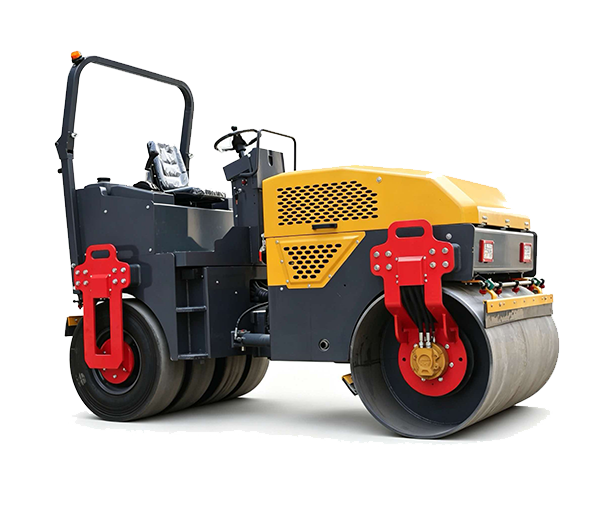
That is where I see the value of a 3–4 ton road roller. This class of compact construction machinery gives contractors more working weight and compaction force than very small rollers while remaining practical for urban roads, parking areas, residential developments, repair work and other medium-scale projects.
At HKLOONG Heavy Industry Technology (Hefei) Co., Ltd., we focus on equipment R&D, precision manufacturing, quality testing, customized modification and global distribution. Our HKLOONG product range covers crawler excavators, Wheel loaders, Backhoe loaders and amphibious wetland Excavators. When developing construction equipment, I always look at the same basic question: will this machine work reliably when it leaves the factory and enters a real job site?
For a 3–4 ton road roller, that means looking beyond engine power. Drum design, vibration performance, machine balance, hydraulic components, steering, operator controls, service access and overall structural strength all matter. The right combination can give a contractor a useful machine for daily compaction work without moving into the size and transport demands of a much heavier highway roller.
In this guide, I will explain how I look at this roller class, how the compaction process works, where I recommend using it, what technical factors deserve attention, how we approach manufacturing and testing, and what buyers should know before ordering a 3–4 ton vibratory road roller.
1. What Is a 3–4 Ton Road Roller?
A 3–4 ton road roller is a compact-to-medium construction compactor designed to densify soil, aggregate, gravel, asphalt and other suitable materials. Its operating weight provides static pressure, while the vibrating drum can add dynamic compaction energy when the application requires it.
The principle is actually quite easy to understand. Think about a pile of dry sand. Many empty spaces exist between the individual grains. When you press and vibrate the sand, the grains move closer together and the empty spaces become smaller. A road roller applies this basic idea to prepared construction materials on a much larger scale.
For soil and aggregate work, compaction improves the density and stability of the base. For asphalt, controlled rolling helps create a tighter pavement structure and a smoother finished surface. The exact result depends on the material, moisture or temperature, layer thickness, machine settings, number of passes and operating speed.
I consider the 3–4 ton class useful because it sits between lightweight pedestrian or small ride-on rollers and much heavier highway compaction machines. Contractors can use it on jobs where a small machine needs more working force but a large roller would be unnecessarily difficult to transport or maneuver.
Typical applications include local road construction, asphalt maintenance, parking lots, residential roads, driveways, industrial yards, sidewalks, cycling paths, landscaping projects and foundation preparation. Depending on the drum and machine configuration, it can be used for different stages of earthwork and pavement construction.
One thing I always tell buyers is not to choose a roller based on operating weight alone. Two machines with similar weights can behave quite differently because their drum width, vibration system, centrifugal force, engine, hydraulic system and operating controls may not be the same.
| Factor | What It Does | Why I Check It |
|---|---|---|
| Operating weight | Provides static pressure | Helps determine the basic loading on the material |
| Drum width | Determines working coverage | Affects productivity and suitability for narrow areas |
| Vibration frequency | Controls vibration cycles | Needs to match the material and working conditions |
| Vibration amplitude | Controls drum movement | Important for selecting suitable compaction energy |
| Travel speed | Controls time spent over each area | Influences productivity and compaction effectiveness |
Source: Federal Highway Administration (FHWA) guidance identifies machine weight, size, compaction energy, operating speed, vibration amplitude and frequency, material properties and ground conditions as factors affecting compaction performance. Source: FHWA Intelligent Compaction FAQ.
2. How Does a 3–4 Ton Vibratory Road Roller Work?
When I explain the working principle of a vibratory road roller, I normally separate it into two simple forces: static load and dynamic force.
Static Load From Machine Weight
The first force comes from the weight of the machine. The steel drum presses against the surface, transferring the machine's weight into the material below. This pressure helps reduce voids between particles.
A 3–4 ton roller has more operating mass than a very small compact roller, so it can provide a stronger basic load while still maintaining a relatively compact machine size. This is useful when working on prepared soil, aggregate bases and suitable asphalt surfaces.
Dynamic Force From Vibration
The second force comes from vibration. Inside the drum assembly, an eccentric mechanism creates rapid movement. When vibration is switched on, the drum transfers repeated mechanical energy into the material.
This helps particles move and settle. It is particularly useful for granular materials and suitable pavement layers. However, vibration is not something I recommend using blindly. More vibration does not always mean better compaction.
FHWA technical guidance explains that roller amplitude and frequency need to be considered together with material type, layer thickness, temperature and other job conditions. ([fhwa.dot.gov](https://www.fhwa.dot.gov/pavement/pubs/014724.pdf))
Travel Speed Matters Too
The operator also controls travel speed. If the roller moves too quickly, the machine spends less time applying compaction energy to a particular area. If it moves too slowly, productivity can suffer and the material may receive unnecessary energy.
For this reason, I prefer a steady and controlled rolling pattern rather than simply driving back and forth as quickly as possible. A consistent pass pattern also makes it easier for the site team to monitor the work.
Passes and Material Condition
The number of passes required is not a fixed number for every project. Soil type, moisture, asphalt temperature, layer thickness, roller settings and required density all affect the result.
For earthwork, FHWA describes control-strip procedures in which contractors evaluate material conditions and establish an appropriate number and sequence of passes. ([fhwa.dot.gov](https://www.fhwa.dot.gov/construction/cpmi04b8.cfm))
So, if someone asks me, “How many passes does a 3–4 ton road roller need?” I would not give them one universal number. I would first ask what material they are compacting and what result the project specification requires.
| Operating Variable | General Effect | Practical Approach |
|---|---|---|
| Higher machine weight | Increases static loading | Use when the application requires greater working mass |
| Higher vibration frequency | Increases vibration cycles | Select according to material and machine design |
| Higher amplitude | Increases drum movement | Use carefully on suitable layer thicknesses |
| Lower travel speed | Allows more compaction action per area | Keep speed within the project and machine requirements |
| Additional passes | Increases total compaction effort | Confirm through field testing rather than guessing |
Source: FHWA, Intelligent Compaction technology guidance and FAQ; FHWA, Compaction control and control-strip guidance.
3. Main Features I Look for in a 3–4 Ton Road Roller
When I evaluate a 3–4 ton road roller, I do not start with a single number on a specification sheet. I look at the complete machine and how its components work together.
Compact but Useful Working Weight
The 3–4 ton range provides a practical amount of machine mass for many road and groundwork projects. It is still compact enough for locations where a large roller would be inconvenient, while providing more static loading than very lightweight equipment.
Steel Drum Designed for Repeated Loading
The drum is the machine's direct contact point with the ground. It has to deal with continuous pressure and vibration during daily operation. Drum alignment, surface condition, structural strength and connection to the frame all deserve attention.
Reliable Vibration System
A roller can only deliver consistent compaction if its vibration system operates smoothly. Bearings, eccentric components, shafts and related parts need to be correctly selected and assembled.
I pay particular attention to abnormal noise and vibration during machine testing because small mechanical problems can become much larger after hours of repeated operation.
Responsive Steering and Travel
A road roller is not useful if it can compact well but is difficult to control. The operator needs predictable forward and reverse movement and smooth steering response, especially when working close to curbs, buildings and other equipment.
Water Spray for Asphalt Applications
For asphalt work, a water spray system can help prevent hot asphalt from sticking to the drum. The actual tank size and spray arrangement vary by machine configuration, but the system should provide even coverage and be easy to inspect and clean.
Operator Visibility
Good visibility is important on small construction sites. The operator needs to see the drum, pavement edge, obstacles and people working nearby. A clear operating position can make daily work more comfortable and reduce unnecessary maneuvering.
Easy Maintenance Access
Construction equipment needs regular maintenance. I therefore consider access to filters, fluid inspection points, lubrication locations, hydraulic connections and other service areas during the design process.
A machine that is easy to inspect is easier to keep in good working condition.
| Reference Machine | Operating Weight | Drum Width | Engine Power | Vibration Frequency |
|---|---|---|---|---|
| Caterpillar CB2.5 | 2,521 kg | 1,000 mm | 36 kW | 2,520 vpm |
| Caterpillar CB2.7 | 2,700 kg | 1,000 mm | 36 kW | 2,520 vpm |
| Caterpillar CB3.5 | 3,550 kg | 1,300 mm | 36 kW | 2,520 vpm |
Source: Caterpillar official specifications for CB2.5, CB2.7 and CB3.5 tandem vibratory rollers. These figures are provided only as external reference data and are not HKLOONG specifications. Source: Caterpillar Tandem Vibratory Rollers.
4. Where I Would Use a 3–4 Ton Road Roller
I see this roller class as particularly useful for contractors who need more capacity than a lightweight roller but do not need a large highway compactor.
Urban Road Construction
Urban construction often means working around traffic lanes, buildings, sidewalks, drainage systems and existing infrastructure. A compact roller can be easier to maneuver in these restricted areas.
For road base preparation and suitable asphalt layers, the machine can provide controlled compaction without taking up the working space of a much larger roller.
Parking Lots
Parking lots are another practical application. The working area is usually broad enough for a ride-on roller but can contain tight corners, entrances, curbs and other obstacles.
A 3–4 ton tandem roller can be useful for aggregate base preparation and asphalt compaction when the machine configuration and site requirements are suitable.
Residential Roads and Driveways
Residential construction often requires a balance between machine capacity and site access. A large highway roller may be excessive for a small housing project, while a very light roller may not provide enough working force.
This is one reason I see the 3–4 ton road roller as a practical choice for small residential roads, driveways and access routes.
Industrial Yards
Industrial yards can require strong aggregate bases and durable pavement surfaces. A compact roller can be used for foundation layers, base courses and suitable asphalt work depending on the construction plan.
Road Maintenance and Repair
Maintenance crews often work on limited sections rather than an entire highway. A compact machine is easier to bring into these areas and can work around existing infrastructure.
Landscaping and Path Construction
Walkways, cycling paths, recreational areas and landscape projects also benefit from controlled compaction. A 3–4 ton machine provides more capacity than very small pedestrian equipment while remaining relatively compact.
Foundation and Ground Preparation
Before slabs, paved yards or other structures are constructed, prepared ground may need to be compacted. The roller can be used on suitable soils and granular materials according to the engineering plan.
Still, I always recommend matching the roller to the soil type. Cohesive clay, granular soil and mixed fill do not respond to compaction in exactly the same way. Moisture condition is also important.
| Application | Why the 3–4 Ton Class Can Fit | Key Point to Control |
|---|---|---|
| Urban roads | Good balance of size and compaction capability | Site access and rolling pattern |
| Parking lots | Suitable for medium-sized paved areas | Drum width and asphalt temperature |
| Residential roads | Compact enough for restricted sites | Layer thickness and pass count |
| Industrial yards | Useful for aggregate and pavement work | Required density and production rate |
| Road repair | Easier transport and maneuverability | Material temperature and edge access |
| Paths and landscaping | More controlled than large rollers | Ground condition and working width |
Source: Application considerations are based on FHWA pavement and earthwork compaction guidance. See FHWA Intelligent Compaction Technology and FHWA compaction control guidance.
5. 3–4 Ton Road Roller vs. Heavier Rollers: How I Make the Choice
One of the most common buying questions is whether a contractor should purchase a 3–4 ton roller or move directly to a heavier machine.
My answer is simple: start with the project. If the work is mainly small roads, repair sections, parking lots, residential developments and areas with restricted access, a compact roller may provide a better overall balance.
A heavier roller becomes more attractive when the project requires higher production, wider working coverage or greater compaction force. Large highway projects can justify larger machines because the increased capacity can reduce the time needed to complete large areas.
But bigger is not automatically better. A heavy machine can be harder to transport, more difficult to maneuver and less suitable for tight work areas. It may also cost more to operate when its full capacity is not needed.
What I Compare Before Making a Recommendation
I normally compare five basic points: working area, material, required density, production target and transport conditions.
For example, if a contractor is repairing several small urban streets, I would look closely at machine width, turning space and transportation requirements. If the same contractor is building a large industrial yard, productivity and drum coverage may become more important.
FHWA also points out that compaction performance depends on several interacting factors rather than a single machine specification. This is why I prefer application-based equipment selection.
| Roller Class | Typical Strength | Typical Limitation | Good Fit |
|---|---|---|---|
| Very light compact roller | Excellent access and easy transport | Lower operating mass | Small repair and landscaping jobs |
| 3–4 ton road roller | Balanced size, weight and maneuverability | Lower production than large highway rollers | Urban roads, parking lots and medium projects |
| Heavy tandem roller | Higher working mass and coverage | Greater transport and space requirements | Large pavement projects |
Source: General equipment-class comparison based on FHWA compaction principles and Caterpillar published roller specifications. The table is a practical selection guide, not a standardized classification system. Sources: FHWA; Caterpillar.
6. How We Build and Test Construction Equipment at HKLOONG
For me, manufacturing quality starts before the welding table and continues until the completed machine has passed its final checks. A road roller works under repeated mechanical loading, so every major system needs to be considered as part of the whole machine.
Structural Frame
The frame supports the drum, engine, hydraulic system, operator station and other components. It must handle normal working loads as well as repeated vibration. We therefore pay attention to material selection, dimensional accuracy, welding quality and structural inspection.
Drum and Drum Assembly
The drum needs to maintain correct alignment and provide stable contact with the working surface. Manufacturing accuracy matters because even small alignment problems can become more obvious when the machine is vibrating continuously.
Vibration Components
The vibration mechanism contains rotating and moving parts that operate under repeated dynamic loads. Bearings, shafts, eccentric components and housings must be correctly matched and assembled.
During testing, I pay attention to vibration response, abnormal sound, temperature and general machine behavior. A machine should not merely start and move; its important systems should operate together in a predictable way.
Hydraulic System
Depending on the configuration, hydraulic components can control travel, steering and other machine functions. Hose routing and connections need to be protected from unnecessary wear. Leakage testing is also an important part of quality inspection.
Engine and Cooling System
The engine is the source of machine power, but engine output alone does not tell the full story. Cooling, fuel supply, transmission or hydraulic power delivery and overall machine matching are equally important.
Final Functional Testing
Before shipment, we check the complete machine rather than looking only at individual components. Typical functional checks can include starting performance, forward and reverse travel, steering, braking, vibration operation, hydraulic functions, control response and abnormal noise inspection.
For export customers, I also understand the importance of practical documentation and service information. A machine may spend most of its life thousands of kilometers from our factory, so clear technical communication and suitable spare-parts support are part of the complete supply process.
Our goal at HKLOONG is not to build equipment that looks good only in a showroom. I want the machine to make sense when an operator is working with it eight hours a day on an actual construction site.
7. Why I Recommend HKLOONG for Your 3–4 Ton Road Roller Project
Choosing a construction equipment supplier is about more than finding a machine with an attractive price. For an international buyer, the supplier's engineering ability, production process, quality inspection, customization capability and communication after delivery can all affect the real cost of ownership.
At HKLOONG Heavy Industry Technology (Hefei) Co., Ltd., we combine R&D, precision manufacturing, quality testing, customized modification and global distribution. This allows us to approach equipment from both the engineering side and the customer's actual working requirements.
Engineering Experience Across Construction Equipment
Our HKLOONG lineup includes crawler Excavators, wheel loaders, backhoe loaders and amphibious Wetland excavators. These machines operate in very different environments, but they share one requirement: the equipment has to handle real work, not just laboratory conditions.
That experience influences how I think about a 3–4 ton vibratory road roller. I pay attention to structure, component matching, operator control, maintenance and field conditions instead of looking at one specification in isolation.
Customized Machine Configuration
Different markets can have different engine, emissions, electrical, safety and transport requirements. Different projects can also need different drum widths, vibration configurations or auxiliary equipment.
We can discuss these requirements before production and work toward a configuration that fits the customer's intended application.
Quality Control Before Delivery
A problem discovered at our factory is much easier to solve than a problem discovered after the machine has arrived overseas. This is why final functional inspection is important.
I want customers to receive equipment that has already been checked as a complete machine rather than simply receiving a collection of assembled components.
Support for International Buyers
Our global distribution experience means we understand that an overseas machine purchase involves more than manufacturing. Transportation, documentation, spare parts, maintenance information and communication all form part of the project.
If a buyer provides the working material, site conditions, target capacity, transport limitations and local requirements, we can evaluate whether the 3–4 ton class is appropriate and discuss a suitable machine configuration.
8. Frequently Asked Questions About 3–4 Ton Road Rollers
What is a 3–4 ton road roller mainly used for?
A 3–4 ton road roller is commonly used for compacting soil, aggregate, gravel and suitable asphalt layers. Typical applications include urban roads, parking lots, residential roads, driveways, industrial yards, road maintenance, paths and ground preparation.
Is a 3–4 ton road roller suitable for asphalt?
Yes. A properly configured vibratory or tandem roller can be used for suitable asphalt applications. The operator must consider asphalt temperature, layer thickness, mix characteristics, rolling speed, vibration settings and the project's compaction requirements.
Can a 3–4 ton roller compact soil?
Yes. It can be used for suitable soil and aggregate materials. However, the final compaction result depends on soil type, moisture content, layer thickness, machine settings and pass count. The roller should be selected as part of the complete earthwork plan.
What is the difference between a static roller and a vibratory roller?
A static roller mainly uses its machine weight to press the material. A vibratory roller combines machine weight with mechanical vibration. Vibration can increase compaction energy and help particles rearrange, but it must be used according to the material and working conditions.
How many passes should I make?
There is no single number that works for every project. I recommend determining the rolling pattern through field testing or the project's control-strip procedure. Material type, moisture, asphalt temperature, layer thickness, roller speed, vibration and required density all influence the number of passes.
What does drum width mean for productivity?
Drum width determines how much surface the machine covers during each pass. A wider drum can cover more area per pass, but it may be less convenient in narrow working areas. I recommend balancing coverage with site access rather than simply choosing the widest drum available.
Is a 3–4 ton roller easy to transport?
Compared with heavier highway rollers, this class is generally more manageable for transportation. However, actual transport requirements depend on the machine's operating weight, dimensions, local road regulations and the selected transport equipment.
What should I check when buying a 3–4 ton road roller?
I recommend checking operating weight, drum width, vibration frequency, amplitude, centrifugal force, engine power, travel speed, steering, braking, water spray capacity, service access, transport dimensions, safety equipment and spare-parts support.
Can HKLOONG customize the machine?
HKLOONG specializes in equipment R&D, precision manufacturing, quality testing and customized modification. We can discuss machine requirements according to the customer's project, working environment, market requirements and intended application.
How do I choose between a 3 ton and 4 ton road roller?
I would start with the actual project instead of the nominal tonnage. Consider the material, layer thickness, working width, required density, site size, production target and transport conditions. A 4 ton configuration may provide more working mass, while a 3 ton machine may offer advantages where mobility and transport are more important.
Can a 3–4 ton roller be used for small road construction?
Yes. This is one of the applications where the machine class can make practical sense. It provides more working capability than very light equipment while remaining compact enough for many urban, residential and maintenance projects.
Find the Right 3–4 Ton Road Roller for Your Job
After working with construction equipment, I have learned that choosing a roller is really about matching machine behavior to the material and the job site. The largest roller is not automatically the right roller, and the highest engine power does not automatically produce the best compaction.
A 3–4 ton road roller can provide a useful balance of operating weight, vibration capability, maneuverability and transport practicality. For contractors working on urban roads, parking lots, residential developments, industrial yards, asphalt repairs and other medium-sized projects, this class deserves serious consideration.
Before contacting a supplier, I recommend preparing a few basic details: What material will you compact? What is the layer thickness? How wide is the working area? What density or pavement requirement must you meet? How many hours per day will the machine work? How will you transport it? What are the local engine and emissions requirements?
These details give us a much better starting point than simply saying, “I need a 3–4 ton roller.” They help us understand whether you need a single-drum roller, tandem vibratory roller or another configuration.
At HKLOONG Heavy Industry Technology (Hefei) Co., Ltd., I take the same practical approach to every equipment project. We bring together R&D, precision manufacturing, quality testing, customized modification and global distribution under the HKLOONG brand.
If you are searching for a 3–4 ton road roller, 3–4 ton vibratory road roller, compact road roller for asphalt, small road roller for construction, 3 ton soil compactor or 4 ton tandem road roller, our team can discuss the working conditions and help determine a suitable configuration.
My approach is straightforward: understand the project first, select the machine second, and make sure the final equipment is practical for the work it is expected to do. That is how I believe construction machinery should be chosen.
Technical References
Federal Highway Administration (FHWA), Intelligent Compaction guidance and technical references: FHWA Pavement Publications.
Federal Highway Administration (FHWA), Intelligent Compaction FAQ and performance factors: FHWA Intelligent Compaction FAQ.
Federal Highway Administration (FHWA), construction compaction and control-strip guidance: FHWA Compaction Control.
Caterpillar, official tandem vibratory roller specifications used as external comparison references: Caterpillar Tandem Vibratory Rollers.
Important specification note: The external machine specifications shown in the comparison tables are published reference data from the cited sources. They are not HKLOONG product specifications. Exact HKLOONG specifications, dimensions, operating weight, engine configuration and vibration parameters should be confirmed against the specific model and configuration offered for your market.



 WhatsApp
 Phone
Phone E-mail
 Message