

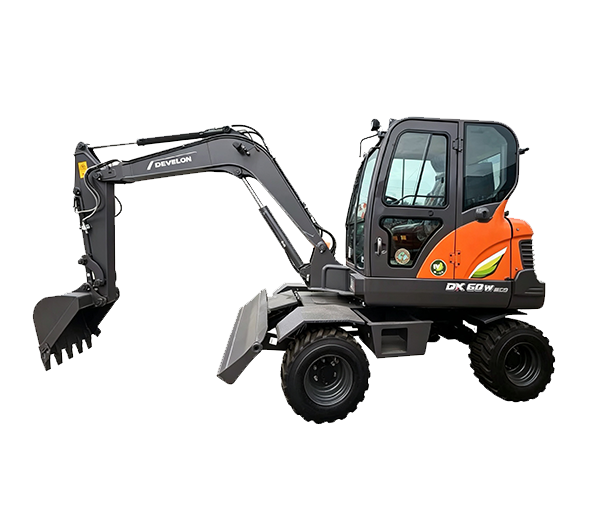
DEVELON 60 Wheeled Excavator for Urban Construction and Road Work
When I talk about a 60 Wheeled Excavator, I usually focus on one thing first: mobility.
A machine can have good digging power, but that does not automatically make it the right machine for every job. If I am working on a city road, a drainage project, a small utility site, a landscaping project or a municipal repair job, I may need to move the excavator from one working point to another many times during the day.
That is where a Wheeled Excavator makes sense.
The DEVELON DX60W is a compact wheeled excavator designed for this kind of flexible working environment. According to DEVELON's published specifications, the DX60W uses a YANMAR 4TNV98C engine, has a rated power of 49.9 kW at 2,400 rpm and a published bucket capacity of 0.175 m³. DEVELON lists the model within its wheeled excavator range.
At Ganglong Heavy Industry Technology (Hefei) Co., Ltd., I work with customers looking for construction machinery, mining machinery, agricultural machinery and matching attachments. Together with Hefei Ganglong International Trade Co., Ltd., our international trade team serves customers in Asia, Africa, America and other markets.
In my experience, the value of a 60 Wheeled Excavator is not simply its engine power or bucket size. The real value comes from the combination of digging capability, road mobility, compact dimensions and flexible operation.
In this product page, I will explain the DEVELON 60 Wheeled Excavator from a practical point of view. I will cover how the machine works, what its main features mean on a real jobsite, which industries can use it, how I compare configurations, and how we handle inspection, payment, packing and international delivery.
A 60 Wheeled Excavator is generally a smaller wheeled excavator in the roughly 6-ton class. It is designed for jobs where the contractor needs real excavation capability but does not want to bring a large 15-ton or 20-ton wheeled excavator onto every site.
The DEVELON DX60W is a good example of this machine class.
According to DEVELON's official product information, the DX60W has a 49.9 kW rated power output at 2,400 rpm and a 0.175 m³ bucket capacity. The listed engine is the YANMAR 4TNV98C.
These numbers may look simple, but they tell me quite a lot about the machine's intended working range.
I would normally consider this type of excavator for:
Urban road maintenance
Small infrastructure projects
Drainage work
Utility trenching
Pipeline and cable installation
Landscaping
Municipal maintenance
Site preparation
Light material handling
General excavation
The wheeled undercarriage is particularly useful when the excavator has to move between suitable work areas on roads or paved surfaces.
That is the first thing I would explain to a customer. A 60 wheeled excavator is not simply a smaller version of a crawler excavator. Its design is built around a different working pattern.
| Item | Published DX60W Data |
|---|---|
| Machine type | Wheeled Excavator |
| Rated power | 49.9 kW / 67.0 HP at 2,400 rpm |
| Engine | YANMAR 4TNV98C |
| Bucket capacity | 0.175 m³ |
| Typical machine class | Approximately 6-ton class |
Source: DEVELON official DX60W product information. The current official page does not publish every dimensional and operating parameter, so those figures have not been estimated here. Actual specifications may vary according to market and configuration.
This is also why I prefer to confirm the exact machine configuration before a quotation. The same model name can sometimes appear with different market specifications, emissions requirements, attachments or equipment packages.
Let me explain the working principle in simple terms.
The engine provides the basic power. The hydraulic system turns that engine power into controlled hydraulic movement. The hydraulic system then operates the boom, arm, bucket, swing system and other working functions.
The operator controls these movements from the cab.
At the same time, the wheeled undercarriage allows the machine to travel between work areas. This is different from a crawler excavator, where the tracks are also an important part of the machine's ground contact and working stability.
On a normal excavation cycle, I can think of the process in a few simple steps.
I position the machine near the excavation area.
I stabilize the machine according to the working conditions.
I lower the boom and place the bucket into the material.
The arm and bucket work together to fill the bucket.
I swing the upper structure toward the unloading point.
I release the material and return the bucket to the digging position.
Then the cycle starts again.
It sounds simple, but smooth hydraulic control makes a real difference. If the boom, arm and bucket movements are easy to control, the operator can work more accurately and avoid unnecessary movements.
Suppose I am working on a city drainage project.
In the morning, I may be digging beside one section of road. Later, the crew may need to move 200 or 300 meters down the same road to continue another section.
That kind of job is one reason I would consider a wheeled excavator.
Instead of treating the machine as something that stays in one excavation pit all day, I can use it as a mobile working machine.
Of course, road travel must always follow local regulations and site safety requirements. The fact that a machine is wheeled does not mean it can automatically travel on every public road without additional requirements.
For international customers, I therefore check the destination and application before discussing the final configuration.
When I look at a compact wheeled excavator, I do not only look at the biggest number on the specification sheet. I want to know whether the machine will be easy to use on the customer's actual site.
A 60-class wheeled excavator is much easier to fit into smaller working areas than a Large Wheeled Excavator.
This matters in cities.
Urban construction often means narrow roads, existing buildings, parked vehicles, utility lines and other equipment working nearby. A smaller machine gives the operator more options for positioning.
That does not mean I would use it for every heavy excavation job. It means the machine has a natural advantage where space is limited.
DEVELON publishes 49.9 kW, or 67.0 HP, at 2,400 rpm for the DX60W. The listed engine is the YANMAR 4TNV98C.
For this machine class, the engine provides the basic power needed for excavation and hydraulic work.
However, I always tell customers not to compare Excavators only by engine horsepower. A machine is a complete system. Hydraulic performance, operating weight, bucket size, working equipment and operator control all affect real-world productivity.
The official DEVELON page lists a 0.175 m³ bucket capacity for the DX60W.
A bucket of this size makes sense for smaller excavation work, drainage, utility trenches, landscaping and similar applications.
But the bucket should always match the material.
If I am digging loose soil, the working conditions are different from digging hard clay, gravel or heavily compacted material. A contractor should also consider bucket teeth, bucket shape and attachment compatibility.
This is probably the most important feature for the keyword 60 Wheeled Excavator.
The machine is intended to work in places where moving between different locations is part of the job.
For road maintenance crews, municipal contractors and utility teams, this can be very practical.
The excavator does not have to perform every task with the standard bucket.
Depending on hydraulic specifications and approved equipment, suitable attachments can include different buckets, Hydraulic Breakers, grapples, Quick Couplers and other working tools.
Before I recommend an attachment, I check its hydraulic flow, pressure, weight and connection requirements against the machine. This is a small detail, but it can prevent a lot of trouble later.
The strongest point of a compact wheeled excavator is flexibility.
One day, a contractor may use the machine for drainage. The next day, it may be used for landscaping. A few days later, the same machine may work on a utility trench.
This makes the machine attractive to contractors who have different small and medium jobs rather than one huge excavation project.
| Application | Why a 60 Wheeled Excavator Can Be Useful | Typical Work |
|---|---|---|
| Road maintenance | Convenient movement between road sections | Drainage, roadside excavation and repair |
| Utility work | Compact working footprint | Cable, water and pipe trenches |
| Landscaping | Flexible excavation and material movement | Grading, planting areas and soil work |
| Municipal projects | Suitable for changing work locations | Drainage and public infrastructure maintenance |
| Site preparation | Excavation and loading capability | Small foundations and site cleanup |
| Light material handling | Attachment flexibility | Moving soil and suitable materials |
Source: DEVELON published wheeled excavator application information and DX60W product positioning. Final application suitability depends on site conditions, machine configuration and attachments.
One thing I like about wheeled excavators is that the machine can be part of the transportation plan, not just the excavation plan.
If a contractor has several nearby work zones, moving the excavator becomes part of the daily schedule.
A crawler excavator is very good at staying on a jobsite and working there. A wheeled excavator is often more useful when the jobsite itself keeps changing.
Urban projects are rarely perfect.
There may be traffic, pedestrians, existing buildings, underground pipes and cables, limited parking space and narrow working areas.
A compact wheeled excavator can make it easier to position the machine without bringing a very large piece of equipment into a small work area.
Still, I would never promise that any excavator can work safely in every urban location. Site access must be checked first.
Another practical point is operator experience.
Even a good machine will not deliver good results if the operator is unfamiliar with the controls or uses the wrong attachment for the job.
For trenching, accurate bucket movement is important. For loading, swing control matters. For road work, travel and positioning become more important.
In other words, machine performance is partly about the equipment and partly about how the equipment is used.
Road work is one of the clearest applications for a wheeled excavator.
Road crews may need to remove soil, prepare drainage channels, clean roadside areas, excavate for utilities or repair damaged sections.
Because the machine is wheeled, it can be particularly useful when the working areas are spread along an existing road.
Drainage work often involves repeated trenching.
The operator may need to dig a trench, remove the excavated soil, position pipes and then continue to another section.
A Compact Excavator is useful here because the work is often carried out close to existing roads, buildings or landscaping.
Water pipes, communication cables, electrical lines and other utility systems often require narrow trenches.
In these situations, the excavator does not need to be huge. What matters more is that the machine can work accurately in a limited space.
The 60-class wheeled excavator can be considered when the required trench depth, bucket size and ground conditions fit the machine's working range.
Landscaping projects can involve much more excavation than people expect.
Large gardens, parks, commercial properties and public spaces may require soil removal, grading, drainage preparation and material movement.
A 60 Wheeled Excavator provides more digging capability than many small machines while remaining relatively compact.
Municipal work is another natural application.
A municipal contractor may repair drainage in one area today and work on roadside maintenance somewhere else tomorrow.
That changing schedule is exactly where equipment mobility becomes useful.
Before construction starts, the site may need clearing, excavation, leveling and preparation.
A compact wheeled excavator can support these jobs when the required digging depth and material conditions are within its working range.
I find model comparisons useful, but only when the figures are compared carefully.
DEVELON's current China product information lists the DX60W, DX125W, DX150W and DX210W within its wheeled excavator range. Their published engine power and bucket capacities increase as the machine class becomes larger.
| Model | Rated Power | Published Bucket Capacity | Engine |
|---|---|---|---|
| DX60W | 49.9 kW / 2,400 rpm | 0.175 m³ | YANMAR 4TNV98C |
| DX125W | 86.1 kW / 2,000 rpm | 0.5 m³ | DEVELON DN03 |
| DX150W | 110 kW / 2,000 rpm | 0.57 m³ | DEVELON DL06 |
| DX210W | 126.5 kW / 2,000 rpm | 0.92 m³ | DEVELON DL06 |
Source: DEVELON official China wheeled excavator product information. Published specifications are market-specific and may differ from other regional versions.
This table shows why I do not use the word “better” when comparing excavators.
A DX210W has much more published engine power and bucket capacity than a DX60W, but that does not mean it is automatically the right machine for a small utility project.
If I need to work in a narrow urban area, move frequently and perform relatively small excavation tasks, the smaller machine may make more sense.
If I need to move large amounts of soil or work on a larger infrastructure project, a larger wheeled excavator may be more suitable.
The correct machine depends on the job.
| Factor | Wheeled Excavator | Crawler Excavator |
|---|---|---|
| Road mobility | Strong practical advantage on suitable roads | Usually requires transport for longer road moves |
| Urban work | Well suited to many road-based applications | Useful but less focused on road travel |
| Soft or rough ground | Requires careful site assessment | Tracks provide a different ground-contact setup |
| Frequent relocation | Convenient for suitable short-distance movement | Usually slower to relocate between separate sites |
| Excavation | Suitable for many general excavation tasks | Strong choice for dedicated excavation sites |
Source: General equipment operating characteristics; actual performance depends on machine model, tires/tracks, ground conditions, attachments and local operating requirements.
I use this comparison to start a conversation, not to make a decision for the customer.
For every project, I still need to know the ground conditions, travel distance, excavation depth, working area and attachment requirements.
At Ganglong, I see machinery supply as more than simply finding a machine and putting a price on it.
For an international customer, the process includes model confirmation, machine condition, inspection, documents, payment, packing and transportation.
The first step is to confirm what the customer actually means by “60 Wheeled Excavator”.
For a DEVELON machine, I would normally confirm whether the customer needs the DX60W, a DX60W ECO version or another regional configuration.
This matters because DEVELON publishes multiple 60-class wheeled excavator versions, and the specifications are not necessarily identical. For example, the current China product pages list both the DX60W and DX60W ECO, with different engine power and bucket specifications.
| Item | DX60W | DX60W ECO |
|---|---|---|
| Rated power | 49.9 kW / 2,400 rpm | 36.4 kW / 2,200 rpm |
| Bucket capacity | 0.175 m³ | 0.18 m³ |
| Engine | YANMAR 4TNV98C | DEVELON DW02 / YANMAR 4TNV94L |
| Published main applications | Wheeled excavator range | Landscaping / road building |
Source: DEVELON official China product pages for DX60W and DX60W ECO. Actual specifications and availability depend on market and machine configuration.
This is a good example of why I never assume that a model name tells the whole story.
Before delivery, we can arrange checks according to the confirmed order.
I normally pay attention to the following:
Machine appearance
Engine starting and operating condition
Hydraulic system
Electrical system
Boom operation
Arm operation
Bucket operation
Swing function
Travel function
Wheels and tires
Stabilizing equipment
Attachments
Documents and accessories
For used machinery, the inspection becomes even more important. I also check visible oil leakage, cylinder condition, pins and bushings, tire condition, working hours where available and signs of previous repairs.
For international orders, payment is commonly arranged by T/T.
A typical arrangement may involve a deposit before order processing and the remaining balance before shipment. The exact payment terms are confirmed between both parties according to the actual transaction.
I do not give every customer the same delivery time.
The schedule depends on the selected DEVELON model, configuration, quantity and machine availability.
If the required machine is already available, preparation may focus on inspection, documents and shipping. If a particular configuration needs to be arranged, the schedule can be different.
That is why I confirm availability before giving a final delivery schedule.
For complete construction machines, international transportation is generally arranged by sea.
For smaller spare parts and suitable accessories, air or express transportation may be more practical.
The final choice depends on destination, cargo dimensions, weight, shipping schedule and customer requirements.
Before shipment, the machine is securely fixed and protected according to the transportation arrangement.
Loose parts and accessories can be packed separately in cartons or wooden cases.
I want the customer to receive more than just the machine. The accessories, documents and packing should also match the confirmed order.
Ganglong Heavy Industry Technology (Hefei) Co., Ltd. was founded in 2013. Together with Hefei Ganglong International Trade Co., Ltd., we operate across equipment R&D, manufacturing, testing, customization and global sales.
Our own product range includes HKLOONG excavators, loaders, Backhoe loaders and swamp excavators.
At the same time, we provide complete machine sales and leasing services for domestic and international brands, including Hitachi, SANY, Lonking, Hyundai, XCMG, SHANMON and LOVOL.
For DEVELON equipment, our role is that of a machinery supplier and international trade service provider. We do not present ourselves as the manufacturer of DEVELON equipment.
I think this distinction is important for international buyers.
When a customer searches for a DEVELON 60 Wheeled Excavator, they need to know who produces the original equipment and who is handling the supply transaction.
Our international trade team has experience in construction machinery, mining machinery and agricultural machinery. We have served markets across Asia, Africa, America and other regions.
My approach is fairly simple.
First, I understand the job.
Then I confirm the machine.
After that, I check the configuration, attachments, inspection requirements and shipping conditions.
Only then do I move toward the final quotation and delivery plan.
For example, if a customer says, “I need a 60 Wheeled Excavator for road work,” I would want to know whether the machine will mainly perform drainage, roadside excavation, utility trenching, landscaping or material handling.
Those jobs may sound similar, but they can require different buckets and attachments.
That is how I try to make machinery sourcing practical rather than simply sending a generic product sheet.
The DEVELON DX60W is a wheeled excavator in the compact 60-class range. DEVELON's official product information lists a YANMAR 4TNV98C engine, 49.9 kW rated power at 2,400 rpm and a 0.175 m³ bucket capacity.
The published rated power is 49.9 kW, or 67.0 HP, at 2,400 rpm.
DEVELON lists a 0.175 m³ bucket capacity for the DX60W on its official China product page.
The current DEVELON China product page lists the YANMAR 4TNV98C as the engine for the DX60W.
A 60 Wheeled Excavator can be considered for road maintenance, drainage, utility trenching, landscaping, municipal construction, site preparation and general excavation, provided the machine configuration matches the working conditions.
The main reason is mobility. A wheeled excavator is designed to move conveniently between suitable work areas, which can be useful when road or municipal projects have multiple working points.
Its compact 60-class size and wheeled design make this type of machine suitable for many urban applications. However, the final suitability depends on road access, working space, excavation requirements and local regulations.
Suitable attachments can expand the machine's working range. Possible tools include different buckets, breakers, grapples and other hydraulic attachments, subject to the machine's hydraulic specifications and approved configuration.
No. DEVELON publishes different specifications for these models. The current China product information lists 49.9 kW and 0.175 m³ for the DX60W, while the DX60W ECO is listed at 36.4 kW and 0.18 m³.
Delivery time depends on the exact model, configuration, order quantity and machine availability. I confirm the actual schedule after the machine and destination have been determined.
Complete machines are generally transported by sea. Suitable spare parts and accessories can be shipped by air or express when practical.
Yes. We can arrange inspection of the machine appearance, engine, hydraulic and electrical systems, working functions, attachments and required documents according to the confirmed order.
For me, the 60 Wheeled Excavator is about flexibility more than raw size.
The DEVELON DX60W is a compact wheeled excavator with a published 49.9 kW rated power, YANMAR 4TNV98C engine and 0.175 m³ bucket capacity.
Those specifications put it into a useful working range for contractors who need an excavator that can handle everyday digging while remaining practical for road-based and urban jobs.
I would look at this machine for drainage, road maintenance, utility work, landscaping, municipal construction and other applications where the machine may need to change location frequently.
At the same time, I would not choose a machine simply because the model name contains “60”. The actual project still comes first.
Ground conditions, excavation depth, working space, bucket requirements, attachments, road regulations and destination-country requirements all matter.
DEVELON also offers different versions in the 60-class range, so confirming the exact model is important. The DX60W and DX60W ECO, for example, have different published engine power and engine specifications.
At Ganglong, I prefer to keep the purchasing process straightforward. I confirm the machine, check the configuration, arrange inspection, prepare the documents and accessories, and then organize packing and international transportation.
For buyers searching for a DEVELON 60 Wheeled Excavator, DX60W Wheeled Excavator, 60 wheel excavator for Construction, 60 Hydraulic Wheeled Excavator or compact wheeled excavator for road work, the best starting point is the actual working condition.
Once I know what the machine needs to do every day, it becomes much easier to confirm whether the DX60W configuration is suitable and which attachments or supporting equipment should be included.
That is the way I prefer to handle construction machinery sourcing: understand the job first, verify the machine carefully, confirm the details clearly, and then arrange a delivery plan that makes sense for the customer.
2435092534@qq.com
86 158 5511 9567


©2026 HKLOONG Heavy Industry Technology (Hefei) Co., Ltd. All Rights Reserved.

This website uses cookies to ensure you get the best experience on our website.
 Español
 Pусский
 Français
 العربية
 WhatsApp
 Phone
Phone E-mail
 Message