

DEVELON 150 Wheeled Excavator for Flexible Construction and Road Work
When I talk about a 150 Wheeled Excavator, I usually start with one simple question: where will the machine spend most of its working day?
That question matters more than it sounds. A Wheeled Excavator is not simply a crawler excavator with tires. Its main advantage is mobility. If I am working on an urban road, drainage project, utility installation or municipal construction site, I may need to move the machine between different work areas several times a day. In that situation, having a wheeled undercarriage can make daily work much easier.
For the DEVELON 150-class wheeled excavator, the DX150W-7B is an important model to look at. DEVELON publishes this machine with an operating weight of 13,520 kg, a 0.76 m³ SAE heaped bucket and 100 kW net engine power at 2,000 rpm. The company positions the model for applications including commercial building construction and infrastructure construction.
At Ganglong Heavy Industry Technology (Hefei) Co., Ltd., I work with customers who need construction machinery, mining machinery, agricultural machinery and matching attachments. Together with Hefei Ganglong International Trade Co., Ltd., our team also handles international machinery sales and trade services for customers in Asia, Africa, America and other markets.
In this article, I will look at the DEVELON 150 Wheeled Excavator from a practical point of view. I will cover how the machine works, what its main features mean on a real jobsite, where I would use it, how I compare different 150-class configurations, and how we handle inspection, payment, packing and international delivery.
A 150-class wheeled excavator sits in a useful range for contractors who need more working capacity than a Compact Excavator but do not want to move around with a very large machine.
The word “wheeled” is the key here.
Instead of crawler tracks, the machine uses a wheeled undercarriage. This allows the excavator to travel more conveniently on suitable roads and paved surfaces. For contractors working in cities, towns, industrial areas and infrastructure projects, this can save time when the machine needs to move between nearby work zones.
The DEVELON DX150W-7B has a published operating weight of 13,520 kg. Its standard published bucket capacity is 0.76 m³, and its DEVELON engine provides 100 kW of net power at 2,000 rpm.
Those figures give me a good idea of where this machine fits. It is large enough for serious excavation, but it remains much more mobile than a heavy crawler excavator.
I would normally consider a machine in this class for:
Road construction and road maintenance
Urban infrastructure projects
Drainage and sewer construction
Pipeline and utility work
Commercial building construction
Municipal engineering
Site preparation
Landscaping and land development
Material handling with suitable attachments
General excavation and loading
The actual application still matters. If a machine will spend nearly all of its time digging on rough ground, I may compare it with a crawler excavator. If it needs to move frequently around roads and urban construction zones, a wheeled excavator becomes much more interesting.
| Item | DEVELON DX150W-7B |
|---|---|
| Machine type | Wheeled Excavator |
| Operating weight | 13,520 kg |
| Bucket capacity | 0.76 m³ |
| Engine | DEVELON engine |
| Net engine power | 100 kW at 2,000 rpm |
| Application focus | Commercial Building Construction / Infrastructure Construction |
Source: DEVELON official DX150W-7B product specifications. Actual machine configuration and specifications may vary by market.
One thing I always remind customers is that “150” does not mean every 150-class excavator has the same specification. Model generation, emissions standard, boom, arm, bucket, stabilizer arrangement and market version can all affect the final machine.
From the outside, excavator operation looks quite simple. The operator lowers the boom, moves the arm, fills the bucket, swings the upper structure and dumps the material.
But several systems have to work together to make that cycle smooth.
The engine produces the main power. The hydraulic pumps transfer power into hydraulic flow and pressure. That hydraulic energy is then used to operate the boom, arm, bucket, swing system and other hydraulic functions.
The wheeled undercarriage has another job. It allows the excavator to travel between suitable working areas. Depending on the machine configuration, stabilizers, a dozer blade or other support equipment can help maintain working stability while the excavator is digging.
For me, the working cycle can be explained in five simple steps.
I position the excavator as close as practical to the working area.
I lower the boom and place the bucket into the material.
The arm and bucket work together to collect soil or other material.
The upper structure swings toward the truck or unloading area.
The bucket opens and releases the material.
Then the cycle starts again.
On a busy construction site, small differences in each cycle can add up over a full working day. That is why hydraulic response, operator control, travel ability and attachment matching all matter.
The biggest practical difference between a wheeled excavator and a crawler excavator is mobility.
Imagine a contractor working on several sections of an urban road. The machine may finish one drainage section in the morning and need to move several hundred meters to another work area after lunch.
With a wheeled excavator, that type of movement can be much more convenient when local road and safety rules allow it.
This is why I often see wheeled Excavators used for municipal work, road maintenance, utility construction and infrastructure projects.
Of course, wheels are not automatically better. Tracks usually provide a different level of ground contact and stability on rough or soft terrain. The right choice depends on the work.
When I explain construction equipment to a customer, I try not to bury the useful information under technical language. A specification only matters when I can connect it to a real job.
The DX150W-7B has a published operating weight of 13,520 kg.
That puts the machine in a practical class for medium-sized construction and infrastructure work. It is not a small city excavator, but it is also not so large that every job requires heavy transport planning.
For contractors who regularly move between work zones, this balance can be useful.
The published SAE heaped bucket capacity is 0.76 m³.
I would not automatically say that a bigger bucket is better. Bucket selection should follow the material and the job. Loose soil, topsoil and similar materials may allow a different bucket choice from compacted clay, gravel or abrasive materials.
The bucket also affects the relationship between the excavator and the dump truck. If the bucket is too large for the material or the machine configuration, it can create unnecessary stress. If it is too small, productivity may suffer.
DEVELON publishes 100 kW of net engine power at 2,000 rpm for the DX150W-7B.
Engine power is important, but I never judge an excavator by horsepower alone. The hydraulic system, machine weight, pump control, attachment and operator all affect what the machine can actually accomplish.
The DEVELON 150 Wheeled Excavator is especially interesting when the job involves roads and infrastructure.
DEVELON describes the DX150W-7B as a wheeled excavator for commercial building construction and infrastructure construction. That application focus matches the kind of work where road mobility can provide a real practical benefit.
A wheeled excavator becomes much more useful when it can work with different attachments.
Depending on the hydraulic configuration and approved equipment, contractors may use different buckets, Hydraulic Breakers, grapples, Quick Couplers and other tools.
I normally recommend starting with the tasks the customer performs most often. If 80 percent of the work is trenching and excavation, a good bucket setup should come first. If the machine will frequently break concrete or handle materials, then the hydraulic attachment requirements need to be checked before ordering.
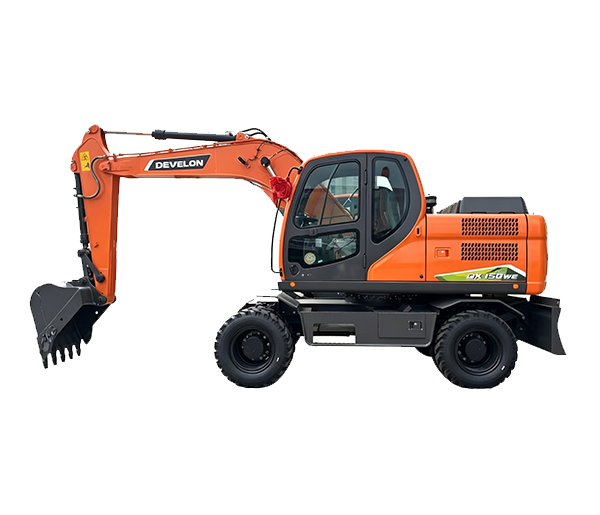
The main advantage of this machine class is not simply digging power. It is the combination of digging, mobility and working flexibility.
That combination becomes particularly useful in urban construction.
A contractor may need to excavate a drainage trench, move material, clean the roadside, install pipes and then travel to another nearby location. One machine that can perform several of these tasks can be easier to manage than a fleet of specialized machines.
| Application | Useful Feature | Typical Work |
|---|---|---|
| Road construction | Wheeled mobility | Excavation, drainage, grading and loading |
| Urban infrastructure | Compact road-based movement | Utility trenches and pipe installation |
| Municipal projects | Flexible working setup | Road maintenance and drainage |
| Commercial construction | Digging and loading capability | Site preparation and foundation work |
| Landscaping | Attachment flexibility | Grading and soil movement |
| Utility construction | Travel plus excavation | Water, sewer and cable projects |
Source: DEVELON published DX150W-7B application information and specifications. Actual suitability depends on site conditions and selected equipment.
This is where I think the wheeled design really earns its place.
If two work areas are close to each other and connected by suitable roads, the machine can move between them without the same type of transport arrangement normally required for a crawler excavator.
However, I always make one point clear: the machine's maximum travel capability does not override local traffic regulations. Road access, legal dimensions, safety requirements and site conditions must all be checked.
Because a wheeled excavator does not sit on crawler tracks, proper machine positioning becomes very important during excavation.
Depending on the configuration, the machine can use stabilizing equipment to support working operations. When the machine is properly positioned, the operator can concentrate on digging rather than constantly correcting the machine position.
For trenching beside roads, this is especially useful. The machine needs to stay stable while keeping enough space for traffic, barriers and other site equipment.
If a customer asks me where a 150 Wheeled Excavator makes the most sense, I normally start with infrastructure work.
Road work is a natural application for a wheeled excavator.
The machine can be used for roadside excavation, drainage, material loading, trench preparation and general site work. When several sections of a road need attention, road mobility becomes a useful part of the machine's value.
For road maintenance contractors, this can be especially practical because the machine may need to move from one repair point to another.
Drainage work involves repeated trenching, pipe installation, backfilling and site cleanup.
The operator needs good control of the bucket because trench width and depth often need to be kept within a defined range. A machine with suitable working reach can also reduce the need for constant repositioning.
Water and sewer projects often take place along existing roads. That makes machine mobility particularly useful.
The DEVELON 150 class can be considered for excavation, pipe trenching, material handling and related site preparation, provided the selected configuration matches the depth and ground conditions.
DEVELON specifically lists commercial building construction among the main applications for the DX150W-7B.
The machine can support foundation excavation, site preparation, soil removal, loading and general earthmoving.
For a building site where the excavator must move around the property frequently, the wheeled design can be convenient.
Municipal contractors often deal with smaller work areas spread across a town or city. Roadside drainage, utility repairs, landscaping and public infrastructure maintenance may all require excavation equipment.
This is one of the areas where I see a strong reason to consider a 150 wheeled excavator.
Large landscaping projects can involve a surprising amount of excavation and material movement. Commercial properties, parks and industrial sites may require grading, trenching, soil movement and preparation work.
A 150-class machine offers considerably more working capacity than a small landscaping excavator while still providing useful mobility.
One thing I do not recommend is treating every machine with “150” in the name as identical.
For example, DEVELON currently lists the DX150W-7B at 13,520 kg with a 0.76 m³ bucket and 100 kW net power. DEVELON's wider wheeled excavator range also includes models such as the DX140W-7K and DX160W-7K, which show how specifications can change as machine size and configuration change.
| Model | Operating Weight | Bucket Capacity | Engine Power | Published Travel Speed |
|---|---|---|---|---|
| DX140W-7K | 15,800 kg | 0.59 m³ | 113 kW / 152 hp | 2.7 / 9.2 / 37 km/h |
| DX150W-7B | 13,520 kg | 0.76 m³ | 100 kW / 136 PS | Market/configuration dependent |
| DX160W-7K | 17,000 kg | 0.59 m³ | 113 kW / 152 hp | Configuration dependent |
| DX190W-7 | 18,320 kg | 0.80 m³ | 121 kW / 1,900 rpm | Configuration dependent |
Source: DEVELON official published specifications for the respective wheeled excavator models. Specifications vary by market, emissions standard and configuration.
This comparison tells me something important: model numbers are only a starting point.
A customer may need a machine around the 150 class, but the actual choice can depend on working weight, bucket requirement, engine power, road speed, digging range, emissions standard and available attachments.
The destination country also matters. A machine available in one market may have a different engine or emissions configuration from a machine supplied to another region.
That is why I confirm the exact model and destination before preparing a final quotation.
The boom and arm combination can change the machine's working range significantly.
A shorter arm can be useful when stronger digging force is needed close to the machine. A longer working setup can provide more reach for trenching and loading. Neither is automatically better.
I always ask customers what they are actually digging and how deep they need to go.
When I supply construction machinery internationally, I treat the machine inspection and delivery process as part of the product service.
The excavator itself is only one part of the transaction. The customer also needs the correct documents, accessories, packing, shipping arrangement and delivery schedule.
First, I confirm the exact DEVELON model and configuration.
For a 150 Wheeled Excavator, this can include the production version, engine specification, emissions standard, boom and arm, bucket, stabilizer arrangement, attachments, machine condition and destination.
Before shipment, we can arrange checks according to the confirmed order.
I normally focus on:
Machine appearance
Engine starting and operating condition
Hydraulic system
Electrical system
Boom and arm functions
Bucket operation
Swing system
Travel and steering functions
Wheels and tires
Stabilizers or blade equipment
Attachments
Required documents
For used equipment, I also pay attention to oil leakage, cylinder condition, pins and bushings, tire wear and signs of previous heavy use.
Photos are useful, but I do not think photographs alone are enough to judge a construction machine.
For international orders, payment is commonly arranged by T/T. A typical structure can include a deposit before order processing and the remaining balance before shipment.
The exact terms are agreed between both parties according to the machine, order and transaction conditions.
Delivery time is not a fixed number because the situation depends on the selected DEVELON model, configuration, order quantity and machine availability.
If a machine is already available, the process can focus on inspection, documents, preparation and shipping. If a specific configuration needs to be arranged, the schedule can be different.
For this reason, I prefer to confirm the delivery schedule after the exact machine has been identified.
For complete machines, international transportation is generally arranged by sea.
The final shipping method depends on the destination country, port, machine dimensions, shipping schedule and customer requirements.
Suitable spare parts and accessories can be shipped separately by air or express when practical.
The machine is securely positioned and protected for transportation. Loose parts and accessories are normally separated from the main machine and packed in suitable cartons or wooden cases where required.
Before shipment, I want the machine, accessories, documents and packing arrangement to match the confirmed order. This reduces the chance of small problems becoming expensive problems after the machine arrives.
Ganglong Heavy Industry Technology (Hefei) Co., Ltd. was founded in 2013. Together with Hefei Ganglong International Trade Co., Ltd., we work across equipment R&D, manufacturing, testing, customization and global sales.
Our own product range includes HKLOONG excavators, loaders, Backhoe loaders and swamp excavators. At the same time, we provide complete machine sales and leasing services for domestic and international brands, including Hitachi, SANY, Lonking, Hyundai, XCMG, SHANMON and LOVOL.
For DEVELON equipment, our role is as a machinery supplier and international trade partner. We do not claim to manufacture DEVELON machines. DEVELON is the original equipment brand, while our role is to help customers source, inspect, purchase and arrange delivery of suitable construction equipment.
I think this distinction is important. When a customer buys an excavator internationally, they should know who made the machine and what the supplier is responsible for.
Our international trade team has experience with construction machinery, mining machinery and agricultural machinery, and has served customers across Asia, Africa, America and other regions.
When a customer asks me for a 150 Wheeled Excavator, I do not want to send a generic machine quotation without understanding the application.
I want to know:
What type of work will the excavator perform?
How deep does it need to dig?
Will it work mainly on roads or off-road?
What attachments are required?
What is the destination country?
Is the customer looking for a new or used machine?
What emissions standard is required?
Does the customer need a specific boom and arm combination?
These questions may take a little more time at the beginning, but they make the final equipment recommendation much more practical.
A 150 Wheeled Excavator generally refers to a wheeled excavator in the 150-class range. In the DEVELON range, the DX150W-7B is one relevant model, with a published operating weight of 13,520 kg, 0.76 m³ bucket capacity and 100 kW net engine power.
DEVELON lists the DX150W-7B mainly for commercial building construction and infrastructure construction. In practical use, this machine class can also support road work, drainage, utility construction, municipal projects, site preparation and landscaping.
The official DEVELON specification lists an operating weight of 13,520 kg. Actual machine weight can change according to attachments and configuration.
The published SAE heaped bucket capacity for the DX150W-7B is 0.76 m³. The suitable bucket can vary depending on material, working conditions and machine configuration.
DEVELON publishes 100 kW of net engine power at 2,000 rpm for the DX150W-7B.
The main reason is mobility. A wheeled excavator is designed to travel between suitable work areas more conveniently, making it useful for road, municipal, infrastructure and urban construction projects. A crawler excavator may be more suitable for jobs where ground stability and off-road excavation are the main priorities.
Yes. Road construction and infrastructure work are suitable applications for this machine class. The wheeled design is particularly useful when the excavator needs to move between different road-based work zones.
Yes, depending on the machine's hydraulic system and configuration. Possible Excavator Attachments include different buckets, hydraulic breakers, grapples, quick couplers and other tools. The attachment must be matched to the machine's hydraulic and lifting capabilities.
Delivery time depends on the exact DEVELON model, configuration, order quantity and machine availability. After confirming the machine and destination, I can arrange the expected delivery schedule according to the actual order situation.
Complete machines are generally transported by sea for international orders. Suitable spare parts and accessories can be shipped by air or express when appropriate.
The machine is securely fixed and protected during transportation. Loose parts and accessories can be packed separately in cartons or wooden cases. The final packing arrangement is confirmed according to the shipping method and destination.
Yes. According to the confirmed order, we can arrange checks covering the machine appearance, engine, hydraulic and electrical systems, working functions, attachments and required documents.
When I look at a DEVELON 150 Wheeled Excavator, I see a machine built around a very practical idea: combine useful excavation capability with the ability to move around roads and urban jobsites.
The DX150W-7B provides a good example. DEVELON publishes it with a 13,520 kg operating weight, 0.76 m³ bucket capacity and 100 kW net engine power at 2,000 rpm. The company identifies commercial building construction and infrastructure construction as key application areas.
For me, the value of this machine is not just in those numbers.
The real question is whether the machine fits the job. If I am working on drainage, road maintenance, utility installation or municipal construction, the wheeled design can be a useful advantage. If I am working continuously on rough ground where mobility on tracks matters more, I would compare the machine with a crawler excavator.
I also pay close attention to the exact version. A 150-class excavator can have different specifications depending on its model generation, market, emissions standard and configuration. That is why I always confirm the exact machine before discussing a final order.
At Ganglong Heavy Industry Technology (Hefei) Co., Ltd., my approach is straightforward. I first understand the application, then confirm the machine configuration, inspection requirements, payment terms, documents, packing and shipping plan.
For international buyers searching for a DEVELON 150 Wheeled Excavator, DX150W-7B wheeled excavator, 150 wheel excavator for construction, 150-class wheeled excavator for road work or DEVELON wheeled excavator for infrastructure projects, I believe the most useful starting point is the actual job requirement.
Once the working conditions are clear, it becomes much easier to choose the right bucket, boom, arm, attachments and machine configuration.
That is how I prefer to handle construction machinery sourcing: understand the work first, check the equipment carefully, confirm every important detail, and then arrange a practical delivery plan.
 RELATED
2435092534@qq.com
86 158 5511 9567


©2026 HKLOONG Heavy Industry Technology (Hefei) Co., Ltd. All Rights Reserved.

This website uses cookies to ensure you get the best experience on our website.
 Español
 Pусский
 Français
 العربية
 WhatsApp
 Phone
Phone E-mail
 Message