

DEVELON 210 Wheeled Excavator for Flexible Construction and Road Work
When I talk with customers about a DEVELON 210 Wheeled Excavator, the first thing I usually ask is not how much horsepower they want. I ask where the machine will work.
That may sound like a simple question, but it makes a big difference when choosing a Wheeled Excavator. A machine working beside city roads has very different needs from one working in a quarry. A contractor handling drainage, utility installation and road maintenance may care more about road mobility, working speed and attachment flexibility, while a customer doing heavy earthmoving may pay more attention to digging force, bucket capacity and stability.
For the 210-class DEVELON wheeled excavator, the DX210W-7 is one of the key models I look at. DEVELON publishes the DX210W-7 with an operating weight of about 21.9 tons, a 0.86 m³ SAE heaped bucket, and 141.4 kW net engine power at 1,900 rpm. The published maximum digging reach is 9,410 mm, while maximum digging depth is 5,555 mm.
These numbers give me a useful starting point, but I never treat a specification sheet as the whole story. The actual configuration, attachments, tires, boom and arm, counterweight, destination market and working conditions all affect how a machine performs in the field.
At Ganglong Heavy Industry Technology (Hefei) Co., Ltd., I work with customers looking for construction machinery, mining machinery, agricultural machinery and related attachments. Together with Hefei Ganglong International Trade Co., Ltd., our team handles international machinery sales and trade services for customers across Asia, Africa, America and other markets.
In this page, I will explain what I look at when evaluating the DEVELON 210 Wheeled Excavator, where it makes sense to use it, how its working system operates, what specifications are worth paying attention to, and how we handle inspection, payment, packing and international delivery.
A wheeled excavator has one obvious advantage over a crawler excavator: it can move around much more easily on roads and paved surfaces.
That makes a big difference for contractors working in cities and areas where several work zones are close together. Instead of putting the machine on a trailer every time it needs to move a short distance, the operator can drive it between suitable work areas, subject to local road and transport regulations.
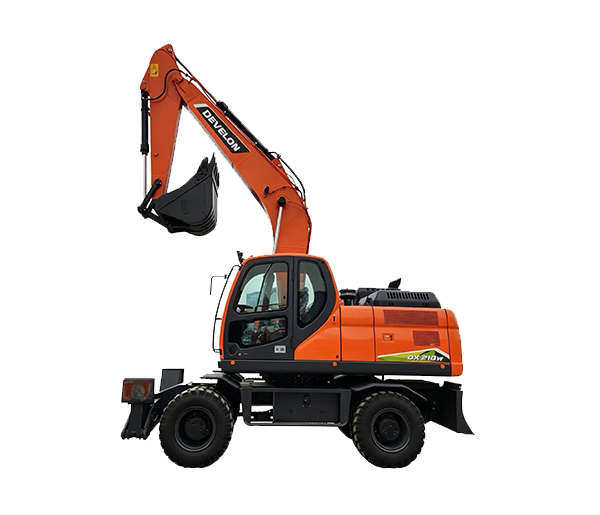
The DEVELON 210 wheeled excavator is built around this idea. It combines the digging function of a Hydraulic Excavator with a wheeled undercarriage that allows the machine to travel between jobs more easily.
The DX210W-7 is listed by DEVELON as a wheel excavator. Its published operating weight is 21.9 tons and its standard bucket capacity is 0.86 m³. The machine uses a DEVELON DL06V engine with a published net power of 141.4 kW at 1,900 rpm.
For me, this puts the machine into a useful middle-to-Large Wheeled Excavator class. It is not a small urban machine, but it is also not designed only for the biggest earthmoving projects.
I would consider this type of machine when the job requires a combination of digging ability and road mobility.
Road construction and maintenance
Urban infrastructure projects
Drainage and sewer construction
Utility installation
Pipeline work
Municipal construction
Building site preparation
Landscaping and site development
Material handling with suitable attachments
General excavation and loading
The important thing is that the machine should match the job. If a contractor spends almost all day digging on soft or rough ground without needing road travel, a crawler excavator may make more sense. If the machine must frequently move between urban work zones, a wheeled excavator can offer a practical advantage.
| Item | DEVELON DX210W-7 |
|---|---|
| Machine type | Wheeled Excavator |
| Operating weight | 21.9 ton |
| Bucket capacity | 0.86 m³ |
| Engine | DEVELON DL06V |
| Net engine power | 141.4 kW at 1,900 rpm |
| Maximum travel speed | Up to 35 km/h |
| Maximum digging reach | 9,410 mm |
| Maximum digging depth | 5,555 mm |
| Maximum digging height | 6,985 mm |
| Overall width | 2,530 mm |
Source: DEVELON official DX210W-7 product specifications. Actual specifications may vary according to market, equipment and machine configuration.
When someone sees an excavator working, the basic movement looks easy. The boom goes down, the arm pulls in, the bucket fills, the upper structure swings and the material is dumped. But there is quite a lot happening underneath that simple movement.
The engine supplies the main mechanical power. The hydraulic system converts that power into controlled movement for the boom, arm, bucket, swing mechanism and other functions. The operator uses the controls inside the cab to adjust these movements according to the task.
On a wheeled excavator, the travel system is another important part of the machine. The wheels and steering system allow the excavator to move from one suitable work location to another. This is one of the main reasons contractors choose a wheeled excavator instead of a crawler machine.
For normal excavation, I would describe the working cycle in five simple steps.
The operator positions the machine close to the excavation area.
The boom and arm move the bucket into the material.
The bucket curls and collects soil, gravel or another suitable material.
The upper structure swings toward a truck, stockpile or other unloading point.
The bucket opens and the material is released.
After that, the cycle starts again.
In real construction work, cycle time matters. If the operator spends too much time repositioning the machine, waiting for trucks or moving between work areas, the excavator's theoretical digging performance does not mean much.
That is why I look at the complete working process rather than one isolated specification. The machine needs to have enough digging force, but it also needs to move efficiently, provide good operator control and work well with the other equipment on site.
For urban construction, road mobility can be one of the most useful features of a wheeled excavator.
DEVELON publishes several travel speed figures for the DX210W-7, including 4, 9, 33 and 35 km/h depending on the travel range. The actual usable speed depends on operating conditions, road regulations, tires, machine configuration and safety requirements.
I always remind customers that maximum travel speed is not the same thing as normal working speed. A construction machine still needs to be operated according to local traffic rules and site safety requirements.
When I compare construction equipment, I try to avoid making the explanation unnecessarily complicated. A customer usually wants to know one simple thing: what will this machine actually help me do?
The DX210W-7 has a published operating weight of 21.9 tons and a 0.86 m³ bucket. That gives it enough size for many road, infrastructure and general excavation jobs while keeping the machine within a class that is still practical for mobile construction work.
The 0.86 m³ bucket is also a useful reference when planning truck loading. However, I would not choose a bucket based on volume alone. Soil density, rock content, digging resistance and the required cycle time all matter.
DEVELON lists a maximum digging reach of 9,410 mm for the DX210W-7. A reach of this size gives the operator room to work around trenches, road edges, foundations and other areas without constantly moving the complete machine.
For drainage work, this can be especially useful. The excavator can remain in a suitable position while the operator works along the trench. Of course, actual working range depends on the boom, arm and attachment configuration.
The published maximum digging depth is 5,555 mm. This makes the machine suitable for many utility, drainage, foundation and earthmoving applications.
But maximum digging depth is a laboratory-style specification, not a promise that every job should be dug to that depth. Ground conditions, trench safety, machine position and attachment selection must always be considered.
A modern wheeled excavator can do much more than dig with a standard bucket.
Depending on the machine configuration and attachment system, customers may use buckets, Hydraulic Breakers, grapples, Quick Couplers, compactors, crushers, pulverizers and other tools.
This flexibility is valuable for contractors who want one machine to handle several different tasks during the year. I normally recommend selecting attachments according to the actual work plan instead of buying every possible attachment at the beginning.
The biggest practical advantage of the DEVELON 210 Wheeled Excavator is the combination of excavation and mobility.
Think about a city road project. The contractor may need to remove old material, dig a drainage channel, install pipes, prepare a road section and move to another location later the same day.
A wheeled excavator can be a very useful machine for this type of work because it is designed to travel between suitable work areas without the same type of trailer movement required by many crawler machines.
DEVELON describes the DX210W-7 as a machine for applications including processing/manufacturing and infrastructure construction. The company's product information also places strong attention on road and infrastructure work for its wheeled excavator range.
| Working Area | Why a 210 Wheeled Excavator Can Be Useful | Typical Tasks |
|---|---|---|
| Road construction | Good mobility between nearby work zones | Excavation, drainage, loading, grading |
| Urban infrastructure | Designed for mobile construction work | Utility trenches, pipe installation, site preparation |
| Municipal projects | Flexible working and attachment options | Road maintenance, drainage, material handling |
| Building construction | Strong digging capability and working reach | Foundation work, earthmoving, loading |
| Landscaping | Flexible attachment use | Site preparation, grading and material movement |
| Utility projects | Good combination of digging and mobility | Water, sewer and cable trenching |
Source: DEVELON published DX210W-7 application information and specifications. Actual suitability depends on site conditions, attachment and local operating requirements.
Some people think a wheeled excavator is simply a crawler excavator with tires. I do not look at it that way.
The undercarriage design changes the way the machine interacts with the ground. On many wheeled Excavators, additional support equipment such as stabilizers or a dozer arrangement can help the machine stay steady during excavation, depending on the configuration.
This becomes particularly important when digging from the side of a road or working close to a trench. The operator needs to position the machine correctly and use the available support systems properly.
For this reason, I always recommend looking at the complete configuration instead of asking only whether the machine has wheels.
If I were choosing applications for this machine, I would start with projects where mobility has real value.
Road work is one of the most natural applications for a wheeled excavator. The machine can excavate roadside soil, prepare drainage, load material and perform other construction tasks while moving between suitable work areas.
For road maintenance contractors, this flexibility can be particularly useful. One machine may be needed at several locations during a project rather than staying in one fixed excavation area.
Drainage work requires accurate trench excavation and frequent repositioning. The operator needs to control the bucket carefully, maintain the required trench shape and avoid damaging nearby pipes or existing infrastructure.
The 210-class machine provides enough working range for many medium-to-large drainage projects while retaining the mobility expected from a wheeled excavator.
Water pipes, gas lines, electrical cables and communication infrastructure all require excavation. In cities, space is often limited and traffic is always a concern.
This is where a wheeled excavator can be useful. The machine can work around roads and construction zones while its attachment options allow it to perform more than simple digging.
The DEVELON 210 can also be used for general building construction, including site preparation, excavation and loading.
For deep foundations or larger earthmoving jobs, the exact boom and arm configuration becomes important. Before I quote a machine, I want to know the required digging depth and working radius rather than simply hearing “210 excavator.”
With the correct attachment and working setup, an excavator can also handle certain material-moving jobs.
This might include moving construction debris, handling pipes, sorting materials or loading suitable bulk material. The attachment, lifting radius and load weight must all be checked before using the machine for lifting or handling work.
Large landscaping and land development projects often involve digging, grading, moving soil and preparing new areas.
The 210-class machine may be larger than what is needed for small gardens, but for commercial landscaping, industrial property development or large site preparation, its working capacity can make sense.
One thing I always tell buyers is not to assume that every machine called “210” has exactly the same specification.
DEVELON has published different versions of the 210-class wheeled excavator, including the DX210W-7, DX210W-7B, DX210W-7K and older DX210WA. These machines may have different engines, emissions standards, weights, travel performance and working ranges.
| Model | Operating Weight | Engine Power | Bucket | Max Digging Depth |
|---|---|---|---|---|
| DX210W-7 | 21.9 ton | 141.4 kW net | 0.86 m³ | 5,555 mm |
| DX210W-7B | 20,100 kg | 121 kW net | 0.86 m³ | 6,275 mm |
| DX210WA | 19.9–20.9 ton | 120 kW net | 0.51–1.35 m³ | 6,010 mm |
Source: DEVELON official product specifications for DX210W-7, DX210W-7B and DX210WA. These are different versions and should not be treated as one identical machine.
The table is useful because it shows something buyers sometimes miss. The newest or most powerful version is not automatically the correct machine for every customer.
For example, a customer working in a market with specific emissions requirements may need one configuration, while a customer buying a used machine for a different market may be considering an older version.
That is why I ask for the destination country early in the sales process. The country can affect emissions requirements, documents, shipping arrangements and machine availability.
Buying a construction machine internationally is very different from buying a small spare part online. There are many details to confirm before the machine leaves the yard.
I first confirm whether the customer needs the DX210W-7, DX210W-7B, DX210W-7K, DX210WA or another 210-class configuration.
I also check the working requirements, bucket, attachments, destination, emissions standard, machine condition and production year where applicable.
Before delivery, we can arrange checks according to the confirmed order. These checks can cover the machine's appearance, engine, hydraulic system, electrical system, working functions, attachments and required documents.
For a used machine, I pay extra attention to the parts that tell me how the machine has actually been used.
Engine starting and running condition
Hydraulic response
Boom and arm movement
Bucket cylinder condition
Swing operation
Travel system
Wheel and tire condition
Steering system
Stabilizer or dozer equipment
Electrical functions and dashboard
Cab condition
Oil leakage and visible damage
I do not consider a machine ready simply because it looks clean in photographs. A proper inspection should focus on working condition as well as appearance.
For international machinery orders, payment is commonly arranged by T/T. A typical arrangement may involve a deposit before order processing and the balance before shipment.
However, I do not treat this as a fixed rule for every order. The exact payment terms are agreed between both parties based on the machine, order and transaction conditions.
Before shipment, I check that the machine and its accessories correspond with the confirmed order. Required documents are prepared, and loose accessories are organized for packing.
For international orders, a complete DEVELON 210 wheeled excavator is generally transported by sea. The exact shipping method depends on the destination, port, machine dimensions, shipping schedule and customer requirements.
Because the machine is already designed for road mobility, that does not mean it can simply be driven to any international destination. Export transportation still requires proper shipping arrangements and documentation.
The machine is securely positioned and protected for transportation. Loose parts, accessories and smaller components are normally packed separately in cartons or wooden cases where appropriate.
Before loading, I prefer to check the packing arrangement against the shipping plan. It is a small step, but it can make a big difference when the machine reaches the destination.
Ganglong Heavy Industry Technology (Hefei) Co., Ltd. was founded in 2013. Together with Hefei Ganglong International Trade Co., Ltd., we operate across equipment R&D, manufacturing, testing, customization, sales and international trade.
Our own brands include HKLOONG excavators, loaders, Backhoe loaders and swamp excavators. At the same time, we provide complete machine sales and leasing services for domestic and international brands including Hitachi, SANY, Lonking, Hyundai, XCMG, SHANMON and LOVOL.
For DEVELON equipment, our role is that of a machinery supplier and international trade partner. We do not describe ourselves as the manufacturer of DEVELON machines. DEVELON is the original equipment brand, while our work is to help customers source, inspect, purchase and arrange delivery of suitable machines.
This distinction is important for an international buyer. I believe a supplier should be clear about what it manufactures, what it supplies and what services it provides.
Our international trade team has worked with construction machinery, mining machinery and agricultural machinery customers in Asia, Africa, America and other regions.
When a customer contacts me about a DEVELON 210 Wheeled Excavator, I want to understand the project first. If the customer needs road mobility, I look at the wheeled configuration. If the customer needs heavy digging on rough ground and does not need frequent road travel, I may suggest comparing it with a crawler excavator class.
I also look at the destination country. A machine that is suitable for one market may not be the right choice for another because of emissions regulations, road requirements, shipping conditions or local service considerations.
In other words, I do not believe the buying process should start with “What is the cheapest 210 excavator?” It should start with “Which 210 excavator configuration fits my work?”
The DEVELON 210 Wheeled Excavator generally refers to DEVELON's 210-class wheeled excavator models, including the DX210W-7 and related versions. These machines combine hydraulic excavation capability with a wheeled undercarriage designed for flexible movement between suitable work locations.
DEVELON's official product information lists the DX210W-7 at approximately 21.9 tons operating weight. The actual weight can vary with equipment, attachments and configuration.
The official DX210W-7 specification lists the DEVELON DL06V engine with 141.4 kW net power at 1,900 rpm. Different 210-class versions can use different engines and power ratings, so I always confirm the exact model.
The published maximum digging depth is 5,555 mm. This is a maximum specification for the stated configuration. Actual working depth depends on boom and arm setup, ground conditions, attachment and machine position.
DEVELON lists a maximum digging reach of 9,410 mm for the DX210W-7. The actual working range depends on the selected configuration and attachment.
The published DX210W-7 specification lists a 0.86 m³ SAE heaped bucket. Other DEVELON 210-class versions can have different bucket ranges, so buyers should confirm the exact configuration before ordering.
Yes. Road construction and infrastructure work are among the practical applications for wheeled excavators. Their ability to travel between suitable work zones makes them useful for road maintenance, drainage, utility work and other urban construction tasks.
Yes. The combination of digging capability and road mobility makes this machine class suitable for many urban projects. However, local traffic regulations, road permissions, working space and site safety requirements must always be checked.
It can be used for certain mining-support and material-handling applications, but suitability depends on the actual mine, material, ground conditions and production requirements. For very heavy quarrying or mining work, I would compare the machine with larger crawler excavators and other purpose-built equipment.
Attachment availability depends on the exact machine and hydraulic configuration. Common Excavator Attachments can include general-purpose buckets, breakers, grapples, quick couplers, compactors, pulverizers and other tools. The attachment should always be matched to the machine's hydraulic and lifting capacity.
There is no single fixed delivery time. It depends on the selected DEVELON model, configuration, order quantity, machine availability, inspection requirements and destination. For international orders, I confirm the expected schedule before the order is finalized.
International machinery transactions are commonly arranged by T/T, with a deposit before order processing and the balance before shipment. The exact payment terms are confirmed between both parties according to the specific transaction.
Complete machines are generally transported by sea. Suitable spare parts and accessories can be shipped by air or express when practical. The final method depends on the destination, shipping requirements and customer needs.
After working with construction machinery buyers, I have learned that the right excavator is rarely decided by one specification.
For the DEVELON 210 Wheeled Excavator, the main attraction is the balance between digging performance and mobility. The DX210W-7 has a published 21.9-ton operating weight, 0.86 m³ bucket capacity, 141.4 kW net engine power, 9,410 mm maximum digging reach and 5,555 mm maximum digging depth.
Those figures make it a practical machine to consider for road construction, urban infrastructure, drainage, utilities, municipal projects, building construction and general excavation.
But I always come back to the same point: the exact configuration matters.
The 210-class DEVELON range includes different versions, and their operating weight, engine output, emissions standard, bucket options and working range can vary. A buyer should therefore confirm the exact model instead of relying only on the words “DEVELON 210.”
At Ganglong, my approach is straightforward. I first understand the customer's working conditions, then confirm the machine configuration, inspection requirements, payment terms, documents, packing and shipping plan.
For an international construction machinery order, those details are just as important as the excavator itself.
If you are looking for a DEVELON 210 Wheeled Excavator, DEVELON DX210W-7, DX210W-7 wheeled excavator, 210 ton class wheeled excavator or a DEVELON wheeled excavator for road construction, I recommend starting with the actual job requirements. Once the digging depth, working range, attachment, road mobility, destination and operating conditions are clear, it becomes much easier to identify the right machine configuration.
That is how I prefer to handle construction machinery sourcing: understand the job, check the machine, confirm the details and then arrange the delivery.
 RELATED
 RELATED
2435092534@qq.com
86 158 5511 9567


©2026 HKLOONG Heavy Industry Technology (Hefei) Co., Ltd. All Rights Reserved.

This website uses cookies to ensure you get the best experience on our website.
 Español
 Pусский
 Français
 العربية
 WhatsApp
 Phone
Phone E-mail
 Message