

HW155 Wheeled excavator for Construction, Roadwork and Utility Projects
When I talk with customers about a wheeled Excavator, I usually ask one simple question first: where will the machine spend most of its working time?
It sounds like a basic question, but it can change the whole equipment selection. A machine that stays in one quarry all day has different needs from a machine that moves between road construction sites, drainage projects, utility work and municipal jobs.
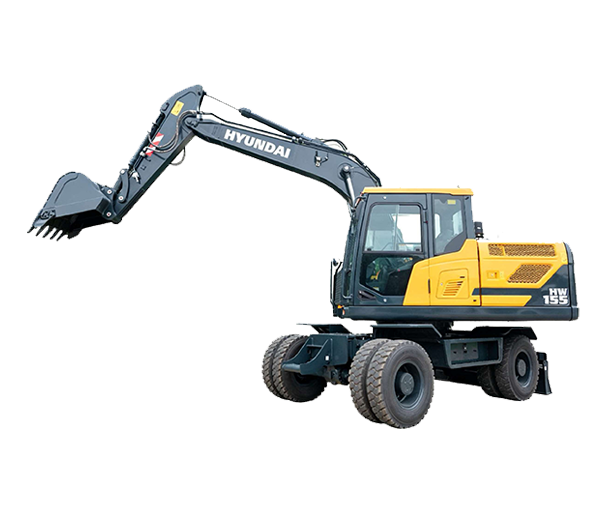
That is where the Hyundai HW155 Wheeled Excavator becomes interesting. It is a 14-ton-class wheeled excavator designed to combine useful digging performance with the mobility of a wheeled machine.
According to Hyundai construction equipment's official China product information, the HW155 has an operating weight of 14,300 kg, engine power of 125 kW at 2,000 rpm, and a standard bucket capacity of 0.58 m³. A 0.65 m³ bucket is also listed as an optional configuration. Hyundai's published specifications also give an overall length of 7,850 mm, overall height of 3,400 mm, maximum digging depth of 4,820 mm, maximum digging height of 8,500 mm, and travel speeds of 10.8/40.5 km/h.
These numbers make the HW155 a practical machine for customers who need more working capacity than a compact wheeled excavator can provide but do not necessarily need a much larger 20-ton-class machine.
At Ganglong Heavy Industry Technology (Hefei) Co., Ltd., we work with construction machinery customers in different markets, so I prefer to look at the machine from a real working point of view rather than simply copy a specification sheet. In this article, I will explain what the HW155 is, how it works, where it can be used, what its specifications mean in practice, and how we handle supply and international delivery.
The HW155 is a wheeled excavator designed for excavation, loading, trenching, roadwork, utility construction and other jobs where machine mobility is important.
The word "wheeled" is the key here.
Unlike a crawler excavator, the HW155 uses a wheeled chassis. This allows it to move conveniently on suitable roads and firm surfaces. For a contractor working on a long road project or several nearby sites, that can make daily machine movement much easier.
I would not say that wheels are automatically better than tracks. They solve a different problem.
Crawler Excavators are well known for their strong ground contact and stability on many difficult surfaces. Wheeled excavators are more attractive when road mobility and frequent relocation are important.
That difference is especially useful in urban construction, road maintenance, municipal engineering and utility projects.
| HW155 Specification | Published Data | What It Means in Practice |
|---|---|---|
| Machine type | Wheeled excavator | Designed for excavation with road mobility |
| Operating weight | 14,300 kg | Places the machine in the 14-ton working class |
| Engine power | 125 kW / 2,000 rpm | Provides the main power for working and hydraulic functions |
| Standard bucket | 0.58 m³ | Suitable for general excavation and material handling |
| Optional bucket | 0.65 m³ | Provides another bucket-size option for suitable applications |
| Overall length | 7,850 mm | Important for transport and site access |
| Overall height | 3,400 mm | Important when checking clearance |
Source: Hyundai Construction Equipment China official HW155 product information. Final specifications should be confirmed according to the actual machine, working equipment and order configuration.
One thing I like about looking at the machine this way is that the numbers start to make sense.
A 14,300 kg operating weight tells me that this is not a small landscaping machine. The 125 kW engine gives it a useful power level for serious excavation and material-handling work. The 0.58 m³ standard bucket gives the machine a reasonable balance between bucket volume and working size.
In other words, the HW155 is built for contractors who expect the machine to work hard but still need it to move around the project with reasonable flexibility.
I also see the HW155 as more than a simple digging machine.
Depending on the working equipment and hydraulic configuration, an excavator can be used with different attachments for different tasks. A bucket may be used for normal excavation. A breaker can be used for suitable demolition or breaking work. A grapple or other attachment may be useful for material handling.
The exact attachment should always be confirmed before ordering because hydraulic flow, mounting dimensions, machine configuration and application requirements all need to match.
The working principle of the HW155 is easier to understand than it may sound.
The engine creates mechanical power. The hydraulic system converts that power into controlled hydraulic movement. Hydraulic oil is sent through the system to operate the boom, arm, bucket, swing function and other working equipment.
When the operator wants to dig, the boom positions the working equipment, the arm moves the bucket toward the material, and the bucket cuts into the ground. The hydraulic cylinders provide the movement needed to fill the bucket.
After the bucket is full, the operator raises the boom and swings the upper structure toward the dumping point. The bucket opens, the material is released, and the machine returns to the excavation position.
This cycle happens again and again during a working day.
It may look simple from outside, but good excavation is really about keeping the whole cycle smooth.
If the operator swings too far, waits too long or makes unnecessary movements, fuel and time are wasted. If the bucket is too large for the material or working conditions, the machine may not work as comfortably as expected.
That is why I usually recommend looking at the complete machine configuration instead of focusing only on engine power.
The hydraulic system is basically the machine's muscle system.
The engine supplies the energy, but the hydraulic system decides how that energy is delivered to the working equipment.
For an operator, smooth hydraulic control can make everyday work much easier. Trenching, loading, grading and positioning require controlled movement rather than simply maximum force.
This becomes especially important when the machine works near buildings, roads, pipes, cables or other equipment.
The HW155's wheeled design is one of its most useful features for mobile contractors.
Hyundai's published HW155 data lists travel speeds of approximately 10.8/40.5 km/h. The two figures represent the machine's different travel-speed ranges rather than a single constant working speed.
For a contractor, the practical benefit is simple: the excavator can move between suitable working areas without being treated exactly like a crawler machine that normally requires transport equipment for relocation.
Of course, actual travel must follow local road regulations, site conditions and machine operating requirements. A wheeled excavator should never be treated like an ordinary road vehicle simply because it has tires.
The HW155 has a published operating weight of 14,300 kg.
This gives the machine a substantial working platform for excavation and lifting-related tasks.
Operating weight also matters when planning transportation. Before shipping a machine internationally, I need to consider not only the weight but also its dimensions, shipping method, loading arrangement and destination port.
For customers buying construction equipment for overseas projects, this information should be confirmed before the machine is booked for transportation.
Hyundai lists the HW155 engine power at 125 kW at 2,000 rpm.
That power level gives the machine the energy needed for its excavation and hydraulic work.
But again, I would not judge an excavator only by its engine power.
The engine, hydraulic system, machine weight, bucket, boom, arm and control system all need to work together. A good machine specification is really a package.
The standard bucket capacity is listed at 0.58 m³, with a 0.65 m³ option also listed by Hyundai.
Bucket selection is important because the bucket is the part of the machine that directly touches the material.
Loose soil, clay, gravel, demolition debris and harder materials do not behave in exactly the same way. For normal excavation, a general-purpose bucket may be suitable. For more abrasive or difficult materials, a different bucket design may make more sense.
When a customer asks me for an HW155 quotation, I prefer to confirm the actual material before discussing the bucket.
Hyundai's official HW155 product page lists a maximum digging depth of approximately 4,820 mm.
This gives the machine a useful working range for trenching, drainage, foundation preparation and utility construction.
For example, a contractor installing drainage pipes may need to excavate along a roadside. The HW155 can provide the required working reach for many such applications while retaining the mobility of a wheeled excavator.
Of course, maximum digging depth is a technical limit. Actual working depth should always be based on the site conditions, ground stability, attachment configuration and safe operating procedures.
The published maximum digging height is approximately 8,500 mm.
This can be useful for higher-level excavation and loading applications.
If the machine will load material into trucks, I recommend checking the actual truck body height and machine position rather than assuming that the maximum digging height automatically means every truck can be loaded comfortably.
The published overall height of the HW155 is approximately 3,400 mm.
This is a number that customers sometimes forget when they are focused on digging performance.
But if the machine needs to pass under a structure, enter a workshop, move through a restricted construction entrance or be transported by a particular trailer, overall height suddenly becomes very important.
For international orders, I always recommend checking the complete transport dimensions before final shipping arrangements are made.
When I compare excavators, I do not simply look for the machine with the largest number.
Instead, I ask what the customer actually needs. A contractor working in city streets may care about mobility and dimensions. A utility contractor may focus on digging depth and attachment compatibility. A material-handling company may care more about lifting configuration and stability.
Here is the core HW155 data published by Hyundai.
| Technical Item | HW155 Published Data | Practical Consideration |
|---|---|---|
| Operating weight | 14,300 kg | Important for working class and transportation |
| Engine power | 125 kW / 2,000 rpm | Provides power for working operations |
| Engine | Cummins B7 | Engine configuration listed by Hyundai China |
| Standard bucket | 0.58 m³ | General excavation and material handling |
| Optional bucket | 0.65 m³ | Alternative bucket capacity |
| Overall length | 7,850 mm | Important for access and transport |
| Overall height | 3,400 mm | Important for clearance |
| Maximum digging depth | 4,820 mm | Useful for trenching and excavation |
| Maximum digging height | 8,500 mm | Useful for elevated excavation and loading |
| Travel speed | 10.8 / 40.5 km/h | Supports movement between suitable work areas |
Source: Hyundai Construction Equipment China official HW155 product page. Specifications may vary according to market, configuration, working equipment and production version.
The table below helps show where the HW155 sits within Hyundai's published wheeled excavator range in China.
| Model | Operating Weight | Rated Power | Standard Bucket |
|---|---|---|---|
| HW60ECO | 5,650 kg | 36.2 kW / 2,200 rpm | 0.18 m³ |
| HW80G | 6,800 kg | 55.8 kW / 2,200 rpm | 0.30 m³ |
| HW125V | 12,300 kg | 86.1 kW / 2,000 rpm | 0.50 m³ |
| HW155 | 14,300 kg | 125 kW / 2,000 rpm | 0.58 m³ |
| HW210 | 21,920 kg | 150 kW / 2,000 rpm | 1.00 m³ |
Source: Hyundai Construction Equipment China official wheeled excavator product listing. The comparison is intended to show model size and published specifications, not to rank machine performance.
From this comparison, the HW155 clearly occupies the 14-ton class between the smaller HW125V and the larger HW210.
That can be useful for buyers who need a substantial wheeled excavator but do not want to jump directly to a 20-ton machine.
| Factor | HW155 Wheeled Excavator | Crawler Excavator |
|---|---|---|
| Road mobility | Strong point on suitable roads | Normally requires transport for longer relocation |
| Working on firm surfaces | Well suited | Also suitable |
| Soft or muddy ground | Requires careful assessment | Often provides better ground contact |
| Urban work | Useful for many applications | Suitable when transport and site access are available |
| Frequent relocation | One of its main advantages | Usually less convenient |
Source: Practical comparison based on the operating characteristics of wheeled and crawler excavators. It is not a manufacturer performance ranking.
This is why I do not tell every customer to choose a wheeled excavator.
If the project is mainly on firm roads and construction sites with frequent relocation, the HW155 makes sense to investigate. If the machine will spend most of its time in deep mud, loose ground or difficult off-road conditions, a crawler excavator may be more appropriate.
Road construction is one of the most natural applications for a wheeled excavator.
Road projects are rarely limited to one small working point. The machine may need to excavate drainage channels in one area, load material in another area and then move further down the project.
The HW155 can be used for excavation, drainage preparation, roadside work, loading and general earthmoving when the machine configuration matches the project.
Road maintenance contractors have a slightly different challenge.
The work may involve repairing drainage, cleaning roadside areas, digging around damaged sections or preparing material for repairs.
Because the HW155 is a wheeled excavator, its mobility can be useful when the project involves several locations connected by suitable roads.
Water pipes, drainage pipes, telecommunications and other underground utilities often require trench excavation.
The HW155 has a published maximum digging depth of around 4.82 meters, giving it a useful working range for many trenching applications.
When working near existing underground services, however, machine capability is only one part of the job. Proper site information, safe excavation procedures and trained operators remain essential.
Municipal projects can include road repairs, drainage systems, landscaping, public facilities and other infrastructure work.
These jobs often involve tight working areas and frequent movement.
A wheeled excavator can be practical when the machine needs to move around developed areas and suitable road surfaces are available.
Construction sites may require excavation for foundations, drainage, service lines and site preparation.
The HW155 can support these tasks when the machine dimensions and working range fit the site.
Before ordering, I would always check access width, overhead clearance, ground condition and working space. A machine can have excellent specifications and still be the wrong choice if it physically cannot enter the jobsite.
Land development often begins with clearing, grading, drainage and earthmoving.
The HW155 can be used for suitable excavation and material-handling work during these stages.
Again, the wheeled configuration is most useful when the ground provides enough support and the project requires regular movement.
Agricultural projects may involve irrigation channels, drainage, farm access roads and general land preparation.
The HW155 can be considered for these applications when site access and ground conditions are suitable.
For very soft farmland or wet ground, I would carefully compare the machine with a crawler excavator before making the final selection.
An excavator does not have to spend its entire life with one bucket.
Depending on the machine configuration, customers may consider different attachments for breaking, grabbing, handling or other specialized tasks.
Hyundai has also described the later HW155A as a multi-purpose machine that can work with equipment such as forks, grapples, mowers and mulchers. That information relates specifically to the HW155A generation rather than the older HW155, so I would not automatically transfer those options to every HW155 without checking compatibility.
This distinction is important when buying used or older equipment.
When a customer asks us for an HW155 Wheeled Excavator for Sale, I do not think the correct response is simply to send a price.
The first step is to understand the actual machine requirement.
I want to know what the machine will actually do.
Road construction?
Utility trenching?
Municipal work?
Building construction?
Material handling?
Agricultural infrastructure?
General earthmoving?
This helps us understand the required bucket, attachment and working configuration.
The destination country is also important.
Different markets can have different requirements concerning emissions, road operation, documentation and import procedures.
For international orders, we confirm the destination before finalizing the shipping plan.
Production time and delivery time depend on the selected model, configuration, order quantity and machine availability.
I prefer to confirm availability first rather than promise a delivery date that has not been checked.
Once the actual machine and order details are confirmed, we can discuss the expected schedule.
Before shipment, we can arrange checks according to the confirmed order.
For a complete machine, this may include:
Machine appearance
Engine condition
Hydraulic system
Electrical system
Working functions
Bucket and attachments
Tires and visible wear
Required documents
For a used HW155, I would pay additional attention to wear, leakage, tire condition, working performance and general operating condition.
The inspection should match what the customer actually needs. There is no point creating a huge checklist that looks impressive but does not answer the important questions.
Construction equipment is an international product, so documentation matters.
We can coordinate the required machine documents according to the confirmed order and destination requirements.
Before shipment, I prefer to make sure the customer understands exactly which documents will be supplied.
For international orders, T/T is commonly used. A typical arrangement includes a deposit before order processing and the balance before shipment.
However, the exact payment terms are agreed between the buyer and seller based on the actual order.
Complete excavators are generally shipped by sea for international orders.
Shipping arrangements depend on the destination, port, machine dimensions, loading plan and available vessel schedule.
Suitable spare parts and accessories may be shipped by air or express when their size and weight make that practical.
Heavy equipment must be secured properly for transportation.
The machine is fixed according to the shipping arrangement, while loose accessories and smaller components can be packed separately.
Cartons or wooden cases may be used for appropriate loose items. The final packing method is confirmed according to the machine, destination and transportation requirements.
Our role at Ganglong is broader than simply putting a machine on a quotation sheet.
Ganglong Heavy Industry Technology (Hefei) Co., Ltd. was founded in 2013. Together with Hefei Ganglong International Trade Co., Ltd., we operate across construction machinery, mining machinery, agricultural machinery and matching attachments.
We have our own HKLOONG excavators, loaders, Backhoe loaders and swamp excavators. At the same time, we provide complete machine sales and leasing services for several domestic and international brands, including Hyundai.
For Hyundai equipment, I want to make one point very clear: we are a supplier and international trade service provider, not the manufacturer of Hyundai machines.
Our job is to help customers source the required equipment, confirm the configuration, coordinate
 RELATED
 RELATED
info@hkloong.com
86 158 5511 9567


©2026 HKLOONG Heavy Industry Technology (Hefei) Co., Ltd. All Rights Reserved.

This website uses cookies to ensure you get the best experience on our website.
 Español
 Pусский
 Français
 العربية
 WhatsApp
 Phone
Phone E-mail
 Message