

HW210 Wheeled Excavator for Construction, Roadwork and Heavy-Duty Earthmoving
When I talk about the Hyundai HW210 Wheeled excavator, I usually focus on one thing first: this is a machine for customers who need serious excavation capacity but still want the mobility of a wheeled Excavator.
That combination is what makes a machine like the HW210 different from a typical crawler excavator. A crawler machine is often chosen when the excavator spends most of its working life on rough or soft ground. A Wheeled Excavator has another job to do. It needs to dig, load, trench and handle material, but it also needs to move between suitable working areas with less dependence on transport equipment.
According to Hyundai construction equipment China's official product information, the original HW210 has an operating weight of 21,920 kg, rated engine power of 150 kW at 2,000 rpm, and a standard bucket capacity of 1.0 m³. The same official product information lists a maximum digging depth of 6,410 mm, maximum digging height of 10,000 mm, overall length of 9,360 mm, and overall height of 3,365 mm. The listed engine is a Cummins B7.
These figures put the HW210 in a much larger working class than compact wheeled Excavators. It is a machine for contractors who may be working on roads, municipal infrastructure, utility projects, large building sites, earthmoving jobs and other applications where a smaller machine simply does not provide enough working capacity.
At Ganglong Heavy Industry Technology (Hefei) Co., Ltd., I prefer to look beyond the specification sheet. A machine can have impressive numbers, but the real question is whether those numbers fit the job. So in this product page, I will explain how I look at the HW210, how it works, where I would use it, what its main specifications mean, and how we handle supply and international delivery.
The HW210 Wheeled Excavator is a heavy-class wheeled excavator designed for excavation, trenching, loading, road construction, utility work, earthmoving and material handling.
The basic idea behind it is simple: put a powerful excavator working system on a wheeled platform so the machine can perform demanding jobs while retaining useful mobility.
Hyundai's China product listing places the HW210 at 21,920 kg operating weight, with 150 kW engine power and a 1.0 m³ standard bucket.
At this size, I would not normally describe the HW210 as a compact urban excavator. It is a substantial machine. Before ordering one, I would want to know the jobsite access, road conditions, working space, transportation plan and actual material to be excavated.
Those details matter because the machine is not just a set of numbers. A 21.9-ton excavator needs enough room to work safely, and its size needs to match the project.
| HW210 Specification | Published Value | Practical Meaning |
|---|---|---|
| Machine type | Wheeled excavator | Excavation machine designed with road mobility |
| Operating weight | 21,920 kg | Places the machine in the 21-ton working class |
| Rated engine power | 150 kW / 2,000 rpm | Provides the main power for excavation and hydraulic work |
| Standard bucket | 1.0 m³ | Suitable for substantial excavation and material handling |
| Overall length | 9,360 mm | Important for site access and transportation |
| Overall height | 3,365 mm | Important for clearance and transport planning |
Source: Hyundai Construction Equipment China official HW210 product information. Final specifications should be confirmed against the actual machine, production version and configuration.
The 1.0 m³ bucket is also worth paying attention to.
Compared with smaller wheeled excavators, this gives the HW210 a much larger material-handling capability per bucket cycle. Of course, bucket capacity does not tell the whole story. The material density, digging conditions, loading distance and truck size all affect real productivity.
For normal soil and suitable bulk materials, however, a 1.0 m³ bucket gives the machine a useful working level for larger construction projects.
Some customers ask me why they should consider a wheeled excavator when a crawler excavator is available.
My answer is usually: look at the way the machine moves during the working day.
If an excavator stays in one pit or quarry for months, crawler tracks may make more sense. But if the machine needs to move along roads, between utility work areas or across a long infrastructure project, the wheeled design can become much more useful.
That is the basic reason behind the HW210.
The working principle of the HW210 is based on hydraulic power.
The engine provides the main mechanical power. The hydraulic pumps convert that engine power into hydraulic flow. Hydraulic oil is then sent through the machine's hydraulic system to control the boom, arm, bucket, swing system and other working functions.
For a basic digging cycle, the operator positions the machine beside the excavation area. The boom lowers the working equipment, the arm moves the bucket into the material, and the bucket cuts and collects the soil or other suitable material.
Once the bucket is full, the boom lifts it. The upper structure swings toward the dumping location, and the operator releases the material into a truck or stockpile.
Then the machine swings back and begins the next cycle.
That sounds straightforward, but a good operator knows that smooth cycles are more important than simply moving everything as fast as possible.
Too much swinging wastes time. Waiting too long wastes fuel. Using a bucket that does not match the material can slow the job down. Working too close to obstacles can also create unnecessary risk.
So when I evaluate an excavator, I look at the whole working system rather than just one specification.
The engine gives the machine energy, but hydraulic control is what turns that energy into useful movement.
For excavation, the hydraulic system needs to coordinate the boom, arm and bucket. For loading, it needs to move the bucket smoothly while the upper structure swings. For grading or positioning work, the operator needs fine control rather than only maximum force.
This is particularly important on a Large Wheeled Excavator because the machine may be used in areas where precision matters.
Road construction, drainage, utility work and municipal projects often involve existing roads, pipes, buildings and other equipment. The operator needs to place the bucket where it is needed without unnecessary movement.
Hyundai's official China HW210 information lists two travel-speed ranges of approximately 9.3 km/h and 35.5 km/h.
The exact operating speed depends on the selected travel range and working conditions.
For a contractor, the important point is that the machine is designed to move under its own power on suitable surfaces.
That does not mean it should be treated exactly like a road vehicle. Local traffic laws, machine operating rules, road conditions and site safety requirements still apply.
The HW210 has a published operating weight of 21,920 kg.
At roughly 22 tons, the machine has a substantial working presence.
Operating weight affects more than digging stability. It also affects transportation planning, site access and ground conditions.
When an overseas customer asks us about the HW210, I always want to know how the machine will reach the final jobsite. A 22-ton machine needs a suitable transport plan. Port handling, trailer selection, loading arrangements and local road restrictions all need to be considered.
The original HW210 listed by Hyundai China uses a 150 kW engine rated at 2,000 rpm.
This is a substantial power level for a wheeled excavator in this working class.
But I always tell customers not to compare excavators by engine power alone.
The engine works together with the hydraulic system, pump flow, machine weight, working equipment, bucket and control system. A machine with more horsepower is not automatically more suitable for every project.
The standard bucket capacity of the China-market HW210 is listed as 1.0 m³.
This is one of the features that clearly separates the HW210 from smaller wheeled excavators.
A 1.0 m³ bucket can move a meaningful amount of material per cycle. This can be useful for soil excavation, loading, site preparation, drainage work and general earthmoving.
But bucket selection should always match the actual material.
Loose soil is different from wet clay. Gravel is different from hard rock. Demolition debris is different from ordinary soil.
If a customer plans to use the HW210 in abrasive or heavy-duty conditions, I would discuss the appropriate bucket and wear parts before confirming the order.
Hyundai's official China HW210 page lists a maximum digging depth of approximately 6,410 mm.
This gives the machine a substantial working range for trenching, drainage, foundation work and deeper excavation.
For utility contractors, this can be useful when working on larger pipelines and drainage systems.
Still, maximum digging depth is a technical maximum. Actual safe working depth depends on ground conditions, excavation design, machine position, attachment configuration and site safety requirements.
The published maximum digging height is approximately 10,000 mm.
This gives the HW210 a useful reach for elevated excavation and loading work.
If the customer plans to load material into trucks, I recommend checking the truck dimensions and working position rather than relying on maximum height alone.
The official China specification lists an overall length of approximately 9,360 mm.
This is a number that matters when the machine is transported or needs to enter a restricted jobsite.
Before international shipment, I would confirm the actual machine dimensions and shipping configuration. Optional equipment can affect dimensions, and the final transport arrangement should be based on the actual unit.
The published overall height is approximately 3,365 mm.
Again, this is more than a specification-sheet number.
If the excavator needs to pass beneath a bridge, enter a workshop or move through a construction entrance, overhead clearance becomes a real issue.
For that reason, I recommend checking site access before purchasing a machine of this size.
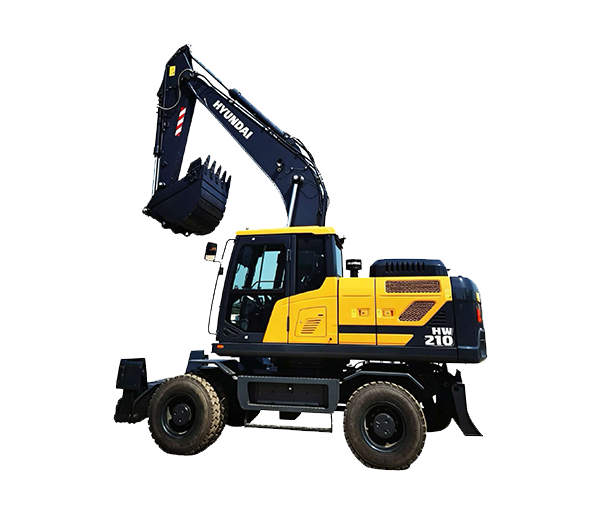
I like technical tables when they help a customer understand the machine. I do not like them when they are just a wall of numbers.
For the HW210, the most useful starting points are operating weight, engine power, bucket capacity, dimensions, travel speed and digging range.
| HW210 Technical Item | Published Value | Why I Check It |
|---|---|---|
| Operating weight | 21,920 kg | Shows the machine's working class and affects transport |
| Engine | Cummins B7 | Main power source listed for the China-market model |
| Rated power | 150 kW / 2,000 rpm | Supports excavation and hydraulic operations |
| Standard bucket | 1.0 m³ | Provides substantial bucket volume |
| Overall length | 9,360 mm | Important for transportation and site access |
| Overall height | 3,365 mm | Important for clearance checks |
| Maximum digging depth | 6,410 mm | Useful for deeper excavation and trenching |
| Maximum digging height | 10,000 mm | Useful for elevated excavation and loading |
| Travel speed | 9.3 / 35.5 km/h | Supports movement between suitable work areas |
Source: Hyundai Construction Equipment China official HW210 product information. Specifications are subject to model, market and configuration differences and should be confirmed against the actual machine before purchase.
It is also useful to compare the HW210 with other wheeled excavators in Hyundai's China product range.
| Model | Operating Weight | Rated Power | Standard Bucket |
|---|---|---|---|
| HW60ECO | 5,650 kg | 36.2 kW / 2,200 rpm | 0.18 m³ |
| HW80G | 6,800 kg | 55.8 kW / 2,200 rpm | 0.30 m³ |
| HW125V | 12,300 kg | 86.1 kW / 2,000 rpm | 0.50 m³ |
| HW155 | 14,300 kg | 125 kW / 2,000 rpm | 0.58 m³ |
| HW210 | 21,920 kg | 150 kW / 2,000 rpm | 1.0 m³ |
Source: Hyundai Construction Equipment China official wheeled excavator product listing. The table compares published specifications and is not a performance ranking.
This comparison shows why the HW210 belongs to a different working class from the compact HW60ECO or mid-size HW155.
The difference is especially clear in bucket capacity. The HW210's 1.0 m³ standard bucket is substantially larger than the 0.58 m³ standard bucket listed for the HW155.
That does not mean the HW210 is always the right choice. A larger machine needs more working space, more transport planning and suitable ground conditions.
| Working Factor | HW210 Wheeled Excavator | Crawler Excavator |
|---|---|---|
| Movement between nearby work areas | Convenient on suitable roads and firm surfaces | Usually slower and often requires transport |
| Urban road projects | Useful where road mobility matters | Can work, but relocation may require more planning |
| Soft or muddy ground | Requires careful site assessment | Often provides strong ground contact |
| Long infrastructure projects | Useful when frequent relocation is needed | Suitable when the machine remains on prepared working areas |
| Heavy excavation | Suitable within its working configuration | Also available in many heavy-duty configurations |
Source: Practical comparison based on the operating characteristics of wheeled and crawler excavators. It is not intended as a manufacturer ranking.
This is why I always start with the jobsite.
If the machine needs to move frequently and the route is suitable for a wheeled excavator, the HW210 becomes an interesting option.
If the machine will spend most of its life in difficult off-road conditions, a crawler excavator may deserve closer consideration.
Road construction is one of the applications where the HW210 can make practical sense.
A large road project may involve drainage, excavation, material loading, shoulder work and site preparation across different sections.
The wheeled design gives the machine useful mobility when suitable road surfaces are available.
With a 1.0 m³ standard bucket, the machine can also handle a meaningful volume of material during each cycle.
Road maintenance is another area where mobility matters.
A contractor may need to repair drainage in one section, remove material in another and move further along the road later in the day.
The HW210 can be considered for excavation, drainage, material handling and other suitable maintenance tasks.
Before choosing a machine this large for maintenance work, however, I would check whether the working areas actually provide enough space.
Large utility projects can require serious excavation capacity.
The HW210's published maximum digging depth of 6,410 mm gives it a useful range for deep trenching and larger drainage or pipeline work.
When working around underground services, machine power is only one part of the job. Accurate site information, proper excavation procedures and trained operators are still essential.
Municipal construction can involve drainage systems, roads, public facilities, land preparation and infrastructure upgrades.
A wheeled excavator can be useful because the machine may need to work across developed areas rather than staying in one isolated construction pit.
The HW210 is worth considering when the project requires a larger working class and has enough space for a 21.9-ton machine.
Large building projects often require foundation excavation, drainage, utility trenches and earthmoving.
The HW210 can support these activities when its dimensions and working range fit the site.
I would always check entrance width, overhead clearance, ground bearing conditions and swing space before bringing a machine of this size onto a construction site.
Large-scale land development can involve excavation, soil movement, drainage preparation and site shaping.
The HW210's larger bucket and working range make it suitable for many heavy earthmoving tasks.
For very soft or wet ground, however, I would compare the machine with a crawler excavator before final selection.
The HW210 can also be considered for suitable quarry and heavy material applications, depending on the actual material, bucket and attachment.
For hard rock and severe abrasive conditions, I would not simply assume that the standard bucket is appropriate. Bucket type, teeth, wear protection and hydraulic attachment requirements need to be checked.
Excavators are often used for more than digging.
With suitable working equipment, the HW210 can support material-handling tasks. Depending on the machine configuration, customers may consider buckets, breakers, grapples or other attachments.
Attachment compatibility should always be confirmed before ordering.
When a customer sends me an inquiry for an HW210 Wheeled Excavator for Sale, I do not want to answer with only a price.
There are several things we need to confirm first.
I start by asking what the machine will actually do.
Road construction?
Large utility project?
Municipal engineering?
Foundation excavation?
Heavy earthmoving?
Material handling?
Quarry-related work?
The answer helps us understand the bucket and attachment requirements.
The destination country matters for international machinery orders.
Different markets may have different requirements for emissions, documents, road operation and import procedures.
We therefore confirm the destination before the final shipping plan is prepared.
Production and delivery time depend on the selected model, configuration, order quantity and actual machine availability.
I prefer to confirm the supply situation before promising a delivery date.
Once the machine and configuration are confirmed, we can discuss the expected production or preparation schedule.
Before shipment, we can arrange checks according to the confirmed order.
For a complete HW210, this can include:
Machine appearance
Engine condition
Hydraulic system
Electrical system
Working functions
Bucket and attachments
Tires and visible wear
Required documents
If the machine is used, I would also pay close attention to operating condition, hydraulic leakage, tire wear, working equipment and visible damage.
The inspection should answer the customer's real questions instead of becoming a pile of paperwork.
For international equipment orders, T/T is commonly used.
A typical arrangement includes a deposit before order processing and the balance before shipment.
The actual payment terms are agreed by both parties according to the order.
For international orders, complete wheeled excavators are generally transported by sea.
The final shipping plan depends on the destination, port, machine dimensions, loading arrangement and available shipping schedule.
For smaller spare parts and suitable accessories, air freight or express delivery may be considered when practical.
Heavy equipment needs to be secured properly during transportation.
The HW210 is fixed according to the shipping arrangement, while loose components and accessories can be packed separately.
Cartons or wooden cases may be used for appropriate loose parts.
The final packing and loading arrangement is confirmed according to the destination and transportation requirements.
Ganglong Heavy Industry Technology (Hefei) Co., Ltd. was founded in 2013.
Together with Hefei Ganglong International Trade Co., Ltd., we operate across construction machinery, mining machinery, agricultural machinery and matching attachments.
Our group has its own HKLOONG excavators, loaders, Backhoe loaders and swamp excavators. At the same time, we provide complete machine sales and leasing services for domestic and international brands including Hitachi, SANY, Lonking, Hyundai, XCMG, SHANMON and LOVOL.
For Hyundai equipment, I want to be very clear about our role.
We are a supplier and international trade service provider. We are not the manufacturer of Hyundai machines.
Our job is to help customers source the required Hyundai equipment, confirm the machine configuration, coordinate inspection, arrange documents and organize international delivery.
Sometimes the customer needs only one excavator.
Sometimes the HW210 is part of a much larger equipment package.
A road contractor may need an excavator, Wheel loader, attachments and spare parts. A mining customer may need excavation equipment together with supporting machinery. An infrastructure contractor may need several machines for different stages of the same project.
Because our business covers different machinery categories, we can discuss the equipment requirement as a complete package.
Hefei Ganglong International Trade Co., Ltd. serves as the professional international trade arm of our group.
Our team has experience in construction machinery, mining machinery and agricultural machinery, with customers across Asia, Africa, America and other international markets.
International machinery sales are not only about finding a machine.
There are specifications to confirm, documents to prepare, inspections to arrange, payment terms to agree on and shipping details to coordinate.
Small misunderstandings at the beginning can create big problems later, so I prefer to make every important point clear before the order moves forward.
If a customer wants a particular attachment, we check compatibility.
If a customer has a special destination requirement, we discuss it before shipment.
If the machine is not immediately available, we explain the actual supply situation.
If the customer needs a pre-shipment inspection, we arrange it according to the confirmed order.
For heavy construction machinery, I believe clear information is much more useful than exaggerated promises.
The China-market HW210 is listed by Hyundai at 21,920 kg operating weight.
The official China product information lists 150 kW at 2,000 rpm.
The Hyundai China HW210 product page lists a Cummins B7 engine.
The standard bucket capacity listed for the China-market HW210 is 1.0 m³.
The published maximum digging depth is approximately 6,410 mm.
The published maximum digging height is approximately 10,000 mm.
The Hyundai China product page lists an overall length of approximately 9,360 mm.
The published overall height is approximately 3,365 mm.
Hyundai's China product information lists two travel-speed ranges of approximately 9.3 km/h and 35.5 km/h. Actual travel should follow operating instructions and local road requirements.
Yes. The HW210 can be considered for road excavation, drainage, roadside work, material handling and other suitable infrastructure applications where its size and working range fit the project.
Yes. Its working range makes it suitable for many utility and trenching applications, including larger drainage and pipeline projects.
It can be suitable for larger urban and municipal projects, but the customer should check road access, working space, machine dimensions and local operating requirements before choosing a machine of this size.
Suitable attachments can be considered depending on the machine configuration. Hydraulic flow, mounting dimensions and application requirements should be confirmed before ordering.
No. The HW210 is a wheeled excavator. Its wheeled chassis is designed to provide mobility on suitable roads and firm working surfaces.
Yes. Ganglong can arrange international supply according to the confirmed machine, destination and commercial terms. Complete machines are generally transported by sea.
Yes. We can arrange checks covering the machine appearance, engine, hydraulic and electrical systems, working functions, attachments and required documents according to the confirmed order.
No. Ganglong is a construction machinery supplier and international trade service provider. Hyundai is the original equipment brand. We help customers source and arrange Hyundai machinery according to their requirements.
When I look at the Hyundai HW210 Wheeled Excavator, I see a machine designed for customers who need a larger excavator but still value road mobility.
With its published 21,920 kg operating weight, 150 kW rated power and 1.0 m³ standard bucket, the HW210 sits at the larger end of Hyundai's China wheeled excavator range.
Its approximately 6.41-meter maximum digging depth and 10-meter maximum digging height also give it a useful working range for substantial excavation, trenching, drainage, road construction and infrastructure projects.
But I would not choose the HW210 simply because it is larger.
I would choose it when the project actually needs its working capacity.
If the machine needs to move between suitable work areas, a wheeled excavator can offer a practical advantage. If the job is mainly deep excavation on soft or difficult off-road ground, I would compare the site conditions carefully with a crawler excavator.
The right machine is the one that matches the work.
At Ganglong Heavy Industry Technology (Hefei) Co., Ltd., we support customers through the complete equipment purchasing process. We can help confirm the machine model and configuration, arrange inspection, coordinate documents, discuss payment terms, organize packing and arrange international transportation.
For customers searching for a HW210 Wheeled Excavator, Hyundai HW210 Excavator, HW210 Hydraulic Excavator, HW210 Excavator for Sale or a 21 ton wheeled excavator for construction, I recommend starting with the actual project requirements.
Tell us what the machine needs to dig, where it will work, what bucket or attachment is required, how often it needs to move and where it needs to be delivered. From there, we can work through the machine configuration, availability, inspection, payment and shipping details step by step.
Technical note: Hyundai has also introduced later HW210A and HW210A+ models with different specifications. The figures in this page refer specifically to the original HW210 information published by Hyundai Construction Equipment China and should not be automatically applied to HW210A or HW210A+. The final machine specification, configuration, availability, attachments, payment terms and delivery schedule should always be confirmed against the actual machine and order documents.
 RELATED
 RELATED
2435092534@qq.com
86 158 5511 9567


©2026 HKLOONG Heavy Industry Technology (Hefei) Co., Ltd. All Rights Reserved.

This website uses cookies to ensure you get the best experience on our website.
 Español
 Pусский
 Français
 العربية
 WhatsApp
 Phone
Phone E-mail
 Message