
 Español
 Pусский
 Français
 العربية

When I choose a dumper for a construction site, I look at one simple question first: can it move the required material safely and efficiently through the actual working area? A machine may have enough engine power, but if it is too wide for the site, difficult to steer, or not suitable for muddy ground, that extra power does not help much.
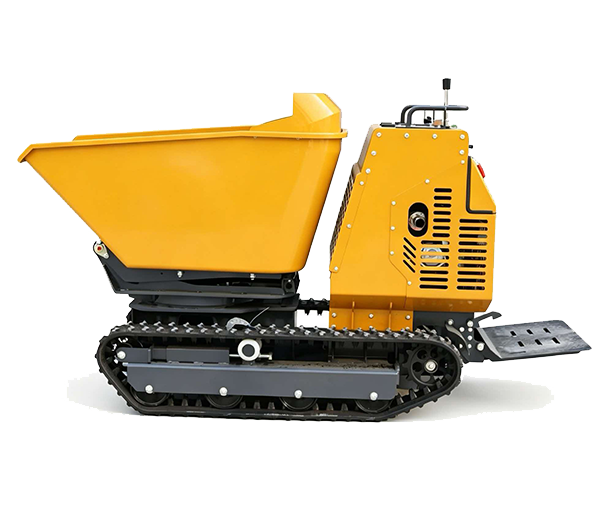
Our 800–2000L Dumper is designed around this practical idea. It is a compact off-road material transport machine for moving soil, sand, gravel, crushed stone, construction waste, landscaping materials, and other bulk loads. The skip can be hydraulically lifted to discharge material quickly, while the strong chassis, large tread tires, and compact body help the dumper work on rough and uneven job sites.
I see the 800–2000L capacity range as a useful size for many small and medium construction projects. It is large enough to reduce repeated manual transport, but compact enough to work in areas where a large dump truck would be difficult to use. Depending on the final configuration, this type of dumper can support earthmoving, road construction, landscaping, farm work, utility projects, building sites, and general site material handling.
At HKLOONG Heavy Industry Technology (Hefei) Co., Ltd., we combine equipment R&D, precision manufacturing, quality testing, customized modification, and global distribution. For me, a useful dumper is not simply a vehicle with a tipping box. The engine, transmission, hydraulic lifting system, chassis, tires, braking system, operator controls, and skip all need to work together.
1. What Is an 800–2000L Dumper?
An 800–2000L dumper is a compact construction vehicle designed to carry and discharge bulk materials. The “800–2000L” description refers to the approximate skip capacity range covered by this product concept. The actual payload depends on the machine configuration, material density, skip design, and rated operating conditions.
The main difference between a site dumper and an ordinary road truck is the type of working environment. A compact dumper is designed for short-distance material movement on construction sites, rough ground, narrow access roads, slopes, muddy areas, and other places where conventional transport vehicles may not be practical.
The basic operating process is easy to understand. I load material into the skip, drive the machine to the required location, raise the skip using the hydraulic system, discharge the material, lower the skip, and return for the next load. Repeating this cycle allows one operator and one machine to handle a large amount of material with much less manual work.
| System | Main Job | Practical Benefit |
|---|---|---|
| Diesel engine | Provides driving and hydraulic power | Supports transport and tipping work |
| Heavy-duty chassis | Supports the machine and payload | Handles rough construction conditions |
| Hydraulic tipping system | Raises the skip | Allows fast material unloading |
| Dumping skip | Carries bulk material | Reduces manual handling |
| Large tread tires | Provide traction and ground contact | Improve mobility on uneven ground |
| Operator controls | Control movement and tipping | Make repetitive transport work easier |
The capacity range also gives buyers more flexibility. A smaller skip can make sense when access is extremely tight, while a larger configuration can reduce the number of trips when the site has more working space. I would always select the capacity based on the material, travel distance, site conditions, and loading equipment rather than choosing the largest available skip automatically.
2. How the 800–2000L Dumper Works
The working principle of a dumper is quite simple, but several mechanical systems have to work together correctly. I normally break the operation into four steps: loading, transport, positioning, and hydraulic discharge.
Step 1: Loading the Material
The dumper is positioned beside an Excavator, Wheel loader, Backhoe loader, or another loading machine. Soil, sand, gravel, stones, construction debris, or landscaping material is loaded into the skip.
At this stage, I pay attention to how the material is distributed. A load that is heavily concentrated on one side can affect machine balance and handling. Operators should also avoid exceeding the rated payload. Capacity measured in liters does not automatically mean the same payload in kilograms because different materials have different densities.
Step 2: Transporting the Load
Once loaded, the operator drives the dumper to the unloading point. The engine supplies the power needed for movement, while the drivetrain transfers torque to the wheels.
This is where an off-road dumper shows its value. Construction sites rarely have perfect roads. The ground may contain loose soil, stones, mud, trenches, slopes, or temporary access paths. A compact dumper with suitable tires, ground clearance, and traction can keep working where a normal road vehicle would be less useful.
Step 3: Positioning for Unloading
The operator positions the machine where the material needs to be placed. Depending on the skip design, material can normally be discharged to the front or through another tipping arrangement specified for the machine.
Compact dimensions are particularly useful here. On a landscaping project or small building site, there may be fences, buildings, trees, trenches, or temporary structures around the working area. A smaller machine can make it easier to reach the required location.
Step 4: Hydraulic Tipping
The operator activates the hydraulic lifting system. Hydraulic cylinders raise the skip, allowing gravity to move the bulk material out of the container. After unloading, the skip is lowered and the machine is ready for another cycle.
The hydraulic system is therefore a key part of the dumper. It needs enough lifting force to handle the intended load while remaining stable during tipping. The hydraulic circuit should also be designed for regular repetitive operation rather than occasional use.
3. Technical Features I Consider Important
When I evaluate an off-road construction dumper, I do not focus on engine horsepower alone. A practical machine needs balanced performance. The chassis, payload, tipping system, traction, dimensions, and operator controls all matter.
Compact Dimensions
A compact dumper is especially useful on small construction sites. It can pass through narrower access points and turn in areas where a conventional truck would need more space.
As a current industry reference, Wacker Neuson's 1501 wheel dumper has a width of about 1,305 mm, a length of 3,300 mm, and a payload of 1,500 kg. The manufacturer specifically describes its compact dimensions as useful for small construction sites, narrow driveways, and difficult-to-reach areas.
Strong Chassis
The chassis carries more than the empty machine. It must handle the machine weight, payload, vibration, braking forces, turning forces, and repeated loading and unloading cycles.
For this reason, I prefer a straightforward frame structure with enough strength for the intended application. The design should also provide sensible access for inspection and service.
Hydraulic Tipping System
The tipping system is what turns the dumper from a simple carrier into a productive material-handling machine. A hydraulic cylinder provides the lifting force, while the skip geometry determines how the material leaves the machine.
A good tipping cycle should be predictable. The operator should be able to raise and lower the skip smoothly instead of dealing with unnecessary jerking or unstable movement.
Traction on Difficult Ground
Construction sites can be soft and uneven. Large tread tires and a suitable drivetrain help the machine maintain traction. Depending on the final configuration, features such as four-wheel drive, articulated steering, or other off-road systems can further improve mobility.
Wacker Neuson, for example, describes its wheel dumper range as suitable for uneven terrain and highlights articulated pendulum joints, traction, and off-road capability as important parts of dumper performance.
Simple Operator Controls
I like simple controls because construction equipment is often used for repetitive work. The operator needs to concentrate on the load, the ground, nearby workers, and the unloading location. Controls that are easy to understand can reduce unnecessary steps during every transport cycle.
4. Capacity Comparison: Why 800L to 2000L Matters
Capacity is one of the first specifications buyers compare, but I always remind customers that skip volume and payload are not the same thing. One liter of dry gravel does not weigh the same as one liter of loose soil or wet material.
Published manufacturer data gives a useful picture of how payload and skip volume can change across compact dumper classes.
| Reference Dumper | Payload | Heaped Skip Capacity | Shipping / Operating Reference | Source |
|---|---|---|---|---|
| Wacker Neuson DW10 | 1,000 kg | 525 L | Shipping weight 1,137–1,182 kg | Wacker Neuson official range |
| Wacker Neuson DW15 | 1,500 kg | 850 L | Shipping weight 1,186–1,233 kg | Wacker Neuson official range |
| Wacker Neuson DW20 | 2,000 kg | 1,280 L | Shipping weight 2,034 kg | Wacker Neuson official range |
| Wacker Neuson DW30 | 3,000 kg | 1,750 L | Shipping weight 2,142 kg | Wacker Neuson official range |
Source: Wacker Neuson official wheel dumper specifications. These figures are external reference data and are not HKLOONG product specifications.
This comparison shows why I would not select a dumper only by the word “liters.” The right machine depends on the relationship between skip volume, rated payload, material density, machine weight, and site conditions.
For example, if I am transporting relatively light landscaping material, a larger volume may be useful. If I am carrying dense stone, the rated payload may become the limiting factor before the skip looks physically full.
5. 800–2000L Dumper Applications
The biggest advantage of this size of dumper is versatility. I can use it for many short-distance transport jobs where moving material by hand would take too much time and using a large truck would be inefficient.
| Industry or Project | Typical Material | Why a Compact Dumper Helps |
|---|---|---|
| Building construction | Soil, sand, gravel, concrete debris | Moves materials around active work areas |
| Road construction | Crushed stone, aggregate, soil | Supports short-distance site transport |
| Landscaping | Topsoil, mulch, stones, garden waste | Works around gardens and restricted access areas |
| Earthmoving | Excavated soil and fill material | Connects digging and dumping operations |
| Utility projects | Backfill soil, sand, trench material | Useful around narrow trenches and work zones |
| Farm and rural projects | Soil, feed, aggregate, organic material | Provides flexible off-road transportation |
On a construction project, I often see the dumper working together with an excavator or loader. The excavator digs and loads. The dumper transports. Another machine may spread or compact the material. This simple equipment chain can save a lot of manual movement.
For landscaping, the compact size becomes even more important. A large truck may not be able to reach the garden or backyard. An 800–2000L compact dumper can be a more practical material transport solution when the access path is narrow.
For road work, the machine can transport aggregate, soil, and other materials between nearby work points. It is not intended to replace a highway dump truck for long-distance hauling. Its value comes from efficient movement inside the work area.
6. Manufacturing and Quality Checks I Follow
A dumper spends its working life in conditions that are not particularly gentle. Dust, mud, vibration, heavy loads, water, stones, and repeated hydraulic cycles are normal. Because of that, manufacturing quality matters just as much as the basic design.
Frame and Chassis Manufacturing
I start with the load-bearing structure. The frame must support the machine, payload, hydraulic components, engine, operator station, and tipping mechanism. Welding quality and dimensional accuracy are important because the chassis is the foundation for the other systems.
Skip Fabrication
The skip needs enough strength for repeated loading and tipping. Material selection, plate thickness, reinforcement areas, hinge points, and cylinder mounting positions should all be considered together.
The shape also affects loading and unloading. A practical skip should allow material to enter easily and leave without unnecessary buildup after tipping.
Hydraulic System Inspection
I pay close attention to hydraulic hoses, cylinders, fittings, valves, and connections. A dumper may perform hundreds of tipping cycles during normal use, so the hydraulic system needs to be properly assembled and checked.
Wacker Neuson's published 1501 data, for example, lists a 25 L/min hydraulic flow rate and a hydraulic pump as part of the machine specification. The exact hydraulic configuration varies by model, but it shows why hydraulic performance is an important part of a modern dumper specification.
Powertrain and Braking
The engine and drivetrain should be matched to the expected payload and terrain. I also consider braking performance important because a loaded dumper behaves differently from an empty one, especially on slopes.
Final Testing
Before delivery, the machine should undergo functional checks. Depending on the configuration, these can include engine operation, steering, braking, hydraulic tipping, skip movement, electrical systems, tire condition, safety equipment, and leakage inspection.
I believe this final stage is important because the customer should receive a machine that has already been checked as a complete system, not simply a collection of assembled parts.
7. Why I Would Choose HKLOONG for an 800–2000L Dumper
When I evaluate a dumper supplier, I do not only ask about the machine itself. I also look at whether the manufacturer understands customization, inspection, delivery, and after-sales technical support.
HKLOONG Heavy Industry Technology (Hefei) Co., Ltd. is a comprehensive industrial enterprise focused on equipment R&D, precision manufacturing, quality testing, customized modification, and global distribution. Our product range includes crawler excavators, wheel loaders, backhoe loaders, and amphibious wetland Excavators under the HKLOONG brand.
That equipment background gives us a practical understanding of construction environments. A dumper often works as part of a larger machine system. For example, the skip capacity should make sense with the excavator or loader that fills it. The machine dimensions should fit the site. The transport capacity should match the expected material flow.
For customers looking for a compact construction dumper, off-road dumper for sale, small site dumper, or 800–2000L material transport dumper, customization can be considered according to the application.
Possible customization areas may include skip capacity, body dimensions, tipping arrangement, engine configuration, drivetrain, tires, hydraulic components, operator protection, lighting, safety equipment, and other working requirements.
I also think communication before production is important. If the machine will work on steep ground, muddy soil, narrow roads, or a high-frequency construction site, those conditions should be known before the configuration is finalized. It is much easier to build the right machine when the working environment is clear from the beginning.
8. FAQ About the 800–2000L Dumper
What is an 800–2000L dumper used for?
It is designed for short-distance transport of bulk materials such as soil, sand, gravel, crushed stone, construction waste, topsoil, and landscaping materials. It is mainly intended for construction sites, road projects, earthmoving, landscaping, utility work, and similar applications.
Is the 800–2000L capacity the same as the payload in kilograms?
No. Liters describe volume, while kilograms describe weight. The actual payload depends on material density. Wet soil, dry sand, gravel, and crushed stone can have very different weights even when they occupy a similar volume.
Can this dumper work on muddy ground?
It is designed for off-road work, but actual performance depends on the drivetrain, tires, ground clearance, machine weight, load, and site conditions. Extremely soft or deep mud may require a tracked dumper or another specialized machine.
Can the skip be hydraulically lifted?
Yes. Hydraulic tipping is a core function of this type of dumper. The hydraulic cylinder raises the skip so that the material can be discharged efficiently.
Is a compact dumper suitable for narrow construction sites?
Yes. Compact dimensions are one of the main reasons to choose a site dumper. It can be useful where access roads, buildings, fences, landscaping areas, or other structures limit the working space.
What materials can the dumper carry?
Typical materials include soil, sand, gravel, crushed stone, fill material, topsoil, mulch, construction debris, and similar bulk materials. The material should remain within the machine's rated payload and skip limitations.
How do I choose between an 800L and 2000L dumper?
I would look at four main points: material density, required payload, site width, and transport distance. A smaller dumper can be easier to maneuver in tight spaces, while a larger capacity can reduce the number of trips when there is enough room to operate safely.
Can HKLOONG customize the dumper?
Customization can be considered according to the required capacity, dimensions, powertrain, tipping system, tires, hydraulic configuration, operator protection, and working environment. The final design should be confirmed from the customer's actual application.
What information should I provide before ordering?
I recommend providing the required skip volume, expected material type, estimated payload, terrain, maximum slope, working area dimensions, daily operating hours, loading machine, unloading method, and local engine or safety requirements. These details help us select a more suitable configuration.
Conclusion: Choose the Dumper Around the Job Site
I do not think a dumper should be selected simply because it has a large skip or a powerful engine. The better question is whether the complete machine fits the job.
The 800–2000L Dumper is designed for customers who need a compact and practical way to move bulk materials around construction and off-road working areas. Its hydraulic tipping system reduces manual unloading, while its compact structure makes it suitable for many sites where larger transport vehicles are difficult to operate.
For earthmoving, road construction, landscaping, utility work, building projects, and general site transport, the right capacity can improve the entire material-handling cycle. When the dumper is correctly matched with an excavator or loader, the machines can work together as a simple and efficient transport system.
At HKLOONG, I approach the machine from that practical point of view. I consider the material, terrain, payload, site dimensions, transport distance, unloading method, and maintenance requirements before finalizing the configuration.
If you are comparing an 800L dumper, 1000L site dumper, 1500L off-road dumper, 2000L construction dumper, or a customized compact dumper for construction, the best starting point is not the machine catalog. It is the job you need the machine to perform.
Technical Reference Sources
Wacker Neuson – Official Wheel Dumper Product Range and Technical Data.
Wacker Neuson – 1501 Wheel Dumper Technical Data.
Wacker Neuson – 1501 Wheel Dumper Product Information and Application Features.
Wacker Neuson – DT15 Track Dumper Technical Data.
Specification note: The 800–2000L capacity range in this page is based on the requested HKLOONG product name. Exact HKLOONG specifications, including payload, engine power, dimensions, hydraulic flow, tipping angle, ground clearance, tire size, transmission, and operating weight, should be confirmed against the final technical datasheet and machine configuration.



 WhatsApp
 Phone
Phone E-mail
 Message