
 Español
 Pусский
 Français
 العربية

When I look at a material handling machine, I do not only ask how much it can lift. I also ask where it can work, how easily it can move, how quickly the operator can position a load, and whether the machine can be adapted to different jobs. That is the thinking behind our Compact 4WD Telescopic Loader.
At HKLOONG Heavy Industry Technology (Hefei) Co., Ltd., we develop and manufacture heavy equipment with a focus on practical field use. Our work covers equipment R&D, precision manufacturing, quality testing, customized modification, and global distribution. Under the HKLOONG brand, our product range includes crawler excavators, Wheel loaders, Backhoe loaders, amphibious wetland Excavators, and material handling equipment.
The Compact 4WD Telescopic Loader is designed for customers who need more reach than a conventional compact loader can provide, but still want a machine that can work in relatively tight areas. I see it as a useful middle ground between a traditional loader and a larger telehandler. It can move materials, reach forward, lift loads, and work across construction, agriculture, landscaping, industrial handling, and other applications where space and mobility matter.
Rather than making the machine complicated for the sake of adding features, our approach is simple: build a compact machine around useful lifting reach, four-wheel traction, stable handling, practical controls, and attachment flexibility. The exact configuration can also be discussed according to the customer's working conditions, attachment requirements, local regulations, and transport needs.
1. Why I Designed the Compact 4WD Telescopic Loader Around Flexibility
A normal wheel loader is very useful when the main job is scooping, carrying, and loading material. A forklift is useful when the load needs to be lifted vertically. A telescopic loader adds another useful movement: the boom can extend forward. That changes how the machine approaches a job.
For example, imagine that a pallet is sitting behind a low wall, inside a building entrance, beside a truck, or several meters away from the machine. With a conventional loader, the operator may need to reposition the whole machine repeatedly. A telescopic boom can reduce this movement by allowing the operator to reach the load from a better position.
That is where the Compact 4WD Telescopic Loader becomes interesting. Its compact body is intended for maneuverability, while four-wheel drive helps the machine maintain traction on uneven or changing surfaces. The telescopic boom provides adjustable working reach, giving the operator more choices when placing or retrieving materials.
I also consider the working environment when designing this type of equipment. Construction sites are rarely perfectly flat. Farms can have wet or loose ground. Landscaping projects may have narrow access routes. Industrial yards can contain pallets, materials, vehicles, and other obstacles. A machine that can move confidently and position itself accurately can be more useful than one that simply has a large lifting number on a specification sheet.
The important point is that lifting capacity is not a single number that applies to every boom position. As the boom extends, the load moment changes. The actual safe working load must therefore be determined from the machine's rated capacity chart and operating instructions for the specific configuration.
What a Telescopic Boom Changes
A telescopic boom allows a load to be positioned at different distances from the machine. This makes the machine suitable for loading, unloading, stacking, feeding materials, and reaching over obstacles when the application allows it.
OSHA describes variable-reach rough-terrain forklifts as machines equipped with telescoping booms that allow loads to be picked and placed at different distances and lift heights. This is one reason telehandler-style equipment is useful when ordinary forklift geometry is not enough. :contentReference[oaicite:0]{index=0}
At the same time, I always recommend that operators treat the load chart as a working tool, not just a document stored in the cab. The load, boom angle, boom extension, attachment, ground condition, and machine position all affect safe operation.
2. How the Compact 4WD Telescopic Loader Works
The working principle is easier to understand than it may first appear. The machine combines a four-wheel-drive chassis, lifting system, telescopic boom, hydraulic system, operator controls, and interchangeable attachment interface into one mobile platform.
When the operator starts a lifting cycle, hydraulic power is used to control the boom and attachment. The boom can raise, lower, and extend according to the machine's design. The attachment at the front transfers the lifting force to the load. At the same time, the chassis and tires provide the support needed to move the machine around the site.
The four-wheel-drive system is particularly useful when the surface is not perfectly smooth. Instead of relying only on two driven wheels, power is delivered through all four wheels according to the machine configuration. This can help improve traction when moving over loose soil, gravel, grass, or other challenging surfaces. It does not mean the machine can safely operate on every type of terrain. Ground condition still has to be checked before lifting or traveling with a load.
The boom is the key difference from a standard compact wheel loader. When the operator extends it, the load moves farther away from the machine. This increases reach but also changes the machine's load balance. That is why a professional operator must always check the rated capacity for the actual boom position.
For example, Caterpillar's telehandler information clearly shows how rated capacity can vary between operating positions. Its TH0642 lists a rated load capacity of 2,722 kg, while its capacity at maximum forward reach is listed as 408 kg. The figures are model-specific and should not be used as specifications for our machine, but they demonstrate an important engineering principle: lifting capacity changes as reach increases. :contentReference[oaicite:1]{index=1}
Basic Operating Sequence
Inspect the machine, attachment, tires, hydraulic system, and work area before operation.
Estimate the load weight and select the correct attachment.
Check the manufacturer's load chart for the planned lifting height and reach.
Position the machine on suitable ground with enough clearance.
Engage the attachment correctly and approach the load carefully.
Lift and extend the boom smoothly without sudden movements.
Keep the load within the permitted capacity and travel configuration.
Place the material slowly and return the boom to a safe travel position.
This process sounds basic, but good machine operation is often about doing the simple things consistently.
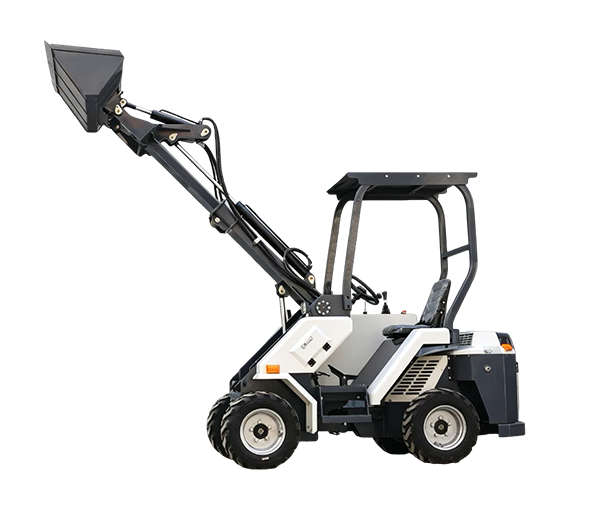
3. Main Features I Focus on in This Compact Telescopic Loader
Compact Structure for Restricted Areas
The first feature is the compact format. Large telehandlers are useful when high lifting height and long reach are the main priorities, but they can become difficult to position in narrow work areas. Our compact approach focuses on giving customers a machine that is easier to place around buildings, material stacks, farm facilities, landscaping projects, and industrial yards.
A smaller machine footprint can also make transportation and site movement easier, depending on the final configuration and local transport rules. For contractors moving between multiple small projects, that can be a practical advantage.
Four-Wheel Drive Traction
Four-wheel drive is another important part of the design. When the work surface changes from paved ground to gravel, soil, grass, or compacted construction ground, traction becomes a real issue. The 4WD configuration is intended to help the machine transfer engine power to the ground more effectively.
I do not treat 4WD as a replacement for good site preparation. If the ground is too soft, too steep, unstable, or unsuitable for the machine, the correct decision is to stop and reassess the operation.
Telescopic Reach
The telescopic boom gives the machine a wider working envelope than a fixed loader arm. Operators can use controlled extension to reach materials at different distances. This can be useful when unloading trucks, stacking materials, placing goods, or working around obstacles.
Attachment Flexibility
The front attachment interface is important because one machine may need to perform several jobs during the same week. Depending on the machine configuration and customer requirements, applications can include forks, buckets, material handling tools, and other compatible attachments.
Before selecting an attachment, I recommend checking its weight, connection method, rated capacity, dimensions, and compatibility with the specific machine. A heavier attachment can reduce the useful lifting capacity of the machine, so attachment selection should always be treated as part of the engineering calculation.
Practical Operator Control
A machine can have excellent mechanical performance and still be frustrating if its controls are difficult to understand. Our goal is to keep the operator's main functions clear and practical. Lifting, boom extension, attachment operation, steering, travel, and auxiliary hydraulic functions should be easy to manage without unnecessary complexity.
4. Technical Advantages: What Matters in Real Work
When I compare a telescopic loader with other material handling machines, I focus on the complete working cycle rather than one isolated specification.
| Machine Type | Main Strength | Typical Limitation | Where a Compact Telescopic Loader Can Help |
|---|---|---|---|
| Compact Wheel Loader | Loading and carrying materials | Limited forward reach compared with a telescopic boom | Provides additional reach while retaining compact-site mobility |
| Standard Forklift | Vertical pallet handling | Less flexible for long forward reach and uneven outdoor work | Combines mobile outdoor handling with telescopic reach |
| Large Telehandler | High lift and long reach | Larger footprint and potentially higher transport or operating demands | Offers a more compact option for smaller work areas |
Source basis: This is an engineering-use comparison rather than a manufacturer test. OSHA identifies variable-reach rough-terrain forklifts as telescoping-boom machines for placing loads at different distances and heights. Caterpillar's current telehandler specifications also demonstrate the combination of lift height, forward reach, operating weight, travel speed, and steering radius that buyers commonly evaluate. :contentReference[oaicite:2]{index=2}
Another point I pay close attention to is maneuverability. Four-wheel steering, where available in a machine configuration, can reduce turning space. Current Caterpillar telehandler information, for example, reports a smaller turning radius for four-wheel steering than for two-wheel steering on its TH0642 and TH0842 models. This is useful evidence of why steering configuration matters when working in restricted spaces. :contentReference[oaicite:3]{index=3}
| Reference Telehandler | Rated Capacity | Maximum Lift Height | Maximum Forward Reach | Operating Weight |
|---|---|---|---|---|
| Caterpillar TH0642 | 2,722 kg | 12.8 m | 8.4 m | 9,819 kg |
| Caterpillar TH0842 | 3,629 kg | 12.8 m | 8.4 m | 10,599 kg |
| Caterpillar TH1055 | 4,536 kg | 16.6 m | 12.5 m | 13,534 kg |
Source: Caterpillar published specifications for TH0642, TH0842, and TH1055. These figures are reference data from other manufacturer's machines and are not specifications for the HKLOONG Compact 4WD Telescopic Loader. :contentReference[oaicite:4]{index=4}
I include this comparison because buyers sometimes look only at maximum lifting capacity. In practice, you should compare lifting capacity together with reach, lift height, machine size, operating weight, steering system, attachment options, ground conditions, and the actual load chart.
5. Where I See the Compact 4WD Telescopic Loader Being Used
Construction
Construction is one of the most natural applications. Materials such as bricks, blocks, boards, pipes, pallets, bags, and equipment often need to be moved around a changing site. The telescopic boom gives operators another way to position loads, while the compact chassis can be useful where space is limited.
Agriculture
Farms have a different set of requirements. Materials may need to be moved around barns, storage areas, yards, greenhouses, and livestock facilities. Depending on the attachment, a telescopic loader can support pallet handling, feed handling, material movement, and general farm logistics.
Four-wheel drive is especially useful for outdoor farm conditions, but operators still need to consider soil strength, slopes, wet ground, and the effect of a raised load on machine stability.
Landscaping
Landscaping companies often work in places where a large machine is inconvenient. Soil, stone, paving materials, plants, pallets, and other supplies may need to be moved through relatively narrow access routes. A compact telescopic loader can provide lifting and reach without requiring the footprint of a larger telehandler.
Industrial and Warehouse Yards
Outdoor industrial yards can require a mixture of loading, unloading, stacking, and material transport. Unlike a conventional indoor forklift, a 4WD telescopic loader is intended for more varied outdoor conditions, subject to the machine's actual specification and operating limitations.
Property Maintenance and General Material Handling
Large properties, equipment yards, agricultural facilities, and maintenance contractors may also benefit from a flexible machine that can perform several handling tasks instead of keeping separate machines for every small job.
6. Manufacturing Process: How We Approach Machine Quality
For me, reliable equipment starts long before the machine reaches the customer. It begins with design decisions, material selection, component matching, welding quality, machining accuracy, hydraulic assembly, electrical installation, testing, and final inspection.
At HKLOONG, we integrate R&D, precision manufacturing, quality testing, customized modification, and distribution. This gives us a better view of the machine as a complete system rather than a collection of unrelated parts.
Structural Fabrication
The chassis and boom are load-bearing structures, so dimensional control and welding quality matter. During production, structural components need consistent positioning and suitable welding processes. The purpose is not simply to make the steel look strong; the structure must work correctly under repeated operating loads.
Machining and Component Assembly
Machined connection points, pins, bushings, mounting surfaces, and other critical parts need suitable tolerances. Poor alignment can lead to uneven wear and unnecessary stress. We therefore treat precision machining as an important part of the manufacturing process.
Hydraulic System Inspection
The hydraulic system controls key functions such as boom lifting and extension. Hydraulic hoses, fittings, cylinders, valves, and connections need to be checked during assembly and testing. Clean hydraulic assembly is also important because contamination can damage sensitive hydraulic components.
Functional Testing
Before delivery, the completed machine should be checked as a working system. Depending on the configuration, this can include engine operation, travel, steering, hydraulic movement, boom operation, attachment interface, controls, and safety-related functions.
We also recognize the importance of applicable international safety requirements. ISO 20474-1:2017 sets general safety requirements for earth-moving machinery and covers significant hazards associated with commissioning, operation, and maintenance. ISO 20474-3:2017 provides requirements specific to loaders and is intended to be used with the general requirements. :contentReference[oaicite:5]{index=5}
| Production Stage | What We Check | Why It Matters |
|---|---|---|
| Design and Configuration | Machine layout, boom system, attachment interface, hydraulic requirements | Creates a balanced machine system for the intended application |
| Structural Manufacturing | Dimensions, welding, alignment, connection points | Supports structural reliability during repeated operation |
| Component Assembly | Hydraulic, electrical, drivetrain and control components | Reduces installation and functional problems |
| Final Testing | Travel, steering, lifting, boom extension and control functions | Confirms that the completed machine operates as intended |
Source basis: The safety focus in this process is aligned with the scope of ISO 20474-1:2017 and ISO 20474-3:2017, while the exact inspection plan depends on the machine configuration and destination-market requirements. :contentReference[oaicite:6]{index=6}
7. Why I Recommend HKLOONG for a Compact 4WD Telescopic Loader
Choosing a machine supplier is not only about comparing the price on two quotations. For industrial equipment, I think buyers should also look at engineering capability, customization support, manufacturing control, testing, spare parts, communication, and after-sales service.
HKLOONG Heavy Industry Technology (Hefei) Co., Ltd. is built around equipment R&D, precision manufacturing, quality testing, customized modification, and global distribution. We operate our own HKLOONG brand and develop equipment for demanding working environments.
Our product range gives us experience across several types of heavy machinery, including crawler Excavators, wheel loaders, backhoe loaders, and amphibious Wetland excavators. That broader machinery background is useful because a telescopic loader is not an isolated product. It combines chassis engineering, hydraulics, structural design, power transmission, controls, and attachment technology.
I also understand that different customers need different configurations. A contractor working on urban construction projects may care more about compact dimensions and maneuverability. A farm may care more about traction and attachment flexibility. An industrial customer may focus on pallet handling, working height, service access, or a specific attachment.
For that reason, we can discuss customized requirements rather than assuming that one configuration fits every application. Before confirming a project, I recommend that customers provide the typical load weight, required lift height, required forward reach, ground conditions, preferred attachment, working environment, transport limitations, and destination market. These details allow us to evaluate whether the proposed configuration is suitable.
There is also a safety reason for taking this approach. OSHA emphasizes that equipment must not be operated above its rated capacity and that load weight should be verified through a reliable source or recognized calculation method where applicable. :contentReference[oaicite:7]{index=7}
For telehandler-style work, I would always prefer an honest capacity discussion over a large headline number. The right machine is the one whose rated capacity, reach, stability, attachment, and operating environment match the real job.
8. Frequently Asked Questions About the Compact 4WD Telescopic Loader
What is a Compact 4WD Telescopic Loader?
A Compact 4WD Telescopic Loader is a compact material handling machine that combines four-wheel-drive mobility with a telescopic boom. It is designed to lift, move, load, unload, and position materials where forward reach is important. Compared with a conventional compact loader, the telescopic boom provides greater flexibility for placing loads at different distances.
What is the difference between a compact loader and a telescopic loader?
A conventional compact loader usually uses a shorter lifting arm or loader linkage and is very effective for scooping and carrying materials. A telescopic loader uses a boom that can extend forward, making it more suitable for applications where the load needs to be placed farther away or at a higher position.
Is 4WD useful for construction sites?
Yes, four-wheel drive can be useful on many outdoor construction surfaces because it can improve traction. However, 4WD does not make unsuitable ground safe. Operators still need to evaluate slope, soil strength, surface condition, load weight, and machine stability before operating.
Can the loader use different attachments?
The machine can be configured around compatible attachments depending on the model and customer requirements. Forks, buckets, and other material handling tools can serve different applications. The attachment must always be compatible with the machine and its rated capacity.
Can the machine work on uneven ground?
The Compact 4WD Telescopic Loader is designed with outdoor material handling in mind, but uneven ground requires careful operation. The operator should reduce speed, keep the load in a safe travel position, avoid sudden steering movements, and follow the manufacturer's operating instructions and load chart.
Does maximum reach mean maximum lifting capacity?
No. Maximum reach and maximum lifting capacity should never be treated as the same thing. As the boom extends, the load moves farther from the machine and the load moment changes. Manufacturer load charts are therefore essential. Caterpillar's published telehandler specifications provide a clear example of how capacity can decrease substantially at maximum forward reach. :contentReference[oaicite:8]{index=8}
How should I choose the right model?
I suggest starting with the real job instead of starting with the machine name. Tell us the maximum load weight, average load weight, lifting height, forward reach, working surface, attachment type, available space, and expected working hours. From there, we can evaluate the suitable configuration.
What should I check before buying a telescopic loader?
I recommend checking the complete load chart, operating weight, dimensions, turning radius, lift height, forward reach, attachment compatibility, hydraulic configuration, engine and transmission specification, service requirements, safety equipment, documentation, spare parts support, and local compliance requirements.
Is the Compact 4WD Telescopic Loader suitable for agriculture?
It can be a practical choice for many agricultural material handling tasks, particularly where pallet movement, feed handling, stacking, loading, and general yard work are required. The final configuration should be selected according to ground conditions, load requirements, attachments, and farm layout.
Final Thoughts: A Compact Machine Built Around Real Work
I believe a good Compact 4WD Telescopic Loader should do more than provide lifting power. It should help the operator reach materials, move through the work area, handle different tasks, and work efficiently without making everyday operation unnecessarily complicated.
The combination of a compact structure, four-wheel drive, telescopic boom, hydraulic lifting system, and attachment flexibility gives this type of machine a broad range of possible uses. Construction contractors can use it for material placement and site logistics. Farmers can use it for yard and storage work. Landscapers can use it for moving soil, stone, plants, and pallets. Industrial users can use it for outdoor loading, unloading, and material handling.
At HKLOONG, our approach is to start with the customer's actual working conditions and then match the equipment configuration to those requirements. We combine R&D, manufacturing, quality testing, customized modification, and global distribution so that the machine is considered as a complete working system rather than just a list of parts.
If you are comparing compact telehandlers, 4WD material handling equipment, or small telescopic loaders for a specific project, I recommend preparing your load, reach, lift height, attachment, ground condition, and site dimensions first. Those details make the equipment selection much more accurate.



 WhatsApp
 Phone
Phone E-mail
 Message