
 Español
 Pусский
 Français
 العربية

When I talk with customers about a Doosan 75 Wetland excavator, I usually focus on the working condition first. A machine working on dry construction land and a machine working beside a river, pond or muddy field do not face the same problems. On soft ground, machine stability, track width, ground pressure, working height and hydraulic performance can make a real difference.
At Ganglong Heavy Industry Technology (Hefei) Co., Ltd., we supply and arrange construction machinery for customers in different countries and working environments. We also work with our international trade team to handle equipment sourcing, configuration confirmation, inspection, documents, transportation and delivery. For a machine such as the Doosan 75 Wetland excavator, I prefer to confirm the actual working condition before recommending a configuration.
The name “Doosan 75” can refer to different generations and market versions. Doosan's construction equipment business is now associated with the DEVELON brand in many markets, while the DX75 name is still shown in some regional product information. For example, the official DEVELON China site currently lists the DX75 with a rated power of 36.2 kW at 2,200 rpm and a 0.3 m³ bucket, using a Yanmar 4TNV94L engine in that listed version.
That point is worth mentioning because I do not want customers to buy a machine based only on a product title. Production year, market, engine, emissions standard, undercarriage, bucket, hydraulic configuration and optional equipment can all affect the final machine. When we quote a Doosan 75 excavator, we confirm these details before the order is finalized.
1. What Is a Doosan 75 Wetland Excavator?
A wetland excavator is built or configured for jobs where ordinary construction machines may have difficulty maintaining stable movement. Typical working areas include marshes, muddy fields, riverbanks, ponds, drainage channels, shallow water areas and other soft-ground locations.
The basic idea is simple. The machine needs to spread its weight over a larger contact area and maintain enough stability while the operator digs, lifts and swings. Depending on the project, this can involve wider tracks, extended undercarriage components, increased ground clearance, special attachments or other modifications.
When I describe a 75 Wetland excavator, I am therefore talking about a 75-class excavator prepared for wet or soft-ground work rather than suggesting that every standard DX75 leaving a factory is automatically a dedicated wetland machine.
This difference is important for international buyers. A standard excavator may be suitable for normal earthmoving, while a wetland project may require a very different undercarriage. Before I arrange equipment, I want to know whether the machine will work in mud, shallow water, soft agricultural land, riverbank soil or a normal construction site.
The official regional DX75 information provides a useful reference point for the base machine. The listed model has 36.2 kW rated power, a 0.3 m³ bucket and a Yanmar 4TNV94L engine. However, the same official page leaves many detailed dimensions and operating-weight fields blank, so I would not invent those figures when preparing an international quotation.
For customers searching online for a Doosan 75 Wetland Excavator for Sale, the most important step is therefore to separate the basic excavator specification from the special wetland configuration. That gives us a much clearer purchasing discussion.
2. How Does the 75 Wetland Excavator Work?
The working principle of the excavator is not complicated. The engine provides power, while the hydraulic system transfers that power to the boom, arm and bucket. Hydraulic oil is pushed through the system under pressure, allowing the operator to control the working equipment with the joysticks.
At the beginning of a digging cycle, the crawler tracks position the excavator. The boom lowers the working equipment, the arm moves toward the material, and the bucket cuts into the soil. Once the bucket is full, the boom and arm lift the load. The upper structure then swings toward the dumping area, the bucket opens, and the machine returns to the digging position.
On ordinary ground, this process is already important. On wetland ground, it becomes even more important because the operator cannot simply drive the machine anywhere. Poor positioning can cause the tracks to sink, which makes the machine harder to move and may create a recovery problem.
This is why I look at the crawler system together with the hydraulic system. A powerful hydraulic system helps the machine dig, but a suitable undercarriage helps the machine stay where it needs to be while digging.
For a wetland project, I also pay attention to the ground itself. Mud can behave very differently from firm soil. A shallow muddy area may support a machine reasonably well, while deep soft soil may require wider tracks, temporary access roads, mats or other ground-support measures.
In other words, a Doosan 75 Wetland excavator is not simply about putting a normal excavator into a wet field. The whole machine and the working method need to match the site.
3. Main Features I Consider Before Supplying a Doosan 75 Wetland Excavator
Wide or Extended Track Configuration
The undercarriage is one of the first things I check for soft-ground projects. Standard crawler tracks already distribute machine weight better than wheels, but wetland work may require additional track width or an extended undercarriage.
A wider track increases the contact area between the machine and the ground. In simple terms, the machine's weight is spread over more ground area. This can help reduce the pressure placed on the surface, although the final result depends on the complete machine weight, track dimensions and soil condition.
For customers working on marshland or muddy agricultural land, I normally ask for photos or videos of the site when possible. It is much easier to discuss a suitable setup after seeing the actual ground than after reading only “wetland project” on an inquiry form.
Stable Working Platform
Excavation creates forces that move through the boom, arm, bucket and upper structure. When the bucket is full, the machine also has to handle the weight while swinging.
A stable undercarriage and suitable counterweight help the machine maintain balance. On soft ground, this becomes especially important because the ground itself may move or deform under the tracks.
I always remind customers that stability is not only a machine specification. Operator technique, bucket size, digging position, ground slope and material weight all affect stability. A machine should not be overloaded simply because the hydraulic system can lift a heavy bucket.
Reliable Hydraulic Performance
Hydraulics are the working muscles of an excavator. They control the boom, arm, bucket, swing and travel functions. For wetland excavation, smooth hydraulic control can be useful because the operator may need to make small adjustments while working on unstable ground.
The official DX75 information lists a 36.2 kW rated engine power and a 0.3 m³ bucket for the referenced version. These figures give customers a starting point, but the actual wetland configuration may use different equipment, so the final hydraulic and attachment specifications should always be confirmed before purchase.
Ground Clearance
Ground clearance can also matter in wet areas. Mud, roots, stones, vegetation and uneven ground can make travel more difficult than on a prepared construction site.
A suitable undercarriage helps the machine move through difficult areas while keeping important components away from direct contact with the ground. However, ground clearance should not be considered separately from stability. A machine that is too high or poorly configured may not be the right choice simply because it has more clearance.
Attachment Flexibility
A wetland project is rarely limited to one type of digging. Customers may need buckets for soil removal, dredging attachments, hydraulic thumbs, grabs or other tools depending on the project.
For drainage work, a narrow bucket may be useful. For land reclamation, a larger bucket may improve material handling. For dredging or water-related work, the attachment and boom configuration need to be checked carefully.
When customers ask me for a Doosan 75 excavator for wetland construction, I therefore ask about the attachment before I finalize the equipment plan.
4. Doosan 75 Excavator Reference Specifications
Because the Doosan brand has transitioned to DEVELON in many markets and different DX75 versions exist, I prefer to use official regional data rather than combine specifications from unrelated generations.
The following table uses the current official regional DX75 information available from DEVELON. It is a reference for the base machine, not a claim that every wetland configuration has exactly these specifications.
| Specification | DX75 Reference Data | Why It Matters |
|---|---|---|
| Rated power | 36.2 kW / 2,200 rpm | Provides engine power for excavation and machine operation |
| Bucket capacity | 0.3 m³ | Provides a reference for standard digging and material handling |
| Engine | Yanmar 4TNV94L | Engine specification for the listed regional version |
| Machine type | DX75 crawler excavator | Tracked excavator platform for earthmoving applications |
Source: Official DEVELON Asia/China DX75 product page. The official page currently lists these figures but does not provide all operating-weight and working-range fields, so those values are not estimated here.
The official DEVELON equipment list also shows that the DX75 belongs to the smaller crawler excavator range, alongside models such as the DX60D, DX60E, DX75E and DX80D. The listed DX75E uses a different engine and power specification from the DX75, which is another good example of why model suffixes should not be ignored when buying machinery.
| Model | Rated Power | Bucket Capacity | Engine |
|---|---|---|---|
| DX60D | 36.4 kW / 3,000 rpm | 0.3 m³ | DEVELON DW02 |
| DX75 | 36.2 kW / 2,200 rpm | 0.3 m³ | Yanmar 4TNV94L |
| DX75E | 36.4 kW / 3,000 rpm | 0.3 m³ | DEVELON DW02 |
| DX80D | 36.4 kW / 3,000 rpm | 0.3 m³ | DEVELON DW02 |
Source: Official DEVELON regional crawler excavator product listings. Specifications can vary by market and model version.
This comparison is useful for one simple reason: the number “75” alone does not tell the whole story. The DX75 and DX75E shown by the same official regional source have different engine specifications. If I were preparing an export quotation, I would confirm the exact suffix and machine documentation instead of treating them as identical products.
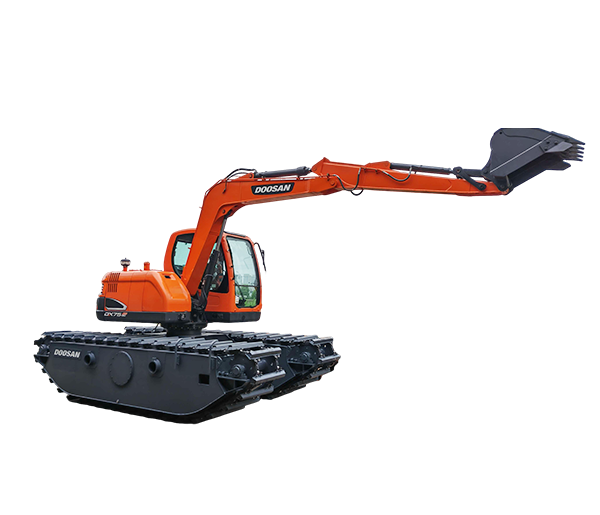
5. Wetland Configuration and Soft-Ground Performance
For me, this is the most important part of the product page. A standard crawler excavator and a properly prepared wetland excavator should not be treated as the same thing.
Wetland work usually involves three basic problems: low ground bearing capacity, unstable surfaces and difficult access. The excavator needs enough contact area to reduce the chance of sinking, enough stability to perform digging safely, and enough mobility to move between working points.
Wide tracks are one possible solution. Depending on the machine and project, customers may also consider extended track systems or other specialized undercarriage arrangements. The exact configuration depends on the base excavator and supplier capability.
I also consider the height of the working area. If the excavator is working beside a pond or river, the operator may need to reach farther without moving the whole machine onto unstable ground. In this case, a suitable boom, arm and attachment combination may be more useful than simply increasing bucket size.
For dredging work, the machine may also need to work from the bank rather than entering deep water. A long-reach configuration can sometimes help keep the main machine on firmer ground while the attachment reaches into the work area. However, this is a specialized setup and needs a proper load and stability check.
Another point that is easy to overlook is transportation. A wide wetland undercarriage can be very useful at the worksite but may increase the machine's transport width. This can affect the trailer, loading method, road permits and shipping cost.
That is why I never choose a wetland configuration based on one feature alone. I look at the entire chain:
Ground condition
Required working depth
Required digging reach
Track width and undercarriage
Attachment type
Machine transport dimensions
Expected daily workload
Local transport and operating requirements
This approach is much more practical than simply asking for the “widest track available.”
6. Where Can I Use a 75 Wetland Excavator?
Wetland Construction
Wetland construction is the most obvious application. The machine can be used for excavation, material handling, drainage channels, land shaping and access preparation in areas where the soil is soft or frequently wet.
For smaller construction projects, a 75-class excavator can offer a useful balance between working ability and site access. It is not as large as a heavy Mining Excavator, so it can be more practical for projects where the working area is limited.
Dredging and Pond Maintenance
Dredging is another common reason customers look for a 75 Wetland excavator. Ponds, drainage channels and shallow water areas may collect sediment over time. Removing this material can improve water flow and restore usable capacity.
The important question is how the excavator will access the work area. If the machine can remain on stable ground, a suitable long-reach attachment may be enough. If it must travel directly over soft ground, the undercarriage becomes much more important.
Water Conservancy Projects
Water conservancy work often involves channels, riverbanks, embankments, ponds and drainage systems. Excavators may be used for digging, bank shaping, sediment removal and material placement.
These projects can change from one section to another. One area may be firm, while another may be wet and unstable. A machine with a suitable configuration can help operators deal with these changes more easily.
Agriculture and Land Improvement
Large agricultural projects can also need excavation equipment for drainage, pond construction, irrigation channels and land improvement.
In agricultural areas, soil conditions are often very different from those on prepared construction sites. A machine may need to travel over soft fields without causing excessive damage to the surface. Track selection and operating technique are therefore important.
Environmental Projects
Environmental projects may involve wetland restoration, sediment removal, waterway maintenance and land rehabilitation. These projects often require careful control of the excavation process because the operator may be working close to water, vegetation or protected areas.
Municipal Engineering
Municipal drainage, pipeline work, small waterway projects and land preparation can also use this class of crawler excavator. For these applications, transport size and jobsite access may be just as important as digging performance.
Mining and Material Handling
Although a 75-class excavator is not normally the first machine I would choose for very large-scale mining, it can be useful for smaller mining support tasks, drainage, site preparation, material handling and maintenance work.
For customers working in mining environments, I always recommend checking the material hardness and expected operating hours before selecting the bucket and attachment. Heavy or abrasive material can change the wear rate considerably.
7. How We Source, Inspect and Deliver the Machine
Ganglong Heavy Industry Technology (Hefei) Co., Ltd. was founded in 2013. Together with Hefei Ganglong International Trade Co., Ltd., we operate across construction machinery, mining machinery, agricultural machinery and related attachments.
Our business includes our self-branded HKLOONG excavators, loaders, Backhoe loaders and swamp excavators. At the same time, we provide complete machine sales and leasing services for domestic and international brands according to customer requirements.
For brands such as Doosan/DEVELON, Hitachi, SANY, Lonking, Hyundai, XCMG, SHANMON and LOVOL, our role is to source, supply and arrange related services rather than claim that we manufacture those branded machines ourselves.
Step 1: Confirm the Project
I start by asking simple questions. Where will the machine work? Is the ground muddy, sandy, agricultural, marshy or firm? How deep does the machine need to dig? Is the machine working in water? What attachment is required? How will the machine reach the site?
These questions may seem basic, but they often prevent expensive mistakes later.
Step 2: Confirm the Machine
After understanding the project, we confirm the available machine, model suffix, production year, configuration and condition. For used machinery, operating hours and visible wear are also important.
For a Doosan 75 Wetland excavator, I pay special attention to the crawler system because the undercarriage is one of the most important parts of a machine working on soft ground.
Step 3: Inspection Before Shipment
Before shipment, we arrange inspection of the machine appearance, engine, hydraulic system, undercarriage, working equipment and basic operating functions.
For used machines, I also recommend checking the hydraulic cylinders for leakage, track components for excessive wear, hoses, pins and bushes, engine condition and the general working response of the machine. The exact inspection scope depends on the machine and customer requirements.
Step 4: Documents and Accessories
Standard accessories, operation manuals, spare parts and required documents are prepared according to the order. If the customer needs additional spare parts for long-distance operation, we can discuss them before shipment.
Step 5: Payment
For international orders, payment is commonly arranged by T/T. A deposit is normally paid before production, preparation or sourcing, with the balance arranged before shipment. Exact payment terms are confirmed in the commercial contract.
Step 6: Transportation
Complete wetland excavators are generally transported by sea for international orders. The final shipping method depends on machine size, destination, urgency and local port conditions.
For spare parts and smaller accessories, air freight or express delivery can be considered when speed is more important than transportation cost.
Step 7: Packing
Heavy machinery needs proper securing rather than ordinary box packing. We protect the machine according to transportation requirements, secure it against movement and pack loose components separately when needed.
Small accessories and spare parts can be placed in cartons or wooden cases. Exposed components can also receive additional protection depending on the shipping route and destination.
8. Why Choose Ganglong for a Doosan 75 Wetland Excavator?
When buying construction machinery from overseas, the machine itself is only one part of the transaction. The other part is everything around the machine: communication, configuration, inspection, documents, payment, loading and transportation.
This is where I believe an experienced international trade team can make the process easier. Our team at Hefei Ganglong International Trade Co., Ltd. has experience with construction machinery, mining machinery and agricultural machinery, and we have served customers across Asia, Africa, America and other international markets.
We can help customers compare available machines and confirm whether the proposed configuration matches the project. If the customer needs a wetland excavator rather than a standard crawler excavator, we can discuss the undercarriage and attachment requirements before confirming the quotation.
We also understand that customers may have different priorities. One buyer may care most about machine price. Another may care about operating hours, spare parts, shipping time or a specific engine. Someone working in a remote area may care more about maintenance support and spare-parts availability.
I do not think there is one machine configuration that is perfect for every project. The better approach is to start with the working condition and then select the machine around it.
For customers searching for a Doosan 75 Wetland Excavator Supplier, Doosan 75 excavator for sale, 75 Wetland excavator supplier or a Doosan 75 excavator for wetland construction, we can discuss the machine condition, configuration, attachments and delivery requirements together.
9. Doosan 75 Wetland Excavator FAQ
Is the Doosan 75 a dedicated wetland excavator?
Not every Doosan 75 or DX75 is a dedicated wetland excavator. The standard DX75 is a crawler excavator, while a wetland version normally requires a configuration suitable for soft or waterlogged ground. Depending on the project, this can involve wider or extended tracks and other changes. I recommend confirming the complete configuration before purchase.
What is the rated power of the Doosan DX75?
The official regional DEVELON DX75 page currently lists 36.2 kW at 2,200 rpm for the referenced DX75 version. It also lists a 0.3 m³ bucket and Yanmar 4TNV94L engine. Different DX75 generations and market versions may have different specifications.
What is the difference between DX75 and DX75E?
The official regional DEVELON product information shows different specifications. The listed DX75 uses a Yanmar 4TNV94L engine with 36.2 kW at 2,200 rpm, while the DX75E uses a DEVELON DW02 engine with 36.4 kW at 3,000 rpm. Both are listed with a 0.3 m³ bucket in that regional product information.
Can a Doosan 75 excavator work in muddy areas?
It can be configured for suitable soft-ground applications, but I would not recommend putting a standard machine into deep mud without checking the ground condition and undercarriage. For wetland projects, track width, machine weight, ground pressure, stability and access conditions all need to be considered.
What work can a 75 Wetland excavator do?
Depending on its configuration, it can be used for excavation, drainage, dredging, land reclamation, water conservancy work, agricultural drainage, environmental projects, municipal engineering and material handling. The attachment should be selected according to the specific task.
Can it be used for dredging?
Yes, a suitable configuration can be considered for dredging and sediment removal. However, the working reach, boom and arm arrangement, attachment, machine position and ground stability should all be checked before the machine enters the project.
How do I choose the right track width?
I normally start with the actual ground condition. Wider tracks can increase the contact area and may help reduce ground pressure, but they also increase machine width and can make transportation more difficult. The best track configuration is therefore a balance between ground performance and transport requirements.
What is the production or delivery time?
There is no single production time for every Doosan 75 Wetland excavator. The schedule depends on the machine model, configuration, order quantity, availability and any required customization. We confirm the expected preparation and delivery schedule before the order is finalized.
How do you inspect the excavator before shipment?
We arrange inspection of the appearance, engine, hydraulic system, undercarriage, working equipment and basic operating functions. For used equipment, additional checks can be arranged according to customer requirements, including wear condition and service-related information when available.
How is the machine transported?
Complete wetland excavators are generally transported by sea for international orders. Spare parts and accessories can usually be shipped by air or express when required.
How is the excavator packed?
The machine is securely positioned and fixed according to transportation requirements. Protective film or other protection can be used where appropriate. Loose parts, accessories and spare parts are normally packed separately in cartons or wooden cases.
Conclusion: Match the Doosan 75 to the Ground, Not Just the Product Name
After years of working with construction machinery inquiries, I have learned that the product name is only the starting point. A Doosan 75 Wetland excavator can be useful for wetland construction, drainage, dredging, agriculture, environmental projects and other soft-ground work, but its real performance depends heavily on how the machine is configured.
The official regional DX75 data gives us a useful base reference of 36.2 kW rated power and a 0.3 m³ bucket for the listed version. At the same time, official regional information shows that different DX75-family models can use different engines and specifications.
For that reason, I always recommend confirming the exact model, production year, engine, undercarriage, track width, bucket, attachments and destination requirements before making a final decision.
At Ganglong Heavy Industry Technology, our job is not simply to quote a machine name. We help customers connect the right equipment with the real project. From sourcing and configuration confirmation to inspection, documents, payment, packing and sea transportation, we can support the complete international purchasing process.
If you are looking for a Doosan 75 Wetland excavator, Doosan 75 excavator or 75 Wetland excavator for sale, send us your working conditions, required attachment, destination country and preferred configuration. We can then check the available equipment and work out a practical supply and delivery plan for your project.



 WhatsApp
 Phone
Phone E-mail
 Message