

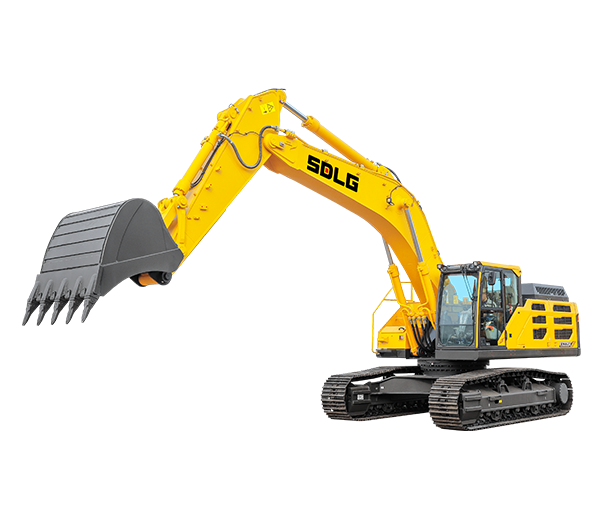
E6335H Hydraulic Excavator for Heavy Construction and Earthmoving
When I help a customer choose a hydraulic Excavator, I do not start with the biggest number on the specification sheet. I start with the job. What are we digging? How hard is the ground? How deep do we need to dig? How far does the material need to be moved? Will the machine work eight hours a day, or much longer? These questions usually tell me more than a product photo.
The SDLG E6335H Hydraulic Excavator is a heavy crawler excavator designed for demanding construction and earthmoving work. According to SDLG's published product information, the E6335H has an operating weight of about 34,800 kg, a 1.9 m³ standard bucket, a maximum digging force of 222.6 kN, a maximum digging reach of 10,860 mm, and a maximum digging depth of 7,220 mm. The published specifications also show a 215 kW engine, 10.7 r/min swing speed, and 3.0/5.0 km/h low/high travel speeds.
For me, those figures tell a simple story. This is not a small excavator intended for light landscaping or narrow residential work. It is a large working machine aimed at projects where digging force, reach, stability, and long working cycles matter.
SDLG lists the E6335H for applications including utilities, heavy infrastructure, and quarries and aggregates. That fits the way I would normally position this machine: large excavation jobs, infrastructure construction, earthmoving, quarry-related work, and other demanding applications where a Compact Excavator would simply take too many cycles to complete the same task.
At Ganglong Heavy Industry Technology (Hefei) Co., Ltd., I look at the E6335H from the buyer's side. My role is not to pretend that we manufacture every third-party brand we supply. We work as a construction machinery supplier and international trade service provider. We can help customers discuss machine selection, configuration, inspection, attachments, documents, transportation, and delivery arrangements.
The easiest way for me to explain the E6335H is this: it is a large crawler excavator built for serious digging.
The machine uses an engine, hydraulic pumps, valves, cylinders, motors, boom, arm, bucket, and crawler undercarriage as one working system. The engine provides the power, while the hydraulic system turns that power into movement. The operator controls the boom, arm, bucket, swing, and travel functions from the cab.
That may sound simple, but the coordination between these parts is what makes an excavator useful.
When I watch a skilled operator work, the machine rarely performs just one movement at a time. The boom may rise while the arm pulls in. The bucket closes as the machine reaches the material. Then the upper structure swings, the bucket opens, and the material is placed into a truck or stockpile.
The better these movements work together, the smoother the digging cycle becomes.
For the E6335H, SDLG publishes a full electronic control positive-flow hydraulic system, a maximum hydraulic flow rate of 2 × 290 + 25.5 L/min, and a maximum digging force of 222.6 kN on its current product information. The English product material also lists a 215 kW BFM8-29T2 engine and a 590 L fuel tank.
These numbers are useful, but I never recommend looking at them separately. A machine with strong hydraulic power still needs the right bucket, suitable ground conditions, correct maintenance, and an experienced operator.
There is one point I like to make clear because online product names can sometimes cause confusion. The E6335H is published as a crawler excavator. Its specifications include a crawler undercarriage, 600 mm shoe width, 2,590 mm track gauge, and a 5,070 mm track length.
So if a customer is specifically searching for an “E6335H Hydraulic Excavator,” this model is a straightforward match. If the project requires a wheeled excavator, I would recommend confirming the model again rather than replacing one machine type with another.
For heavy excavation, the crawler layout has a practical advantage: it gives the machine a stable working platform. That is useful when the machine is digging hard material, working on uneven ground, or handling a large bucket.
Whenever I receive an inquiry about an excavator, I usually open the technical sheet before discussing the price. I want to know what the machine can physically do.
For the E6335H, the current SDLG product page lists an operating weight of 34,800 kg, bucket capacity of 1.9 m³, maximum digging force of 222.6 kN, maximum reach of 10,860 mm, and maximum digging depth of 7,220 mm. It also lists an overall length of 11,000 mm, overall width of 3,190 mm, and overall height of 3,450 mm.
| Specification | E6335H Published Data | Why I Check It |
|---|---|---|
| Operating weight | 34,800 kg | Shows the machine class and transport requirements |
| Bucket capacity | 1.9 m³ | Helps estimate material handled per cycle |
| Maximum digging force | 222.6 kN | Important for hard soil and demanding excavation |
| Swing speed | 10.7 r/min | Affects swing movement during loading cycles |
| Travel speed | 3.0 / 5.0 km/h | Important for movement around the jobsite |
| Maximum digging reach | 10,860 mm | Shows working reach from the machine |
| Maximum digging depth | 7,220 mm | Useful for deep excavation and foundation work |
| Maximum dumping height | 7,090 mm | Important for truck loading and material placement |
| Overall dimensions | 11,000 × 3,190 × 3,450 mm | Important for transport and site access |
Source: SDLG published E6335H product information and English technical material. Specifications can vary by market, configuration, and product update, so I recommend confirming the final machine data before ordering.
The bucket capacity is another number I pay attention to. SDLG's English material lists a 1.9 m³ bucket, while its product information gives a bucket capacity range of 1.6–2.0 m³. That difference is a good example of why I prefer to confirm the exact configuration instead of copying one number from an old catalogue.
The published material also lists a 6,200 mm boom and 3,200 mm arm. The machine has a 600 mm shoe width and a 2,590 mm track gauge, giving me a clearer picture of the physical size of the excavator.
The current English SDLG material lists the E6335H with a BFM8-29T2 engine, rated at 215 kW at 1,800 rpm, with 7.8 L displacement and six cylinders. The same document lists maximum torque of 1,255 Nm at 1,350 rpm.
For the hydraulic system, the published data gives a full electronic control positive-flow system and a maximum flow rate of 2 × 290 + 25.5 L/min. The implement circuit relief setting is listed at 34.3/37 MPa, while the travel circuit is listed at 34.3 MPa.
For a buyer, I would not expect these numbers to tell the whole story. They simply tell us what the machine is designed around. Actual output on a jobsite will depend on the soil, attachment, operator, temperature, altitude, maintenance condition, and work cycle.
One of the easiest mistakes when buying construction machinery is looking only at the machine and forgetting the work around it.
An excavator does not work alone.
On a road project, the E6335H may dig while dump trucks remove the material. On a quarry site, it may work with loaders, trucks, crushers, or screening equipment. On an infrastructure project, it may prepare foundations while other machines handle grading and compaction.
So when I estimate whether an excavator is suitable, I look at the complete cycle.
The bucket enters the ground and collects material. The boom and arm provide the movement while hydraulic cylinders control the bucket and working equipment.
The E6335H's published maximum digging force is 222.6 kN, giving it a strong working capability for heavy excavation. The English technical material separately lists ISO bucket digging force at 223 kN and arm digging force at 171 kN.
These figures matter when the machine is dealing with harder soil or larger loads. But they should not be interpreted as a promise that the excavator can dig through every type of rock without additional equipment. Hard rock often requires drilling, blasting, ripping, or hydraulic breaking depending on the project.
After filling the bucket, the operator swings the upper structure toward the truck or stockpile.
The published swing speed is 10.7 r/min.
In real work, swing speed is only one part of productivity. If the truck is parked too far away, the operator still has to make a longer swing. If the truck is too small, the excavator may have to load more cycles. If the working area is poorly arranged, even a powerful excavator can lose time.
That is why I always ask about the site layout when a customer wants to estimate productivity.
The E6335H has two published travel speeds: 3.0 km/h and 5.0 km/h.
These speeds are useful for moving around the jobsite, but a crawler excavator is not designed to travel long distances on public roads like a road vehicle. For international delivery and long-distance relocation, transportation planning is part of the purchase decision.
When I explain the E6335H to a customer, I try not to use too many technical words. I would rather explain what each feature means in daily work.
The published maximum digging reach is 10,860 mm, maximum digging depth is 7,220 mm, maximum cutting height is 10,045 mm, and maximum dumping height is 7,090 mm.
That gives the machine a useful working envelope for large excavation jobs.
For example, if I am discussing foundation excavation, I care about digging depth. If I am discussing loading trucks, dumping height becomes more important. If the customer needs to reach over a wider working area, maximum digging reach matters more.
The E6335H uses a full electronic control positive-flow hydraulic system according to SDLG's published technical material.
In simple terms, the hydraulic system is designed to manage oil flow according to the machine's working movements. For the operator, the goal is controlled and efficient machine response rather than simply having a large pump.
The published E6335H specifications list a 590 L fuel tank.
A large fuel tank is useful for long working cycles because the machine does not need to stop for refueling as frequently as a machine with a much smaller tank. Actual fuel consumption, of course, depends on load, operating mode, operator habits, environment, and working hours.
SDLG's current product information describes the E6335H with an H-series cab, an 8-inch LCD screen, ROPS cabin, and air suspension seat.
From an operator's point of view, these details are not just decoration. The operator may spend most of the day in the cab, so visibility, control layout, display information, and seat comfort can have a real effect on daily work.
The published product information also mentions an electric-hydraulic control system, intelligent control mode, remote fault diagnosis, and software OTA through a T-box.
For fleet owners, digital monitoring can make maintenance and troubleshooting easier. I would still confirm which functions are available in the customer's target market and exact machine configuration before making them part of a purchase decision.
| Feature | Published Information | Practical Meaning |
|---|---|---|
| Engine power | 215 kW | Provides power for heavy working operations |
| Hydraulic flow | 2 × 290 + 25.5 L/min | Supports the hydraulic working system |
| Fuel tank | 590 L | Supports longer working cycles |
| Cab display | 8-inch LCD | Shows operating information to the operator |
| Maximum digging reach | 10,860 mm | Provides a wide working envelope |
| Maximum digging depth | 7,220 mm | Supports deep excavation work |
Source: SDLG official E6335H product information and published English technical material.
SDLG specifically lists utilities, heavy infrastructure, and quarries and aggregates among the E6335H application areas.
From my experience, those applications make sense because the machine is large enough to handle demanding excavation and material handling tasks.
Infrastructure projects can include highways, bridges, drainage systems, large foundations, industrial facilities, and other large construction work.
These projects often require continuous excavation and material movement. A Large Excavator can help reduce the number of digging cycles compared with a much smaller machine.
For this type of customer, I normally ask about the excavation volume, soil condition, required depth, truck capacity, and working schedule.
Quarry work is harder on equipment than many ordinary construction jobs.
There may be dust, hard material, uneven ground, long working hours, and heavy loads. The machine needs proper maintenance and the right attachment for the job.
If the material is too hard for normal bucket excavation, I would discuss whether breaking equipment, ripping, drilling, or another method is more suitable. A hydraulic excavator should not be expected to solve every ground condition with a standard bucket.
Utility projects include water, drainage, pipelines, cables, and other underground infrastructure.
For large utility projects, the E6335H's digging reach and depth can be useful. However, I would also consider whether the working area provides enough room for a machine of this size.
A large excavator needs space to swing, travel, and operate safely. If the project is in a narrow urban street, a smaller excavator may be easier to manage.
Road construction involves excavation, embankment work, drainage, material loading, and site preparation.
The E6335H can be considered when the project requires high digging capability and large material handling capacity. Its crawler design also gives it a stable working base on suitable construction sites.
Large earthmoving projects are where I would expect a machine like the E6335H to make the most sense.
When the job involves moving a large amount of soil every day, machine capacity becomes important. A larger bucket and strong digging capability can reduce the number of cycles needed to move the same amount of material.
Customers often ask me whether they should choose a 35-ton excavator, a 25-ton machine, or a smaller model. I do not give the same answer to everyone.
The correct choice depends on the job.
| Excavator Class | Typical Strength | Typical Application | What I Would Check |
|---|---|---|---|
| Mini Excavator | Small size and easy access | Landscaping, utilities, small construction | Site space and required digging force |
| Mid-size excavator | Balanced size and productivity | General construction and earthmoving | Material volume and transport |
| 25-ton class | Good balance for larger construction | Roads, foundations, earthmoving | Required bucket size and job cycle |
| E6335H class | Large working capacity and reach | Heavy infrastructure, quarrying, utilities | Site space, transport and daily workload |
Source: General machinery-class comparison based on construction equipment operating practice. E6335H specifications are based on SDLG published data. The other categories are general equipment classes rather than specific competing models.
I would not say that the larger machine is automatically better. If a customer is working in a small area, a large excavator can actually make the job harder. If the customer has a large quarry or infrastructure project, however, choosing a machine that is too small can increase cycle time and operating cost.
That is why I always bring the conversation back to the actual project.
SDLG's published E6335H material lists bucket options including 1.65 m³ and 1.9 m³ configurations. The published attachment table also gives different bucket widths and weights.
This is another point that I like to explain to buyers. Bucket capacity is not just a bigger-is-better decision.
A bucket needs to match the material and working conditions. A general-purpose bucket may work well in ordinary soil. Harder material may require a different tooth configuration or bucket design. The attachment weight also affects the working system.
For an international construction machinery order, I treat the supply process as part of the product.
A customer may find the right excavator online, but that is only the beginning. The machine still has to be confirmed, inspected, documented, packed, loaded, shipped, and delivered.
I first ask about the customer's application.
Is it road construction? Quarry work? Utility excavation? Infrastructure? Earthmoving? What is the ground like? How many machines are required? Does the customer need a bucket only, or additional attachments?
These questions help me avoid recommending equipment based only on the model name.
Before quotation, I confirm the machine model, configuration, available attachments, machine condition, quantity, and destination.
This is especially important because specifications can differ by market and production version. Even SDLG's public pages may present slightly different figures depending on the specific product material and version.
Before delivery, we can arrange checks on the machine appearance, major operating functions, hydraulic system, electrical system, working equipment, accessories, and required documents according to the confirmed order.
If the customer has a third-party inspection company or a detailed inspection checklist, I prefer to confirm that requirement before shipment preparation.
For our international supply process, payment is commonly arranged by T/T, such as a deposit followed by the balance before shipment. The exact terms depend on the confirmed order and commercial agreement.
I recommend that customers confirm the machine specification, inspection requirements, delivery terms, payment schedule, and documents in writing before payment.
The E6335H is a large crawler excavator. The published overall dimensions are approximately 11,000 mm long, 3,190 mm wide, and 3,450 mm high, so transportation needs to be planned rather than treated like ordinary cargo.
Complete machines are generally transported by sea for international orders. Loose accessories and suitable spare parts can be packed separately. Depending on the cargo and destination, smaller parts may be shipped by air or express.
| Supply Stage | What I Confirm | Why It Matters |
|---|---|---|
| Project discussion | Application, ground and workload | Helps match the machine to the job |
| Machine confirmation | Model, configuration and availability | Avoids specification misunderstandings |
| Attachment confirmation | Bucket and other working tools | Ensures the machine can perform the intended task |
| Inspection | Appearance, systems and functions | Improves order transparency |
| Documentation | Commercial and machine documents | Supports export and import procedures |
| Shipping | Packing, loading and transport route | Reduces transportation problems |
Source: General international supply process provided for Ganglong Heavy Industry Technology and Hefei Ganglong International Trade. Exact arrangements depend on the confirmed machine, destination and customer requirements.
Ganglong Heavy Industry Technology (Hefei) Co., Ltd. was founded in 2013. Together with Hefei Ganglong International Trade Co., Ltd., our business covers construction machinery, mining machinery, agricultural machinery, attachments, equipment sourcing, customization, sales, leasing, and international trade.
Our own HKLOONG product range includes Excavators, loaders, Backhoe loaders, and swamp excavators. At the same time, we provide complete machine sales and leasing services involving domestic and international brands such as Hitachi, SANY, Lonking, Hyundai, XCMG, SHANMON, and LOVOL.
For me, the useful part of this business model is that customers do not always need just one machine.
A contractor may need an excavator for foundation work, a Wheel loader for material handling, an attachment for a special operation, and spare parts for maintenance. A mining customer may need several machines working together. An agricultural project may require a completely different equipment combination.
Because our business covers several machinery categories, I can look at the project as a complete equipment requirement instead of focusing on one product page.
Our international trade team has experience serving customers across Asia, Africa, America, and other markets. That experience matters because international machinery transactions involve more than product selection.
There are shipping documents, port arrangements, packing requirements, payment terms, inspection requirements, local working conditions, and spare parts considerations.
I also believe in being clear about our role.
When we supply a third-party brand, we do not describe that brand's machine as our own manufactured product. Our role is to arrange sourcing, supply, sales, inspection, logistics coordination, and related international trade services.
That distinction is important to me because a professional buyer needs to know who actually manufactures the machine and who is handling the international supply.
The E6335H is a large SDLG crawler hydraulic excavator. SDLG's published information lists an operating weight of 34,800 kg, a 1.9 m³ bucket capacity, 222.6 kN maximum digging force, and 10,860 mm maximum digging reach.
SDLG's current product information lists the operating weight at 34,800 kg. Some third-party published specifications may show slightly different figures depending on market version or configuration, so I recommend confirming the exact machine before ordering.
The current SDLG product page lists a 1.9 m³ bucket, with a bucket capacity range of 1.6–2.0 m³. The English technical material also lists a 1.9 m³ bucket and additional bucket configurations.
The published maximum digging depth is 7,220 mm. The same technical material lists a maximum vertical wall digging depth of 5,420 mm.
SDLG's published technical data gives a maximum digging reach of 10,860 mm and a maximum digging reach on ground of 10,650 mm.
The current SDLG English technical material lists the BFM8-29T2 engine, with 215 kW rated power at 1,800 rpm, 7.8 L displacement, six cylinders, and 1,255 Nm maximum torque at 1,350 rpm.
The published E6335H specification lists a maximum hydraulic flow rate of 2 × 290 + 25.5 L/min. The hydraulic system is described as a full electronic control positive-flow system.
No. The published E6335H information identifies it as a crawler excavator. Its specifications include a track gauge of 2,590 mm and 600 mm track shoe width. If a buyer specifically requires a wheeled excavator, I recommend confirming another model rather than treating the two configurations as interchangeable.
SDLG lists utilities, heavy infrastructure, and quarries and aggregates as application areas for the E6335H. In practical terms, the machine can also be considered for large earthmoving, road construction, foundation excavation, and other demanding construction work when the machine configuration matches the project.
Yes. SDLG's published technical material lists multiple bucket configurations, including 1.65 m³ and 1.9 m³ options. The correct bucket should be selected according to the material, working condition, and machine configuration.
I normally start by confirming the application, destination, quantity, machine configuration, bucket or attachment requirements, inspection needs, and delivery schedule. After that, we can discuss machine availability, commercial terms, documentation, packing, and transportation.
Complete construction machines are generally transported by sea for international orders. Because the E6335H is a large crawler excavator, dimensions, loading arrangements, securing, port requirements, and destination conditions should be confirmed before shipment.
When I look at the E6335H Hydraulic Excavator, I see a machine designed around heavy work rather than light-duty convenience.
The numbers support that impression. The machine has a published operating weight of 34,800 kg, 215 kW engine power, 1.9 m³ bucket capacity, 222.6 kN maximum digging force, 10,860 mm maximum digging reach, and 7,220 mm maximum digging depth.
But numbers are only the beginning.
If I were buying this excavator for my own project, I would first make sure that the machine size fits the job. Then I would look at ground conditions, digging depth, material type, bucket selection, daily working hours, truck matching, transport requirements, and maintenance support.
I would also confirm the exact specification shown on the quotation. This is especially important for international machinery because equipment specifications can vary between markets and product versions.
For customers searching for an E6335H Hydraulic Excavator for Sale, SDLG E6335H Excavator, E6335H heavy excavator, or E6335H crawler excavator, my advice is straightforward: do not compare machines by price alone.
Compare the actual working capability, configuration, attachment, inspection condition, transport plan, and long-term maintenance requirements.
At Ganglong, this is how I approach machinery supply. I want to understand the project first, confirm the actual machine second, and then work through inspection, payment, documentation, packing, and transportation.
A large excavator is a serious investment. When the machine is correctly matched to the job, however, it becomes much more than a piece of equipment. It becomes part of the daily production system that keeps a construction, infrastructure, quarry, utility, or earthmoving project moving.
info@hkloong.com
86 158 5511 9567


©2026 HKLOONG Heavy Industry Technology (Hefei) Co., Ltd. All Rights Reserved.

This website uses cookies to ensure you get the best experience on our website.
 Español
 Pусский
 Français
 العربية
 WhatsApp
 Phone
Phone E-mail
 Message