

SDLG EA715UG Plus wheel excavator for Flexible Construction and Road Work
When I talk with customers about a SDLG EA715UG Plus Wheel Excavator, I usually do not begin with a long list of numbers. I start with a much simpler question: what kind of work will the machine actually do?
That question matters because a wheel excavator is not simply a crawler Excavator With Wheels added underneath. The whole working idea is different. A wheeled machine is useful when excavation performance needs to go together with easy movement between suitable work areas.
For contractors working on roads, utility projects, municipal construction, landscaping, drainage, building sites, and general earthmoving, this type of machine can be very practical.
The EA715UG Plus Wheel Excavator is the model I am focusing on in this product page. Since equipment configurations can vary by market, production version, optional equipment, and customer requirements, I prefer to confirm the exact technical configuration before an order instead of filling the page with numbers that may not apply to every machine.
That is also how I handle machinery supply at Ganglong Heavy Industry Technology (Hefei) Co., Ltd.
We were founded in 2013. Together with Hefei Ganglong International Trade Co., Ltd., we work across construction machinery, mining machinery, agricultural machinery, equipment customization, machine sales, leasing, and international trade.
Our own HKLOONG product range includes Excavators, loaders, Backhoe loaders, and swamp excavators. At the same time, we supply complete machines from a range of domestic and international brands according to customer requirements and availability.
For SDLG equipment, our role is to provide machinery supply and international trade services. We do not describe ourselves as the manufacturer of SDLG machines. Instead, we help customers with model confirmation, configuration, inspection, documents, packing, shipping, and other practical purchasing details.
The SDLG EA715UG Plus Wheel Excavator belongs to the Wheeled Excavator category. The basic idea behind a wheeled excavator is simple: combine the digging ability of an excavator with the mobility of a road-going machine.
This becomes useful when the machine does not stay in one excavation area all day.
Think about a contractor working on a city drainage project. In the morning, the machine may be working beside one road. Later, the crew may need to move several blocks to another excavation point. If the road and local regulations allow it, a wheeled excavator can travel between suitable work areas under its own power.
That is different from the normal working pattern of a crawler excavator.
A crawler machine is excellent when traction, stability, and off-road working are the main concerns. But when a project involves frequent movement on paved or relatively hard surfaces, the wheeled excavator format can offer a different kind of convenience.
SDLG's current product range includes wheel excavators as a specific excavator category, alongside large, medium, small, mini, and differentiated excavators. Its product range also covers Wheel loaders, Motor graders, backhoe loaders, road rollers, bulldozers, skid-steer loaders, and electric equipment.
From my point of view, this tells us something important about choosing construction machinery: the machine should be selected around the job rather than around the machine name.
If your work is mainly urban excavation and road maintenance, a wheeled excavator deserves attention.
If your work is mainly heavy quarry excavation on rough ground, I would look at a different machine category.
If your work takes place inside very narrow gardens or residential properties, a Compact Excavator may be more practical.
The EA715UG Plus should therefore be understood as a flexible working machine for applications where mobility matters as much as excavation.
There are a few things I check whenever I evaluate a wheeled excavator for a customer.
This sounds obvious, but it is easy to forget.
A customer may tell me, “I need an excavator,” but that does not tell me enough.
I want to know whether the machine will stay inside one construction site, move between several roads, work beside a highway, operate around buildings, or travel between different municipal projects.
If the machine needs to move regularly between suitable locations, wheels can become a real working advantage.
Wheels are useful, but they are not a magic solution for every type of ground.
Hard surfaces, paved roads, compacted construction areas, and similar working environments can suit a wheeled excavator well.
Soft mud, deep loose soil, steep off-road areas, and some heavy earthmoving applications may require the traction and stability of a crawler excavator instead.
This is why I never recommend choosing the EA715UG Plus simply because someone searched for “Wheel Excavator for Sale.” The application needs to match the machine.
The excavator itself is only one part of the working system.
A bucket may be enough for general digging, but some projects need Hydraulic Breakers, Quick Couplers, grapples, different buckets, or other attachments.
The correct attachment can change how useful a machine becomes during a normal working day.
For example, a contractor doing drainage work may need a Trenching Bucket. Another contractor working in demolition may focus more on a hydraulic breaker. A landscaping contractor may need a different bucket arrangement for soil handling.
So when customers ask me about an EA715UG Plus Excavator, I also ask what they want to put on the front of it.
The basic working principle is similar to other Hydraulic Excavators.
The engine supplies power. The hydraulic system converts that power into controlled movement. Hydraulic pumps send oil through the system, while valves control where that oil goes.
The operator uses the controls to operate the boom, arm, bucket, and upper structure.
When the operator wants to dig, several movements happen together.
The boom positions the working equipment. The arm moves the bucket toward or away from the machine. The bucket cylinder controls the bucket itself. The upper structure can swing to position the material for loading or dumping.
None of these movements is especially complicated when looked at separately. The real skill is making them work together smoothly.
That is why operator control matters so much.
A good operator does not simply move the joystick as fast as possible. The operator watches the ground, bucket position, material, nearby obstacles, machine stability, and the next movement.
This is particularly important in urban construction.
When an excavator is working next to a road, there may be vehicles, workers, pipes, cables, walls, signs, and other equipment nearby. Smooth movement is usually more useful than simply trying to work at maximum speed.
The wheeled configuration also changes the way the machine moves around a project.
Instead of relying entirely on a transport vehicle for every relocation, the machine can travel on suitable surfaces when local rules and site conditions allow it.
That is one of the biggest reasons contractors consider a SDLG Wheel Excavator for municipal and road-related work.
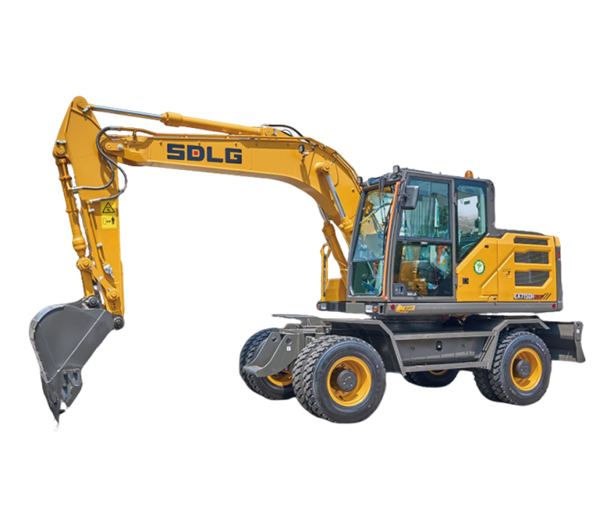
The first feature is the obvious one: wheels.
For projects spread across roads or several nearby work locations, mobility can save time.
Every minute spent loading, securing, transporting, unloading, and repositioning equipment is part of the real cost of a project. If the machine can move between suitable work areas on its own, the daily working process can become simpler.
Of course, this depends on local road regulations, traffic conditions, machine configuration, and the actual travel distance.
The second thing I look at is whether the machine has enough digging capability for the customer's normal work.
This includes digging depth, digging reach, bucket capacity, hydraulic performance, and the type of bucket being used.
For general excavation, drainage, landscaping, and utility work, the machine needs to be able to reach the required working area without constant repositioning.
Hydraulics are the heart of a modern excavator.
The hydraulic system controls most of the machine's working movements. When the system is properly matched with the engine and control system, the operator can perform several movements with better coordination.
In real work, that matters more than a specification sheet may suggest.
Imagine digging a narrow trench beside a building. The operator needs to lower the boom, extend the arm, control the bucket, and avoid the building at the same time.
Good hydraulic control helps make those small movements predictable.
I also pay attention to the cab.
Operators can spend many hours inside the machine. A comfortable seat, clear visibility, practical control layout, and sensible access to controls can make a difference during a long shift.
Operator comfort is not just about luxury.
If the operator can see the work area clearly and control the machine naturally, daily work becomes easier to manage.
Another feature that I never ignore is maintenance access.
Construction machinery works in dust, mud, rain, heat, and other difficult conditions. Even a well-built machine needs regular maintenance.
Daily inspection should be simple enough for the operator or maintenance team to actually do it.
Before purchasing, I recommend checking access to service points, filters, fluid inspection areas, engine components, hydraulic components, and other routine maintenance locations.
Road construction is one of the natural application areas for a wheeled excavator.
Road projects often require excavation, drainage work, roadside preparation, material handling, and utility installation.
The machine may also need to move along a project rather than remain in one fixed location.
That is where a wheel excavator can offer practical value.
Municipal projects can involve many different jobs.
One week may involve drainage. Another project may involve road maintenance. Another may involve underground utilities or roadside landscaping.
The advantage of a flexible machine is that it can support different tasks without being tied to one narrow application.
For contractors handling several municipal jobs, this flexibility can be useful.
Water pipes, drainage systems, electrical cables, and communication lines often require trench excavation.
These projects can also take place in busy areas where existing infrastructure is nearby.
An excavator used for this kind of work needs controlled movement and a working range that matches the trench dimensions.
When I discuss an EA715UG Plus wheel excavator for utility work, I therefore look at the complete configuration, including bucket and any auxiliary hydraulic requirements.
Large landscaping projects involve more than planting trees.
Soil removal, drainage, pond construction, ground shaping, site preparation, and material movement can all require excavation equipment.
A wheeled excavator can be useful when the project covers a relatively large area and the machine needs to move frequently.
Building sites can require foundation excavation, drainage preparation, site clearing, backfilling, and material handling.
The right machine depends on the size of the site and the ground conditions.
For sites where road mobility is important and excavation requirements are moderate, a wheeled excavator can be worth considering.
Agricultural construction can also require excavation.
Drainage channels, irrigation systems, farm roads, ponds, land preparation, and infrastructure maintenance are examples.
SDLG's broader equipment range covers construction, agriculture and landscaping applications, so machinery selection can be matched to the type of work rather than using one machine for everything.
Customers often ask me which excavator type is better.
I usually change the question.
Instead of asking which one is better, I ask which one fits the job.
| Item | Wheel Excavator | Crawler Excavator |
|---|---|---|
| Mobility on suitable roads | Strong advantage | Usually requires transport for longer relocation |
| Soft ground | Depends strongly on site conditions | Generally better suited to many soft-ground applications |
| Urban road work | Well suited to many applications | Can work well but relocation may require transport |
| Trenching | Suitable when configuration matches the job | Suitable across a wide range of excavation work |
| Long-distance site movement | Potentially convenient on suitable roads | Usually requires a transport solution |
| Typical strength | Mobility and flexibility | Traction and stability |
Source: General equipment-category comparison based on SDLG's published excavator product range and wheel-excavator classification.
This table is not saying that one machine type can replace the other.
For example, a crawler excavator can be extremely useful on difficult ground where wheel mobility provides little benefit.
On the other hand, a wheeled excavator becomes attractive when a contractor needs to work along roads and move between suitable work areas.
That difference is the reason I would consider the EA715UG Plus for municipal and road-oriented applications.
When a customer contacts us about an EA715UG Plus Wheel Excavator for Sale, I do not want to send a price and stop there.
There are several details I prefer to confirm first.
I ask where the machine will be used.
The destination country matters because local regulations, emissions requirements, transportation rules, and available configurations can vary.
I also ask what the machine will actually do.
Excavation, drainage, utility construction, landscaping, road maintenance, material handling, and other applications can require different attachments and configurations.
One machine and a fleet order are not handled in exactly the same way.
For multiple machines, production availability, inspection arrangements, shipping space, and documentation all need to be considered.
The attachment list should be confirmed before the order rather than added as an afterthought.
Depending on the project, customers may need different buckets or other working attachments.
I always recommend confirming hydraulic compatibility before adding a hydraulic attachment.
Production or preparation time depends on the selected model, exact configuration, quantity, and availability.
For that reason, I do not use one fixed delivery period for every order.
We confirm the actual schedule according to the machine and customer requirements.
Before shipment, we can arrange checks according to the confirmed order.
The inspection can include machine appearance, main operating functions, hydraulic and electrical systems, attachments, accessories, and required documents.
For an overseas customer, this step is especially useful because the buyer may not be able to inspect the machine personally.
There is something worth explaining here.
Construction machinery specifications can change according to market, emission standard, production year, optional equipment, and configuration.
SDLG's official product platform itself lists different excavator models with different technical configurations, while its product range is divided into several excavator categories.
For example, official SDLG product pages show that wheel excavators can have very different operating weights, bucket capacities, engine powers, digging ranges, and travel speeds depending on the model. The E7210H, for instance, is listed at 22,400 kg with a 0.95 m³ bucket and 123 kW rated power, while the E660H is listed at 6,050 kg with a 0.23 m³ bucket and 36.2 kW rated power.
This is exactly why I do not recommend copying a specification from another SDLG excavator and attaching it to the EA715UG Plus.
For a real purchase, I would confirm the following information from the actual quotation or machine configuration:
| Specification to Confirm | Why I Check It |
|---|---|
| Operating weight | Helps confirm machine class and transportation requirements |
| Engine model and power | Confirms the actual power unit and market configuration |
| Bucket capacity | Must match the intended digging material and application |
| Maximum digging depth | Important for trenching and utility work |
| Maximum digging radius | Shows the useful working range |
| Travel speed | Important when frequent movement is part of the job |
| Hydraulic flow | Important when using hydraulic attachments |
| Auxiliary hydraulic configuration | Confirms attachment compatibility |
| Overall dimensions | Important for transport and jobsite access |
| Emission standard | Needs to match destination-market requirements |
Source: SDLG published product specifications and product-category information; exact EA715UG Plus configuration should be confirmed before order.
For me, this is part of being practical with customers.
A machine specification should help someone make a purchasing decision. It should not simply make a webpage look impressive.
Although we supply different brands and models, I have learned that the details around a construction machine matter just as much as the brand name.
A machine works under repeated load.
The boom moves thousands of times. Hydraulic cylinders work under pressure. Pins and bushings experience repeated movement. The frame has to deal with working forces. Electrical components must function in dusty and wet environments.
That is why the manufacturing process of an excavator involves more than assembling an engine and hydraulic system.
The boom, arm, frame, counterweight, and other structural parts need to be designed for repeated working loads.
Welding quality matters because structural components are continuously exposed to vibration and stress.
The hydraulic system is another key area.
Hydraulic hoses, valves, cylinders, pumps, and fittings all need to work together.
For customers using hydraulic attachments, the auxiliary hydraulic circuit becomes especially important.
The engine is the source of the machine's working energy.
But engine power alone does not tell the whole story.
The engine, hydraulic system, cooling system, transmission-related components, and electronic control system all need to work together.
Before shipment, the machine should be checked according to the confirmed order.
For our supply process, we can coordinate checks covering appearance, operating functions, hydraulic and electrical systems, accessories, and documents.
This gives the customer a clearer picture of what is actually being shipped.
International construction machinery purchasing has more steps than buying a normal industrial product.
The machine is large, heavy, expensive to transport, and often needs special shipping arrangements.
So I normally divide the process into several stages.
We first understand the customer's application, destination, working conditions, quantity, and preferred configuration.
We confirm the requested EA715UG Plus model and the available configuration.
If the customer requires specific attachments or options, these are discussed at this stage.
Price, payment terms, preparation time, inspection requirements, and delivery arrangements are confirmed before the order moves forward.
T/T is commonly used for international machinery transactions. A deposit followed by the balance before shipment can be arranged, but the exact terms depend on the agreement between both parties.
Before shipment, we can arrange the agreed inspection and prepare the required documents and accessories.
The machine is secured for transportation. Loose accessories can be packed separately in cartons or wooden cases where appropriate.
Complete construction machines are generally transported by sea for international orders.
Spare parts and suitable smaller accessories can be shipped by air or express when that makes more sense for the customer.
The final method depends on the destination, machine size, shipping route, and customer requirements.
Our company is not built around one single machine.
Ganglong Heavy Industry Technology (Hefei) Co., Ltd. works across construction machinery, mining machinery, agricultural machinery, equipment development, customization, sales, leasing, and international trade.
Our own HKLOONG machines include excavators, loaders, backhoe loaders, and swamp excavators.
At the same time, our international trade business allows us to work with customers who need complete machines and related equipment from different brands.
For an SDLG EA715UG Plus Wheel Excavator, I see our job as connecting the customer's actual project with the right purchasing process.
That includes more than giving a model name.
We can help customers check:
Model and configuration
Application requirements
Attachment requirements
Machine availability
Inspection arrangements
Accessories
Technical documents
Payment arrangements
Export packing
Sea, air, or express transportation
Delivery requirements
Our international trade team has experience serving customers across Asia, Africa, America, and other regions.
Different markets ask different questions.
Some customers care most about machine availability. Others focus on attachments. Some need a particular emission configuration. Others need help with transportation and export documents.
That is normal in international machinery trading.
Our approach is to discuss those details before the order instead of discovering them after the machine has already been shipped.
The SDLG EA715UG Plus is a wheeled excavator designed for excavation and related construction work where machine mobility is an important part of the job.
Wheel excavators are commonly considered for road construction, municipal projects, utility installation, drainage, landscaping, building construction, material handling, and other applications where the machine may need to move between suitable work areas.
A wheel excavator uses wheels and is particularly useful when road mobility is important. A crawler excavator uses tracks and generally provides strong traction and stability on many difficult ground conditions.
It can be considered for urban construction, especially projects involving roads, utilities, drainage, landscaping, and other work where mobility is useful. The exact suitability depends on the site and machine configuration.
Its wheeled configuration is designed around mobility, making the machine suitable for consideration in road-related work. Actual road travel must always follow local traffic and equipment regulations.
Attachments can be discussed according to the application and machine configuration. Hydraulic compatibility, attachment weight, hydraulic flow, and operating requirements should be confirmed before purchase.
I recommend confirming the exact model configuration, production version, destination market, engine, hydraulic system, bucket, dimensions, and other technical data before placing an order.
Preparation or production time depends on machine availability, selected configuration, order quantity, and customer requirements. The actual schedule should be confirmed before order execution.
T/T is commonly used in international machinery transactions. A deposit and balance arrangement may be used, with the exact payment schedule agreed by both parties.
Complete machines are generally shipped by sea for international orders. Smaller spare parts and suitable accessories can be transported by air or express depending on size, weight, destination, and urgency.
Yes. According to the confirmed order requirements, we can arrange checks covering machine appearance, main functions, hydraulic and electrical systems, accessories, and required documents.
When I look at the SDLG EA715UG Plus Wheel Excavator, I think about one word first: flexibility.
A wheeled excavator makes sense when a contractor needs excavation capability but also needs to move around a project with less dependence on heavy transport equipment.
That can be valuable in road construction, municipal engineering, drainage, utility installation, landscaping, building construction, and similar work.
But I would not choose the machine just because the phrase “wheel excavator” sounds useful.
I would first check the ground conditions.
Then I would check the required digging depth and reach.
Then I would look at the bucket and attachments.
After that, I would confirm the machine configuration, local regulations, transportation requirements, and service arrangements.
This approach is much more practical than comparing machines only by one specification.
For customers searching for an EA715UG Plus Wheel Excavator for sale, SDLG EA715UG Plus Excavator, SDLG Wheel Excavator, EA715UG Plus Excavator, or SDLG Wheeled Excavator Supplier, Ganglong can assist with the international supply process and help confirm the actual machine configuration before purchase.
Our goal is straightforward: understand the customer's work, confirm the machine, check the details, arrange the shipment, and keep the process clear from quotation to delivery.
For construction machinery, that kind of practical communication matters. A machine is not just a product on a webpage. It is a working tool that needs to perform in a real jobsite, under real conditions, for real people.
That is how I approach the EA715UG Plus.
 RELATED
2435092534@qq.com
86 158 5511 9567


©2026 HKLOONG Heavy Industry Technology (Hefei) Co., Ltd. All Rights Reserved.

This website uses cookies to ensure you get the best experience on our website.
 Español
 Pусский
 Français
 العربية
 WhatsApp
 Phone
Phone E-mail
 Message