

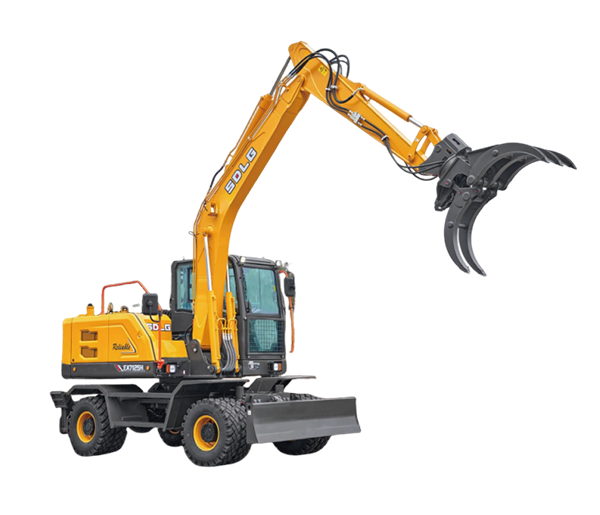
SDLG EA7125H wheel excavator for Road Construction and Material Handling
When I talk with customers about a SDLG EA7125H Wheel Excavator, I usually start with the working conditions rather than the machine price. A wheeled Excavator can look very similar to other Excavators at first glance, but the way it works on a real jobsite is quite different.
The biggest difference is mobility. A wheel excavator is built for customers who need excavation performance but also want the machine to move between suitable working areas more easily. This is especially useful for road construction, municipal projects, utility work, landscaping, drainage, material handling, and other jobs where the machine does not stay in one place all day.
The EA7125H Wheel Excavator is a model I would consider when a customer needs a machine in the roughly 9.5-ton working class. Publicly available specifications list an operating weight of about 9,500 kg, rated engine power of 74 kW, travel speed of around 29 km/h, bucket digging force of 45 kN, maximum digging depth of 4,190 mm, and maximum digging radius of 7,990 mm. The published dimensions are approximately 6,940 × 2,270 × 2,945 mm. Exact specifications can vary according to configuration and market, so I always recommend confirming the actual machine before ordering.
For me, those numbers tell a simple story. This is not a tiny machine for occasional garden work, but it is also not a huge excavator designed only for heavy earthmoving. It sits in a useful range for contractors who need a practical combination of working capacity and road mobility.
At Ganglong Heavy Industry Technology (Hefei) Co., Ltd., we have been involved in construction machinery and international equipment trading since 2013. Together with Hefei Ganglong International Trade Co., Ltd., we work across equipment R&D, manufacturing, customization, machine sales, leasing, and international trade.
Our own HKLOONG product range includes excavators, loaders, Backhoe loaders, and swamp excavators. We also supply complete machines from domestic and international brands according to customer requirements and machine availability.
For SDLG equipment, our role is that of a machinery supplier and international trade service provider. We do not manufacture SDLG machines ourselves. Instead, we help customers confirm the model, configuration, attachments, inspection, documents, packing, shipping, and other details involved in an international machinery purchase.
The SDLG EA7125H is a Wheeled Excavator designed for excavation and related material-handling work where mobility is important.
The first thing I notice about this type of machine is not the engine. It is the wheels.
That sounds simple, but it changes the way the machine fits into a project.
Imagine a road contractor working on several sections of a city road. The machine may need to dig a drainage trench in one area, move several hundred meters, work on a utility line, and then move again to another section.
With a crawler excavator, every long relocation may require a transport solution. With a wheeled excavator, the machine can travel between suitable locations under its own power, subject to local road regulations and working conditions.
That is where I see the main value of the EA7125H Wheel Excavator.
It is designed around the idea that excavation and mobility need to work together.
SDLG's current excavator range separates its products into Large Excavators, medium excavators, wheel excavators, small excavators, ultra-large excavators, Mini Excavators, and differentiated excavators. This shows that wheeled excavators are treated as a specific working category rather than simply another version of crawler equipment.
For a contractor, that distinction matters.
If the machine spends most of its life on soft ground, a crawler excavator may make more sense. If the machine works mainly on suitable roads and hard surfaces and needs to move frequently, a wheel excavator can be a much more natural fit.
So when a customer asks me for an EA7125H Excavator for sale, I first want to understand where the machine will work.
Specifications do not tell the whole story, but they give us a useful starting point.
For the EA7125H, publicly available product information lists the following main figures.
| Specification | Published EA7125H Value |
|---|---|
| Machine Type | Wheeled Excavator |
| Operating Weight | 9,500 kg |
| Engine Power | 74 kW |
| Engine Speed | 2,200 r/min |
| Bucket Digging Force | 45 kN |
| Maximum Digging Depth | 4,190 mm |
| Maximum Digging Radius | 7,990 mm |
| Maximum Grabbing Height | 8,306 mm |
| Maximum Dumping Height | 5,484 mm |
| Travel Speed | 29 km/h |
| Swing Speed | 0–11 r/min |
| Overall Dimensions | 6,940 × 2,270 × 2,945 mm |
Source: Publicly available EA7125H technical data. Exact configuration should be confirmed before purchase.
The first number I look at is the 9,500 kg operating weight.
This gives me a good idea of the machine's general working class and also matters when planning international transportation.
The second number is the 74 kW engine power. Engine power is important, but I never use it alone to judge an excavator. The engine has to work together with the hydraulic system, transmission, working equipment, and control system.
The third number is the 45 kN bucket digging force. This gives us a useful indication of the machine's ability to penetrate and remove material during excavation.
Then I look at the digging range.
A maximum digging depth of around 4,190 mm gives the machine useful reach for drainage, utility trenches, road construction, and other excavation tasks that require more than shallow digging.
The maximum digging radius of approximately 7,990 mm also means the operator can cover a reasonable working area without moving the machine after every bucket cycle.
Finally, there is the travel speed of around 29 km/h.
For a wheeled excavator, this is one of the numbers I care about most because mobility is one of the main reasons to choose this machine category in the first place.
The working principle is based on hydraulic power.
The engine produces mechanical power. The hydraulic system uses that power to create controlled movement in the boom, arm, bucket, and upper structure.
When the operator pushes the controls, hydraulic oil is directed to the required actuator. The boom can rise or lower. The arm can move inward or outward. The bucket can open or close. The upper structure can rotate to move material to another position.
It sounds straightforward, but good excavation is really about coordination.
Take trench digging as an example.
The operator first positions the machine correctly. The boom lowers. The arm reaches into the soil. The bucket cuts into the ground and collects material. The boom lifts the loaded bucket. The upper structure swings. The bucket opens and releases the soil.
Then the cycle starts again.
A good excavator should make these movements easy for the operator to control.
The EA7125H also brings the wheeled chassis into the picture.
After finishing one section of work, the machine can travel to another suitable location without needing to be loaded onto a trailer for every short move.
That can be particularly useful in municipal construction.
For example, a contractor may need to repair drainage systems at several locations along a road. The ability to move the excavator between work areas can reduce unnecessary transport operations.
Of course, I always remind customers that road travel must follow local laws and safety requirements. A machine's maximum travel speed is not the same thing as permission to travel at that speed everywhere.
The most obvious feature is the wheeled chassis.
For road work and urban projects, this can be a major practical advantage.
The machine can move around suitable hard surfaces and travel between nearby work areas. That makes the EA7125H different from an excavator that depends heavily on a transport truck for relocation.
When a project is spread over several locations, this mobility can save time.
At approximately 9,500 kg, the EA7125H provides more working capacity than many smaller wheeled excavators.
This makes it suitable for contractors who need a machine capable of handling serious daily excavation but do not need a very large excavator.
The machine can be considered for road construction, drainage, utility work, municipal projects, landscaping, material handling, and general construction.
The published engine power is 74 kW at 2,200 r/min.
I would not look at this number by itself.
What matters is how the engine works with the hydraulic system and transmission.
SDLG's published descriptions of its H-series wheeled excavators emphasize the matching of the power system, transmission, and hydraulic system for working efficiency. For example, the E7210H is described as using an electronically controlled hydraulic system with coordinated compound movements and quick response.
That design idea is important when looking at the broader SDLG Wheel Excavator family.
The published EA7125H bucket digging force is about 45 kN.
For the operator, digging force affects how the bucket enters and breaks through soil.
Real digging performance still depends on the ground, bucket type, operator technique, hydraulic condition, and working angle.
A specification gives us a reference. The jobsite gives us the real answer.
The published maximum digging depth is around 4,190 mm and maximum digging radius is around 7,990 mm.
That gives the EA7125H a useful working range for many utility and infrastructure tasks.
When I look at digging range, I also consider how much repositioning will be needed.
If the machine can reach more of the working area from one position, the operator may spend less time moving the machine and more time actually working.
The published maximum grabbing height is about 8,306 mm, while the maximum dumping height is listed at approximately 5,484 mm.
These figures are useful when the machine is used for material handling.
For example, a contractor may need to load material into a truck or move material over a certain height.
The actual lifting and loading operation must always stay within the manufacturer's operating limits and the appropriate load chart.
Road projects are one of the clearest applications for a wheel excavator.
There are usually many small jobs within one larger project.
Drainage needs to be excavated. Roadside soil needs to be moved. Utility trenches need to be opened. Old material needs to be removed. New material needs to be handled.
The machine may also need to move along the road between different work sections.
That is where a wheeled excavator can be practical.
Municipal contractors often face changing work conditions.
One project may involve drainage. Another may involve underground utilities. Another may involve roadside maintenance.
A flexible wheeled excavator can support several of these tasks instead of being limited to one narrow application.
The EA7125H is therefore worth considering for municipal construction and infrastructure maintenance.
Drainage work often involves long trenches and repeated excavation cycles.
The machine needs enough digging depth and reach to excavate the required channel.
The EA7125H's published digging depth of around 4.19 meters gives it a useful working range for many trenching applications.
The operator still needs to work according to the actual trench design, soil conditions, underground utilities, and safety requirements.
Water pipes, drainage pipes, electrical cables, and communication lines all require careful excavation.
The challenge is that utility work often happens in areas where existing infrastructure is already present.
The operator needs control rather than simply maximum power.
A well-matched bucket and careful operation can help the machine work around existing structures.
Large landscaping projects can involve a surprising amount of earthmoving.
There may be ponds, drainage channels, planting areas, roads, retaining structures, or large amounts of soil to move.
A wheeled excavator can be useful when the project covers a broad area and the machine needs to relocate frequently.
The EA7125H can also be considered for certain material-handling tasks.
Its published grabbing height and dumping height are useful references when customers want to use the machine for loading or moving material.
However, I always separate “can reach” from “can safely lift.”
These are not the same thing.
For lifting operations, the operator must check the approved lifting capacity, working radius, attachment weight, ground conditions, and applicable safety requirements.
When a customer asks me which excavator is better, I usually ask one more question: better for what?
There is no useful answer without knowing the application.
| Machine Type | Main Working Advantage | Typical Applications | Mobility Between Suitable Sites |
|---|---|---|---|
| Wheel Excavator | Excavation combined with road mobility | Road work, utilities, municipal projects, landscaping | High on suitable surfaces |
| Crawler Excavator | Traction and stability | Earthmoving, quarrying, heavy construction | Usually needs transport for longer relocation |
| Mini Excavator | Compact size and access | Gardening, landscaping, small construction | Good for short-distance site movement |
| Large Excavator | High excavation capacity | Mining, quarrying, large infrastructure | Generally transported between jobsites |
Source: General equipment-category comparison based on SDLG's published excavator product range and wheel-excavator classification.
I would choose a crawler excavator when the ground and working conditions require strong traction.
I would look at a mini excavator when access is the biggest problem.
I would consider a large excavator when production volume and heavy excavation are the main priorities.
And I would look seriously at a machine such as the EA7125H Wheel Excavator when road mobility and excavation need to work together.
Another useful way to understand the EA7125H is to place it beside other wheeled excavators in the SDLG product family.
| Model | Machine Type | Operating Weight | Rated Power | Bucket Capacity |
|---|---|---|---|---|
| EA775H | Wheeled Excavator | 7,000 kg | Not listed in the referenced source | 0.23 m³ |
| EA780H | Wheeled Excavator | 7,100 kg | Not listed in the referenced source | 0.23 m³ |
| EA7105H | Wheeled Excavator | 9,200 kg | 62.5 kW | Configuration dependent |
| EA7125H | Wheeled Excavator | 9,500 kg | 74 kW | Configuration dependent |
| E7150H | Wheeled Excavator | 14,700 kg | Not listed in the referenced source | 0.6 m³ |
Source: Publicly available SDLG Wheeled Excavator product information and model listings.
This comparison is useful because it shows where the EA7125H sits within the broader wheel excavator range.
It is heavier than the EA775H and EA780H, while remaining smaller than the E7150H.
That can make the EA7125H interesting for customers who need more capacity than a compact wheeled excavator but do not want to move into a much larger machine.
Still, I would not select a machine based only on operating weight.
Bucket capacity, digging depth, hydraulic flow, attachment requirements, transport dimensions, engine configuration, and local regulations all need to be checked.
When an overseas customer contacts us about an EA7125H Wheel Excavator for Sale, I usually work through the order in several steps.
The destination country affects many details.
Emission requirements, road regulations, import rules, shipping routes, and documentation can vary from one market to another.
That is why I do not assume that the same configuration is suitable for every country.
I want to know what the machine will actually do.
Road construction?
Drainage?
Utility work?
Landscaping?
Material handling?
Municipal maintenance?
Different jobs can require different buckets, hydraulic options, and attachments.
Once the application is clear, we confirm the machine configuration.
This includes the basic machine, engine and emission configuration, working equipment, bucket, optional attachments, and other requirements where applicable.
Production or preparation time depends on the selected model, configuration, order quantity, and actual machine availability.
So I do not give every customer the same delivery statement.
The schedule should be confirmed according to the actual order.
Before shipment, we can arrange checks according to the agreed order requirements.
These checks can cover the machine appearance, main functions, hydraulic system, electrical system, attachments, accessories, and required documents.
This is especially useful for customers buying from overseas.
A 9.5-ton excavator is not a small parcel.
International transportation needs planning.
The machine dimensions, destination port, shipping route, loading method, and local delivery conditions all need to be considered.
For complete machines, sea transportation is generally suitable for international orders.
Before loading, the machine needs to be properly prepared and secured.
Loose accessories can be packed separately in cartons or wooden cases when appropriate.
The exact packing method depends on the shipping arrangement and destination.
For spare parts or smaller accessories, air freight or express shipping may be more practical when speed is important.
Our international trade team helps coordinate these details as part of the supply process.
I prefer to keep the commercial process simple and clear.
After the model and configuration are confirmed, we discuss the quotation, availability, preparation time, inspection requirements, payment terms, and transportation.
T/T is commonly used for international construction machinery transactions.
A typical arrangement may involve a deposit followed by the balance before shipment. However, the exact percentage and timing are agreed by both parties according to the actual transaction.
Before shipment, we can coordinate the agreed inspection.
We also check whether the required accessories and documents have been prepared.
Once everything is ready, the machine can be prepared for loading and international transportation.
For me, this part of the process is just as important as choosing the machine.
A good excavator still needs the correct configuration, correct documents, correct packing, and a suitable shipping arrangement.
Although Ganglong supplies equipment from different brands, our experience in machinery has taught us to pay close attention to how construction equipment is built and maintained.
An excavator works under repeated load every day.
The boom moves again and again. The arm handles constant hydraulic force. Pins and bushings experience repeated movement. The chassis carries the machine. Hydraulic hoses work under pressure.
That means structural quality matters.
The boom, arm, frame, and other load-bearing parts need to handle repeated working forces.
Welding quality and structural design are important because these parts are exposed to vibration and changing loads during normal excavation.
The hydraulic system is one of the most important parts of any excavator.
Pumps, valves, cylinders, hoses, and fittings must work together correctly.
For customers who plan to use hydraulic attachments, I also check the auxiliary hydraulic requirements before recommending a configuration.
The engine supplies the basic power, but the machine's working performance depends on the whole system.
Engine output, hydraulic power, transmission, cooling, and electronic controls need to work together.
That is why I prefer to look at the complete machine rather than focus on one specification.
Before delivery, the machine can be checked according to the customer's confirmed requirements.
We can arrange checks of appearance, operating functions, hydraulic and electrical systems, accessories, and documents.
This gives overseas customers more confidence about what is being shipped.
Ganglong Heavy Industry Technology (Hefei) Co., Ltd. was founded in 2013.
Together with Hefei Ganglong International Trade Co., Ltd., we provide a broad range of machinery-related services.
Our own HKLOONG products include excavators, loaders, backhoe loaders, and swamp excavators.
We also supply complete machines from other domestic and international brands according to customer requirements.
Our international trade team has experience working with customers across Asia, Africa, America, and other regions.
For an SDLG EA7125H, our job is not to pretend to be the manufacturer.
Our job is to make the purchasing process easier to manage.
That can include:
Confirming the EA7125H model.
Checking the available machine configuration.
Understanding the customer's application.
Confirming bucket and attachment requirements.
Checking machine availability.
Discussing production or preparation time.
Arranging pre-shipment inspection.
Checking accessories and documents.
Coordinating export packing.
Arranging international transportation.
Following the order through delivery.
In international machinery trading, small details can become big problems if they are ignored.
A wrong attachment can cause compatibility problems.
A wrong configuration can create import difficulties.
Incorrect dimensions can affect transportation.
Missing documents can delay customs clearance.
That is why I prefer to confirm these points before shipment.
The SDLG EA7125H is a wheeled excavator designed for excavation, material handling, road construction, municipal projects, utility work, landscaping, and related applications.
Publicly available specifications list an operating weight of approximately 9,500 kg. The final machine weight can vary depending on configuration and attachments.
Publicly available EA7125H data lists engine power of approximately 74 kW at 2,200 r/min.
The published maximum digging depth is approximately 4,190 mm.
The published maximum digging radius is approximately 7,990 mm.
Publicly available specifications list a travel speed of approximately 29 km/h. Actual travel speed depends on operating conditions, road conditions, safety requirements, and applicable regulations.
The published bucket digging force is approximately 45 kN.
Yes. Its wheeled configuration makes it suitable for consideration in road construction, road maintenance, drainage, municipal projects, and utility work where mobility between suitable working areas is useful.
Yes. Municipal drainage, utility installation, roadside maintenance, landscaping, and general excavation are potential applications for this type of wheeled excavator.
It can be considered for suitable material-handling work. However, lifting operations must follow the manufacturer's approved limits, working radius, attachment requirements, and local safety regulations.
Attachments can be discussed according to the application. Bucket type, hydraulic flow, attachment weight, auxiliary hydraulic configuration, and machine compatibility should be confirmed before ordering.
Preparation or production time depends on machine availability, configuration, order quantity, and customer requirements. The actual schedule should be confirmed before the order is finalized.
T/T is commonly used for international machinery transactions. A deposit and balance arrangement may be used, with the exact payment terms agreed between both parties.
Complete machines are generally transported by sea for international orders. Suitable spare parts and smaller accessories can be shipped by air or express depending on size, weight, destination, and urgency.
Yes. According to the confirmed order requirements, we can arrange checks covering machine appearance, main functions, hydraulic and electrical systems, accessories, and required documents.
After looking at the EA7125H from the perspective of an equipment supplier, I see its main value in the balance between working capability and mobility.
The approximately 9,500 kg operating weight gives it a useful working class. The 74 kW engine provides a solid power reference. The 45 kN bucket digging force supports general excavation work. The approximately 4,190 mm digging depth and 7,990 mm digging radius provide useful working range.
But the number I would pay special attention to is the approximately 29 km/h travel speed.
That is because mobility is one of the main reasons to choose a wheeled excavator.
For contractors working on roads, municipal projects, drainage systems, utilities, landscaping, and similar jobs, the ability to move between suitable work areas can make a real difference to the daily workflow.
At the same time, I would never choose the EA7125H only because it has wheels.
I would first check the ground.
Then I would check the required digging depth and reach.
Then I would check the bucket and attachment requirements.
After that, I would confirm the exact machine configuration, destination requirements, inspection process, transportation method, and commercial terms.
That is how I believe construction machinery should be purchased.
For customers searching for an EA7125H Wheel Excavator for Sale, SDLG EA7125H excavator, EA7125H wheeled excavator, SDLG wheel Excavator Supplier, or EA7125H excavator specifications, Ganglong can help with the practical supply process from model confirmation through international delivery.
A machine is not just a product sitting on a website. It has to work in the real world, on real roads, in real soil, with real operators.
That is why I prefer to discuss the job first and the machine second.
When the application, configuration, attachment, inspection, and delivery plan all match, the EA7125H becomes much more than just another wheeled excavator model. It becomes a practical piece of equipment for getting everyday construction work done.
2435092534@qq.com
86 158 5511 9567


©2026 HKLOONG Heavy Industry Technology (Hefei) Co., Ltd. All Rights Reserved.

This website uses cookies to ensure you get the best experience on our website.
 Español
 Pусский
 Français
 العربية
 WhatsApp
 Phone
Phone E-mail
 Message