

SDLG EA770H wheel excavator for Construction, Utilities and Road Work
When I talk about the SDLG EA770H Wheel Excavator, I usually do not start with the price. I start with one simple question: where are you going to use it?
That question matters because a wheel Excavator is built for a different kind of working life from a crawler excavator. If the machine needs to move between suitable work areas, work around roads, handle utility projects, or support municipal construction, the ability to travel on wheels becomes a very practical advantage.
The EA770H is a compact Wheeled Excavator from SDLG. According to the manufacturer's published technical information, it has an operating weight of about 6,200 kg, a 0.21 m³ bucket capacity, 45 kN maximum digging force, 36.8 kW engine power, and a maximum digging radius of 6,188 mm. Its published maximum digging depth is 3,526 mm. These figures give me a useful picture of what this machine is designed to do.
I also pay attention to its physical size. The published overall dimensions are approximately 6,230 mm long, 2,090 mm wide, and 2,976 mm high. For contractors working in urban areas, utility projects, landscaping, and road maintenance, these dimensions can be just as important as engine power.
At Ganglong Heavy Industry Technology (Hefei) Co., Ltd., we have been working in the construction machinery field since 2013. Together with Hefei Ganglong International Trade Co., Ltd., we provide equipment-related services covering machinery supply, customization, testing, sales, leasing, and international trade.
Our own HKLOONG range includes Excavators, loaders, Backhoe loaders, and swamp excavators. At the same time, we supply complete machines from a range of domestic and international brands according to customer requirements and actual machine availability.
For the SDLG EA770H, our role is as a machinery supplier and international trade service provider. We are not the manufacturer of SDLG equipment. Our job is to help customers select the appropriate machine, confirm the configuration, arrange inspection, prepare export details, and coordinate transportation.
The SDLG EA770H Wheel Excavator is a wheeled excavator in the approximately 6.2-ton class. It is designed for excavation and related material-handling work where mobility between suitable working areas is important.
SDLG places the EA770H within its wheel excavator product category, alongside other construction machinery designed for different working conditions. The manufacturer's product information identifies utilities, heavy infrastructure, and quarries and aggregates among its application areas for the EA770H.
For me, the most interesting part is the balance between machine size and working range.
A 6,200 kg excavator is not a mini machine for very small garden jobs. At the same time, it is far easier to handle than a much larger excavator when the project does not require a large amount of earthmoving capacity.
This makes the EA770H worth considering for contractors who want one machine that can handle ordinary excavation while also moving around a project with less hassle.
Think about a utility contractor working on several sections of a road.
In the morning, the machine may dig a trench for a water pipe. Later, it may move to another section for drainage work. The next day, it may be used for roadside excavation or landscaping.
That kind of work is where I would look at a wheel excavator.
The wheels are not just a design choice. They are part of the machine's working concept.
Of course, wheeled equipment still has limits. Soft ground, steep terrain, mud, and rough off-road conditions may favor crawler machines. I always tell customers that the correct excavator depends on the ground, not simply on the product name.
When I evaluate a construction machine, I like to separate the numbers into three groups: working capacity, digging range, and physical size.
That gives me a clearer picture than looking at engine power alone.
| EA770H Specification | Published Value |
|---|---|
| Machine Type | Wheel Excavator |
| Operating Weight | 6,200 kg |
| Bucket Capacity | 0.21 m³ |
| Maximum Digging Force | 45 kN |
| Engine Model | YCF3050-T450 |
| Engine Power | 36.8 kW |
| Maximum Flow Rate | 151 L/min |
| Slewing Speed | 11 r/min |
| Fuel Tank Capacity | 120 L |
| Maximum Digging Radius | 6,188 mm |
| Maximum Digging Depth | 3,526 mm |
| Maximum Discharge Height | 4,307 mm |
| Overall Length | 6,230 mm |
| Overall Width | 2,090 mm |
| Overall Height | 2,976 mm |
Source: SDLG official EA770H technical information. Specifications may vary with configuration, market, and equipment options.
The first figure that catches my attention is the 6,200 kg operating weight.
It puts the EA770H in a useful middle ground. It is large enough for many regular excavation jobs but still considerably more compact than heavy-duty wheeled excavators designed for much larger infrastructure projects.
Then there is the 0.21 m³ bucket capacity.
This tells me that the EA770H is intended for controlled excavation rather than moving huge volumes of material in every cycle.
That is actually a good thing for many utility and municipal jobs. A smaller bucket can give the operator better control when digging around existing structures, pipes, cables, or narrow work areas.
The published 45 kN maximum digging force is another useful number.
Digging force is not the same as total productivity, but it gives us an idea of the machine's ability to work into soil and other materials under suitable conditions.
The maximum digging depth of 3,526 mm is also important.
For drainage, utility installation, foundation-related work, and general excavation, depth often matters more than people realize.
Finally, the 6,188 mm maximum digging radius gives the operator a useful working envelope around the machine.
In real work, reach means fewer unnecessary repositioning movements. That can make a difference during repeated excavation cycles.
The basic working principle of the EA770H is easy to understand.
The engine provides power. The hydraulic system turns that power into controlled movement. The boom, arm, and bucket then work together to dig, lift, move, and discharge material.
When I explain an excavator to someone who is not familiar with construction machinery, I compare it to a person's arm.
The boom is like the upper arm.
The arm extends and pulls back.
The bucket does the actual digging and scooping.
The hydraulic system is what gives the whole movement strength and control.
During a normal digging cycle, the operator positions the machine, lowers the working equipment, pushes the bucket into the soil, curls the bucket to collect material, lifts the boom, rotates the upper structure, and dumps the material.
Then the machine returns to its digging position and repeats the cycle.
It sounds simple, but efficient excavation depends on how smoothly these movements work together.
SDLG's wheeled excavator family uses hydraulic systems designed to coordinate working movements. For example, SDLG describes the larger E7210H wheeled excavator as using an electronically controlled hydraulic system designed for quick response and flexible combined movements. This provides useful context for understanding the design approach of SDLG's H-series wheeled excavators, although specifications and systems vary by model.
For the EA770H, I focus on the practical result: the machine needs to provide controlled movement for digging, loading, trenching, and material handling while remaining easy to move around the jobsite.
The wheel configuration adds another layer.
After completing one work section, the machine can travel to another suitable area without requiring the same kind of transport arrangement normally associated with moving a crawler excavator over short road distances.
That is one of the main reasons contractors consider a 6 ton wheel excavator instead of a crawler machine.
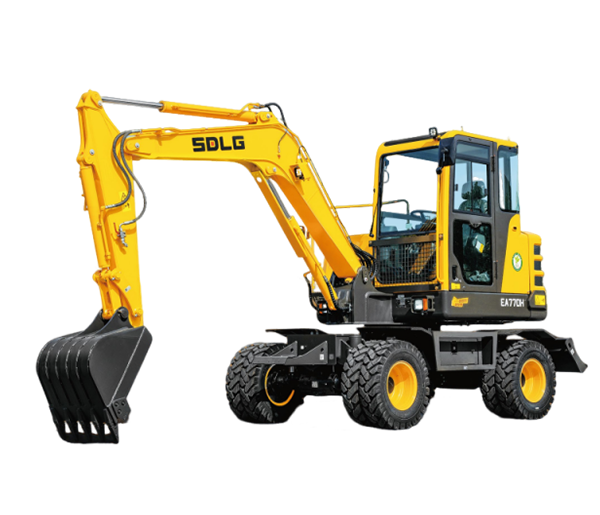
The EA770H measures approximately 6,230 mm long, 2,090 mm wide, and 2,976 mm high according to published specifications.
These dimensions make it easier to think about the machine in real working environments.
Urban construction sites are rarely wide open spaces.
There may be parked vehicles, buildings, fences, utility poles, roads, sidewalks, and other machines around the working area.
A machine that is too large can spend more time waiting for space than doing useful work.
That is why I always check dimensions before recommending equipment for an urban project.
The 6,200 kg operating weight gives the EA770H enough physical presence for many general construction and excavation jobs while keeping it in a relatively compact machine class.
For international buyers, weight also matters during shipping.
The shipping company needs to know the machine's dimensions and weight before the transportation plan is confirmed.
The published maximum digging force is 45 kN.
For everyday excavation, this provides a useful working reference.
Still, I never tell a customer that one number guarantees performance in every type of soil.
Soil conditions, moisture, rock content, bucket design, digging angle, operator skill, and machine condition all affect actual results.
The published bucket capacity is 0.21 m³.
This is a practical size for many smaller excavation and utility applications.
It also makes sense when precision matters.
For example, a utility contractor digging around existing infrastructure does not always want to remove a huge amount of soil with every bucket.
Control can be more important than raw volume.
The published maximum flow rate is 151 L/min.
Hydraulic flow is important because hydraulic attachments can have different flow requirements.
If a customer wants to use a breaker, auger, hydraulic grab, or other attachment, I check the attachment specifications against the excavator's hydraulic configuration before confirming the order.
This is one of those details that is easy to ignore when buying a machine online but can become a headache later.
The published fuel filling amount is 120 L.
Fuel capacity does not tell us exactly how long a machine can operate because fuel consumption depends on workload, engine condition, operating habits, idle time, and working environment.
Still, it is useful when planning daily operations and site refueling.
I would not describe the EA770H as a machine for only one type of project.
Its size and wheel configuration make it suitable for several applications where moderate excavation capability and mobility are both useful.
Road maintenance is one of the first applications I think about.
Roadside drainage, shoulder repair, utility work, soil removal, and small infrastructure projects often require a machine that can move between work sections.
A wheel excavator fits this working pattern well.
The operator can complete one section and then relocate to another suitable area without treating every movement like a major transportation job.
Municipal projects often take place in busy areas.
Water pipes, drainage systems, sidewalks, roadside facilities, and underground utilities can all require excavation.
The EA770H's compact width and useful digging range make it worth considering for this kind of work.
The key point is not simply that the machine can dig.
It is that the machine can dig while fitting into a more mobile urban workflow.
Utility contractors have a very specific challenge.
They often need to dig accurately rather than simply dig quickly.
A 0.21 m³ bucket can be useful for controlled excavation, especially when working around existing infrastructure.
Before excavation, the contractor still needs proper utility location procedures and site safety planning. No excavator can replace careful jobsite preparation.
Drainage work is another natural application.
The machine may need to excavate channels, trenches, or roadside drainage sections.
The published maximum digging depth of 3,526 mm gives the EA770H a useful range for many medium-depth excavation tasks.
Actual suitability depends on the required trench dimensions, ground conditions, slope, and local project requirements.
Large landscaping projects can involve substantial earthmoving.
Ponds, drainage channels, tree planting areas, retaining structures, and site preparation can all require excavation.
A wheeled excavator can be useful when the working area is spread out and the machine needs to relocate frequently on suitable surfaces.
SDLG lists heavy infrastructure among the EA770H application areas.
In this type of work, the machine may support excavation, material handling, drainage, site preparation, or other smaller tasks within a larger project.
I would not use the EA770H where the job clearly requires a much larger excavator. Instead, I see it as a practical support machine for work where its size and mobility make sense.
| Application | Why the EA770H Can Fit | Typical Work |
|---|---|---|
| Road Maintenance | Wheeled mobility and compact dimensions | Drainage, roadside excavation, shoulder work |
| Utilities | Controlled digging and useful reach | Pipe trenches, cable trenches, drainage |
| Municipal Projects | Flexible movement between suitable areas | Urban construction and maintenance |
| Landscaping | Moderate digging capacity | Earthmoving, ponds, site preparation |
| Infrastructure Support | Compact working class | Excavation and material handling |
| Quarries and Aggregates | 45 kN digging force | Suitable supporting excavation tasks |
Source: SDLG official EA770H application information and published technical specifications. Actual application suitability depends on working conditions and attachments.
When customers ask me whether a wheel excavator or crawler excavator is better, I usually avoid giving a simple answer.
The better question is: which machine fits the ground and the work?
A crawler excavator has its own strengths. Tracks provide good traction and stability on many types of difficult ground.
A wheel excavator has a different advantage. It is designed around mobility on suitable surfaces.
| Feature | EA770H Wheel Excavator | Crawler Excavator |
|---|---|---|
| Undercarriage | Wheels | Tracks |
| Short-Distance Road Mobility | Strong advantage on suitable roads | Usually limited |
| Soft or Muddy Ground | More condition-sensitive | Generally more suitable |
| Urban Road Work | Well suited to suitable conditions | Often requires transport between locations |
| Utility Work | Well suited to mobile projects | Also widely used |
| Landscaping | Useful for spread-out sites | Useful for rough terrain |
| Frequent Relocation | One of its main advantages | Usually less convenient |
Source: Equipment-category comparison based on standard machine configurations and SDLG's published distinction between wheel excavators and other excavator categories.
I would choose a crawler excavator when traction is the main concern.
I would consider a wheel excavator when the machine needs to move frequently between suitable hard-surface work areas.
For smaller construction and municipal work, I would also compare the EA770H with a Mini Excavator.
A mini excavator may be better where access is extremely tight. The EA770H becomes more interesting when the customer needs more digging reach, a larger working platform, and wheeled mobility.
| Machine Type | Typical Strength | Best Question to Ask |
|---|---|---|
| Mini Excavator | Compact access | Is the working space very narrow? |
| Wheel Excavator | Mobility plus excavation | Will the machine move between work areas frequently? |
| Crawler Excavator | Traction and stability | Is the ground rough, soft, or difficult? |
| Large Excavator | High production capacity | Does the project require large-volume excavation? |
This is why I do not believe there is one excavator that is right for every contractor.
The right machine is the one that matches the job.
Buying construction machinery internationally involves more than finding a machine and sending payment.
There are several practical steps that I prefer to confirm before the order is finalized.
I first ask what the customer plans to do with the machine.
Road work, utility excavation, landscaping, drainage, municipal construction, and material handling can all require slightly different configurations.
This also helps me understand whether the EA770H is actually suitable for the project.
Once the application is clear, we confirm the selected model and configuration.
Bucket requirements, hydraulic attachments, working equipment, and other options should be discussed before purchase.
If the customer needs a Hydraulic Breaker or another attachment, I also check compatibility rather than simply adding an attachment to the quotation.
Preparation or production time depends on the selected model, configuration, order quantity, and actual machine availability.
For that reason, I do not promise a fixed delivery time without checking the real order situation.
This is especially important for overseas customers who may already have a construction project schedule.
Before shipment, we can arrange checks according to the confirmed order.
These may include machine appearance, main operating functions, hydraulic and electrical systems, attachments, accessories, and required documents.
For international customers, this step is particularly useful because they may not be able to inspect the machine in person.
The machine needs to be properly secured for transportation.
Loose parts and accessories can be packed separately in cartons or wooden cases where appropriate.
The exact packing method depends on the destination, shipping method, machine configuration, and customer requirements.
Complete excavators are generally transported by sea for international orders.
Smaller spare parts and suitable accessories can be sent by air or express when that makes more sense.
We coordinate the shipping details according to the destination and agreed commercial terms.
Ganglong Heavy Industry Technology (Hefei) Co., Ltd. was founded in 2013.
Over the years, our business has developed around construction machinery, mining machinery, agricultural machinery, attachments, and international equipment trading.
Our group also operates Hefei Ganglong International Trade Co., Ltd., which focuses on international trade and serves customers across Asia, Africa, America, and other markets.
Our own HKLOONG product range covers excavators, loaders, backhoe loaders, and swamp excavators.
At the same time, we provide complete machine sales and leasing services for a number of domestic and international brands.
When I handle an SDLG EA770H for sale inquiry, I see my role as connecting the machine with the customer's actual project.
That means I care about the details around the machine, not just the machine itself.
Model confirmation
Application assessment
Machine configuration
Bucket and attachment requirements
Availability
Inspection arrangements
Accessories and documents
Export packing
Shipping arrangements
After-order communication
This approach becomes even more important when the buyer is thousands of kilometers away.
A small misunderstanding about machine dimensions can affect shipping.
A wrong hydraulic attachment can create compatibility problems.
A missing document can delay customs clearance.
An unclear configuration can lead to unnecessary communication after the order is placed.
I would rather confirm these details before shipment.
That is the practical side of international machinery supply.
The SDLG EA770H is a wheeled excavator with an operating weight of approximately 6,200 kg. It is designed for applications including utilities, infrastructure support, road-related work, landscaping, excavation, and other suitable construction tasks.
The published operating weight is 6,200 kg. The final operating weight may vary depending on the selected configuration and attachments.
The published bucket capacity is 0.21 m³.
The published maximum digging force is 45 kN.
The published maximum digging depth is 3,526 mm.
The published maximum digging radius is 6,188 mm.
The published engine power is 36.8 kW, with the engine model listed as YCF3050-T450.
The published fuel filling amount is 120 L.
The published overall dimensions are approximately 6,230 mm long, 2,090 mm wide, and 2,976 mm high.
The machine can be considered for utilities, heavy infrastructure, road maintenance, municipal construction, landscaping, drainage, material handling, and suitable quarry or aggregate support work.
Yes. A wheeled excavator can be useful for road construction and maintenance where the machine needs to move between suitable working areas. Actual suitability depends on road conditions, project requirements, and local regulations.
Yes. Its digging depth, reach, compact working dimensions, and 0.21 m³ bucket capacity make it suitable for consideration in many utility excavation projects.
Suitable hydraulic attachments can be discussed according to the machine configuration. Hydraulic flow, pressure, attachment weight, mounting system, and other compatibility requirements should be confirmed before ordering.
We can help confirm the model and configuration, check availability, arrange inspection, prepare accessories and documents, organize export packing, and coordinate international transportation.
T/T is commonly used for international machinery transactions. A deposit followed by the balance before shipment may be arranged, with exact terms confirmed between the buyer and seller.
Complete machines are generally transported by sea for international orders. Suitable spare parts and smaller accessories may be shipped by air or express depending on size, destination, and urgency.
Yes. We can arrange checks on the machine appearance, main functions, hydraulic and electrical systems, accessories, and required documents according to the confirmed order.
When I look at the SDLG EA770H Wheel Excavator, I see a machine designed around a very practical idea: useful excavation capacity without giving up wheeled mobility.
The 6,200 kg operating weight gives it a manageable working class. The 0.21 m³ bucket provides a useful balance for controlled excavation. The 45 kN digging force gives it solid working capability for its class. The 3,526 mm maximum digging depth and 6,188 mm maximum digging radius give the operator a useful working envelope.
But the real story is not any single number.
It is how those numbers work together.
If I were choosing the EA770H for a customer, I would first look at the ground conditions.
Then I would look at the required digging depth.
Then I would check the working area and how often the machine needs to move.
After that, I would check bucket size, attachment requirements, hydraulic needs, transport dimensions, and local regulations.
If the project involves municipal construction, road maintenance, utility work, drainage, landscaping, or similar applications on suitable surfaces, the EA770H is a model worth considering.
For customers searching online for an EA770H Wheel Excavator for Sale, SDLG EA770H Excavator, EA770H wheeled excavator, SDLG Wheel Excavator supplier, 6 ton wheel excavator, or EA770H excavator specifications, I recommend looking beyond the basic product title.
Check the actual configuration.
Check the application.
Check the attachment compatibility.
Check the shipping dimensions.
Check the inspection process.
And check who will handle the machine after the order is placed.
At Ganglong, that is where we focus our work.
We help customers connect the right machine with the right project and then handle the practical details of international supply.
For us, supplying a construction machine is not simply about putting a model number on a quotation. The machine has to arrive in the right configuration, with the agreed accessories and documents, properly prepared for transportation, and ready for the customer's actual working conditions.
That is the standard I use when discussing the SDLG EA770H Wheel Excavator.
2435092534@qq.com
86 158 5511 9567


©2026 HKLOONG Heavy Industry Technology (Hefei) Co., Ltd. All Rights Reserved.

This website uses cookies to ensure you get the best experience on our website.
 Español
 Pусский
 Français
 العربية
 WhatsApp
 Phone
Phone E-mail
 Message