


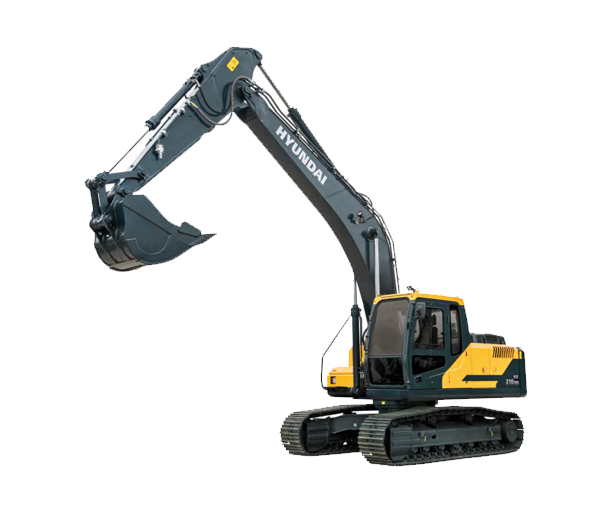
HX210HD Crawler Excavator for Construction, Earthmoving and Heavy-Duty Work
When I talk with a customer about a crawler excavator, I usually ask one simple question first: what kind of work will the machine actually do?
It sounds basic, but this question saves a lot of trouble later.
A customer may say, “I need a 21-ton Excavator.” But that does not tell me whether the machine will be digging foundations, opening drainage trenches, preparing roads, loading trucks, working in a quarry, or moving soil all day on a large construction site.
For me, the machine needs to match the job. Engine power, hydraulic flow, bucket capacity, working range, machine weight and attachment selection all have to make sense together.
The Hyundai HX210HD Crawler Excavator is a medium-class tracked excavator designed for demanding construction and earthmoving applications. Hyundai's official specification lists an operating weight of approximately 21 tons, rated power of 110 kW at 2,000 rpm, and a bucket capacity of 1.2 m³, with a published bucket range of 0.87–1.20 m³. The machine uses a Hyundai 6BTAA-5.9 engine and two main hydraulic pumps rated at 234 L/min each.
That combination puts the HX210HD in a practical size range for contractors who need more than a Compact Excavator but do not necessarily need to move into a much heavier machine class.
At Ganglong Heavy Industry Technology (Hefei) Co., Ltd., we work with construction machinery from the supply and international trade side. We help customers confirm machine specifications, configuration, availability, inspection requirements, attachments, documents and shipping arrangements.
So on this page, I am not going to simply repeat a product brochure. I want to explain how I look at the HX210HD Crawler Excavator, what its main specifications mean in real work, where I would use it, and what I would check before arranging an international order.
The Hyundai HX210HD is a tracked Hydraulic Excavator in the 21-ton class. It is designed for jobs where stable digging performance, hydraulic working power and a strong crawler undercarriage are more important than high road speed.
Unlike a Wheeled Excavator, a crawler excavator is not designed mainly for traveling long distances on public roads. It is designed to move around the jobsite, position itself on suitable ground and spend most of its working time digging, lifting, swinging and loading.
That difference is important.
When I look at an excavator for a construction project, I do not only look at how quickly it can travel. I look at how well it can repeat the working cycle.
Dig.
Lift.
Swing.
Dump.
Swing back.
Repeat.
That simple cycle may happen thousands of times over the working life of the machine.
Hyundai lists the HX210HD at around 21 tons operating weight. Its standard published bucket capacity is 1.2 m³, with a 0.87–1.20 m³ bucket range.
For general earthmoving, trenching, foundation excavation and road construction, this gives the machine a useful balance between working capacity and overall machine size.
| Specification | HX210HD Published Data | Why I Look at It |
|---|---|---|
| Machine type | Medium crawler excavator | Shows the general machine class |
| Operating weight | 21 ton | Important for working stability and transportation |
| Rated power | 110 kW / 2,000 rpm | Engine output |
| Engine | Hyundai 6BTAA-5.9 | Published engine model |
| Bucket capacity | 1.2 m³ | Standard published bucket capacity |
| Bucket range | 0.87–1.20 m³ | Configuration range |
| Main pump flow | 2 × 234 L/min | Hydraulic system capacity |
| Implement circuit | 350 kgf/cm² | Published hydraulic pressure |
Source: Hyundai construction equipment official HX210HD product specification. Actual specifications should be confirmed for the exact machine configuration and destination market.
One thing I always tell customers is that the model number is only the starting point.
The actual bucket, boom, arm, track width, attachments and other equipment can change the final machine specification.
That becomes especially important when arranging international shipping.
The working principle of the HX210HD is actually quite easy to understand.
The diesel engine creates mechanical power. The hydraulic pumps turn that engine power into hydraulic flow. Hydraulic oil then travels through the system and operates the boom, arm, bucket, swing system and travel motors.
In simple language, the engine provides the energy, while the hydraulic system delivers that energy to the parts that need to move.
Imagine the HX210HD working on a foundation excavation.
I would first position the machine on suitable ground. The crawler tracks provide the working platform, while the upper structure can rotate around the machine's center.
The operator lowers the boom and moves the arm toward the soil.
The bucket teeth enter the ground.
The bucket cylinder curls the bucket and fills it with material.
The boom then lifts the loaded bucket. The upper structure swings toward a dump truck or stockpile, and the bucket opens.
The material falls out.
The machine swings back.
Then the next cycle begins.
This is why hydraulic response matters so much. An excavator is not useful just because it has a powerful engine. The power has to be transferred smoothly to the working equipment.
Hyundai lists the HX210HD with two main pumps rated at 234 L/min each. The implement circuit is listed at 350 kgf/cm².
For an operator, hydraulic performance is felt through the controls.
When the boom rises, the arm moves and the machine swings, the hydraulic system has to manage different functions at the same time.
That is particularly important when the machine is loading trucks or working in a tight excavation area.
A smooth working cycle is usually more useful than simply chasing the fastest possible movement.
The crawler tracks are one of the biggest differences between this machine and a wheeled excavator.
Tracks spread the machine's weight over a larger contact area. That helps create a stable working platform on suitable jobsite surfaces.
Hyundai lists a maximum traction force of 21,100 kgf and maximum gradeability of 35 degrees for the HX210HD.
I would not interpret the 35-degree figure as permission to work on any slope at that angle. Real conditions matter. Soil, moisture, track condition, machine orientation and site safety requirements can completely change what is safe.
Published performance numbers are useful for comparison, but the operator still has to work within the machine's manual and actual site conditions.
The HX210HD's approximately 21-ton operating weight puts it into a useful medium excavator class.
For many contractors, this size provides a good working platform for serious excavation without moving into the much larger machines used for very heavy mining applications.
Machine weight also affects transport planning.
When I arrange an international order, I do not use the model name alone to calculate shipping requirements. I confirm the actual configuration and equipment first.
A different bucket, arm, track width or attachment can change the final shipping information.
Hyundai lists the HX210HD with 110 kW rated power at 2,000 rpm, equivalent to 147 hp in the manufacturer's published specification.
Engine power is important, but I would never judge an excavator from horsepower alone.
Think about it this way: the engine is the source of power, but the hydraulic system, pump flow, working equipment and machine weight determine how that power is used.
That is why I prefer to look at the complete specification instead of one large number.
The published HX210HD bucket capacity is 1.2 m³, with a listed range of 0.87–1.20 m³.
This is a practical size for many general excavation and earthmoving tasks.
But bucket capacity should always match the material.
Loose soil is not the same as wet clay. Gravel is not the same as hard rock. A general-purpose bucket is not automatically the right bucket for quarry work.
When a customer tells me they need an HX210HD for mining or quarrying, I ask about the material first.
That small conversation can prevent a much bigger problem later.
The official Hyundai HX210HD specification lists the 6BTAA-5.9 engine and a maximum torque of 64 kgf·m at 1,300 rpm.
For an international buyer, I also look beyond the engine name.
Where will the machine work? Is there local technical support? Can service parts be sourced conveniently? Does the destination have specific emissions or import requirements?
These questions can be just as important as the machine's initial purchase price.
Hyundai lists a 12.2 rpm swing speed for the HX210HD.
Swing speed affects how quickly the upper structure can move between the digging and dumping positions.
In actual work, though, I would rather have controlled movement than simply maximum speed.
The operator needs to position the bucket accurately, especially around trucks, trenches, buildings and other machines.
The official specification lists a 340-liter fuel tank and a 160-liter hydraulic tank.
A fuel tank of this size can be useful when the machine is working for long periods away from a convenient fuel station.
However, I would not tell a customer that the machine will run for a fixed number of hours simply because we know the tank capacity.
Fuel consumption depends on workload, soil, attachment, operator habits, idle time and many other factors.
When a customer asks me to compare machines, I prefer to put the key figures next to each other.
| HX210HD Specification | Published Value | Practical Meaning |
|---|---|---|
| Operating weight | 21 ton | Medium excavator working class |
| Rated power | 110 kW / 2,000 rpm | Main engine output |
| Engine model | Hyundai 6BTAA-5.9 | Diesel engine |
| Maximum torque | 64 kgf·m / 1,300 rpm | Published engine torque |
| Bucket capacity | 1.2 m³ | Standard published capacity |
| Bucket range | 0.87–1.20 m³ | Different working configurations |
| Main pump flow | 2 × 234 L/min | Hydraulic pump flow |
| Implement circuit | 350 kgf/cm² | Published hydraulic pressure |
| Swing speed | 12.2 rpm | Upper structure swing speed |
| Travel speed | 5.7 km/h | Published travel speed |
| Maximum traction force | 21,100 kgf | Published travel force |
| Maximum gradeability | 35° | Published climbing capability |
Source: Hyundai Construction Equipment official HX210HD product specification.
There is another comparison I think is especially useful for buyers because Hyundai has several similar model names.
| Model | Operating Weight | Rated Power | Bucket Capacity | Main Pump Flow |
|---|---|---|---|---|
| HX210HD | 21 ton | 110 kW / 2,000 rpm | 1.2 m³ | 2 × 234 L/min |
| HX210HD+ | 20.78 ton | 110 kW / 2,000 rpm | 0.92 m³ | 2 × 240 L/min |
| HX210S | 20.83 ton | 110 kW / 2,000 rpm | 0.92 m³ | 2 × 222 L/min |
| HX220HD | 21.4 ton | 110 kW / 2,000 rpm | 1.2 m³ | 2 × 234 L/min |
Source: Hyundai Construction Equipment official product specifications for HX210HD, HX210HD+, HX210S and HX220HD. Specifications shown are published model data and should not be treated as a performance ranking.
This table explains why I always ask customers to give me the complete model name.
HX210HD and HX210HD+ sound almost the same, but their published specifications are different.
The HX210HD is listed with a 1.2 m³ bucket and 2 × 234 L/min main pump flow, while the HX210HD+ is listed with a 0.92 m³ bucket and 2 × 240 L/min. The HX210S is also a different configuration, with a published 0.92 m³ bucket and 2 × 222 L/min main pump flow.
For a buyer, one extra letter in the model name can make a real difference to the equipment specification.
Hyundai's HX210HD/HX220HD product literature describes a 5,680 mm boom and a 2,920 mm arm for the relevant standard configuration. The published material also describes heavy-duty boom and arm construction, reinforced bucket and bucket linkage, and a strong lower frame.
There are also different bucket and working-equipment options, including rock-heavy-duty and long-reach configurations in Hyundai's literature. Option availability can vary by region.
That is important because the “best” working equipment depends on the job.
If I am discussing a normal earthmoving project, I look at a general-purpose bucket.
If the customer is working in abrasive material, I pay much more attention to bucket construction and wear parts.
If the customer needs a deep trench, I look at the arm and working range.
There is no reason to pay for equipment that the job does not need.
General construction is one of the most straightforward applications for the HX210HD.
The machine can support excavation, soil removal, site preparation, trenching and material handling on suitable jobsites.
Its 21-ton working class gives contractors a machine that is considerably larger than compact Excavators while remaining below the very large machines used for extreme earthmoving and mining work.
Foundation work needs more than digging power.
The operator often needs to control the bucket carefully and remove soil according to a planned depth and shape.
The HX210HD can be used for foundation excavation when its working range and configuration fit the project.
I would always check the required excavation depth, working space and soil conditions before confirming the machine.
Road projects involve a mixture of tasks.
There may be earth removal, drainage trenches, roadbed preparation, slope work and material handling.
A crawler excavator is useful because it can move around the construction area without depending on road-going mobility.
The HX210HD's 1.2 m³ bucket also gives it a practical working size for many general earthmoving operations.
Drainage and pipeline projects often involve repeated trenching.
The excavator digs a section, removes the soil, moves the material, and then repeats the process.
The HX210HD can support this kind of work when the bucket and arm configuration match the required trench size.
For utility projects, I always add one important reminder: underground services need to be identified before excavation. A powerful excavator does not make an unknown cable or pipe disappear.
Industrial parks, warehouses, housing projects and commercial developments often require large amounts of earthmoving before construction begins.
The HX210HD can be used for site preparation, soil removal, drainage preparation and other suitable earthmoving tasks.
Its crawler platform also makes it practical for moving around prepared construction areas.
The HX210HD can be considered for selected mining and quarry tasks, but I would not automatically treat a standard configuration as a heavy rock machine.
Rock is hard on equipment.
It can increase wear on buckets, teeth, arms, booms and undercarriage components.
If a customer tells me, “We want to use it in a quarry,” I ask what kind of material they are working with.
Granite, limestone, loose stone and blasted rock can create very different working conditions.
Once I understand the material, I can discuss whether a heavy-duty bucket or another configuration makes sense.
With a suitable bucket or attachment, an excavator can also handle soil, aggregate and other materials.
The machine's swing function makes it possible to move material between different positions without constantly repositioning the entire excavator.
For special material handling, the attachment must be checked carefully for hydraulic compatibility and machine balance.
When someone contacts me looking for an HX210HD Excavator for Sale, the first question is usually price.
That is understandable.
But before I give a final commercial offer, I prefer to confirm the machine details first.
I first confirm that the customer needs the HX210HD rather than HX210HD+, HX210S or another nearby model.
This is not just a paperwork issue.
As the comparison above shows, these models can have different bucket capacities, pump flows, operating weights and other specifications.
I ask where the machine will work.
Building construction
Road construction
Foundation excavation
Drainage
Pipeline trenching
Land development
Mining
Quarrying
General earthmoving
Then I ask what material the machine will dig.
Soil and rock are not the same job.
This information helps us discuss the correct bucket and attachment.
I confirm the bucket, boom, arm, track configuration and any requested attachment.
This is also important for transportation planning.
A customer may have a specific working requirement that changes the machine configuration from the standard setup.
Production or preparation time depends on the selected model, configuration, order quantity and machine availability.
For that reason, I prefer to confirm the actual supply situation before giving a firm delivery schedule.
This matters even more when the excavator is being purchased for a project with a fixed starting date.
Before shipment, we can arrange inspection according to the confirmed order.
For an HX210HD, inspection can cover:
Machine appearance
Engine condition
Hydraulic system
Electrical system
Boom and arm movement
Bucket operation
Swing function
Travel function
Undercarriage condition
Attachments
Required documents
I find it much easier to solve a problem before loading than after the machine is already on a vessel.
For international machinery orders, T/T is commonly used.
A deposit is generally arranged before order processing, while the balance is paid before shipment. The exact payment terms are agreed between both parties.
The commercial documents should clearly state the machine model and agreed configuration.
For international orders, complete excavators are generally transported by sea.
The actual method depends on the destination, port, machine dimensions, loading requirements and vessel schedule.
The machine is securely fixed during transportation. Loose accessories and smaller parts can be packed separately in cartons or wooden cases where appropriate.
Suitable spare parts and accessories can also be shipped by air or express when required.
Ganglong Heavy Industry Technology (Hefei) Co., Ltd. was founded in 2013.
Together with Hefei Ganglong International Trade Co., Ltd., we operate across several areas of the construction machinery business, including construction machinery, mining machinery, agricultural machinery and matching attachments.
We have our own HKLOONG product range, including excavators, loaders, Backhoe loaders and swamp excavators.
At the same time, we provide complete machine sales and leasing services for domestic and international brands including Hitachi, SANY, Lonking, Hyundai, XCMG, SHANMON and LOVOL.
I want to make one point very clear.
Ganglong is not the manufacturer of Hyundai equipment.
Hyundai is the original equipment brand.
Our role is to supply and arrange construction machinery, provide international trade support and help customers source the required machine according to their project needs.
That means we can help with model confirmation, configuration discussion, availability, inspection, documents and shipping.
I believe this distinction is important because a machinery buyer should always know who manufactures the equipment and who is handling the supply.
Construction projects rarely use just one machine.
A contractor may need an excavator for digging, a loader for loading, attachments for special tasks and other machines for material handling.
Because our business also covers mining machinery and agricultural machinery, we can discuss combined equipment requirements when a project needs more than one category.
For fleet customers, this can make procurement easier.
Hefei Ganglong International Trade Co., Ltd. serves as our professional international trade arm.
Our team has experience serving customers in Asia, Africa, America and other regions.
International machinery supply is not simply about putting a machine on a ship.
There are commercial documents, inspection, machine preparation, loading, transportation and destination requirements to coordinate.
We handle these steps according to the confirmed order.
I prefer to confirm details early.
If the customer needs a particular bucket, we check it.
If a hydraulic attachment is required, we confirm its compatibility.
If the customer wants a pre-shipment inspection, we agree on the inspection points.
If the destination has special shipping requirements, we discuss those before loading.
For heavy equipment, small details can become expensive problems if nobody checks them early.
Hyundai's official product page lists the HX210HD at approximately 21 tons operating weight. The exact weight can vary with equipment and configuration, so the final machine specification should be confirmed before shipment.
The official Hyundai specification lists the Hyundai 6BTAA-5.9 engine.
The published rated power is 110 kW at 2,000 rpm, or 147 hp in Hyundai's published specification.
Hyundai lists a standard bucket capacity of 1.2 m³, with a published range of approximately 0.87–1.20 m³.
The HX210HD uses two main hydraulic pumps, each listed at 234 L/min.
Hyundai lists the implement circuit at 350 kgf/cm².
The published swing speed is 12.2 rpm.
Hyundai lists a travel speed of 5.7 km/h for the HX210HD.
The official specification lists maximum traction force at 21,100 kgf.
The published maximum gradeability is 35 degrees. This is a manufacturer specification and should not be treated as a general operating recommendation. Actual slope work must follow the machine manual and site safety requirements.
The HX210HD is listed with a 340-liter fuel tank and a 160-liter hydraulic tank.
Yes. The HX210HD can be used for suitable road excavation, drainage, earthmoving, roadbed preparation and material handling work.
Yes. Its 21-ton-class size and crawler design make it suitable for many foundation excavation and site-preparation applications when the working range matches the project.
Yes. It can be used for many trenching and utility excavation projects. The correct bucket and arm configuration should be selected according to trench depth, width and material.
Suitable hydraulic attachments can be considered, but compatibility must be checked first. Hydraulic flow, pressure, attachment weight, mounting dimensions and machine balance all need to be considered.
They are separate Hyundai models. The HX210HD is listed at 21 tons with a 1.2 m³ bucket and 2 × 234 L/min main pump flow, while the HX210HD+ is listed at 20.78 tons with a 0.92 m³ bucket and 2 × 240 L/min main pump flow.
The HX210S is also a separate model. Hyundai lists the HX210S at 20.83 tons with a 0.92 m³ bucket and 2 × 222 L/min main pump flow, while the HX210HD is listed at 21 tons with a 1.2 m³ bucket and 2 × 234 L/min.
Yes. Ganglong can arrange international machinery supply according to the confirmed machine, configuration, destination and commercial terms. Complete machines are generally transported by sea.
Yes. We can arrange checks covering the machine appearance, engine, hydraulic system, electrical system, working functions, attachments, undercarriage and required documents according to the confirmed order.
No. Hyundai is the original equipment brand. Ganglong is a construction machinery supplier and international trade service provider. We help customers source and arrange Hyundai machinery according to their requirements.
When I look at the Hyundai HX210HD Crawler Excavator, I see a machine built around a straightforward idea: provide a solid medium-class excavator for serious construction work.
The published numbers tell the basic story.
Approximately 21 tons operating weight.
110 kW rated power.
1.2 m³ standard bucket capacity.
2 × 234 L/min main hydraulic pump flow.
350 kgf/cm² implement circuit pressure.
12.2 rpm swing speed.
340 liters fuel tank capacity.
These figures make the HX210HD relevant to many applications including construction, foundation excavation, roadwork, drainage, trenching, land development and selected mining or quarry tasks.
But numbers alone do not make a good machine choice.
I always come back to the job.
What material are you digging?
How deep do you need to go?
How much material needs to be moved each day?
Will you use a standard bucket or a hydraulic attachment?
How much space does the machine have to work in?
How will the machine be transported to the project?
Once those questions are clear, choosing the right configuration becomes much easier.
I also recommend paying attention to the exact model suffix. Hyundai publishes several similar models, including HX210HD, HX210HD+ and HX210S, and their specifications are not identical.
At Ganglong Heavy Industry Technology (Hefei) Co., Ltd., we can help with that process from the supply side.
We can discuss the required Hyundai excavator model, confirm the configuration, check availability, arrange inspection, coordinate documents, agree on commercial terms and organize international transportation.
For customers searching for a Hyundai HX210HD Excavator, HX210HD crawler excavator for sale, HX210HD Hydraulic Excavator, 21 ton crawler excavator or Hyundai excavator for construction, I recommend starting with the project rather than the keyword.
Tell us what the machine needs to do, where it will work and where it needs to go. From there, we can work through the machine configuration and supply details step by step.
Technical note: Hyundai specifications may vary by market, machine configuration, working equipment and optional equipment. The specifications used on this page are based on Hyundai's published HX210HD information and should be checked against the final machine specification and commercial documents before an order is confirmed.
info@hkloong.com
86 158 5511 9567


©2026 HKLOONG Heavy Industry Technology (Hefei) Co., Ltd. All Rights Reserved.

This website uses cookies to ensure you get the best experience on our website.
 Español
 Pусский
 Français
 العربية
 WhatsApp
 Phone
Phone E-mail
 Message