

Introduction to Amphibious Wetland Excavators
Amphibious Excavators—also known as swamp or Wetland excavators—are designed for construction operations in swamps and shallow water areas.
For detailed specifications and configuration parameters for wetland excavators ranging from 7 to 40 tons, please contact the dealer.
Core Structural Features
The upper structure consists of a standard Hydraulic Excavator unit, while the undercarriage is replaced with a sealed pontoon
base and widened tracks. The pontoons provide buoyancy, and the tracks allow for movement across silt and shallow water without sinking (unlike standard excavators), enabling seamless operation across land, swamp, and shallow water zones.
Key Functions
River Dredging and Desilting
Clearing silt and weeds from riverbeds and ditches, as well as widening and deepening waterways (e.g., excavating silt directly from the river channel); this is the most common application in inland waterway management.
Wetland and Tidal Flat Ecological Restoration
Wetland rehabilitation, swamp excavation, tidal flat development, and reed pond management, helping to protect wetland water systems.
Hydraulic Embankment Construction
River levee reinforcement, cofferdam excavation, flood control and emergency response, and flood defense projects in low-lying areas.
Pond and Fish Farm Modification
Excavating fish ponds, desilting shrimp ponds, and removing sediment from reservoirs.
Soft-Ground Earthworks
Excavation in swamps and low-lying soft-soil areas; enables construction on muddy sites inaccessible to standard excavators.
Advantages
Moves freely through shallow water and silty swamps without the need for support vessels;
Versatile functionality; supports interchangeable attachments such as buckets and Hydraulic Breakers;
Suitable for operations in narrow rivers and wetlands where large dredging vessels cannot enter.
Applicable Scenarios
River management, wetland restoration, hydraulic engineering, tidal flat development, fish pond modification, and flood control/emergency response.
Relying on a pontoon-track undercarriage, the amphibious wetland excavator operates in swamps, shallows, and silty riverbeds. It is primarily used for river dredging, wetland restoration, pond excavation, and embankment construction, making it ideal for soft-ground or aquatic environments where standard excavators cannot operate.
Hitachi 210 Wetland excavator for Soft Ground, Dredging and Wetland Work
When I talk about a Hitachi 210 Wetland excavator, I do not simply mean a standard 20-ton Excavator working beside water. Wetland jobs are different. The ground can be soft, muddy, uneven, or partly covered by water, and a machine that performs well on ordinary construction sites may not be the right choice in these conditions.
In our daily work at Ganglong Heavy Industry Technology (Hefei) Co., Ltd., we pay close attention to the actual working environment before recommending an excavator. For wetland construction, dredging, drainage, land reclamation, riverbank maintenance, and similar jobs, we normally look at track width, ground pressure, machine stability, working reach, hydraulic performance, attachment requirements, transport conditions, and after-sales support together.
The keyword Hitachi 210 Wetland excavator is commonly used to describe a Hitachi 210-class excavator configured or selected for wetland applications. It should not automatically be understood as the official name of one fixed Hitachi factory model. Hitachi Construction Machinery currently lists the ZX210-7G class with an engine rated output of 120 kW, operating weight of approximately 19,800–21,600 kg, and bucket capacity of 0.8–1.1 m³. Exact specifications vary according to market, configuration, attachment, and machine version.
That distinction matters when buying construction machinery. I would rather confirm the exact machine configuration with a customer than give a nice-looking specification sheet that does not match the actual excavator.
A Hitachi 210 Wetland excavator is generally understood as a Hitachi 210-class crawler excavator prepared for soft-ground and waterlogged working conditions. The basic excavator provides the digging power, hydraulic system, upper structure, engine, and crawler undercarriage. The wetland configuration focuses more attention on how the machine spreads its weight and moves across weak ground.
This is the key difference.
On hard ground, a normal crawler excavator can usually travel and dig without much trouble. On a wetland site, the same machine may sink, slide, or become difficult to recover if the ground cannot support its weight. A wider crawler system can distribute the machine load over a larger area. This can help reduce ground pressure and improve stability.
Depending on the project, the machine may also be supplied with wider track shoes, extended or specially configured undercarriage components, longer working equipment, dredging attachments, buckets, hydraulic tools, or other accessories.
I always recommend looking at the complete working package instead of focusing only on the excavator model number. A machine that looks suitable on paper may need a different undercarriage or attachment before it becomes practical for a particular marsh, riverbank, pond, or drainage project.
Typical applications include:
Wetland construction
River and canal dredging
Drainage and water conservancy projects
Land reclamation
Riverbank maintenance
Pond cleaning
Agricultural drainage work
Environmental restoration projects
Municipal engineering
Mining and material handling in difficult terrain
For customers searching for a Hitachi 210 excavator for wetland work, the important question is not simply whether the machine is a 210-class excavator. The better question is whether its complete configuration matches the ground conditions, working depth, transport restrictions, attachment requirements, and expected workload.
The working principle is still familiar: the engine supplies power, the hydraulic system transfers that power to the working equipment and travel system, and the boom, arm, and bucket perform digging, lifting, loading, and material-handling work.
The difficult part is getting all of this to work safely on weak ground.
When an excavator sits on muddy soil, its weight creates pressure on the ground through the tracks. If the contact area is small, the pressure can be high. If the ground is too soft, the tracks may sink. Wider shoes increase the contact area and can help distribute the machine weight across a larger surface.
This is why wide track wetland excavator and low ground pressure excavator are common search terms in this field.
For example, Hitachi's official specifications for the ZX210LC-6 show an operating weight of about 22,800 kg with 800 mm triple-grouser shoes and a listed ground pressure of approximately 35 kPa. This is a useful reference when discussing how undercarriage configuration affects ground pressure, but it should not be treated as the specification of every Hitachi 210 wetland configuration.
The newer ZX210LCK-7 specification published by Hitachi Construction Machinery Japan lists an operating weight of 23,100 kg, a 600 mm reinforced triple-grouser shoe, and ground pressure of about 48 kPa. The standard bucket capacity shown there is 0.80 m³.
These figures show something important: even within the same 210-class family, the machine configuration can change the operating weight and ground pressure. That is why we check the actual configuration before discussing wetland performance.
| Reference machine | Operating weight | Track shoe | Ground pressure | Source |
|---|---|---|---|---|
| Hitachi ZX210LC-6 | Approx. 22,800 kg | 800 mm | Approx. 35 kPa | Hitachi Construction Machinery |
| Hitachi ZX210LCK-7 | 23,100 kg | 600 mm | Approx. 48 kPa | Hitachi Construction Machinery Japan |
Source: official Hitachi Construction Machinery specifications. Values are configuration-specific and are provided here as technical reference, not as universal specifications for all Hitachi 210 machines.
For a real wetland project, I also consider the depth and type of mud. A machine working on firm wet soil beside a river is very different from a machine working in deep marshland. Ground bearing capacity, water depth, slope, access route, and recovery arrangements all need to be considered.
Tracks are one of the first things I check. Wider track shoes can increase the ground contact area and may reduce ground pressure. For wetland work, this can make a noticeable difference in stability and travel performance.
Hitachi's official ZX210-7 SLF specifications show available 600, 700, 800, and 900 mm track shoe widths, with listed ground pressure decreasing as wider shoe configurations are used. The same model has an operating weight range of 24,600–25,500 kg depending on configuration.
This does not mean that every Hitachi 210 should use 900 mm shoes. Wider tracks also affect overall machine width, transport requirements, turning behavior, and cost. The right choice depends on the job.
A crawler excavator needs enough stability to work while the upper structure is rotating and the bucket is carrying material. This becomes more important when the machine is operating near water or on uneven ground.
I normally ask customers about the working surface before recommending a configuration. If the machine will spend most of its time on firm riverbank soil, the requirements may be quite different from a machine that will enter deep mud regularly.
Hydraulic power controls the boom, arm, bucket, swing, and travel functions. Dredging and wetland work can involve repeated digging, lifting, swinging, and dumping cycles, so smooth hydraulic response is important.
The operator should be able to control the attachment without sudden movements, especially when working near water, slopes, pipelines, drainage structures, or other equipment.
Wetland terrain is rarely perfectly flat. There may be mud ridges, roots, stones, shallow water, drainage channels, and other obstacles. Sufficient clearance can help the undercarriage pass through difficult areas without constantly contacting the ground.
The standard bucket is not always the best tool for wetland work. Depending on the project, customers may need a Dredging Bucket, Mud Bucket, Grading Bucket, long-reach configuration, hydraulic grab, or other attachment.
That is why I treat the attachment as part of the machine package rather than an afterthought.
When customers ask me about the technical side of a Hitachi 210 Wetland excavator, I usually start with official Hitachi data and then move toward the actual project requirements.
The current Hitachi global medium excavator information identifies the ZX210-7G class with 120 kW engine rated output, 19,800–21,600 kg operating weight, and 0.8–1.1 m³ bucket capacity.
Hitachi's North American ZX210LC-7H specification sheet provides another useful reference. It lists a maximum digging reach of 9,920 mm, maximum digging depth of 6,670 mm, maximum cutting height of 10,040 mm, maximum dumping height of 7,180 mm, and minimum swing radius of 3,180 mm for the stated 2.91 m arm configuration.
| Technical item | Hitachi ZX210-7G class | Hitachi ZX210LC-7H reference |
|---|---|---|
| Engine rated output | 120 kW | Varies by regional specification |
| Operating weight | 19,800–21,600 kg | Configuration dependent |
| Bucket capacity | 0.8–1.1 m³ | Configuration dependent |
| Maximum digging reach | Configuration dependent | 9,920 mm |
| Maximum digging depth | Configuration dependent | 6,670 mm |
| Maximum dumping height | Configuration dependent | 7,180 mm |
Source: Hitachi Construction Machinery global medium excavator information and official ZX210LC-7H specification sheet. These figures come from different regional/configuration documents and should not be combined into one exact machine specification.
For wetland projects, I put particular attention on the undercarriage. Hitachi's ZX210LC-7H dimensions document lists an 800 mm track shoe and 3,190 mm overall width for the stated configuration. It also lists minimum ground clearance of 450 mm.
Again, these numbers are references, not a promise that every Hitachi 210 Wetland excavator will have exactly the same dimensions.
In my experience, the 210 class sits in a practical middle ground for many construction and environmental projects. It is large enough to handle serious excavation and material-handling work, while remaining easier to transport than many heavier mining Excavators.
For a river improvement project, for example, the machine may need to remove mud, shape a riverbank, load material, clear vegetation, and move between different work points. A properly configured 210-class excavator can handle several of these tasks with suitable attachments.
For dredging, reach becomes particularly important. Hitachi also offers a ZX210-7 SLF super long front excavator designed for earthmoving work such as dredging, bank maintenance, and slope finishing. Hitachi lists a 15,400 mm maximum digging reach and 11,540 mm maximum digging depth for the published configuration.
This gives us a good example of why the base machine and final configuration should be considered separately. A customer looking for a Hitachi 210 Dredging Excavator may need a different working front from someone performing general wetland excavation.
The same principle applies to attachments. A bucket designed for dense soil is not automatically the best bucket for loose mud. A long-reach setup that is useful for riverbank work may not be ideal for heavy digging close to the machine.
There is no magic configuration that does everything equally well. Good machinery selection is usually about matching the machine to the job.
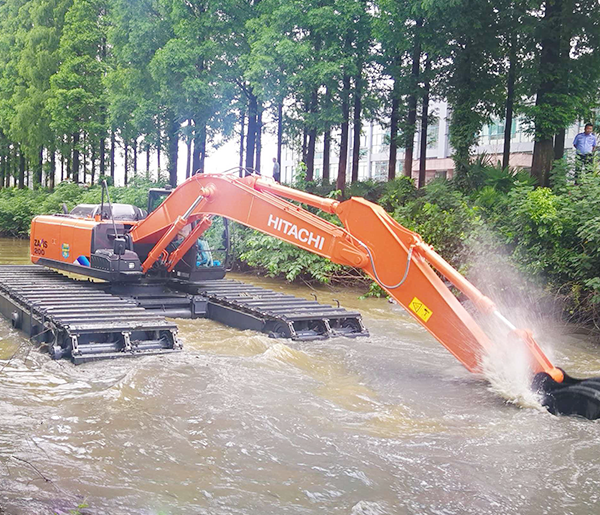
Wetland construction often involves soft soil and restricted access. A machine with a suitable crawler configuration can help with excavation, grading, material movement, and site preparation.
For rivers, canals, ponds, and drainage channels, the machine may be used to remove sediment, reshape banks, clear channels, and handle excavated material.
When greater working reach is required, a long-reach configuration can be considered. Hitachi itself describes its ZX210-7 SLF as suitable for dredging, bank maintenance, and slope finishing.
Water conservancy construction can include canal maintenance, embankment work, drainage improvement, pond excavation, and related earthmoving. These projects often require careful control around water and soft soil.
Farm drainage projects may involve cleaning channels, opening new drainage paths, removing accumulated soil, and maintaining wet farmland. A suitable wetland excavator can save considerable manual labor on these jobs.
Wetland restoration projects often require controlled excavation rather than simply moving as much soil as possible. The operator may need to remove unwanted material, shape shallow areas, improve drainage, or prepare land for ecological restoration.
Municipal projects sometimes involve difficult ground beside roads, waterways, drainage systems, and urban development areas. Machine size, transport width, working reach, and attachment choice all become important.
In selected mining and material-handling applications, a 210-class excavator can be used with suitable buckets or hydraulic attachments. The exact configuration should always be selected according to the material, ground condition, and required production rate.
Ganglong Heavy Industry Technology (Hefei) Co., Ltd. was founded in 2013. Together with Hefei Ganglong International Trade Co., Ltd., we operate across equipment R&D, manufacturing, testing, customization, sales, and international trade activities.
At the same time, I want to make one point very clear: when a customer asks us for a Hitachi 210 excavator, we do not present ourselves as the manufacturer of Hitachi equipment. We provide complete machine sales and leasing services for brands including Hitachi, SANY, Lonking, Hyundai, XCMG, SHANMON, and LOVOL. Our job is to help customers source the right machine and configuration.
This approach is especially useful when the customer needs more than a standard machine.
Before confirming an order, I normally check the following information:
Exact Hitachi model and production version
New or used machine requirement
Working location and ground condition
Required track shoe width
Standard or long-reach working equipment
Bucket type and capacity
Required hydraulic attachments
Emission requirements in the destination market
Shipping port and transportation method
Required spare parts and service items
Once the configuration is confirmed, production or sourcing time depends on the exact excavator model, machine availability, configuration, order quantity, and customization requirements. We confirm the delivery schedule before the order moves forward.
Before shipment, we inspect the machine appearance, engine, hydraulic system, undercarriage, working equipment, and basic operating functions. Standard accessories, manuals, spare parts, and required documents are prepared according to the order.
For international orders, T/T is commonly used, normally with a deposit before production or preparation and the balance before shipment. Complete excavators are generally transported by sea. Smaller spare parts and accessories can be shipped by air or express when suitable.
For packing, the machine is protected with film and securely fixed according to transportation requirements. Loose accessories and spare parts are packed separately, normally using cartons or wooden cases where appropriate.
Our international trade team has experience serving customers across Asia, Africa, America, and other overseas markets. That experience matters because buying an excavator is not simply about finding a machine and putting it on a ship. Documentation, dimensions, loading, customs requirements, spare parts, payment terms, and destination regulations all need attention.
Not necessarily. “Hitachi 210 Wetland excavator” is commonly used as a search and product description phrase for a Hitachi 210-class excavator intended or configured for wetland work. Hitachi has several ZX210-class machines and configurations, so the exact model should be confirmed before purchase.
It depends on the model and configuration. Hitachi's current global information lists the ZX210-7G class at approximately 19,800–21,600 kg operating weight. Other ZX210 versions can have different weights.
It can work in some soft-ground conditions, but a standard configuration should not automatically be treated as a dedicated wetland machine. Ground conditions, water depth, soil bearing capacity, track width, machine weight, attachment, and recovery planning all need to be checked first.
Wider tracks increase the contact area between the machine and the ground. This can help distribute the machine's weight and reduce ground pressure. The actual result depends on machine weight, shoe width, soil condition, and configuration.
Depending on the exact machine and availability, different track shoe widths may be possible. Hitachi publishes configurations with different shoe widths on some ZX210 variants. For example, the ZX210-7 SLF lists 600, 700, 800, and 900 mm shoe options.
Yes, a suitably configured machine can be used in dredging-related work. The working equipment must match the required reach, depth, material, and site conditions. Hitachi's ZX210-7 SLF is specifically presented for applications including dredging and bank maintenance.
Depending on the project, possible attachments include standard buckets, mud buckets, grading buckets, dredging buckets, hydraulic grabs, and other hydraulic tools. We recommend selecting the attachment after understanding the material and working conditions rather than choosing it only by bucket capacity.
There is no single delivery time for every Hitachi 210 Wetland excavator. Timing depends on the exact model, machine availability, configuration, order quantity, customization, inspection, and shipping schedule. We confirm the expected delivery schedule before the order is finalized.
We check the machine appearance, engine, hydraulic system, undercarriage, working equipment, and basic operating functions. We also prepare the required manuals, standard accessories, spare parts, and documents according to the confirmed order.
Complete excavators are normally shipped by sea. Spare parts and smaller accessories can often be sent by air or express. The final transportation method depends on machine dimensions, destination, shipping cost, and customer requirements.
Yes. Besides Hitachi equipment, our group provides complete machine sales and leasing services involving brands such as SANY, Lonking, Hyundai, XCMG, SHANMON, and LOVOL. We also supply construction machinery, mining machinery, agricultural machinery, and matching attachments.
When I evaluate a Hitachi 210 Wetland excavator, I do not start with the word “210”. I start with the ground.
Is the soil firm or deep mud? How much water is present? How far does the machine need to reach? What material will it dig? Does the job need a normal bucket or dredging bucket? How wide can the machine be for transportation? Will it work near a riverbank or drainage channel? What kind of track configuration is suitable?
These questions usually tell us more than the model number alone.
A Hitachi 210-class excavator can provide a useful combination of digging capability, crawler stability, transport practicality, and attachment flexibility. Official Hitachi information also shows that the ZX210 family is available in different configurations, with differences in operating weight, track width, ground pressure, working range, and equipment.
For wetland work, the final configuration is especially important. Wider tracks, suitable attachments, appropriate working equipment, and a realistic understanding of the ground can make the difference between a machine that simply reaches the site and a machine that can actually work there efficiently.
At Ganglong, we focus on matching the equipment with the real project. Whether the requirement is a Hitachi 210 Wetland excavator, a Long-Reach Excavator for dredging, a crawler excavator for soft ground, or another construction machine, we can discuss the working conditions, configuration, inspection requirements, payment terms, shipping method, and spare parts before the order is arranged.
For customers buying internationally, that practical communication is often just as important as the machine itself. A suitable excavator is not only about horsepower or bucket size. It is about getting the right machine, in the right configuration, to the right jobsite.
info@hkloong.com
86 158 5511 9567


©2026 HKLOONG Heavy Industry Technology (Hefei) Co., Ltd. All Rights Reserved.

This website uses cookies to ensure you get the best experience on our website.
 Español
 Pусский
 Français
 العربية
 WhatsApp
 Phone
Phone E-mail
 Message