

PTS4 Self-Priming Sewage Pump for Flexible Wastewater and Dewatering Applications At HKLOONG Heavy Industry Technology (Hefei) Co., Ltd., I look at pumping equipment from a practical point of view: it has to start when the job starts, move difficult water without constant attention, and remain easy enough to service in the field. Alongside our crawler excavators, Wheel loaders, Backhoe loaders and amphibious wetland Excavators, I also provide small equipment for jobs where access is limited and mobility matters. The PTS4 Self-Priming Sewage Pump is positioned for this type of working environment, especially where dirty water, sludge-containing water, sand, grit and other suspended material make ordinary clean-water pumps unsuitable. A 4-inch self-priming sewage pump is useful because it gives operators a practical balance between flow capacity, portability and solids-handling ability. I can see this type of pump being used for construction dewatering, temporary drainage, wastewater transfer, excavation sites, municipal maintenance, agricultural drainage and emergency pumping. The key is not simply the word “pump.” The complete working condition matters: suction distance, discharge height, pipe length, liquid condition, solids content, engine or motor configuration and the amount of time the pump must operate. In this product page, I explain how I approach the PTS4 Self-Priming Sewage Pump, what makes a self-priming design useful, where this type of equipment fits, and what buyers should check before ordering. Because actual pump performance depends on configuration, I recommend confirming the final flow, head, solids-handling size, drive system and dimensions against the specific HKLOONG configuration before purchase.
1. What Is a PTS4 Self-Priming Sewage Pump?
The PTS4 Self-Priming Sewage Pump is a 4-inch class pumping solution intended for applications where the liquid may contain dirt, suspended solids, sand, grit or other materials. Unlike a basic clean-water pump, a sewage or trash pump is designed around a more difficult fluid environment. The pump needs enough internal clearance and a suitable impeller design to reduce the chance of blockage while moving water containing solid particles. The “self-priming” part is equally important. In simple terms, the pump is designed to remove air from the suction line and establish pumping action without requiring the operator to completely fill the suction hose every time the pump is started. This is especially useful on construction sites and temporary drainage jobs where the pump may be moved, stopped and restarted several times. For me, the value of a self-priming pump is not just convenience. It is also about making the daily work routine easier. When a drainage system has to be installed quickly, operators normally want fewer complicated steps between placing the pump and moving water. A self-priming arrangement can help reduce those steps, provided that the suction hose, fittings and installation are correctly selected. Commercial 4-inch self-priming pumps show how wide the performance range can be. For example, published specifications for different 4-inch sewage and trash pump designs can range from several hundred gallons per minute to more than 1,000 GPM, while solids-handling capability can vary considerably. These figures should be treated as product-specific benchmarks rather than assumed specifications for every PTS4 pump. :contentReference[oaicite:0]{index=0} Reference comparison: published 4-inch pump examples Published Pump Example Connection / Size Maximum Flow Solids Handling Maximum Suction / Reprime Information Wacker Neuson PTS4 4 in. 2,322 L/min 50 mm 7.6 m suction head Wastecorp Trash Flow 4 x 4 in. 1,120 GPM 3 in. 25 ft. suction lift DAE MAX440 4 in. intake / 4 in. discharge 900 GPM 1.4 in. 26 ft. automatic priming capability Source: published manufacturer specifications from Wacker Neuson, Wastecorp and DAE Pumps. These figures are reference data for understanding the 4-inch self-priming pump category and are not presented as HKLOONG PTS4 specifications. :contentReference[oaicite:1]{index=1}
2. How the Self-Priming Pump Works
The operating principle is easier to understand than it may sound. A centrifugal pump normally needs liquid around the impeller before it can create useful pumping pressure. Air inside the suction line can prevent a conventional pump from moving water correctly. A self-priming design uses its casing and internal pumping action to help remove that trapped air and establish the liquid flow. When I plan a pumping system, I pay attention to both sides of the pump. The suction side brings wastewater into the pump, while the discharge side sends it toward the drainage point, storage tank, treatment system or other destination. A 4-inch pump can move a significant amount of water, but the real result depends on the complete system rather than pump size alone. For example, a long suction hose can increase resistance. A high discharge point requires more head. Sharp bends and undersized hoses can also reduce useful flow. If the liquid contains large solids, the suction screen or hose design becomes important as well. This is why I do not recommend selecting a sewage pump only by looking at the advertised maximum flow rate. Published PTS4 information from Wacker Neuson provides a useful example of how manufacturers describe this class of equipment. Its PTS4 model is listed as a self-priming centrifugal pump with a 4-inch intake/pressure socket, maximum flow of 2,322 L/min, maximum pump pressure of 3.1 bar, maximum solid diameter of 50 mm and maximum suction head of 7.6 m. :contentReference[oaicite:2]{index=2} These numbers show why a proper pump selection should include more than the product name. If my customer needs a particular flow rate at a particular discharge height, I would first check the operating point and then select the appropriate configuration rather than relying on the maximum published figure.
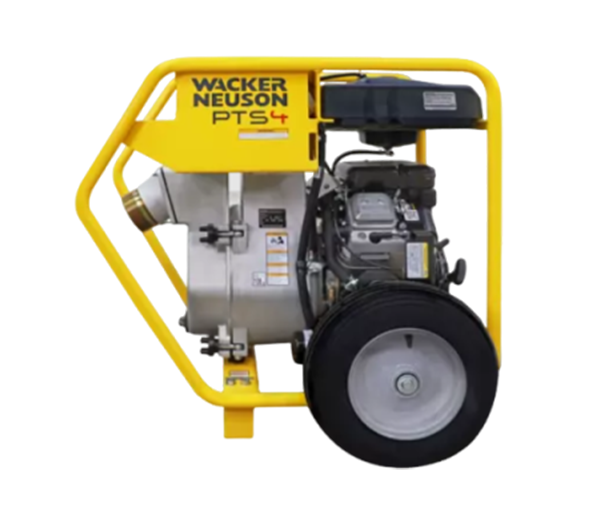
3. Main Features I Focus On Self-priming operation:
The main benefit is easier starting and restarting compared with a conventional pump that requires a fully flooded suction arrangement. This is useful for temporary pumping systems that are frequently moved or restarted. 4-inch flow path: A 4-inch connection is a practical size for many construction and wastewater applications. It provides a useful balance between hose size, handling requirements and potential flow capacity. Dirty-water capability: Sewage and trash pumps are intended for liquids that may contain suspended material. The exact solids size that can pass through a pump depends on its impeller, casing clearance and design. I always recommend checking this value before placing an order. Portable working concept: Small pumping equipment is often used away from a permanent pump station. A compact frame, lifting point, wheel kit or suitable transport arrangement can make a major difference when the equipment has to move around a construction or maintenance site. Practical maintenance: Pumps working with wastewater eventually need inspection. Wear parts, seals, impellers, casing areas and connections should be accessible for checking and replacement. Commercial self-priming sewage pumps commonly include designs that allow operators to access internal components without completely rebuilding the entire unit. For example, Pentair's Hydromatic 40RP specifies a removable rotating assembly and serviceable components, while Wastecorp highlights a back pull-out design and clean-out access on its Trash Flow series. :contentReference[oaicite:3]{index=3}
4. Technical Advantages for Real Working Conditions
When I compare pumping equipment, I focus on what happens after the pump reaches the job site. A pump may have a strong headline specification, but it still needs to deal with hoses, dirty water, changing water levels, limited access and regular maintenance. The first advantage of a self-priming sewage pump is flexibility. It can be used in temporary pumping systems where a permanent submersible installation is not practical. For construction contractors, this can be useful when excavation areas need to remain dry while work continues. The second advantage is solids handling. Wastewater often contains materials that clean-water pumps are not designed to tolerate. Published commercial examples show that solids-handling capability can range from around 1.4 inches to 3 inches or more depending on pump design. :contentReference[oaicite:4]{index=4} The third advantage is serviceability. A pump that is easier to inspect can help reduce unnecessary downtime. For a contractor, this matters because the cost of a stopped job can be much higher than the cost of a replacement component. The fourth advantage is application flexibility. The same basic pumping concept can be used for construction dewatering, wastewater transfer, agricultural drainage and emergency water removal. However, the configuration should always match the liquid and working conditions. Key selection factors for a 4-inch sewage pump Selection Factor Why It Matters What I Recommend Checking Flow rate Determines how quickly water can be moved Required L/min or GPM at the actual operating point Total head Shows how much resistance the pump must overcome Vertical lift plus pipe, hose and fitting losses Solids size Helps reduce clogging and damage risk Largest expected solid particle Suction lift Affects priming and pump performance Vertical distance from water surface to pump Liquid condition Different liquids can affect wear and seals Sand, grit, sludge, chemicals, temperature and debris Drive system Determines how the pump receives power Engine, electric motor or customized arrangement Source basis: manufacturer-published specifications and selection information for 4-inch self-priming and sewage pumps. The table is a practical selection guide, not a specification sheet for one particular pump configuration. :contentReference[oaicite:5]{index=5}
5. Where I Use the PTS4 Self-Priming Sewage Pump Construction dewatering:
Excavation sites can collect rainwater, groundwater and muddy water. Before workers can continue with foundations, pipelines or underground structures, this water may need to be removed. A self-priming pump can be placed outside the deepest part of the excavation while a suction hose reaches the water. Municipal maintenance: Maintenance crews may need temporary pumping during drainage system repairs, pipe work or other infrastructure projects. A portable pump gives the crew another option when the permanent pumping system is unavailable. Wastewater transfer: Where wastewater needs to be moved between temporary tanks, collection areas or treatment points, a suitable sewage pump can provide a practical transfer solution. The actual liquid should always be checked before selecting seals and wetted materials. Agricultural drainage: Farms, irrigation areas, livestock facilities and drainage channels can produce water containing soil, organic material and suspended particles. A suitable trash or sewage pump can be considered where a clean-water pump would not be appropriate. Emergency water removal: Flooding and heavy rainfall can create urgent drainage requirements. In these situations, transport, startup time and ease of operation become particularly important. Industrial sites: Some industrial facilities require temporary removal of process water, wash water or other non-clean liquids. For these applications, I recommend reviewing the liquid chemistry and temperature first. Not every sewage pump is suitable for aggressive chemicals or high-temperature liquids. As a general reference, published 4-inch pump products are used in applications including construction dewatering, wastewater handling, municipal pumping and industrial fluid handling. Wacker Neuson describes its PTS4 for demanding dewatering tasks involving dirty, sandy or gritty water, while Wastecorp lists light wastewater pumping and industrial fluid handling among its applications. :contentReference[oaicite:6]{index=6}
6. Manufacturing and Quality Approach at HKLOONG
At HKLOONG, I treat small equipment with the same practical mindset that I apply to heavy machinery. The fact that a pump is smaller does not mean that manufacturing quality becomes less important. A pump may run for hours under difficult conditions, so the casing, impeller, shaft, seals, connections and drive system all need to work together. Our company integrates equipment R&D, precision manufacturing, quality testing, customized modification and global distribution. This gives us a useful foundation when customers need equipment adapted to a particular working condition instead of simply buying a standard machine from a catalog. For a PTS4 Self-Priming Sewage Pump project, I would normally start by understanding the application. What liquid needs to be pumped? How far does it need to travel? How high does it need to be lifted? What is the expected flow? Are there large solids? How often will the pump be moved? What power source is available? After these questions are clear, the pump configuration can be reviewed. The goal is not to add unnecessary features. The goal is to create a configuration that makes sense for the actual job. Quality control should also cover more than visual inspection. A practical pump evaluation can include checking assembly accuracy, rotating components, sealing areas, connection points, engine or motor installation, operating stability and overall functionality. For export projects, packaging and transport protection are also important because equipment can travel long distances before reaching the final job site. For customers who have special requirements, I can also discuss customized equipment configurations. These may involve drive options, mounting arrangements, hose connections, transport solutions or other application-related details. Final technical specifications should always be confirmed according to the selected configuration.
7. Why I Recommend Working With HKLOONG for Small Equipment Projects
When I work with an equipment buyer, I do not want the conversation to stop at “What is the price?” Price matters, but it is only one part of the purchase. A pump that does not match the actual head, flow, liquid or solids condition can create extra costs later. My approach is to connect the equipment with the working condition. Because HKLOONG has experience across Excavators, loaders, backhoe loaders, amphibious equipment and other machinery, I understand that contractors often need more than one type of equipment on a project. A drainage pump may work alongside excavators, loaders or other site equipment, especially during construction and wetland projects. I also understand that international buyers may have different requirements for power supply, transport, operating environment and local service. That is why customization and technical communication are important parts of our equipment business. For customers looking for a 4 inch self priming sewage pump, self priming trash pump, Portable Sewage Pump, construction dewatering pump or 4 inch wastewater pump, I recommend starting with the working parameters rather than choosing by model name alone. The final product selection can then be based on the required flow, total head, suction lift, solids size, liquid characteristics, power source and operating environment. This makes the purchase more transparent and helps avoid a common mistake: selecting a pump that looks powerful on paper but does not match the actual system. 8. PTS4 Self-Priming Sewage Pump FAQ What is a PTS4 Self-Priming Sewage Pump used for? The pump is intended for applications where dirty water, wastewater, sludge-containing water or water with suspended solids needs to be transferred or removed. Typical applications can include construction dewatering, agricultural drainage, municipal maintenance, wastewater transfer and emergency pumping. The exact suitability depends on the liquid and pump configuration. What does “self-priming” mean? Self-priming means the pump is designed to establish pumping action by handling air in the suction system rather than requiring the operator to completely flood the suction line before every start. The actual priming capability depends on the pump design and installation conditions. Can a 4-inch sewage pump handle solid particles? Yes, many sewage and trash pumps are specifically designed to handle suspended solids. However, the maximum solid size is not determined by the 4-inch connection alone. It depends on the impeller and internal pump design. Published commercial examples show different solids-handling capacities, so I recommend confirming the maximum particle size for the exact configuration before ordering. :contentReference[oaicite:7]{index=7} Is the PTS4 suitable for construction dewatering? Yes, this type of self-priming sewage pump is well suited to many construction dewatering situations, particularly where water contains mud, sand or other suspended material. The required pump capacity should be selected according to the water volume, suction lift, discharge height and pipeline arrangement. Can I use it for clean water? A sewage or trash pump can generally move water, but that does not mean it is always the most economical choice for clean-water duty. If the liquid is clean and contains no solids, a dedicated clean-water pump may be more appropriate depending on the required flow and head. How do I choose the right pump capacity? I recommend providing the required flow rate, suction lift, vertical discharge height, approximate pipe or hose length, pipe diameter, liquid condition and expected solids size. These details allow the pump configuration to be evaluated against the real operating point instead of simply comparing maximum flow numbers. Can HKLOONG customize the PTS4 configuration? HKLOONG supports customized equipment solutions. Depending on the project, customization can be discussed around the drive system, mounting arrangement, connections, transport requirements and other application-related details. Because each modification can affect performance, the final technical configuration should be confirmed with our engineering and sales team before production. What information should I provide when requesting a quotation? I recommend sending the following information: required flow in GPM or L/min, total head, suction lift, discharge distance, hose or pipe size, liquid type, expected solid particle size, operating hours, available power source and project location. If you have photos of the working area or an existing pump, those can also help us understand the application.
Conclusion
The PTS4 Self-Priming Sewage Pump is aimed at a very practical problem: moving difficult water when the job cannot wait for a permanent pumping system. Its 4-inch class makes it suitable for many medium-duty drainage and wastewater tasks, while the self-priming design can make installation and restarting easier in temporary working environments. From my perspective at HKLOONG, the right pump is the one that matches the actual job. Flow, head, suction lift, solids, liquid condition and power source all matter. If those factors are clear before ordering, it becomes much easier to select a suitable configuration and avoid performance problems later. For contractors, municipal teams, agricultural users, equipment distributors and industrial buyers looking for a PTS4 self-priming sewage pump, 4 inch self priming pump, self priming wastewater pump or portable sewage dewatering pump, HKLOONG can discuss the application and provide an equipment configuration based on the required working conditions.
2435092534@qq.com
86 158 5511 9567


©2026 HKLOONG Heavy Industry Technology (Hefei) Co., Ltd. All Rights Reserved.

This website uses cookies to ensure you get the best experience on our website.
 Español
 Pусский
 Français
 العربية
 WhatsApp
 Phone
Phone E-mail
 Message