
 Español
 Pусский
 Français
 العربية


When I talk about a Round Baler, I usually do not start with the machine's appearance or the biggest number on the specification sheet. I start with the material that needs to be baled.
Is it dry hay? Natural grass? Wheat straw? Rice straw? Corn stalks? How large is the field? What tractor is available? How much material needs to be processed during the harvest season?
These questions may sound simple, but they are important.
A round baler is not just a machine that makes round packages. It has to pick up the crop material, feed it smoothly, form a dense bale, hold the bale together and release it at the right time. If one part of this process does not match the crop or tractor, the final result can suffer.
That is why I see a Round Baler as part of a complete harvesting system.
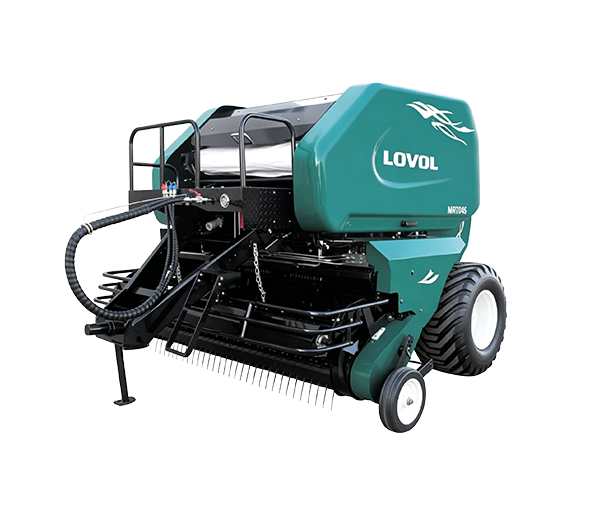
LOVOL describes its 9YRZ Round Baler as equipment for picking up and baling forage, wheat, rice and corn stalks. The published product information highlights strong reliability, operation efficiency, automation, high bale density and adaptability. The current 9YRZ-1.4 specification lists a 2,250 mm Pickup width, net wrapping, 18 forming rollers, a 1,250 × 1,400 mm bale size, rotor feeding and a recommended tractor power of at least 100 hp.
LOVOL also publishes the MR7040 and MR7045 round baler configurations in its broader baler range. These models use an 18-roller forming system, rotor feeding, net wrapping and a published capacity of 30–50 bales per hour, with a matched tractor power requirement of at least 100 hp.
At Ganglong Heavy Industry Technology (Hefei) Co., Ltd., we supply agricultural machinery and matching attachments for international customers. Together with Hefei Ganglong International Trade Co., Ltd., we work with customers on machine selection, configuration confirmation, inspection, documents, packing and international transportation.
For LOVOL equipment, our role is to supply and arrange suitable machines. We do not present third-party LOVOL products as equipment manufactured by Ganglong.
1. What Is a Round Baler?
A Round Baler is an agricultural machine that picks up loose crop material from the field and compresses it into a cylindrical bale.
The working idea is actually quite straightforward.
The tractor pulls the baler through a windrow. The pickup system gathers hay, grass, straw or other suitable material from the ground. A feeding mechanism moves that material into the forming chamber. Inside the chamber, rollers rotate and gradually build the crop into a round bale.
Once the bale reaches the required size and density, the machine wraps it with net or another specified material. The rear section then opens or releases the finished bale, allowing it to return to the field.
That is the basic process.
What makes modern round balers interesting is how many small mechanical systems have to work together to make that process smooth.
Why Use a Round Bale?
Loose hay and straw are difficult to move.
A field full of loose crop material takes up a lot of space, and manual handling can take a huge amount of time.
Compressing the material into round bales makes the crop much easier to collect and transport.
A tractor or suitable loader can move the finished bale. A trailer can carry several bales. A farm can also arrange bales in a dedicated storage area.
For livestock operations, hay and forage can be stored and moved according to feeding needs.
For farms producing straw for bedding, biomass or other uses, baling makes field cleanup and transportation more manageable.
Round Baler vs. Square Baler
Both machines collect and compress crop material, but they create different bale shapes.
A Round Hay Baler creates cylindrical bales, while a square baler creates rectangular bales.
I would not say one type is always better.
The better choice depends on how the farm collects, stores and transports the material.
| Factor | Round Baler | Square Baler |
|---|---|---|
| Bale shape | Cylindrical | Rectangular |
| Typical bale handling | Suitable for mechanical handling | Convenient for stacking and manual handling |
| Common materials | Hay, grass, straw, forage | Hay, grass, straw, forage |
| LOVOL example | 9YRZ Round Baler | 9YF Square Baler |
| Forming method | Roller-based round chamber | Reciprocating square chamber |
Source: LOVOL official agricultural machinery product information for the 9YRZ Round Baler and 9YF Pick-up Square Baler.
2. How a Round Baler Works in the Field
When someone sees a round baler working for the first time, the machine can look complicated.
From the operator's point of view, however, the process can be understood in a few simple stages.
Step 1: The Pickup Collects the Crop
The first job is to collect the material lying in the windrow.
The pickup mechanism rotates as the baler moves forward. Its teeth lift hay, grass or straw from the ground and guide it toward the feeding system.
For the LOVOL 9YRZ-1.4, the published pickup width is 2,250 mm.
A wide pickup can be useful when the windrow is wide and well formed.
But I always remind customers that pickup width alone does not determine field performance.
If the windrow is too thin, scattered or uneven, the baler still has to work harder to create an even bale.
Step 2: The Rotor Feeds the Material
After the pickup collects the crop, the feeding mechanism moves it into the forming chamber.
LOVOL lists a rotor feeding mechanism for the 9YRZ-1.4.
The purpose is simple: keep the crop material moving steadily so the forming chamber receives a consistent flow.
Good feeding is especially important when the crop is dense.
If too much material enters at once, the machine may experience a sudden load. If too little material enters, the bale may take longer to reach its required size.
Step 3: Rollers Form the Bale
Inside the baler, rollers rotate and compress the crop material.
The crop gradually starts to form a cylinder.
The LOVOL 9YRZ-1.4 uses 18 forming rollers.
The rollers are an important part of the forming system because they keep the material moving while the bale grows.
The final bale size published for the 9YRZ-1.4 is 1,250 × 1,400 mm.
In practical terms, this means the machine is designed to produce relatively large round bales rather than small hand-carried bundles.
Step 4: The Bale Is Wrapped
Once the bale reaches the required size, it needs to be held together.
The 9YRZ system uses net wrapping.
Net wrapping helps keep the compressed crop material together so the bale can be released and handled without immediately falling apart.
The quality of the finished bale still depends on crop condition, moisture, density setting and operating adjustment.
Step 5: The Bale Is Released
After wrapping, the finished round bale is released from the baler.
The tractor can then move forward and continue collecting the next windrow.
This continuous working cycle is one of the main reasons round balers are useful during busy harvest periods.
3. Main Features I Look For in a Round Baler
When I evaluate a Round Baler Machine, I pay attention to several practical areas.
Wide Pickup Width
The pickup is the first contact point between the machine and the crop.
LOVOL publishes a 2,250 mm pickup width for the 9YRZ-1.4.
A wide pickup can reduce the number of passes needed to collect a properly formed windrow.
But the actual result depends on the field.
For example, a very narrow windrow does not automatically become more productive just because the pickup is wide.
Rotor Feeding
The feeding mechanism needs to move the crop from the pickup into the forming chamber without unnecessary interruption.
The 9YRZ uses rotor feeding.
For me, the key point is not simply the name of the mechanism. What matters is whether the material enters the forming chamber smoothly and consistently under actual crop conditions.
18 Forming Rollers
The 9YRZ-1.4 has 18 forming rollers.
These rollers are responsible for helping build the round bale inside the chamber.
LOVOL's broader round baler specifications for the MR7040 and MR7045 also list 18 rollers.
Net Wrapping
Net wrapping provides a fast way to secure the finished bale.
This is particularly useful when the operator needs to keep the baling process moving during a short weather window.
Every minute matters when hay needs to be baled before rain.
Optional Cutting Function
The LOVOL 9YRZ-1.4 specification lists 0/7 knives as an optional configuration.
This gives the customer another point to discuss when selecting the machine.
Whether cutting is required depends on the intended use of the bale and the customer's forage handling process.
Safety Protection
A round baler works with large amounts of crop material, rotating components and changing loads.
LOVOL lists a safety bolt as a protection feature on its round baler specification.
I always recommend that operators understand the protection system before beginning work and stop the machine when an abnormal load occurs instead of trying to force it through.
| Specification | LOVOL 9YRZ-1.4 | Practical Meaning |
|---|---|---|
| Pickup width | 2250 mm | Wide crop pickup area |
| Bale forming method | Roller forming | Continuous round bale formation |
| Number of forming rollers | 18 | Roller-based forming chamber |
| Bale size | 1250 × 1400 mm | Large round bale format |
| Feeding mechanism | Rotor | Moves crop into the forming chamber |
| Wrapping method | Net wrapping | Secures the finished bale |
| Optional knives | 0 / 7 | Optional cutting configuration |
| Working efficiency | 30–50 bales/h | Published production range for the round baler family |
| Matched tractor power | ≥100 hp | Recommended tractor power level |
| PTO speed | 760 r/min | Published PTO requirement |
Source: LOVOL official 9YRZ Round Baler product information and LOVOL agricultural machinery baler product page. The 30–50 bales/h capacity is published for the MR7040/MR7045 configuration; buyers should confirm the exact performance specification for the ordered model.
4. Where a Round Baler Is Used
A Round Hay Baler can be useful in many agricultural operations, but I normally divide the applications into several common groups.
Hay Production
Hay is probably the most familiar application.
After grass is cut and dried to a suitable moisture level, it is normally arranged into windrows.
The round baler follows the windrow and collects the dried material.
The machine compresses the material and forms a round bale.
Once the bale is wrapped, it can be transported to storage.
For livestock farmers, this can turn a large amount of loose grass into manageable feed units.
Natural Grass
Natural grass can also be baled when field conditions are suitable.
The important thing is to maintain the right moisture condition.
If the crop is too wet, storage can become difficult. If it is too dry, leaves can be lost during handling.
The baler is part of the process, but good forage management still starts in the field.
Wheat Straw
Wheat straw is another common material for round baling.
After grain harvesting, the remaining straw can be arranged into windrows and collected.
Baled wheat straw is easier to transport than loose straw and can be used for animal bedding, agricultural applications or other suitable purposes.
Rice Straw
LOVOL lists rice stalks among the materials that the 9YRZ Round Baler is designed to pick up and bale.
Rice straw can be challenging because field moisture and ground conditions may vary considerably.
Before choosing a round baler for rice straw, I recommend checking the actual field condition and the intended straw use.
Corn Stalks
LOVOL also includes corn stalks in the application range of the 9YRZ.
However, corn stalks can be much tougher than ordinary hay.
This is why configuration matters.
If the customer needs cutting or special forage processing, the appropriate baler configuration should be discussed rather than assuming every round baler has the same function.
| Crop Material | Main Baling Consideration | Typical Use After Baling | Selection Point |
|---|---|---|---|
| Hay | Moisture and windrow quality | Livestock feed | Stable feeding and bale formation |
| Natural grass | Drying condition | Forage | Pickup and compression |
| Wheat straw | Dry residue collection | Bedding or other uses | Pickup and bale density |
| Rice straw | Field moisture | Straw handling and storage | Field adaptability |
| Corn stalks | Material hardness | Forage or other applications | Optional cutting configuration |
Source: LOVOL official 9YRZ Round Baler product information, which lists forage, wheat, rice and corn stalks among the intended baling materials.
5. Choosing the Right Round Baler and Tractor
This is probably the section I would tell a customer to read twice.
A baler should not be selected by looking only at bale size.
The tractor matters just as much.
Check Tractor Horsepower
The LOVOL 9YRZ-1.4 lists a matched tractor power requirement of at least 100 hp.
That gives us a starting point.
But I still want to know more about the tractor.
What is the exact model?
What is the PTO output?
What is the hydraulic configuration?
How does the tractor perform under continuous field load?
These questions become particularly important when the baler is purchased for export and the tractor may come from a different manufacturer.
Check PTO Speed
The published PTO rotating speed for the 9YRZ-1.4 is 760 r/min.
This is different from some other agricultural implements that use a 540 r/min PTO.
That is exactly why I tell customers not to assume that an implement will automatically match their tractor.
The PTO requirement needs to be checked before the final order.
Check Pickup Width
A wider pickup can help collect a wider windrow in one pass.
The 9YRZ-1.4 has a published 2,250 mm pickup width.
If the farm produces large windrows, this can be useful.
If the field produces small scattered windrows, the operator may need to adjust the previous raking process instead.
Check Bale Size
The 9YRZ-1.4 produces a published bale size of 1,250 × 1,400 mm.
This is important for transportation and storage.
Before buying, I recommend measuring the customer's trailer, storage building and bale handling equipment.
There is no point choosing a large round bale if the customer's storage or transport system cannot handle it efficiently.
Check Field Capacity
LOVOL publishes 30–50 bales per hour for the MR7040/MR7045 round baler configuration.
Actual output in the field will depend on windrow size, crop density, moisture, driving speed, bale size and operator experience.
I never treat a catalog capacity number as a guaranteed field result.
Real farms are not laboratories.
Check the Crop Before Selecting Optional Knives
The 9YRZ-1.4 lists 0/7 optional knives.
If the customer needs chopped forage, this option may be useful.
If the goal is simply to collect and store long hay or straw, the cutting configuration may not be necessary.
The correct choice depends on what happens to the bale after it leaves the machine.
6. Round Baler Maintenance and Daily Operation
A good agricultural machine still needs regular care.
I often tell customers that maintenance is much cheaper when it is done before a problem appears.
A round baler has many moving components, and the working environment is full of dust, dry leaves and crop residue.
Inspect the Pickup
Before starting work, check the pickup teeth.
Look for broken, bent or badly positioned teeth.
The pickup should be able to collect the windrow without digging unnecessarily into the soil.
If the pickup is set too low, it may collect excessive dirt or suffer unnecessary wear.
Check the Feeding Area
Crop material can become trapped around moving components.
Before cleaning or inspection, the machine should be stopped and made safe.
Do not reach into the machine while components are still moving.
This sounds obvious, but harvesting equipment deserves respect.
Inspect the Forming Rollers
The forming rollers are central to the round bale process.
Check for unusual wear, damage or loose components.
LOVOL's published baler information emphasizes high-strength rollers and chains as part of its baler design.
Strong components still need regular inspection because working in dust and crop residue creates continuous wear.
Check the Net Wrapping System
Net wrapping should be checked before the main baling season.
The net needs to travel through the correct path and wrap the finished bale evenly.
If the wrapping system is not working correctly, the bale may not hold together as expected.
Lubrication
LOVOL states that its baler chains use thin-oil lubrication to support service life and that maintenance-free bearings are used in its baler design.
Even with these design features, operators still need to follow the maintenance instructions for the exact model.
Do not assume that “maintenance-free” means the entire machine requires no inspection.
Check Safety Components
The 9YRZ specification lists a safety bolt.
If an overload happens, stop the machine and find the cause.
Do not simply replace the safety component and continue without checking why the overload happened.
7. How We Handle International Round Baler Supply
Ganglong Heavy Industry Technology (Hefei) Co., Ltd. was founded in 2013.
Our business combines equipment R&D, manufacturing, testing, customization and global sales, while our international trade operation supports customers looking for construction machinery, mining machinery, agricultural machinery and matching attachments.
When a customer asks us about a Round Baler for sale, I prefer to discuss the application before sending a final configuration.
We Start With the Material
I first ask what the customer wants to bale.
Hay?
Natural grass?
Wheat straw?
Rice straw?
Corn stalks?
The answer can affect the machine configuration.
LOVOL specifically identifies forage, wheat, rice and corn stalks for its 9YRZ Round Baler.
We Check the Tractor
Next, I check the tractor power and PTO requirement.
For the 9YRZ-1.4, the published tractor power is at least 100 hp and the PTO speed is 760 r/min.
This information needs to be compared with the customer's actual tractor.
We Discuss Bale Size and Handling
The customer needs to tell us how the finished bales will be stored and transported.
If the farm already has a bale loader or tractor-mounted handling attachment, we can consider the bale size when discussing the suitable configuration.
Pre-Shipment Inspection
For international orders, we can arrange checks before shipment according to the agreed requirements.
Depending on the order, inspection can cover the machine structure, pickup mechanism, feeding system, forming rollers, wrapping system, tires, hydraulic components, accessories and documents.
If the customer has a third-party inspection company, inspection requirements can be agreed before delivery.
Payment and Delivery
International orders are commonly arranged by T/T, with a deposit before order processing and the balance before shipment. Exact payment terms are agreed by both parties.
The preparation period depends on the selected LOVOL model, configuration, order quantity and machine availability.
Complete agricultural machinery is generally shipped by sea.
Suitable spare parts and smaller accessories can be shipped by air or express when appropriate.
Before loading, machines are properly secured and prepared for transportation. Loose parts and accessories can be packed separately in cartons or wooden cases according to the product and shipping requirements.
Why This Process Matters
For an international agricultural machinery order, the machine itself is only one part of the project.
The customer also needs the right configuration, documents, packing, transportation plan and after-delivery understanding of the machine.
That is where our international trade experience becomes useful.
8. Round Baler FAQ
What is a Round Baler?
A Round Baler is an agricultural machine that collects hay, grass, straw or suitable crop material and compresses it into cylindrical bales.
What can a Round Baler bale?
The LOVOL 9YRZ Round Baler is designed for forage, wheat, rice and corn stalks. Actual suitability depends on crop condition, moisture, windrow quality and the machine configuration.
What is the LOVOL 9YRZ-1.4?
The LOVOL 9YRZ-1.4 is a round baler with a published 2,250 mm pickup width, 18 forming rollers, rotor feeding, net wrapping and a 1,250 × 1,400 mm bale size.
How much tractor power does the 9YRZ-1.4 require?
The published matched tractor power is at least 100 hp.
What PTO speed does the 9YRZ-1.4 use?
The published PTO rotating speed is 760 r/min.
How many rollers does the 9YRZ-1.4 have?
The published specification lists 18 forming rollers.
What is the pickup width?
The published pickup width is 2,250 mm for the 9YRZ-1.4.
What is the finished bale size?
The published bale size is 1,250 × 1,400 mm for the 9YRZ-1.4.
Does the Round Baler use net wrapping?
Yes. The published 9YRZ-1.4 specification lists net wrapping as the bale wrapping method.
Can the Round Baler cut forage?
The 9YRZ-1.4 lists 0/7 knives as an optional configuration. Whether the cutting function is appropriate depends on the customer's forage application.
How many bales can it produce per hour?
LOVOL publishes a capacity of 30–50 bales per hour for its MR7040/MR7045 round baler configuration. Actual field output depends on crop density, windrow quality, moisture, bale size, field conditions and operator performance.
Is a Round Baler suitable for hay?
Yes. Hay is one of the main applications for round balers. The crop should be baled at an appropriate moisture level for the intended storage conditions.
Can it bale wheat straw?
Yes. LOVOL lists wheat stalks among the materials for its 9YRZ Round Baler.
Can it bale rice straw?
Yes. Rice stalks are also included in the published application range. However, field moisture and crop condition should be considered before choosing the machine.
Can it bale corn stalks?
LOVOL includes corn stalks in the application range of the 9YRZ. For specific forage or cutting requirements, the customer should confirm the suitable configuration before ordering.
Is a Round Baler suitable for livestock farms?
Yes. Round bales are commonly used for hay and forage handling. The suitable machine depends on the livestock operation, forage type, storage method and tractor available.
Can Ganglong supply LOVOL Round Balers internationally?
Yes. Ganglong can arrange international supply of suitable LOVOL agricultural machinery, subject to model availability and destination-market requirements.
Can you arrange inspection before shipment?
Yes. We can arrange agreed pre-shipment checks covering the machine, working components, accessories and documents. The exact inspection scope can be confirmed before shipment.
Final Thoughts: Choosing a Round Baler for Real Farm Work
After working with agricultural machinery, I have learned that a good machine is not simply the one with the longest specification list.
A good Round Baler is one that fits the actual farm.
The crop must be suitable.
The tractor must have enough power.
The PTO must match.
The pickup width should fit the windrow.
The bale size should fit the storage and transport system.
And the operator should be able to maintain the machine without turning every small adjustment into a major project.
The LOVOL 9YRZ Round Baler is designed around this practical idea. The published 9YRZ-1.4 configuration has a 2,250 mm pickup width, 18 forming rollers, rotor feeding, net wrapping, a 1,250 × 1,400 mm bale size and a minimum matched tractor power of 100 hp.
LOVOL also provides other round baler configurations, including the MR7040 and MR7045, with published 1.9 m and 2.3 m working widths, 18 rollers, rotor feeding, 1,250 × 1,230 mm bale dimensions, 30–50 bales per hour capacity and a minimum tractor power of 100 hp.
These figures are useful, but I would still treat them as a starting point.
Real field performance depends on crop condition, moisture, windrow size, field surface, driving speed and operator experience.
That is why I prefer to discuss the whole application with the customer before confirming the final machine.
At Ganglong, we can help international buyers work through the important details, from crop type and tractor matching to machine configuration, inspection, packing and transportation.
If you are searching for a Round Baler, Round Hay Baler, Round Straw Baler, Round Bale Machine or Agricultural Round Baler, the best place to start is not with a price.
Tell us what you want to bale, what tractor you have and how you plan to handle the finished bales.
From there, we can work toward a configuration that makes sense for the actual job.



 WhatsApp
 Phone
Phone E-mail
 Message