
 Español
 Pусский
 Français
 العربية


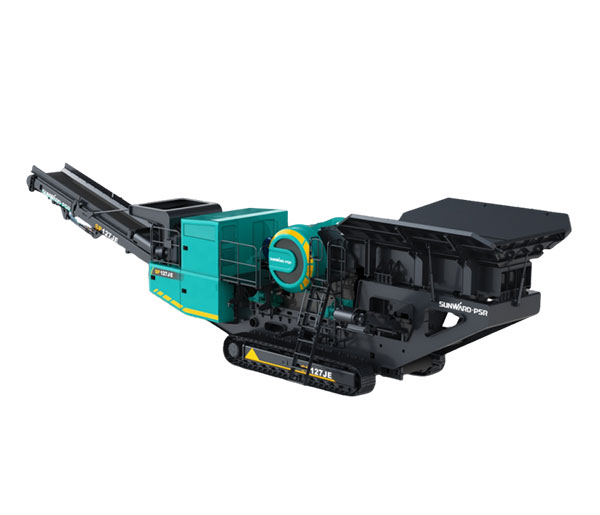
When I talk with customers about mobile crushing equipment, one question comes up again and again: can one machine handle hard material, move easily between working areas, and still keep a steady production rate? This is exactly where the SP127JE Crawler-type Jaw Crushing Station gets my attention.
The SP127JE is an electric crawler jaw crushing plant designed for primary crushing work. According to Sunward's published product information, the machine has a processing capacity of about 170–520 t/h, a maximum feeding size of 700 mm, and a Jaw Crusher inlet opening of approximately 1150 × 760 mm. The published transportation dimensions are about 16,700 × 3,600 × 3,950 mm, while the working dimensions are about 18,251 × 5,032 × 4,541 mm.
From a buyer's point of view, these numbers are useful because they tell us what kind of job the machine is built for. This is not a small crusher for light landscaping work. It is a heavy mobile crushing solution aimed at quarrying, mining, infrastructure construction, aggregate production, and other jobs where large rocks or mineral materials need to be reduced to a more manageable size.
At Ganglong Heavy Industry Technology (Hefei) Co., Ltd., together with Hefei Ganglong International Trade Co., Ltd., we focus on helping customers source construction machinery, mining machinery, agricultural machinery, attachments, and related equipment for different working conditions. Since our group combines equipment-related business, testing, customization, sales, leasing, and international trade experience, we look at a crushing plant from the practical side: where it will work, what material it will process, how it will be transported, and what support the customer needs after delivery.
1. What Is the SP127JE and What Does It Do?
The SP127JE is a crawler-mounted jaw crushing station with an electric crushing drive. In simple terms, it takes large pieces of stone or other hard material and breaks them down into smaller pieces that can be used as aggregate or sent to the next stage of a crushing and screening process.
A jaw crusher works with two crushing surfaces. One jaw stays relatively fixed while the other moves back and forth. When the raw material enters the crushing chamber, the moving jaw pushes the material against the fixed jaw. The material is gradually broken as the crushing force is repeated.
This sounds simple, but the details matter. The shape of the crushing chamber, feeding system, jaw movement, discharge opening, material hardness, moisture, and feeding speed all affect the actual output. That is why I would never judge a crusher only by its maximum theoretical capacity. A real project needs to consider the complete material flow.
The SP127JE combines the jaw crusher with a feeding system, hopper, conveyor system, crawler travel system, and electrical control components. This makes it a complete mobile crushing unit rather than a crusher that needs to be installed permanently in one fixed location.
The published specifications list a maximum feeding size of 700 mm and a processing range of 170–520 t/h. The actual output in a project can vary with the material, feeding method, discharge setting, operating conditions, and other factors, so I recommend using these figures as equipment reference values rather than promising a fixed production rate for every site.
| SP127JE Specification | Published Value | What It Means in Practice |
|---|---|---|
| Machine Type | Crawler Jaw Crushing Plant | Combines crushing and crawler mobility |
| Drive Mode | Electric | Designed around an external electrical power supply |
| Processing Capacity | 170–520 t/h | Suitable for large-volume primary crushing applications |
| Maximum Feeding Size | 700 mm | Allows relatively large raw material to enter the feeding system |
| Crusher Inlet Opening | 1150 × 760 mm | Provides a large jaw crusher feed opening |
| Total Weight | About 58 t | Requires suitable transport planning |
Source: Sunward published SP127JE product specifications. Actual configuration and final delivered machine should be confirmed with the supplier before ordering.
2. How the SP127JE Crawler Jaw Crushing Plant Works
When I explain a Mobile Jaw Crusher to a new customer, I usually break the process into a few simple steps.
First, raw material is loaded into the hopper. Depending on the project, this material may come from blasting, demolition, excavation, mining, quarrying, or another upstream process. The material is then moved toward the vibrating feeder.
The feeder has an important job. It controls how material enters the crusher. If too much material is pushed into the crushing chamber at once, the crusher can become overloaded. If the feed is too slow, the machine may not use its available capacity efficiently. A stable feeding process is therefore just as important as the crusher itself.
After feeding, the material enters the jaw crusher. The jaw movement applies strong compressive force to the rock. Larger pieces are broken into smaller pieces and then move toward the discharge area.
The discharge opening can be adjusted according to the required material size and operating conditions. A smaller opening normally means a finer output, while a larger opening allows more material to pass through. The correct setting depends on the final product requirement and the material being processed.
After crushing, the material moves onto the main conveyor. From there, it can be stockpiled directly or sent to another machine such as a screening plant or secondary crusher.
This is where a crawler crushing station becomes useful. Instead of building a permanent crushing line for every location, the machine can travel between suitable working areas. The published specifications indicate a hydraulic crawler travel system and a maximum climbing angle of around 20 degrees. Site conditions should always be checked before relying on any climbing specification.
3. Main Features I Look at on the SP127JE
Large Feed Capability
The SP127JE is designed for large feed material. Its published maximum feeding size is 700 mm, while the jaw crusher inlet is listed at approximately 1150 × 760 mm. This gives the machine a useful working range for primary crushing where material arrives in relatively large pieces.
For quarry and mining customers, this matters because reducing the need for excessive upstream size reduction can simplify the process. Of course, the actual feed should still meet the machine's operating requirements. Oversized material should not simply be forced into the crusher.
High Throughput Range
The published processing capacity of 170–520 t/h puts the SP127JE into a heavy-duty production class. For a large aggregate project, capacity is not just about how much material the crusher can theoretically process. It is also about keeping the feeder, crusher, conveyor, loading equipment, and downstream screening process working together.
I always suggest customers design the complete production flow instead of choosing a crusher in isolation. A high-capacity crusher connected to an undersized screening system can still create a bottleneck.
Deep V-Shaped Crushing Chamber
Sunward describes the crusher as using a deep “V” cavity, a small nip angle, and a large stroke. These design elements are intended to improve material intake, crushing performance, and throughput while helping control energy use.
For the operator, the simple takeaway is that the crushing chamber is designed to accept and break material effectively rather than relying only on brute force. The exact performance will still depend on the rock type, feed gradation, moisture, discharge setting, and feeding method.
Heavy-Duty Structural Design
Another detail I find worth mentioning is the weldless body design described in Sunward's product information. The purpose is to reduce problems associated with welding stress, cracking, and deformation. The crusher also uses an integral cast bearing housing for the movable jaw assembly.
These are not flashy features, but heavy equipment often depends on exactly these details. A crusher spends its working life dealing with vibration, impact, dust, and large mechanical loads. Structural durability therefore has a direct connection with maintenance and operating reliability.
Centralized Lubrication
Lubrication is one of those basic maintenance jobs that can easily be ignored when a project is busy. The SP127JE uses a centralized lubrication system to support stable operation of relevant lubrication points. Sunward lists centralized lubrication among the machine's configurations.
For the operator, the idea is straightforward: regular lubrication should be easier to manage when the system is designed around centralized service points. It does not remove the need for maintenance, but it can make routine service more organized.
Electrical System Protection
The electric SP127JE is designed around an external electrical power supply. Sunward's published product information describes an integrated variable-frequency system with functions intended to protect electrical components against dust, water, vibration, and heat-related conditions.
This makes the electrical environment at the job site an important part of project planning. Before delivery, I would confirm the available power supply, electrical standards, site connection conditions, and customer requirements instead of assuming that every site can connect the machine in exactly the same way.
4. Where Can I Use an SP127JE?
The most suitable application depends on the raw material and the required final product. Based on the machine's capacity and design, I would normally discuss the SP127JE with customers working in quarrying, aggregate production, mining, road construction, infrastructure projects, recycling, and large earthmoving operations.
Quarrying and Aggregate Production
In a quarry, the first job is often to reduce blasted rock into a manageable size. The SP127JE can serve as a primary crushing machine before screening and secondary or tertiary crushing.
For example, a customer may use the Crawler Jaw Crusher to process granite, basalt, limestone, or similar rock. The exact production result depends heavily on the material properties and the complete plant design.
Mining
Mining operations can involve very different materials, from relatively soft ores to hard and abrasive rock. A jaw crusher is commonly used as a primary size-reduction stage. The SP127JE's large feed capability and high published capacity make it relevant to larger mining projects.
One useful example comes from Sunward's published project information: an SP127JE was used in Indonesia for a road-base filling material project processing basalt, with a reported feed size of up to 700 mm and a reported capacity of 230–280 t/h. This is a project reference, not a universal production guarantee.
Infrastructure and Road Construction
Road projects often need a steady supply of crushed aggregate. A mobile crusher can be useful when the work area changes or when material needs to be processed close to the construction site.
Instead of transporting every large rock to a distant fixed plant, a mobile crushing solution can allow material to be processed closer to where it is needed, subject to local regulations, transport conditions, power availability, and project economics.
Recycling and Demolition
Large construction and demolition projects can generate significant quantities of concrete and other mineral materials. With the right configuration and suitable material preparation, a jaw crushing plant can be part of a recycling process.
However, demolition feed is not identical to clean quarry rock. Steel, wood, plastic, soil, and other unwanted materials can enter the feed stream. Proper sorting and pre-processing are important before using any crushing equipment for recycling.
| Application | Typical Feed Material | Role of SP127JE |
|---|---|---|
| Quarrying | Granite, basalt, limestone and rock | Primary crushing |
| Mining | Ore and hard mineral rock | Primary size reduction |
| Road Construction | Rock and aggregate material | Aggregate preparation |
| Infrastructure | Excavated rock and construction material | Mobile crushing |
| Recycling | Concrete and mineral demolition material | Size reduction after suitable sorting |
Source: Application categories are based on the operating role of crawler jaw crushing equipment and Sunward's published SP127JE project/application information. Actual suitability depends on feed material, site conditions, configuration, and local requirements.
5. SP127JE Compared With a Fixed Jaw Crusher
Customers sometimes ask me a simple question: “Why should I use a crawler jaw crushing plant instead of a fixed crusher?” There is no single answer because the two machines are designed around different project needs.
A fixed crushing plant can make sense when the site is permanent and a complete stationary production line is planned. A crawler crusher becomes more interesting when mobility and site flexibility are important.
| Point of Comparison | SP127JE Crawler Jaw Crushing Plant | Traditional Fixed Jaw Crusher |
|---|---|---|
| Mobility | Crawler-mounted and designed for movement around a site | Normally installed at a fixed location |
| Site Flexibility | Useful for changing work areas | Better suited to long-term fixed production sites |
| Installation Approach | Integrated mobile equipment | Usually part of a stationary plant installation |
| Primary Crushing | Yes | Yes |
| Infrastructure Requirement | Requires suitable operating area and power arrangement | Usually requires a more permanent site setup |
| Best Planning Focus | Mobility, material flow and site changes | Long-term fixed production layout |
Source: SP127JE specifications and product description from Sunward. The fixed-crusher column is a general equipment comparison rather than a specification of a particular competing machine.
In my experience, the right question is not “Which crusher is better?” but “What does this project need?” If the project changes location, mobility may be an important factor. If the operation is permanent and land, foundations, and fixed conveyors are already planned, a stationary solution may be considered instead.
6. Manufacturing, Inspection and Delivery: How We Handle the Order
At Ganglong, we understand that buying a large crushing machine is not the same as buying a small spare part. The machine itself is only one part of the transaction. Customers also need configuration confirmation, technical communication, inspection, documentation, transportation planning, customs coordination, and after-sales communication.
Our group was established in 2013 and combines equipment R&D-related business, manufacturing, testing, customization, sales, leasing, and international trade experience. Hefei Ganglong International Trade Co., Ltd. handles international business and has served customers across Asia, Africa, America, and other global markets.
For an SP127JE order, I normally recommend confirming the following points before production or final shipment:
Required machine model and configuration
Raw material type and approximate hardness
Expected feeding size
Required processing capacity
Required output size
Electrical power and site conditions
Working location and local climate
Transportation route and destination port
Required spare parts and wearing parts
Technical documents and inspection requirements
The reason I put these items on the list is simple: a crusher should be matched to the job before it is shipped. It is much easier to solve a configuration question before delivery than after a 50-plus-ton machine arrives at a remote project site.
Production time depends on the actual machine configuration, order quantity, factory schedule, customization requirements, inspection requirements, and logistics arrangement. Therefore, I would not publish one fixed production cycle for every SP127JE order. Instead, we confirm the production and delivery schedule with the customer before the order is finalized.
Before shipment, the machine can be checked according to the agreed inspection requirements. The inspection focus can include machine appearance, major functions, hydraulic and electrical systems, travel functions, conveyor operation, crushing components, safety-related items, accessories, and documentation.
For export orders, transportation is normally planned according to the machine's dimensions, weight, destination, port conditions, and local import requirements. The published SP127JE transportation dimensions are approximately 16,700 × 3,600 × 3,950 mm, with a published total weight of about 58 tonnes. These figures are important when arranging shipping equipment, route planning, loading, and port handling.
Packaging and protection also need to be handled carefully. Large machinery is normally secured for transportation, with exposed or vulnerable areas protected according to the shipping method. Loose accessories, documents, tools, and spare parts can be packed separately where required. The final packing method is confirmed according to the destination and transportation plan.
7. Why Work With Ganglong for Heavy Equipment Sourcing?
When a customer contacts us, we do not want the conversation to stop at a machine name and a price. Heavy equipment has too many practical details for that.
Ganglong Heavy Industry Technology (Hefei) Co., Ltd. works together with Hefei Ganglong International Trade Co., Ltd. as part of a wider equipment business connected with China Construction Machinery (Group) Co., Ltd. Our business covers construction machinery, mining machinery, agricultural machinery, attachments, complete machines, leasing services, and international trade.
We also work with equipment from a range of brands and product categories. That experience is useful when a customer has a project rather than a fixed machine list. Sometimes the customer knows the material, production target, and working environment but has not yet decided on the complete equipment combination.
In that situation, I prefer to start with the project conditions. What are you crushing? What is the largest feed size? How many tonnes per hour do you need? What final product do you want? Is the site permanent or temporary? Is electrical power available? How far is the machine from the loading area? What is the shipping destination?
These questions may sound basic, but they can prevent expensive mistakes.
Our international trade team has experience serving customers across Asia, Africa, America, and other regions. This means we also pay attention to the part of the purchase that happens after the equipment leaves the factory: export documents, logistics coordination, communication with the customer, and delivery planning.
For customers buying heavy machinery from overseas, communication speed matters. A technically good machine is not enough if nobody answers when the customer needs a document, spare part, packing detail, or shipping update.
That is why our approach is based on complete project communication rather than simply sending a product quotation.
8. SP127JE FAQ
Q1: What is the SP127JE?
The SP127JE is a crawler jaw crushing plant designed for primary crushing applications. It uses an electric drive system and integrates feeding, jaw crushing, conveying, crawler travel, and control-related systems into a mobile crushing unit.
Q2: What is the capacity of the SP127JE?
Sunward's published information gives a processing capacity of approximately 170–520 t/h. Actual production depends on material characteristics, feeding conditions, crusher settings, moisture, operating method, and the complete crushing process.
Q3: What is the maximum feeding size?
The published maximum feeding size is 700 mm. The crusher inlet opening is listed at approximately 1150 × 760 mm. Feed conditions should still be controlled according to the manufacturer's operating requirements.
Q4: Is SP127JE an electric jaw crusher?
Yes. The SP127JE is listed as an electric crawler jaw crushing plant, using an external power supply. Customers should confirm the required electrical conditions before installation and operation.
Q5: Can the SP127JE process hard rock?
It is designed for demanding primary crushing work and can be considered for applications involving rock and mineral materials. However, “hard rock” covers many different materials. Rock hardness, abrasiveness, feed size, moisture, and required output should be reviewed before selecting the final configuration.
Q6: Can it be used in mining?
Yes, the SP127JE can be considered for mining and mineral processing projects where a mobile primary jaw crushing stage is required. Sunward has published an SP127JE application involving manganese ore in South Africa, used together with other crushing and screening equipment.
Q7: Can it be used for quarry aggregate?
Yes. Quarrying and aggregate production are natural applications for a crawler jaw crushing plant. The SP127JE can be used as a primary crushing stage before screening and additional crushing equipment, depending on the required final aggregate sizes.
Q8: How large is the SP127JE during transportation?
Published transportation dimensions are approximately 16,700 × 3,600 × 3,950 mm. The published total weight is about 58 tonnes. Exact shipping arrangements should be based on the final machine configuration and confirmed before dispatch.
Q9: What is the maximum climbing angle?
Published Sunward AU information lists a hydraulic travel system and a maximum climbing angle of 20 degrees. Actual site operation must take account of ground conditions, slope stability, machine condition, safety requirements, and local regulations.
Q10: How long does production take?
There is no single production period that applies to every order. The schedule depends on configuration, order quantity, customization, inspection requirements, factory workload, and shipping arrangements. We confirm the expected production and delivery schedule before finalizing the order.
Q11: How is an SP127JE transported internationally?
Because the machine is large and heavy, international transportation normally requires detailed sea-freight and port planning. The final method depends on the destination, route, port facilities, transportation dimensions, and local regulations. We can coordinate the shipping information based on the customer's destination.
Q12: Can you help with spare parts?
Spare and wearing parts should be discussed according to the machine configuration and expected working conditions. For overseas customers, I recommend preparing commonly required parts before the machine starts long-term operation, especially when the project is located far from major service centers.
Q13: What information should I provide before asking for a quotation?
The more practical information you provide, the more useful the quotation can be. I recommend sending the raw material type, maximum feed size, target capacity, desired output size, working location, available power supply, project duration, destination port, and any special inspection or documentation requirements.
Final Thoughts on the SP127JE
For me, the main value of the SP127JE is not one isolated specification. It is the combination of a large jaw crushing chamber, high published processing capacity, crawler mobility, integrated feeding and conveying, and an electric drive arrangement.
The machine is designed for serious primary crushing work. With a published capacity of 170–520 t/h and a maximum feeding size of 700 mm, it can be considered for quarrying, mining, aggregate production, infrastructure construction, road projects, and selected recycling applications.
At the same time, I would always recommend choosing a crusher based on the complete project rather than the product name alone. Material type, feed size, target output, production demand, power supply, site layout, transportation, and downstream equipment all matter.
If you are sourcing an SP127JE crawler jaw crushing plant for an overseas project, Ganglong can help coordinate the equipment, configuration discussion, quotation, inspection, export documentation, transportation planning, and related machinery sourcing. Our international trade team works with customers across different markets and can communicate around the practical details that come with importing heavy construction and mining equipment.
For a quotation, the most useful starting point is simple: tell us what material you need to crush, the approximate feed size, your target capacity, required output size, project location, and destination port. From there, we can work through the equipment and delivery requirements step by step.



 WhatsApp
 Phone
Phone E-mail
 Message