


SWTH Series Telescopic Boom Handler for Flexible Material Handling and Lifting
When I talk with customers about Telescopic Boom Handlers, I usually start with one simple question: what do you need to lift, and where do you need to put it? A machine can have plenty of power, but if it cannot reach the working position easily, move safely around the site, or handle the daily workload, the numbers on the brochure do not mean much.
That is why I pay close attention to the SWTH Series Telescopic Boom Handler. This series is designed as a multifunctional handling and lifting machine for work where both lifting height and forward reach matter. Sunward describes its SWTH telescopic handlers as integrated mechanical, electrical, and hydraulic equipment for loading, unloading, lifting, and material handling. The published application areas include factories, warehouses, terminals, construction sites, farms, and material yards.
From our side at Ganglong Heavy Industry Technology (Hefei) Co., Ltd., we look at the machine from a practical purchasing point of view. We do not simply ask whether a telehandler looks powerful. We look at the working environment, required lifting height, load, attachments, transport distance, delivery location, and after-sales needs before discussing a suitable configuration.
The SWTH Series Telescopic Boom Handler is particularly useful when a conventional loader cannot provide enough reach and a fixed lifting machine cannot offer enough mobility. The telescopic boom gives the operator more freedom to position loads at different heights and distances, while the machine's steering and drive systems are designed for movement around changing job sites.
For customers searching for a telescopic boom handler, telehandler for construction, telescopic material handler, or telescopic handler for agriculture, the SWTH Series gives us a useful platform to discuss different working requirements.
A telescopic boom handler is, in simple words, a mobile machine that combines the basic jobs of lifting, carrying, and placing materials with the extra reach provided by a telescopic boom.
Instead of lifting a load straight up and then moving it only within a short area, the operator can extend the boom forward to position the load farther away. This is useful when materials need to be placed on a higher platform, loaded into a truck, moved across an obstacle, or positioned at a specific point on a construction site.
The SWTH Series is built around this idea. Sunward's official material describes the series as multifunctional handling and lifting equipment used in modern industry, construction, and agriculture. It also highlights applications in factories, warehouses, terminals, construction sites, farms, and material yards.
For me, the biggest advantage of a telehandler is not one single function. It is the combination of several functions in one machine.
A construction company may use it to move building materials. A farm may use it for handling agricultural products or materials. A warehouse or industrial site may use it for loading and unloading. A material yard may need its lifting reach to position loads more accurately.
The exact capability depends on the model and attachment. That point is important. A telehandler should never be selected only by looking at its maximum lift height. Rated capacity, load position, boom extension, attachment type, ground condition, and machine configuration all affect how the machine can actually be used.
For example, Sunward currently lists the SWTH3507 with a 3,500 kg rated bearing capacity and 7.43 m maximum lifting height, while the SWTH4517 is listed with a 4,536 kg rated bearing capacity and 17.06 m maximum lifting height. These are very different machines within the same general product family, so the final model should always be selected according to the actual job.
| Model | Rated Bearing Capacity | Max. Lifting Height | Max. Extension Length | Weight |
|---|---|---|---|---|
| SWTH3507 | 3,500 kg | 7.43 m | 3.83 m | 8,200 kg |
| SWTH4517 | 4,536 kg | 17.06 m | 13 m | 15,100 kg |
Source: Sunward International official SWTH3507 and SWTH4517 product information.
This comparison is a good reminder that “SWTH Series” is not one fixed specification. When a customer contacts us, I prefer to confirm the exact model first and then discuss the performance figures that actually apply to that machine.
The basic working principle is quite easy to understand.
The engine supplies power to the machine. The transmission and hydraulic systems transfer this power to the travel system, steering system, boom, and attachment functions. The operator uses the control system to drive the machine, raise or lower the boom, extend or retract the telescopic section, and operate the attachment.
The telescopic boom is the part that makes the machine different from a normal Wheel loader. The boom can extend forward, allowing the operator to place the load at a greater horizontal distance from the machine.
Think about a construction site where pallets of materials need to be lifted onto a higher level. A normal loader can raise the bucket, but its working reach may not be enough. A telehandler can approach the area, raise the boom, extend it, and position the load where it is needed.
This does not mean the machine can safely carry the same load at every boom position. In fact, this is one of the most important things an operator needs to understand. As the boom extends, the load position changes and the available lifting capacity can change as well. The load chart and operating instructions for the exact machine must always be followed.
The SWTH Series also focuses on steering flexibility. Sunward's published SWTH material describes three steering modes: front-wheel steering, four-wheel steering, and crab steering. These modes are designed to help the machine adapt to different working conditions.
Front-wheel steering feels more familiar and is useful for normal travel. Four-wheel steering can reduce the turning radius and help when maneuvering in tighter areas. Crab steering allows the machine to move diagonally, which can be useful when approaching a load or working close to an obstacle.
I find this especially useful on construction sites because the working environment rarely stays perfectly open. There may be temporary structures, materials, trucks, walls, trenches, or other machines nearby.
The official SWTH brochure also describes a hydrostatic drive system, 4x4 drive, hydraulic steering assistance, an electro-hydraulic proportional control system, and a frame-leveling function. These features are intended to support stable travel, maneuverability, and more precise operation.
The telescopic boom is the heart of this machine. It gives the operator the ability to reach forward and upward instead of simply lifting a load vertically.
This makes a telehandler useful when the load needs to be placed on a truck, upper platform, building area, storage position, or other location that is not directly beside the machine.
When customers tell me that they need both lifting height and forward reach, I normally put the telehandler category on the table immediately. It can solve a problem that a standard loader may struggle with.
The SWTH Series is designed with multiple steering modes. According to Sunward's published technical material, the machine can use front-wheel steering, four-wheel steering, or crab steering.
That sounds like a small detail until you work in a crowded area. Different steering modes give the operator more ways to approach materials and move around the jobsite.
Working sites are not always smooth. Soil, gravel, construction debris, slopes, and uneven ground can all affect machine movement.
The SWTH Series uses 4x4 drive. Combined with the steering system and suspension design, this gives the machine a practical setup for working away from perfectly flat paved surfaces.
I still recommend checking the actual terrain before choosing a model. No machine should be treated as suitable for every slope, surface, or weather condition simply because it has four-wheel drive.
The published SWTH brochure describes a hydrostatic drive system. In simple terms, this type of drive can provide smooth control of machine movement and can work well with applications that require frequent changes in speed and direction.
For a telehandler, smooth movement is important because the machine is often working with suspended or elevated loads. Sudden movements are not something an operator wants when trying to place a pallet or other material accurately.
Another feature I pay attention to is proportional control. The SWTH Series uses an electro-hydraulic proportional control system and proportional control lever according to Sunward's published information.
The basic idea is simple: the operator should be able to make small control movements without the machine reacting too aggressively. That makes it easier to position the boom and attachment during delicate handling work.
Sunward's SWTH material also highlights a front axle leveling function and rear axle floating arrangement. The purpose is to help the machine adapt to uneven working conditions and improve comfort and stability during operation.
For me, this is one of those features that makes more sense on a real jobsite than in a showroom. Construction surfaces are rarely perfectly flat, and a machine that can better adapt to the ground gives the operator more control.
One of the most common mistakes in machinery buying is comparing products only by their names. I prefer to compare the numbers that directly affect the job.
The following table uses currently published Sunward information for two SWTH models. It is not a ranking. It simply shows how different the models can be within the same telescopic handler family.
| Specification | SWTH3507 | SWTH4517 |
|---|---|---|
| Rated bearing capacity | 3,500 kg | 4,536 kg |
| Maximum lifting height | 7.43 m | 17.06 m |
| Maximum extension length | 3.83 m | 13 m |
| Traction force | 90 kN | 95 kN |
| Power source | Yuchai 88 kW | Cummins |
| Machine weight | 8,200 kg | 15,100 kg |
Source: Sunward International official SWTH3507 and SWTH4517 product pages. The exact engine output and configuration for SWTH4517 should be confirmed for the customer's market and final machine specification.
The difference is quite clear. The SWTH3507 is a more compact telehandler with a 7.43 m maximum lifting height, while the SWTH4517 is designed for substantially greater lifting height and reach.
So if a customer says, “I need a SWTH telehandler,” I do not immediately quote one model. I first ask about the required lifting height, load weight, maximum working reach, site conditions, attachment, and transportation requirements.
That short conversation can save a lot of trouble later.
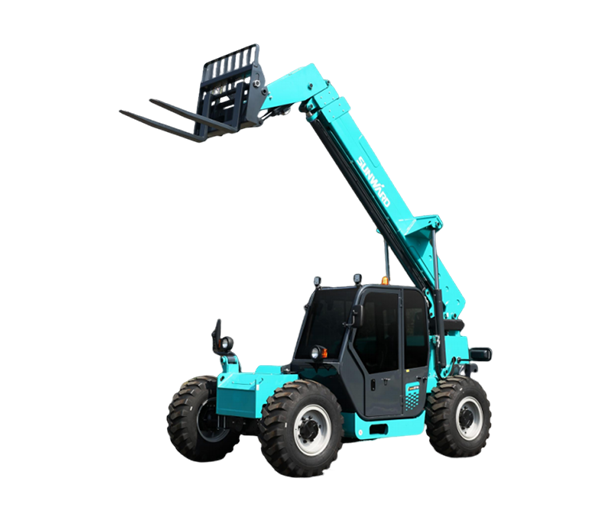
Construction is one of the most natural applications for a telehandler. Building materials often need to be moved from ground level to another working position. Pallets, pipes, boards, blocks, and other materials may need to be lifted and positioned at different heights.
The telescopic boom gives the operator more reach than a standard loader. This can be particularly useful when a truck cannot be positioned directly beside the final unloading point.
On construction sites, I would normally consider the SWTH Series for material handling, loading and unloading, site support, and other lifting tasks where a mobile machine is preferred.
Factories and material yards can also benefit from telescopic handling equipment. The SWTH Series official brochure specifically lists factories, warehouses, terminals, and material yards among its application environments.
For industrial users, the important question is often not simply lifting capacity. Working space, turning radius, floor condition, load type, and required reach can be equally important.
Agricultural work often involves moving materials over uneven ground. Depending on the configuration and attachment, a telehandler can support material handling around farms, storage areas, and agricultural production sites.
Sunward specifically identifies agriculture as one of the main application fields for the SWTH Series. The combination of lifting and forward reach can be useful where materials need to be placed into or taken from elevated or difficult-to-reach positions.
Material yards often involve repeated loading and unloading. A machine with flexible steering and a telescopic boom can help operators approach different loading positions without constantly repositioning other equipment.
The actual application should still be checked carefully because load weight, ground condition, attachment type, and required working cycle can change the machine requirements.
A telehandler can also be used for certain maintenance and support jobs. Some Sunward telehandler materials mention tasks such as cargo loading and unloading, facade-related work, and window cleaning.
For these applications, the attachment and safety configuration become especially important. A telehandler used for people-related work must follow the applicable machine, attachment, and workplace safety requirements rather than being treated like a normal material-handling machine.
From our position as a construction machinery supplier and international trade company, I know that the machine is only one part of an international order.
Ganglong Heavy Industry Technology (Hefei) Co., Ltd. was founded in 2013. Together with Hefei Ganglong International Trade Co., Ltd., we operate across construction machinery, mining machinery, agricultural machinery, and related attachments.
We have our own HKLOONG Excavators, loaders, Backhoe loaders, and swamp excavators, while also supplying complete machines and leasing services involving domestic and international brands such as Hitachi, SANY, Lonking, Hyundai, XCMG, SHANMON, and LOVOL according to customer requirements.
For Sunward equipment, our role is to supply and arrange the equipment rather than claim that we manufacture Sunward machines. I think this is an important distinction for international buyers because clear responsibility makes the purchasing process easier to understand.
The production or preparation cycle for a SWTH Series machine depends on the exact model, configuration, attachment, order quantity, machine availability, customization requirements, and destination.
I do not like giving customers a fixed delivery number before checking these details. A realistic schedule should be confirmed after the machine configuration and commercial conditions are agreed.
Before shipment, we normally check the machine's appearance and basic working condition. The inspection can cover the engine, hydraulic system, electrical system, steering, boom movement, lifting and handling functions, controls, and supplied accessories.
For a telescopic handler, I pay particular attention to the boom and lifting functions because these are central to the machine's daily work. The final inspection scope can also be adjusted according to the order and customer requirements.
Operation manuals, accessory information, spare parts, and required commercial documents are prepared according to the order. For export shipments, the exact document package depends on the destination market and agreed sales terms.
T/T is a common payment method for international construction machinery orders. A typical arrangement is a deposit before production or preparation and the balance before shipment.
However, I always recommend confirming the exact payment terms in the final quotation and sales contract. The agreed terms should be clear before production or shipment starts.
For complete telescopic handlers, sea transportation is normally the practical method for international delivery. The actual shipping plan depends on the destination port, machine dimensions, weight, shipping schedule, and route.
For spare parts and smaller accessories, air freight or express delivery can be considered when the size, weight, urgency, and cost make it suitable.
Before transportation, the machine is prepared to reduce the risk of damage during handling and shipping. Protective film or other suitable covering can be used, and the machine is securely fixed according to the transport method.
Loose accessories and spare parts are normally packed separately in cartons or wooden cases when required. The final packing arrangement can be adjusted according to container loading, shipping requirements, and customer instructions.
| Order Stage | Main Work | Customer Information to Confirm |
|---|---|---|
| Model selection | Match lifting height, capacity, reach and application | Load, working height, reach, ground and attachment |
| Configuration | Confirm machine and optional equipment | Attachment, destination and operating requirements |
| Preparation | Production or machine arrangement | Expected schedule and delivery requirements |
| Inspection | Check appearance and operating functions | Inspection requirements if applicable |
| Documentation | Prepare manuals and commercial documents | Destination-specific document requirements |
| Packing | Protect and secure machine and loose parts | Shipping route and packing requirements |
| Transportation | Arrange international shipment | Destination port and shipping instructions |
Source: Ganglong Heavy Industry Technology and Hefei Ganglong International Trade product supply and export process information provided for this product page.
I understand that buying a telehandler internationally can feel more complicated than buying a normal piece of equipment locally. There are more things to check: machine specifications, attachments, payment, export documents, port arrangements, shipping, spare parts, and communication after the order.
This is where our international trade experience can make the process more practical.
Ganglong Heavy Industry Technology was founded in 2013. Together with Hefei Ganglong International Trade Co., Ltd., our team has experience serving customers across Asia, Africa, America, and other international markets.
Our business covers construction machinery, mining machinery, agricultural machinery, matching attachments, complete machine sales, and leasing services. We can also work with customers looking for different brands or different machine categories when one model does not match the job.
For the SWTH Series, I prefer to work from the application backward.
First, I want to know the load. Then I want to know the required lifting height. After that, I look at the maximum reach, working ground, attachment, daily working hours, and transportation conditions.
This approach is much more useful than simply asking which telehandler has the biggest number in a catalogue.
For example, a customer handling materials in a warehouse may have very different needs from a construction company lifting pallets on an outdoor site. An agricultural customer may care more about ground conditions and attachment compatibility, while an industrial customer may focus on repeated loading cycles and working space.
We can help coordinate the equipment sourcing and commercial process, including configuration discussion, quotation, inspection, documentation, spare parts, packing, and international transportation.
Our goal is simple: make sure the customer knows what machine is being supplied, what configuration is included, how it will be prepared, and how it will reach the destination.
A telescopic boom handler, also called a telehandler or telescopic handler, is a mobile lifting machine with a telescopic boom. It can lift, carry, and position materials at different heights and forward distances. It is commonly used in construction, agriculture, logistics, factories, warehouses, and material yards.
The SWTH Series is designed for multifunctional loading, unloading, lifting, and material handling. Sunward identifies modern industry, construction, agriculture, factories, warehouses, terminals, farms, and material yards as application areas.
Yes. Telescopic handlers are particularly useful on construction sites where materials need to be lifted and positioned at different heights and distances. The exact model should be selected according to load weight, lifting height, working reach, attachment, and ground conditions.
Capacity depends on the exact model. For example, Sunward currently lists the SWTH3507 at 3,500 kg rated bearing capacity and the SWTH4517 at 4,536 kg. These figures should not be treated as interchangeable across the SWTH Series.
The lifting height depends on the model. Sunward's published SWTH3507 information lists a maximum lifting height of 7.43 m, while the SWTH4517 is listed at 17.06 m. The exact load chart should be checked for the selected model and boom position.
The SWTH Series is designed for mobile work environments and uses features such as 4x4 drive, flexible steering, and suspension-related systems. However, every jobsite has different terrain. Slope, soil condition, weather, load, and operating method should be assessed before operation.
Sunward's SWTH technical material describes front-wheel steering, four-wheel steering, and crab steering. These modes give operators more flexibility when traveling and positioning the machine in different working environments.
Attachment compatibility depends on the exact machine configuration and hydraulic system. The SWTH concept is designed for multifunctional handling, and suitable attachments can expand the machine's working range. Before ordering an attachment, its weight, connection, hydraulic requirements, and intended application should be checked.
There is no single preparation period for every order. It depends on the exact model, machine availability, configuration, attachment, quantity, customization, and destination. We confirm the expected schedule after the order requirements are clear.
T/T is commonly used for international machinery orders. A typical arrangement includes a deposit before production or preparation and the remaining balance before shipment. Exact terms are confirmed in the quotation and sales contract.
Complete machines are generally shipped by sea. The final shipping method depends on machine dimensions, weight, destination, route, port conditions, and customer requirements. Spare parts and smaller accessories can be considered for air or express shipment when suitable.
The machine is protected and secured according to the transportation method. Loose accessories and spare parts can be packed separately in cartons or wooden cases. The final packing plan is confirmed according to shipping requirements and customer instructions.
We supply and arrange Sunward equipment as part of our construction machinery and international trade business. We do not describe Ganglong as the manufacturer of Sunward-branded machines. This helps keep the supply relationship and product information clear for international customers.
I recommend starting with the actual job rather than the model number. Tell us the maximum load, required lifting height, maximum reach, working ground, attachment, working hours, and destination. We can then discuss which SWTH configuration is appropriate for those conditions.
After working with construction machinery customers, I have learned that the most useful machine is not always the biggest machine. It is the machine that fits the job without making the operation unnecessarily complicated.
That is where the SWTH Series Telescopic Boom Handler makes sense. It combines lifting, carrying, forward reach, flexible steering, four-wheel drive, and attachment-based operation in one mobile platform.
The series covers different machine sizes and performance levels. The published SWTH3507, for example, has a 3,500 kg rated bearing capacity and 7.43 m maximum lifting height, while the SWTH4517 reaches a published 4,536 kg rated bearing capacity and 17.06 m maximum lifting height. These differences show why the exact working requirement should always come before the final model selection.
For construction, agriculture, warehouses, factories, terminals, and material yards, a telescopic handler can solve a very practical problem: moving a load not only from one place to another, but also up, forward, and into the exact working position.
At Ganglong Heavy Industry Technology (Hefei) Co., Ltd., together with Hefei Ganglong International Trade Co., Ltd., we focus on making the equipment purchasing process clear and workable for customers in international markets. We can support equipment sourcing, configuration discussion, quotation, inspection, documentation, spare parts, packing, and shipping arrangements.
If you are looking for a SWTH Series Telescopic Boom Handler, a telescopic handler for construction, a telehandler for agriculture, or a telescopic material handling machine, the most useful information to send us is your required load capacity, lifting height, working reach, attachment, application, and destination.
Once those details are clear, choosing the right machine becomes much easier. Instead of guessing from a catalogue, we can work from the actual job and build the equipment and delivery plan around it.
2435092534@qq.com
86 158 5511 9567


©2026 HKLOONG Heavy Industry Technology (Hefei) Co., Ltd. All Rights Reserved.

This website uses cookies to ensure you get the best experience on our website.
 Español
 Pусский
 Français
 العربية
 WhatsApp
 Phone
Phone E-mail
 Message