
 Español
 Pусский
 Français
 العربية


When I choose a drilling rig for a mining, quarrying, or construction project, I look beyond the basic machine specifications. I want to know how the rig behaves in real rock, how easily the operator can control the drilling process, how much time is spent on each hole, and whether the machine can keep working without unnecessary stops.
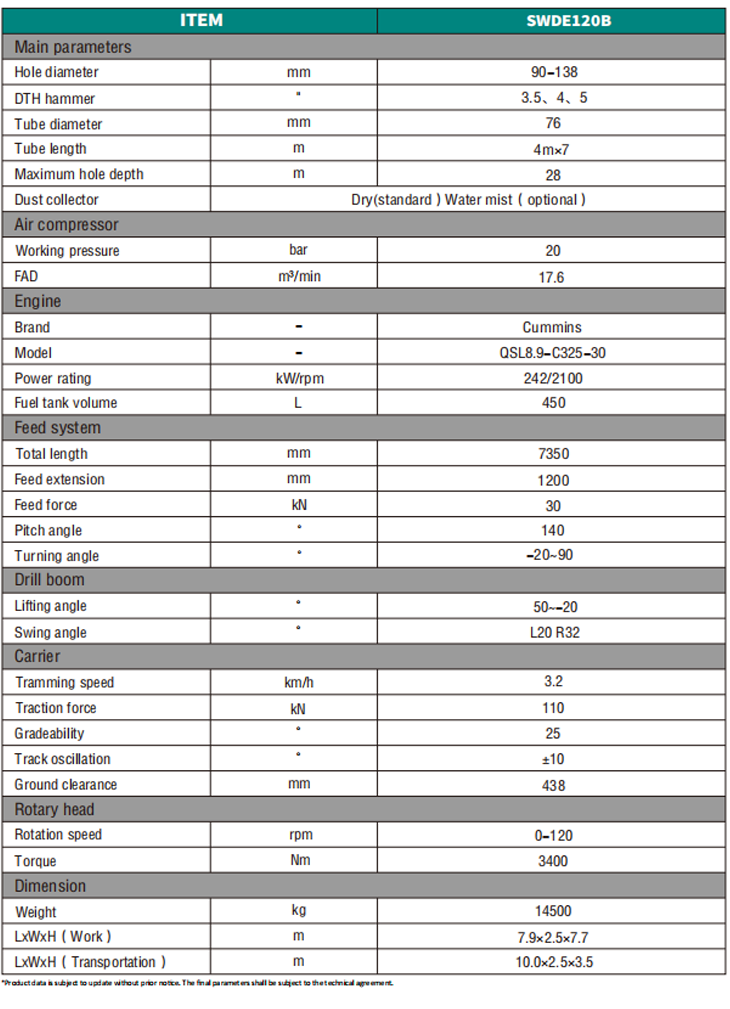
The SWDE120B Integrated DTH Drill Rig is designed around these practical requirements. It is a new-generation drilling solution developed for efficient rock drilling and blasting work, with a focus on productivity, stable performance, energy-conscious operation, and flexible drilling across different ground conditions.
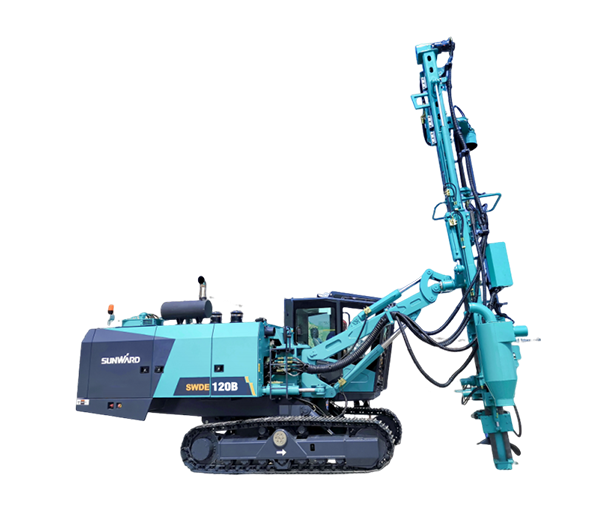
The product information supplied for this model specifies a 138–180 mm drilling diameter and a maximum drilling depth of 36 m with automatic pick-up and unloading rod functions. The machine is designed to support cutting in softer rock and DTH drilling in harder rock. This gives me a more flexible approach when the geological conditions change during a project.
I see this type of equipment as more than just a rock drill. It is a complete working system. The drilling structure, rotary mechanism, feed system, air supply, drill tools, crawler carrier, hydraulic controls, and operator interface all have to work together. When these systems are properly matched, the machine can help improve drilling efficiency and control the cost of each completed hole.
1. What Is the SWDE120B Integrated DTH Drill Rig?
The SWDE120B Integrated DTH Drill Rig is a surface drilling machine designed for rock drilling and blasting applications. DTH stands for down-the-hole. The key idea is simple: instead of keeping the impact hammer at the surface, the pneumatic hammer is placed close to the drill bit at the bottom of the borehole.
Compressed air travels through the hollow drill rods and operates the hammer. The hammer repeatedly strikes the bit while the rotary head turns the drill string. The feed system then pushes the drilling tool into the rock. At the same time, compressed air helps remove broken rock from the borehole.
This arrangement is especially useful for hard-rock drilling. Liebherr explains that DTH drilling uses a hammer mounted at the lower end of the drill rod and is mainly applied to hard and very hard rock.
For me, the integrated design is also important. The drilling system and mobile carrier are developed as one machine, making it easier to move around the working area and carry out repeated drilling cycles.
| Item | SWDE120B Product Reference | Practical Value |
|---|---|---|
| Machine type | Integrated DTH drill rig | Designed for surface rock drilling |
| Drilling diameter | 138–180 mm | Supports medium-to-large drilling requirements |
| Maximum drilling depth | 36 m | Suitable for deeper surface drilling work |
| Rod handling | Automatic pick-up and unloading | Helps simplify multi-rod drilling |
| Rock-drilling approach | Cutting and DTH drilling | Allows the method to match ground conditions |
Source: product information supplied for the SWDE120B. Final specifications should be confirmed according to the actual machine configuration before purchase.
2. How I Work With the DTH Drilling Principle
I like to keep the DTH drilling process easy to understand. The drill bit needs to rotate and receive repeated impact. Rotation allows the bit to attack a new part of the rock, while impact breaks the rock.
Inside the DTH hammer, compressed air drives a piston that strikes the drill bit again and again. The drill string rotates through the rotary head, and the feed mechanism applies forward force. Once the rock is broken, the same air system helps carry the cuttings out of the hole.
USGS technical material describes air-hammer drilling as a process where a pneumatic hammer rapidly strikes the formation while the drill bit rotates, with compressed air returning drilling cuttings toward the surface.
In daily operation, I look at four basic stages:
Positioning: Move the crawler-mounted rig to the planned drilling point.
Alignment: Set the drilling structure according to the required hole direction.
Drilling: Combine rotation, feed, and DTH impact to break the rock.
Flushing: Use compressed air to remove broken material from the borehole.
The important part is the balance between these four actions. Pushing the drill harder does not automatically make drilling faster. Excessive feed force can increase tool wear, while insufficient air flushing can allow cuttings to remain around the bit.
I therefore treat the drilling process as a controlled combination of rotation, feed force, impact energy, and flushing rather than simply running the machine at maximum output.
3. Why I Need Flexible Drilling for Changing Rock
One of the problems I often see in rock drilling is changing geology. A quarry bench may contain weathered material close to the surface and much harder rock underneath. Road construction can face soft layers, fractured rock, and hard formations within the same project.
This is why the SWDE120B is designed around two basic drilling approaches. In softer rock, cutting can be used to remove material. When the formation becomes harder, DTH drilling provides repeated percussion close to the bottom of the hole.
I would not promise one fixed drilling speed for all rock types. Rock strength, abrasiveness, fractures, moisture, hole depth, drilling diameter, bit condition, air supply, feed pressure, and operator settings all influence the result.
| Ground Condition | Possible Method | What I Monitor |
|---|---|---|
| Soft rock | Rotary cutting | Cutting efficiency and tool wear |
| Weathered rock | Cutting or DTH | Changes in hardness and hole stability |
| Medium-hard rock | DTH or cutting | Feed force, rotation, and flushing |
| Hard rock | DTH drilling | Hammer performance and air supply |
| Fractured formations | DTH with suitable settings | Air loss and borehole stability |
Source: comparison based on general DTH and rotary drilling principles. Actual performance depends on geological conditions, drilling tools, machine configuration, and operating settings.
This flexibility is useful for contractors because they do not have to treat every geological change as a completely new drilling job. The drilling method can be adjusted according to the material encountered.
4. Main Features I Focus On
138–180 mm Drilling Diameter
The specified 138–180 mm drilling diameter gives the SWDE120B a useful range for surface drilling and blasting preparation. The correct hole diameter should always be selected according to the blasting plan, rock conditions, required fragmentation, and drilling tools.
I do not recommend automatically choosing the largest diameter. A larger hole may not always produce the most economical result. The drilling pattern, explosive loading, rock structure, and downstream crushing requirements all need to be considered.
Up to 36 m Drilling Depth
The supplied product information specifies a maximum drilling depth of 36 m with automatic pick-up and unloading rod functions. This provides useful depth capability for projects where deeper blast holes are required.
However, I always separate maximum technical depth from normal production depth. Actual performance depends on rock hardness, hole diameter, rod arrangement, drilling angle, air conditions, tool selection, and site layout.
Automatic Rod Handling
When a hole becomes deeper, more drill rods are required. Handling rods manually can take time and increase operator workload. Automatic pick-up and unloading can make the process more organized and help reduce unnecessary handling time during deeper drilling.
Integrated Mobile Platform
The integrated design combines the drilling equipment with a mobile carrier. This is useful when the rig needs to move repeatedly between drilling points. Instead of arranging several separate machines, the operator works with one integrated drilling unit.
Productivity-Focused Operation
The machine is designed for high drilling efficiency, but I measure productivity in a practical way. I care about how many useful meters are completed during a full working shift, not only how fast the drill bit moves while it is in the rock.
Positioning, alignment, rod handling, hole cleaning, maintenance, and movement between holes all affect the final result. Reducing unnecessary downtime can be just as important as increasing penetration speed.
Energy-Conscious Design
The product information emphasizes low construction energy consumption, energy saving, and lower-carbon operation. Actual energy use will still depend on the geology, drilling depth, air demand, idle time, machine settings, and operator habits.
For me, the useful goal is not to promise a fixed energy-saving percentage without project data. It is to build a drilling process that uses power where it is needed and avoids unnecessary idle operation.
5. SWDE120B Applications in Mining and Construction
I would consider the SWDE120B Integrated DTH Drill Rig for a range of surface rock drilling applications where drilling quality and production speed directly affect project costs.
Mining: Open-pit mining often depends on blast-hole drilling before blasting, loading, hauling, and crushing. If drilling falls behind schedule, the later operations can also be delayed.
Quarrying: Quarry benches require planned drilling patterns. Hole diameter, depth, spacing, and angle all affect the blasting result. Stable drilling helps the blasting team work from a more predictable hole pattern.
Road construction: Rock excavation along road projects may require controlled drilling and blasting. Depending on the terrain and excavation design, different drilling directions may be required.
Civil construction: Large construction sites can encounter hard rock that normal Excavators cannot remove efficiently. Drilling provides a controlled way to prepare the rock for blasting or other excavation methods.
General surface drilling: The machine can also be considered for projects that require medium-to-large diameter boreholes within the specified drilling range.
| Industry | Typical Drilling Work | Potential Machine Benefit |
|---|---|---|
| Mining | Blast-hole drilling | DTH method for hard-rock conditions |
| Quarrying | Bench drilling | Useful hole diameter and depth range |
| Road construction | Rock excavation and blasting | Mobile integrated drilling platform |
| Civil engineering | Controlled rock breaking | Flexible drilling approach |
| Site preparation | Surface rock drilling | Cutting and DTH drilling options |
Source: application categories are based on the supplied SWDE120B product description and common surface DTH drilling applications. Actual suitability should be confirmed against the project geology and drilling plan.
6. What Really Controls Drilling Performance?
When I evaluate an integrated DTH drill rig for hard rock, I pay attention to more than the rated drilling depth. Five operating factors usually have a direct effect on drilling results.
Air supply is one of the most important. The DTH hammer needs compressed air to operate, and the air also helps flush cuttings from the hole. Poor air conditions can reduce hammer performance and hole-cleaning ability.
Feed force keeps the bit in contact with the rock. Too little force can reduce drilling efficiency, while excessive force may increase mechanical stress and tool wear.
Rotary speed controls how the bit moves across the rock surface. The suitable speed depends on the bit and geological conditions.
Drill-bit condition also matters. A worn bit may still drill, but penetration can become slower and energy use can increase. Regular inspection of drilling tools is therefore part of controlling the cost per meter.
Flushing performance determines how effectively broken rock leaves the hole. If cuttings build up around the bit, the drilling process becomes less efficient.
| Factor | Effect on Drilling | Practical Check |
|---|---|---|
| Compressed air | Hammer operation and flushing | Pressure, flow, and cuttings removal |
| Feed force | Bit-rock contact | Stable pressure without excessive loading |
| Rotation speed | Bit movement across rock | Match speed to rock and bit |
| Bit condition | Penetration and hole quality | Inspect wear regularly |
| Flushing | Cuttings removal | Watch for poor hole cleaning |
Source: general DTH drilling principles. Specific operating values must be established for the final hammer, bit, air system, machine configuration, and geological conditions.
This is why I do not recommend operating every drilling job at maximum pressure or maximum rotation. The right settings are normally a balance between drilling speed, hole quality, tool life, energy consumption, and machine stability.
7. How I Manufacture the SWDE120B at HKLOONG
At HKLOONG Heavy Industry Technology (Hefei) Co., Ltd., we work across equipment R&D, precision manufacturing, quality testing, customized modification, and global distribution. For drilling equipment, I believe this complete process is important because drilling performance depends on how the whole machine works together.
The main structure is the first area I consider. A DTH drill rig experiences repeated vibration, feed loads, rotary torque, and movement over construction sites. The frame therefore needs suitable structural strength, accurate assembly, and controlled welding quality.
The drilling mechanism is equally important. The feed system, rotary head, drill rods, hammer, and bit all interact during drilling. If one part is poorly matched with another, the operator may not get the expected drilling performance.
The hydraulic system must also provide stable control for the machine's working functions. For equipment operating in dusty and rough environments, maintenance access matters as well. Technicians should be able to inspect and service important components without wasting unnecessary time.
Our quality process focuses on the complete machine. Depending on the configuration, inspection can cover machine movement, drilling-system operation, hydraulic functions, controls, structural condition, and other relevant performance points before delivery.
For customized or overseas projects, I also consider the customer's local conditions. Rock type, climate, transportation requirements, spare-parts availability, operator experience, and expected working hours can all influence the final equipment configuration.
8. Why Choose Our SWDE120B Integrated DTH Drill Rig?
I understand that buying a drilling rig is a long-term equipment decision. The machine affects drilling cost, project schedule, maintenance workload, and the performance of later blasting and excavation operations.
My approach at HKLOONG is therefore based on the actual project rather than one impressive catalog number.
Complete equipment development: We combine R&D, manufacturing, quality testing, customized modification, and technical service.
Practical drilling range: The specified 138–180 mm drilling diameter covers many medium-to-large surface drilling needs.
Deep drilling capability: The stated maximum drilling depth of 36 m provides useful flexibility for deeper blast-hole requirements.
Rock adaptability: Cutting can be used in softer rock while DTH drilling is available for harder formations.
Automatic rod handling: Automatic pick-up and unloading help organize deeper drilling operations.
Project-based configuration: We consider drilling diameter, depth, geology, drilling angle, working environment, and production requirements.
Global service approach: We consider transportation, spare parts, maintenance, and operating conditions when supporting overseas customers.
Before I recommend a configuration, I prefer to understand the job. What type of rock are you drilling? What hole diameter do you need? How deep are the holes? Are they vertical or inclined? How many meters must be drilled each day? What is the local climate and working environment?
These questions usually tell me much more than a simple request for the “most powerful” drilling rig.
SWDE120B Integrated DTH Drill Rig FAQ
What is the SWDE120B Integrated DTH Drill Rig used for?
The SWDE120B is designed for surface rock drilling and blasting-related work. Typical applications include mining, quarrying, road construction, civil construction, and other projects requiring medium-to-large diameter rock holes.
What drilling diameter does the SWDE120B support?
The supplied product information specifies a 138–180 mm drilling diameter. The final bit and drilling-tool configuration should be selected according to the required hole size and geological conditions.
What is the maximum drilling depth?
The supplied product information specifies a maximum drilling depth of 36 m with automatic pick-up and unloading rod functions. Actual drilling depth depends on rock conditions, drilling tools, hole diameter, and machine configuration.
Why is DTH drilling useful for hard rock?
The DTH hammer works close to the drill bit and delivers repeated impact directly near the bottom of the borehole. This makes DTH drilling particularly useful for hard and very hard rock applications.
Can the machine drill soft rock?
Yes. The product is designed to support cutting in softer rock and DTH drilling in harder rock. The appropriate method depends on the actual geological formation.
What affects the drilling cost per meter?
Rock hardness, bit wear, drilling diameter, air consumption, feed force, rotary speed, hole depth, rod handling, maintenance, and idle time all affect the final cost per drilled meter. I recommend evaluating the complete drilling cycle rather than penetration speed alone.
Is the SWDE120B suitable for quarrying?
Yes. Quarrying is a typical application for surface blast-hole drilling. The machine's specified drilling range and depth capability can support many quarry drilling requirements, subject to the actual blast design and geological conditions.
Can the drilling rig be customized?
Configuration can be discussed according to project requirements. I normally consider drilling diameter, depth, rock type, drilling angle, working environment, transportation conditions, and expected production before recommending a configuration.
Final Thoughts
For me, the SWDE120B Integrated DTH Drill Rig is designed around a simple goal: make demanding rock drilling more efficient and easier to manage. The 138–180 mm drilling range, maximum 36 m drilling depth, automatic rod handling, and ability to use cutting or DTH drilling give contractors useful flexibility across different ground conditions.
The machine should still be selected according to the actual project. Rock hardness, abrasiveness, drilling depth, hole diameter, drilling angle, bit selection, air supply, feed force, and operator settings can all change the final result.
At HKLOONG Heavy Industry Technology, I take a complete approach to heavy equipment. From R&D and precision manufacturing to quality testing, customized modification, and global distribution, we focus on equipment that can support demanding industrial and construction work.
If you are planning a mining, quarrying, road construction, or rock blasting project, I recommend evaluating the SWDE120B based on your real drilling plan. When the drilling method, machine configuration, tools, and geological conditions are properly matched, the result can be a more stable drilling cycle, better work efficiency, controlled energy consumption, and a lower overall construction cost.



 WhatsApp
 Phone
Phone E-mail
 Message