

Volvo Wheel excavator EW205 for Construction, Road Work and Utility Projects
When I talk about the Volvo wheel excavator EW205, I usually focus on one word: mobility. A crawler excavator is excellent when the machine needs to stay on one jobsite, but a wheeled Excavator gives me a different kind of flexibility. I can move the machine between work areas much more easily, especially when the project involves roads, streets, drainage systems, municipal work or utility construction.
The Volvo EW205 is a medium-sized Wheeled Excavator designed for demanding excavation and material handling work. Depending on the version and market, the machine is available with a Volvo D6-series diesel engine, a hydraulic system designed for smooth working functions, road travel capability and a range of front attachments. Public Volvo specifications for the EW205 family show operating weights around 20 tonnes, engine output around 129 kW and road travel speeds up to 36 km/h.
From my point of view, the real value of the EW205 is not simply its engine power. It is the combination of digging performance, road mobility, hydraulic control and working flexibility. That combination makes a Volvo EW205 wheel excavator suitable for contractors who need to travel between jobs instead of being tied to one construction site.
One important point should be made before discussing specifications. Volvo has produced different EW205 versions, including EW205D and EW205E configurations, and equipment can vary by market. Therefore, when I supply a machine, I always check the exact model, production year, serial number and configuration instead of treating every EW205 as exactly the same machine.
The Volvo EW205 is a wheeled Hydraulic Excavator in the roughly 20-ton class. Unlike a crawler excavator, it uses wheels and a road-going chassis. This gives the machine an obvious advantage when the operator needs to move around an urban or infrastructure project.
Imagine a drainage project running along several kilometers of road. A crawler excavator can certainly do the digging, but moving it from one section to another often requires additional transport. A wheeled excavator can travel under its own power when road regulations and local conditions allow it.
That is where I see the Volvo EW205 making sense.
The machine is large enough for serious excavation, but it is also designed around mobility. Volvo's published data for the EW205E lists an operating weight of approximately 19,990 to 21,180 kg, gross engine power of 129 kW, bucket capacity from 0.86 to 1.0 m³ and a maximum travel speed of 36 km/h. Earlier EW205D specifications show a similar overall machine class, with an operating weight of 19,800 to 21,800 kg and bucket capacity ranging from 0.48 to 1.1 m³ depending on configuration.
| Item | EW205E Reference | EW205D Reference |
|---|---|---|
| Machine type | Wheeled hydraulic excavator | Wheeled hydraulic excavator |
| Operating weight | 19,990–21,180 kg | 19,800–21,800 kg |
| Gross power | 129 kW | 129.5 kW |
| Bucket capacity | 0.86–1.0 m³ | 0.48–1.1 m³ |
| Maximum travel speed | 36 km/h | 36 km/h |
| Maximum digging depth | 5,565 mm | 5,765 mm |
| Maximum digging reach | 9,685 mm | 9,890 mm |
Source: Volvo construction equipment published EW205E and EW205D technical specifications. The figures above represent published model references and may change according to configuration, market and equipment.
For me, this table tells an important story. The EW205 is not simply a road machine with a small bucket attached. It has the size and working range of a serious hydraulic excavator while adding the mobility advantages of a wheeled undercarriage.
The hydraulic system is where I spend a lot of time when checking an excavator. Engine power is easy to talk about, but digging performance depends on how the engine, pumps, valves and cylinders work together.
On the Volvo EW205, hydraulic power is used for the boom, arm, bucket, swing, travel and auxiliary functions. The operator moves the controls, hydraulic oil is directed to the required circuit, and the cylinders or motors respond.
The basic principle is not complicated. The engine supplies mechanical power. Hydraulic pumps convert that power into hydraulic flow and pressure. Control valves send oil to the correct component. The cylinders then turn hydraulic pressure into physical movement.
What matters on a real jobsite is how smoothly all of these functions work together.
When I inspect a wheel excavator, I look at how quickly the boom responds, whether the arm moves smoothly, whether the bucket has enough force, and whether the machine can perform several functions without strange delays.
Volvo's published EW205 technical data lists a maximum hydraulic flow of 2 x 230 l/min for the EW205 configuration shown in its product documentation. The published data also gives implement relief pressures of 32.4/34.3 MPa depending on operating condition, with a travel system setting of 34.3 MPa.
These numbers are useful for technical comparison, but I do not treat them as the whole story. A hydraulic system is a complete system. Pump condition, oil condition, valve condition, hoses, cylinders and electronic controls all affect actual machine behavior.
For basic digging, almost any operator can make a bucket move. The difference becomes clearer when the work requires accuracy.
Utility trenching is a good example. If the operator is working near an existing water pipe, gas line or communication cable, the bucket cannot simply move at full speed all the time. The operator needs small and predictable movements.
The same applies to grading, drainage work and loading material beside a road. Smooth hydraulic response makes the machine easier to control.
When I evaluate a Volvo EW205 wheel excavator, I normally look at the machine as a complete working package rather than a list of individual specifications.
This is the most obvious feature. The wheeled chassis allows the EW205 to move between work areas without the same transport process normally required for a crawler excavator.
Volvo's published EW205 data gives a maximum travel speed of 36 km/h, with lower speeds available for different working conditions. The Chinese EW205 technical material lists road, off-road and creep speeds of 36, 9 and 3.5 km/h respectively.
Of course, actual road use depends on local traffic laws, machine configuration, tires, permits and site conditions. I never treat the published top speed as permission to drive anywhere at that speed.
The EW205 has a long boom and arm configuration designed for substantial digging reach. A published EW205 specification lists a 5.65 m boom and 2.7 m arm, with a maximum digging reach of approximately 9.685 m.
That reach is useful when the excavator needs to work beside roads, trenches, drainage channels or stockpiles without constantly repositioning the machine.
A wheeled excavator needs a good stabilizing system because digging forces are transmitted through the working equipment to the chassis.
Depending on configuration, the EW205 can be equipped with front dozer equipment and rear outriggers. These components help stabilize the machine during excavation and other demanding work.
When I inspect a machine, I therefore check the outriggers, cylinders, pins, hoses and mounting points rather than looking only at the main boom and bucket.
Published EW205 specifications list bucket breakout force around 144 kN and arm tearout force around 109 kN for the referenced configuration.
For customers, I explain these numbers in simple terms: they indicate that the machine has enough hydraulic force for serious excavation rather than only light landscaping.
The actual result still depends on soil type, bucket selection, digging position and operator technique.
Construction machines often work for many hours in one day. Operator comfort therefore affects more than just convenience.
A clear control layout, good visibility and a properly maintained cab can make repetitive work easier. When I inspect a used Volvo EW205, I check the cab, seat, control functions, display, air conditioning and visibility along with the mechanical components.
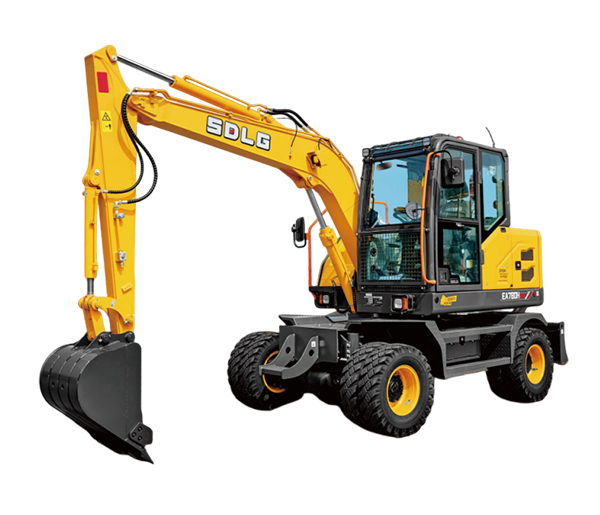
I prefer to explain technical advantages through real working situations.
Take road construction. The machine may need to travel from one section to another, dig drainage channels, load excavated soil, clean ditches and work around existing traffic infrastructure. A wheeled excavator can be useful because its mobility is part of the machine rather than something added later.
Now consider utility construction. The machine may spend one hour digging a trench and the next hour moving a pipe or loading spoil. Hydraulic control and attachment compatibility become more important than simply having a high horsepower figure.
For municipal projects, the ability to travel between locations can also reduce unnecessary machine transport. Again, this depends on local road regulations and site requirements, but the basic advantage remains.
| Technical Item | Published EW205 Reference | Practical Meaning |
|---|---|---|
| Gross engine power | 129 kW | Provides power for excavation and travel functions |
| Maximum hydraulic flow | 2 x 230 l/min | Supports multiple hydraulic working functions |
| Maximum travel speed | 36 km/h | Useful for moving between work areas |
| Bucket breakout force | 144 kN | Supports digging into demanding soil conditions |
| Arm tearout force | 109 kN | Supports arm and bucket digging movement |
| Maximum digging depth | 5,565 mm | Suitable for substantial trench and excavation work |
| Maximum digging reach | 9,685 mm | Allows work across a broad digging area |
Source: Volvo Construction Equipment EW205 technical documentation. Values shown are for a published EW205 configuration and should be checked against the exact machine before ordering.
Another feature I pay attention to is the relationship between hydraulic control and engine power. Volvo's published EW205E information describes an optimized hydraulic system, electronic control and ECO mode working together to improve efficiency and response. The Chinese EW205 CN4 material states that this combination can provide up to a 7% improvement in fuel efficiency under the stated conditions.
I treat such efficiency figures as manufacturer-published test or operating claims, not as a guaranteed fuel saving for every jobsite. Soil, operator behavior, attachment, idle time, travel distance and working cycle all influence actual fuel consumption.
The Volvo EW205 is a flexible machine, but I still like to match the excavator to the job before recommending it.
Road construction is one of the most natural applications for a wheeled excavator. The machine can excavate drainage channels, prepare road edges, remove soil and handle materials around the construction area.
The ability to travel between sections is particularly useful when the work is spread over a long road project.
Municipal contractors often deal with smaller work zones spread across a city. Drainage repair, road maintenance, pipe replacement and public infrastructure work may require the excavator to move frequently.
This is where a Volvo EW205 wheel excavator can have a practical advantage over a crawler machine.
Water, sewage, electricity and communication projects all require excavation. Some jobs require deep and relatively narrow trenches, while others involve lifting pipes and preparing bedding material.
For these applications, I recommend choosing the bucket and hydraulic attachment based on the actual pipe dimensions and soil conditions.
On building sites, the EW205 can handle foundation excavation, soil removal, drainage, backfilling and material handling.
Its working reach is useful when the machine needs to work around the edge of an excavation instead of constantly driving into the work area.
Large landscaping projects can involve much more than planting trees. Site shaping, drainage, soil removal, pond construction and preparation of large public spaces can all require serious excavation capacity.
For smaller gardens, I would normally look at a Compact Excavator instead. The EW205 makes more sense when the project size justifies a roughly 20-ton machine.
I would not position the EW205 as a replacement for a large Mining Excavator. That would be the wrong comparison.
However, it can be useful for support work such as drainage, maintenance, access preparation, material handling and other smaller excavation tasks around mining and quarry sites.
| Industry | Typical EW205 Work | Why a Wheeled Excavator Helps |
|---|---|---|
| Road construction | Drainage, ditching, earthmoving | Fast movement between work sections |
| Municipal engineering | Pipe repair and road maintenance | Good mobility around urban areas |
| Utility construction | Trenching and material handling | Working reach and hydraulic control |
| Building construction | Foundation and site preparation | Large working range and digging force |
| Landscaping | Large-scale soil movement | Strong digging capacity |
| Industrial projects | Site preparation and material handling | Flexible attachment use |
Source: Application recommendations are based on the operating characteristics and published application range of Volvo wheeled Excavators. Actual suitability depends on the project, attachment and local operating requirements.
When customers hear the word “manufacturing,” they sometimes expect a simple explanation about steel, welding and painting. In reality, a modern excavator is a combination of mechanical, hydraulic, electrical and electronic systems.
The boom and arm need strong steel construction because they repeatedly carry digging loads. Pins and bushings need suitable machining and fitting. Hydraulic cylinders need sealing surfaces that can withstand pressure. The engine and hydraulic pumps need to work together. Electronic systems need to communicate with the machine controls.
For me, this is why a final inspection is important.
When arranging a Volvo EW205 machine for an international customer, I can organize checks according to the confirmed order. I normally pay attention to several basic areas.
First, I check the machine identification. The model, serial number, engine information and configuration should match the agreed equipment.
Second, I check the appearance and structure. I look for obvious damage, repaired areas, cracks, unusual welding and signs of major previous work.
Third, I check the engine. Starting behavior, abnormal noise, smoke, temperature and basic operating condition are all worth checking.
Fourth, I check the hydraulic system. I look for leaks and inspect the working movements of the boom, arm, bucket, swing and auxiliary functions.
Fifth, I check the travel system. For a wheeled excavator, tires, axles, steering, brakes and travel functions are especially important because road mobility is one of the machine's main advantages.
Finally, I check the cab, electrical system, lights, displays, controls and accessories.
These checks do not turn an inspection into a guarantee that a machine will never need maintenance. Construction machinery works under heavy loads. The purpose is to identify the machine condition as clearly as possible before shipment.
Ganglong Heavy Industry Technology (Hefei) Co., Ltd. was founded in 2013. Together with Hefei Ganglong International Trade Co., Ltd., we operate as a comprehensive industrial and international machinery business covering equipment supply, customization, testing and global sales.
Our product scope includes construction machinery, mining machinery, agricultural machinery and matching attachments. We also have our own HKLOONG product range, including excavators, loaders, Backhoe loaders and swamp excavators.
For third-party brands such as Volvo, my role is different. I act as a machinery supplier and international trade partner. I do not describe Ganglong as the manufacturer of Volvo construction equipment.
This distinction is important when customers are buying internationally. They need to know whether they are talking to the original manufacturer, an authorized channel, a dealer, a trading company or an independent supplier.
Our international trade team has experience serving customers across Asia, Africa, America and other markets. That experience is useful because an excavator order does not finish when the machine is selected.
I also need to think about the destination country, shipping method, machine dimensions, loading arrangement, documentation, spare parts, accessories and customer inspection requirements.
The delivery period depends on whether the requested Volvo EW205 is available, whether it is a new or used machine, the required configuration, quantity and destination.
For available machines, the process can move directly toward inspection and shipment after order confirmation. For machines requiring sourcing or specific preparation, the schedule is confirmed after the actual equipment and requirements are checked.
I prefer to give customers a realistic delivery schedule rather than a quick number that may change later.
International machinery orders are commonly arranged by T/T. A typical arrangement may involve a deposit before order processing and the balance before shipment. The exact payment structure is confirmed between both parties according to the order.
Complete Volvo EW205 machines are generally transported by sea for international orders. Depending on the destination and shipping plan, loading and securing arrangements are prepared according to the machine dimensions and transport requirements.
Spare parts and suitable accessories can be sent separately by air or express when practical.
Large construction machines are not usually packed like ordinary factory products. The main concern is safe loading, fixing and protection during transportation.
We can arrange suitable protection for exposed components and securely fix the machine for shipping. Loose accessories, tools and smaller parts are packed separately in cartons or wooden cases when necessary.
The final packing and loading method is confirmed according to the machine, destination and shipping arrangement.
The exact weight depends on the version and configuration. Volvo's published EW205E data gives an operating weight of 19,990 to 21,180 kg, while published EW205D data gives 19,800 to 21,800 kg. Individual equipment, counterweight, front attachment and stabilizing configuration can affect the final figure.
Published EW205 technical documentation identifies the Volvo D6J engine for the referenced configuration. Gross power is listed at approximately 129 kW. Engine and emissions configurations can vary by market and model year, so I always confirm the actual engine information before an order.
Published specifications list a maximum travel speed of 36 km/h. Other lower-speed settings are available for different working conditions. Actual road travel must follow local regulations and site safety requirements.
Published figures vary by version and configuration. The EW205E is listed with a maximum digging depth of 5,565 mm, while the EW205D specification lists 5,765 mm. Boom and arm configuration can change the working range.
Yes. Road construction is one of the applications where a wheeled excavator can be particularly useful. The machine can support drainage, ditching, excavation, material handling and site preparation while offering road mobility between work areas.
Yes, attachment options depend on the machine configuration and hydraulic system. Buckets, breakers, grapples, grading tools and other attachments may be considered when their hydraulic and mechanical requirements match the excavator.
The biggest practical difference is mobility. A crawler excavator uses tracks and is well suited to staying on a jobsite and working on uneven ground. A wheeled excavator can travel more easily between work areas and is especially useful for road, municipal and utility projects.
I first confirm the machine, configuration, destination and order requirements. After inspection and document preparation, complete machines are generally transported by sea. The machine is secured for transportation, while loose parts and accessories can be packed separately.
Ganglong supplies a broader range of construction, mining and agricultural machinery. Depending on availability and customer requirements, we can discuss excavators, loaders, attachments and other equipment in addition to the Volvo EW205.
For me, the Volvo EW205 makes the most sense when a customer needs both excavation power and road mobility.
A roughly 20-ton operating class gives the machine enough capacity for serious construction work, while the wheeled undercarriage makes it practical for projects where the excavator needs to move between locations.
Its published specifications show a 129 kW-class engine, travel speed up to 36 km/h, digging depth around 5.5 to 5.8 meters depending on version, and a working range approaching 10 meters. These figures explain why the EW205 is commonly associated with road construction, utility work, municipal engineering, infrastructure projects and general excavation.
But I would not make a purchase decision from the model name alone.
The exact EW205 version matters. Production year matters. Engine and emissions configuration matter. Boom and arm length matter. Tires, outriggers, dozer equipment and attachments matter. For used machinery, working hours and actual machine condition matter even more.
That is why I prefer to confirm the actual Volvo EW205 configuration, inspect the important systems, check the available documents and then arrange transportation based on the customer's destination.
Through Ganglong Heavy Industry Technology and Hefei Ganglong International Trade, I can help international customers with Volvo EW205 sourcing, machine confirmation, inspection, attachments, documentation, payment coordination, packing and overseas transportation according to the agreed order requirements.
In the end, a good excavator purchase is not just about getting a machine with a familiar name. It is about getting the right configuration for the work, understanding what you are buying, and making sure the machine can be delivered in a clear and organized way.
 RELATED
2435092534@qq.com
86 158 5511 9567


©2026 HKLOONG Heavy Industry Technology (Hefei) Co., Ltd. All Rights Reserved.

This website uses cookies to ensure you get the best experience on our website.
 Español
 Pусский
 Français
 العربية


 WhatsApp
 Phone
Phone E-mail
 Message