

Volvo Wheel Excavator EW145 for Construction, Road and Utility Work
When I talk about the Volvo wheel excavator EW145, I usually focus on one practical question first: where will the machine work? A wheeled Excavator is not simply a crawler excavator with tires instead of tracks. Its biggest advantage is mobility. When a contractor needs to move between road sections, drainage projects, utility sites or municipal work areas, being able to travel under its own power can make a real difference.
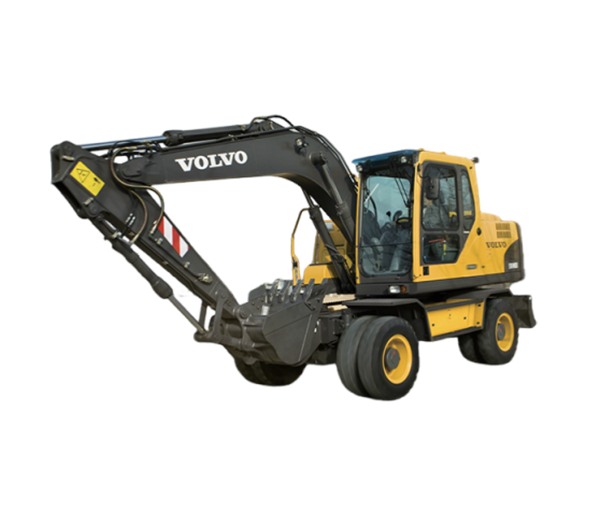
The Volvo EW145 is a medium-sized Wheeled Excavator designed for excavation, material handling, trenching, road maintenance and many other construction jobs. The model is commonly found in the Volvo EW145B Prime family. Volvo's published specifications list an operating weight of 12,800 to 15,000 kg, gross engine power of 110 kW, bucket capacity from 0.23 to 0.6 m³, maximum travel speed of 37 km/h, maximum digging depth of 4,700 mm and maximum digging reach of 7,770 mm for the EW145B Prime configuration.
I also want to make one thing clear before going into the details. Volvo has had different EW145 versions over the years. The earlier EW145B was produced from 2004 to 2009, while the EW145B Prime specifications represent a later configuration. So when I help a customer source a Volvo EW145, I do not rely on the model name alone. I check the exact version, production year, serial number, engine, working equipment and actual configuration.
That small step can prevent a lot of confusion later.
The Volvo EW145 is a wheeled Hydraulic Excavator in roughly the 13 to 15 ton working class. It combines the basic digging functions of a conventional excavator with a road-going wheeled undercarriage.
That combination makes it especially useful for contractors who work across several locations instead of staying in one fixed construction area.
For example, imagine a contractor working on a long drainage project. The crew may need to excavate one section of ditch in the morning, move several hundred meters down the road in the afternoon, and then prepare another section the following day. With a crawler excavator, moving between locations can require additional transport. With a wheeled excavator, the machine can travel between suitable work areas much more easily, subject to local road rules and site conditions.
This is where I see the Volvo EW145 making practical sense.
The machine is large enough to handle serious excavation, but it is not in the same size class as a 20-ton wheeled excavator. That gives it a useful balance between working capacity, mobility and transport requirements.
| Specification | Volvo EW145B Prime | Earlier Volvo EW145B Reference |
|---|---|---|
| Machine type | Wheeled hydraulic excavator | Wheeled hydraulic excavator |
| Operating weight | 12,800–15,000 kg | Approx. 13,100 kg in 2006 specification |
| Engine | Volvo D6E EIE3 | Volvo D6D |
| Gross / rated power | 110 kW gross / 102 kW net | 105 kW rated output |
| Bucket capacity | 0.23–0.6 m³ | 0.58 m³ in 2006 reference |
| Maximum travel speed | 37 km/h | Configuration dependent |
| Maximum digging depth | 4,700 mm | Approx. 7.8 m maximum reach |
Source: Volvo construction equipment published specifications for the EW145B Prime and Volvo's archived EW145B product information. The figures show different model generations and are not intended to represent one single machine configuration.
This distinction is important for buyers. If I am sourcing an older Volvo EW145B, I want to know exactly which generation the customer is buying. An older machine can have a different engine, hydraulic arrangement, working range and emission specification from a later EW145B Prime.
At first glance, hydraulic excavation looks simple. The operator moves a control, the boom goes up or down, the arm moves, and the bucket digs.
Behind that simple movement is a complete hydraulic system.
The diesel engine provides the power needed to drive the hydraulic pumps. The pumps move hydraulic oil through the system. Control valves direct that oil to different cylinders and motors. Hydraulic cylinders then move the boom, arm and bucket, while hydraulic motors handle functions such as swing and other machine movements.
When I inspect a used Volvo EW145, I pay close attention to this system because hydraulic condition tells me a lot about how the machine has been treated.
I look at whether the boom rises smoothly, whether the arm responds correctly, whether the bucket has enough force, and whether the machine can perform combined movements without excessive delay.
I also look for hydraulic oil leaks, damaged hoses, worn cylinder rods and signs of previous repairs.
These are basic checks, but they matter.
A common mistake when comparing Excavators is to look only at engine horsepower.
Engine power is important, but it does not work alone. Pump capacity, hydraulic pressure, cylinder condition, attachment size, boom geometry and machine weight all affect digging performance.
Volvo's EW145B Prime technical data lists a maximum hydraulic breakout force of 92.1 kN under the ISO normal rating and 97.1 kN with power boost. These figures give a useful indication of the machine's digging capability.
For everyday work, I translate that into simpler terms: the EW145 has enough working force for normal construction excavation, trenching, ditching and material handling rather than being limited to light landscaping work.
Actual digging performance will still depend on soil, rock, bucket type, operator technique and machine condition.
Suppose I am digging a water pipe trench next to an existing road. I do not want the boom and bucket to move like an on-off switch. I want predictable movement so the operator can remove soil carefully.
The same applies when cleaning a ditch, shaping a slope or placing a pipe.
That is why hydraulic response is something I check during inspection instead of simply reading the pressure number from a specification sheet.
When a customer asks me about a Volvo EW145 wheeled excavator, I normally divide the machine into several practical areas.
The biggest feature is obviously the wheeled undercarriage.
Volvo's published EW145B Prime specification lists a maximum travel speed of 37 km/h. The technical brochure also lists road, off-road and creep travel speeds of 37 km/h, 10 km/h and 3.6 km/h respectively.
This gives the operator several operating ranges instead of relying on one travel speed for every situation.
Of course, maximum machine speed does not mean that the machine can travel anywhere at 37 km/h. Public-road operation depends on local traffic laws, permits, machine registration and site conditions. I always separate the technical specification from the actual legal operating requirement.
The published EW145B Prime configuration uses a 4.4 m boom and 2.1 m arm. Volvo lists a maximum digging reach of 7,770 mm and a maximum digging depth of 4,700 mm.
That is a useful working range for drainage, utility trenches, building work and road maintenance.
A long reach also means the operator can work from a stable position without constantly repositioning the machine.
Volvo's published specification gives a maximum lifting capacity of 4,860 kg at a reach and height of 6 m and 1 m respectively for the referenced configuration.
I always tell customers not to interpret this number as a general lifting capacity for every position. Excavator Lifting Capacity changes with reach, height, working equipment and machine configuration.
For lifting pipes or other materials, the actual load chart should be checked for the specific machine.
A wheeled excavator needs a strong chassis because it has to handle both road travel and excavation loads.
The Volvo EW145B Prime brochure describes an all-welded torsion box frame, robust excavator axles and an oscillating front axle with automatic or operator-controlled locking.
From a maintenance point of view, I pay attention to the axle, steering, brakes, tires, oscillation mechanism and stabilizers when checking a used machine.
Volvo's Care Cab concept on the EW145B Prime includes improved all-round visibility, an adjustable steering column, ergonomic controls, climate control and vibration damping.
For me, the important point is simple: operators spend hours in the cab. A machine that is difficult to control or uncomfortable to work in can make a long shift harder than it needs to be.
I prefer to explain technical advantages through real working situations rather than filling a page with numbers.
Take ditch cleaning as an example. The excavator needs enough reach to work along the ditch while keeping the machine in a stable position. It may also need to travel to the next section after finishing the first one.
The EW145's wheeled design and working range fit this kind of job well.
Now consider pipe installation. The machine needs controlled digging, enough reach and enough lifting capacity to place pipe sections or handle related materials. The right bucket or lifting attachment is also important.
For road maintenance, mobility becomes even more useful. The excavator may need to travel along a project area, clean drainage channels, remove damaged material and prepare the roadside.
| Technical Item | EW145B Prime Published Data | Practical Meaning |
|---|---|---|
| Gross engine power | 110 kW | Power source for excavation and travel systems |
| Net engine power | 102 kW | Published usable engine output rating |
| Operating weight | 12,800–15,000 kg | Medium wheeled excavator working class |
| Bucket capacity | 0.23–0.6 m³ | Allows attachment selection for different jobs |
| Maximum travel speed | 37 km/h | Supports movement between suitable work areas |
| Maximum digging depth | 4,700 mm | Useful for substantial trenching and excavation |
| Maximum digging reach | 7,770 mm | Provides a broad working envelope |
| Maximum lifting capacity | 4,860 kg | Useful for selected lifting tasks under specified conditions |
Source: Volvo Construction Equipment EW145B Prime official product specifications and technical brochure. Values apply to the published reference configuration and may vary with machine setup and market.
One feature that I find particularly useful is the combination of working and traveling ability. A contractor can use the EW145 for excavation during one part of the day and move it to another suitable work location afterward.
That does not mean the machine replaces every other excavator. A tracked machine is still often better when working continuously on very soft ground or rough terrain. The strength of the EW145 is the balance between excavation and mobility.
The Volvo EW145 is a versatile machine, but I always match it to the actual application.
Road work is one of the clearest applications for a wheeled excavator.
The machine can be used for ditch cleaning, drainage excavation, roadside work, soil removal, material handling and general road maintenance.
Volvo specifically lists ditch cleaning, trench digging, moving construction debris, asphalt stripping, grading for building pads, and lifting and placing pipes among the applications of the EW145B Prime.
These applications make sense because they take advantage of both the excavator's hydraulic working equipment and its mobility.
Water, sewer, electricity and communication projects often require excavation along existing roads.
The EW145 can be useful when contractors need to move along a utility corridor and perform repeated trenching work.
For this type of job, I would pay special attention to bucket width. A narrow trench bucket may be much more suitable than a large general-purpose bucket when the goal is to minimize unnecessary soil removal.
Municipal construction can involve many small work areas rather than one huge jobsite.
Drainage repair, roadside maintenance, pipe replacement and public-space improvement are all examples where a wheeled excavator can be practical.
The ability to travel between suitable locations is one of the main reasons I would consider the EW145 for municipal contractors.
On building sites, the machine can support foundation excavation, drainage work, soil handling and general site preparation.
Its working reach can also be useful when working around the edge of an excavation.
Large landscaping projects often involve much more than moving a few loads of soil.
The machine can support drainage, slope shaping, large-scale soil movement and site preparation. For smaller gardens or narrow residential areas, however, I would normally consider a Compact Excavator instead.
With the correct configuration and approved lifting equipment, the EW145 can also support material handling tasks.
This might include positioning pipes, moving construction materials or handling debris.
I always recommend checking the actual load chart before using an excavator for lifting. Maximum lifting capacity is not one fixed number across the entire working range.
| Application | Typical Work | EW145 Advantage |
|---|---|---|
| Road construction | Ditching, drainage and earthmoving | Road mobility and excavation capability |
| Utility projects | Pipe and cable trenching | Reach and controlled hydraulic operation |
| Municipal work | Drainage and road maintenance | Easy movement between work areas |
| Building construction | Foundation and site preparation | Useful digging depth and reach |
| Landscaping | Large-scale soil shaping | Excavation capacity and attachment flexibility |
| Material handling | Pipe and construction material placement | Working reach and lifting capability |
Source: Application examples are based on Volvo Construction Equipment's published EW145B Prime application information and general operating characteristics. Actual use depends on machine configuration, attachment and local regulations.
An excavator becomes much more flexible when the attachment matches the job.
The standard bucket is the obvious starting point, but it is not the only option.
Volvo's published attachment information lists general-purpose buckets for EW145B Prime, including configurations designed for soil, clay, sand, dirt, gravel and stones. Heavy-duty buckets are available for more demanding materials such as compacted clay, gravel and certain rock conditions.
Volvo also lists Rock Buckets for quarrying and mining applications and Hydraulic Breakers suitable for the EW145B Prime.
This is useful because different materials require different tools.
For normal soil excavation, general-purpose buckets are usually the starting point.
I would use one for common earthmoving, trench excavation and site preparation where the soil does not require a specialized bucket.
When the material becomes harder or more abrasive, a stronger bucket can make more sense.
The heavier construction is intended to deal with tougher materials and increased wear.
For quarrying or highly abrasive ground, the correct rock bucket can be more suitable than a standard digging bucket.
Again, the attachment must match the machine's hydraulic and mechanical limits.
A hydraulic breaker can turn the EW145 into a useful tool for breaking concrete, asphalt or other suitable materials.
Volvo lists HB14 and HB15 low-noise hydraulic breakers as available for the EW145B Prime.
Before installing a breaker, I check the required hydraulic flow, pressure, bracket and hydraulic lines. Connecting an attachment physically is not enough; the hydraulic system needs to be compatible as well.
This is where my role through Ganglong becomes practical.
Ganglong Heavy Industry Technology (Hefei) Co., Ltd. was founded in 2013. Together with Hefei Ganglong International Trade Co., Ltd., we operate across construction machinery, mining machinery, agricultural machinery and related equipment.
We have our own HKLOONG product range, including excavators, loaders, Backhoe loaders and swamp excavators. We also provide machine sales and leasing services involving various domestic and international brands.
For Volvo machines, I work as a supplier and international trade partner. Volvo is the original equipment manufacturer, while Ganglong handles sourcing, supply coordination and related international trade services.
For a Volvo EW145, this is especially important because the model has existed in different versions.
I confirm the model designation, production year, serial number, engine information, operating hours where applicable, bucket, boom, arm, stabilizers, blade and other equipment.
I do not want a customer to order an “EW145” and only later discover that the actual machine is a different generation.
For a used machine, I can arrange checks covering the engine, hydraulic system, electrical system, travel system, steering, brakes, swing function, working equipment and attachments according to the confirmed order requirements.
I also look at the tires, axle condition, hydraulic hoses, cylinder rods, pins and bushings.
For the cab, I check the operator controls, display, lights, air conditioning and basic electrical functions.
The delivery period depends on whether the requested Volvo EW145 is available, whether the machine is new or used, the selected configuration, quantity and destination.
If the machine is already available, the process can move toward inspection and shipment after order confirmation. If sourcing is required, I confirm the schedule after the actual machine has been located and checked.
I prefer to confirm a realistic delivery schedule after knowing the actual equipment rather than giving a general number too early.
International machinery transactions are commonly arranged by T/T. A typical structure may include a deposit before order processing and the balance before shipment. Exact payment terms are agreed between both parties according to the order.
For international orders, complete Volvo EW145 machines are generally transported by sea.
The machine is prepared and secured according to the shipping requirements. Loading arrangements depend on the destination, vessel, container or bulk shipping method and the actual machine dimensions.
Suitable spare parts and accessories can be shipped separately by air or express when practical.
Large Excavators do not need the same kind of packaging as small industrial products. The main job is to protect vulnerable components and keep the machine firmly secured during transportation.
Loose parts, tools and smaller accessories can be packed separately in cartons or wooden cases. Exposed components can be protected against handling and transport conditions where necessary.
The final packing and loading method is confirmed according to the machine and destination.
For the Volvo EW145B Prime, Volvo publishes an operating weight range of 12,800 to 15,000 kg. The exact operating weight depends on machine configuration, working equipment and other options.
The published EW145B Prime brochure identifies the Volvo D6E EIE3 engine. It has six cylinders, 5.7 liters displacement, 110 kW gross power and 102 kW net power in the referenced specification.
The published EW145B Prime specification gives a maximum travel speed of 37 km/h. The technical brochure also lists 10 km/h for off-road travel and 3.6 km/h for creep travel.
Volvo lists a maximum digging depth of 4,700 mm for the referenced EW145B Prime configuration using a 4.4 m boom and 2.1 m arm.
The published maximum digging reach is 7,770 mm for the referenced EW145B Prime configuration.
Yes. Road construction and maintenance are among the applications where a wheeled excavator can be particularly useful. The EW145 can support ditch cleaning, trenching, earthmoving, asphalt-related work, grading and material handling.
Yes. The machine can be used for drainage, water, sewer, electrical and other utility excavation when the selected bucket and working configuration match the job.
Volvo lists HB14 and HB15 low-noise hydraulic breakers as available for the EW145B Prime. Actual attachment compatibility should be confirmed against the machine's hydraulic configuration and mounting interface.
I would not describe one as universally better. A wheeled excavator is particularly useful when frequent road travel and movement between locations are important. A crawler excavator can be more suitable when the machine needs strong ground contact and continuous work on rough or soft terrain.
I can arrange inspection of the engine, hydraulic system, electrical functions, steering, brakes, travel system, swing, working equipment, tires, attachments and overall appearance according to the confirmed order requirements.
Complete machines are generally transported by sea. The machine is securely fixed and protected according to shipping requirements. Spare parts and suitable accessories can be shipped separately by air or express.
Ganglong supplies a broad range of construction machinery, mining machinery, agricultural machinery and matching attachments. Depending on availability and customer requirements, we can also discuss other Volvo equipment and machinery from various domestic and international brands.
When I look at the Volvo EW145, I see a machine built around a very practical idea: combine serious excavation capability with the freedom to move around.
The published EW145B Prime specifications put the machine in the 12.8 to 15 ton operating weight range, with 110 kW gross engine power, a maximum travel speed of 37 km/h, up to 4.7 meters of digging depth and 7.77 meters of maximum digging reach.
Those numbers make sense when I look at the jobs the machine is designed to handle.
Road construction, drainage, utility installation, municipal maintenance, building work, landscaping and material handling can all benefit from a machine that does not have to stay in one place all day.
At the same time, I would never recommend buying a Volvo EW145 simply because the model name looks good on paper. The exact version matters. The production year matters. Engine condition matters. Hydraulic condition matters. Tires, axles, brakes, working equipment and attachments all matter.
For an older Volvo EW145B, these checks become even more important because different production generations can have different specifications.
That is why I prefer a straightforward process: confirm the actual machine, check its identification, inspect the major working systems, verify the equipment and documents, agree on payment and then arrange packing and transportation.
Through Ganglong Heavy Industry Technology and Hefei Ganglong International Trade, I can help customers with Volvo EW145 sourcing, machine confirmation, inspection, attachment matching, documentation, international delivery and related construction machinery supply.
For me, the right excavator is not simply the one with the biggest number on the specification sheet. It is the machine that fits the job, can move where it needs to go, has the right attachment, and can be supplied with clear information from the beginning.
 RELATED
2435092534@qq.com
86 158 5511 9567


©2026 HKLOONG Heavy Industry Technology (Hefei) Co., Ltd. All Rights Reserved.

This website uses cookies to ensure you get the best experience on our website.
 Español
 Pусский
 Français
 العربية
 WhatsApp
 Phone
Phone E-mail
 Message