

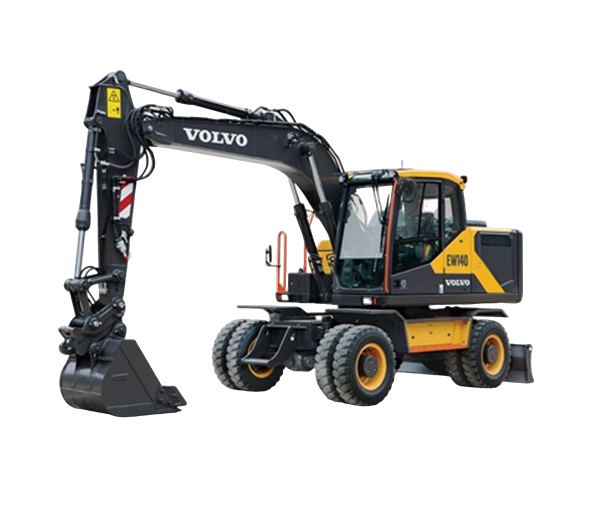
Volvo Wheel Excavator EW140 for Construction, Road Work and Utility Projects
When I talk about a wheel excavator EW140, I usually start with one simple point: this is not just a smaller version of a crawler excavator. A wheeled Excavator has a different job to do. It needs to dig well, but it also needs to move easily from one working area to another. That balance is exactly why the Volvo EW140 has remained an interesting machine in the used construction equipment market.
The Volvo EW140 is a medium-class Wheeled Excavator developed for jobs where mobility, digging ability and flexible operation all matter. The original EW140 was produced from 1999 to 2003. Volvo later developed the EW140B, EW140C and EW140D versions, with production periods and specifications changing from one generation to another. Because of this, I always recommend confirming the exact model year, serial number, configuration and attachments before discussing a machine in detail. Volvo's archived specifications show, for example, that the original EW140 had a rated output of 103 hp, bucket capacities from 0.6 to 0.78 m³, maximum reach of 7.7–8.8 m and an operating weight of about 14.95–15.05 tonnes. The later EW140B offered different specifications, including a 92 kW gross-output engine, 0.19–0.75 m³ bucket range and up to 9.3 m digging reach.
From my point of view as a machinery supplier, this model family is especially interesting for customers who need a machine that can work on construction sites but also travel between nearby locations without relying on a crawler undercarriage. That makes a Volvo EW140 wheeled excavator suitable for road maintenance, utility construction, trenching, drainage work, landscaping, municipal projects and general excavation.
The easiest way to understand the EW140 is to look at how it works in the real world. A crawler excavator is excellent when it needs to stay on one site and work on soft or uneven ground for long periods. A wheeled excavator has another advantage: it can move much more naturally on roads and paved surfaces.
The original Volvo EW140 was developed with this kind of flexibility in mind. Volvo's archived material describes the machine as having technical features such as variable engine speed, a load-sensing hydraulic system and torque control. In simple terms, these systems help the excavator respond to different working conditions instead of delivering the same machine behavior all the time.
That matters when the job changes several times during the day. In the morning, the operator may be digging a drainage trench. A few hours later, the machine may need to move along a road and load material into a truck. Later, it may work on grading or pipe installation. With a wheeled excavator, these changes are part of the machine's normal working environment.
The later EW140B continued this idea. Volvo described it as a machine compact enough for tighter working areas while still having the strength needed for heavier work. Its archived specifications list a 14.3–15.7 tonne operating weight, 92 kW gross power, bucket capacities from 0.19 to 0.75 m³ and a maximum digging reach of 9.3 m.
| Model | Production Period | Rated/Gross Power | Bucket Capacity | Operating Weight |
|---|---|---|---|---|
| Volvo EW140 | 1999–2003 | 103 hp net | 0.60–0.78 m³ | 14.95–15.05 t |
| Volvo EW140B | 2003–2007 | 92 kW gross | 0.19–0.75 m³ | 14.3–15.7 t |
| Volvo EW140C | 2007–2012 | 91 kW net | 0.65–0.98 m³ | 14.4–15.6 t |
| Volvo EW140D | 2012–2017 | 105 kW gross | 0.25–0.82 m³ | 14.1–15.9 t |
Source: Volvo Construction Equipment archived product specifications. Exact specifications vary according to model year, boom, bucket, equipment and market configuration.
Looking at the table, one thing is clear: “EW140” is a model family rather than one single specification. This is an important point when buying a used Volvo wheel excavator. I do not treat every machine carrying the EW140 name as technically identical.
The working principle is straightforward. The engine provides power, the hydraulic system transfers that power to the working equipment, and the operator uses the controls to move the boom, arm and bucket. The wheels and travel system allow the machine to move around the jobsite and, depending on local road regulations and machine configuration, between working locations.
Hydraulics are at the heart of an excavator. When the operator moves a control, hydraulic oil is directed to the relevant cylinder or motor. The boom can rise, the arm can extend or retract, and the bucket can curl into the material. This sounds simple, but good control of hydraulic power is what makes an excavator feel smooth rather than jumpy.
The original EW140 was already equipped with a load-sensing hydraulic system and torque control. For operators, the benefit is not simply a number on a specification sheet. It is the way the machine responds when several functions are used during normal work.
For example, imagine an operator digging a trench beside a road. The machine needs to position itself accurately, lower the boom, extend the arm, fill the bucket and then rotate to place the soil. A useful hydraulic system helps these movements work together in a controlled way.
For lifting work, the situation is slightly different. The operator may use the machine to position pipes or other materials. Here, machine stability, working radius, attachment choice and load chart information become important. I never recommend treating a general excavator specification as a universal lifting capacity. The actual safe load depends on the configuration and working position.
The same idea applies to digging depth and reach. Volvo's published figures are configuration-specific. For example, the EW140B brochure lists a maximum digging reach of 9.3 m and maximum digging depth of 5.7 m. The original EW140 documentation gives different reach and digging-depth figures depending on boom configuration. This is why I check the exact machine configuration before giving a customer a final working-range figure.
The biggest difference is obvious: four wheels instead of crawler tracks. This makes the machine particularly useful for projects spread across roads, streets and several nearby work areas. It can reduce the need to move the machine on a low-bed trailer every time the next work section is only a short distance away, subject to local road rules.
The EW140 family was designed for more than basic digging. Depending on the generation and configuration, it can be used for trenching, lifting, grading, loading and other general excavation work. Attachments can further change what the machine can do.
The original EW140 featured a load-sensing hydraulic system. This type of system is designed to provide hydraulic flow according to the work demand. In everyday language, the machine does not need to behave as if every operation requires full hydraulic power.
Volvo's EW140B information highlights the machine's suitability for tighter spaces and urban work. That is one reason wheeled Excavators remain useful for municipal construction, road maintenance and utility projects where space can be limited.
Volvo's later EW140 generations also placed attention on operator comfort, control layout, visibility and service access. These things may sound less exciting than engine power, but an excavator is operated for hours at a time. A practical cab can make a real difference to daily work.
| Key Item | Volvo EW140 | Volvo EW140B | Volvo EW140D |
|---|---|---|---|
| Machine Type | Wheeled excavator | Wheeled excavator | Wheeled excavator |
| Production Period | 1999–2003 | 2003–2007 | 2012–2017 |
| Max. Reach | 7.7–8.8 m | Up to 9.3 m | Up to 8.53 m |
| Max. Digging Depth | Configuration dependent | Up to 5.7 m | Up to 5.21 m |
| Max. Travel Speed | Configuration dependent | 30 km/h | 35 km/h |
| Breakout Force | Up to 88 kN | 89.5 kN | 108.5 kN boost |
Source: Volvo Construction Equipment archived specifications and brochures. Figures should be treated as model/configuration references rather than specifications for every EW140 machine.
The comparison also shows why buyers should not simply search for “Volvo EW140 specifications” and assume the first number they see applies to every machine. A 1999 machine and a 2017 machine carrying the EW140 name can have noticeably different hydraulic, engine and working specifications.
I like to look at excavator performance from the operator's point of view instead of only looking at horsepower. A machine can have plenty of engine power, but if it is difficult to position, difficult to control or poorly matched to the attachment, that power does not automatically become useful production.
The first advantage of the EW140 concept is mobility. On road construction and utility projects, the machine may need to move several times during the day. A wheeled excavator is naturally suited to this pattern. The EW140D, for example, had a published maximum speed of 35 km/h, while the earlier EW140B specification listed 30 km/h.
The second advantage is hydraulic flexibility. Digging is only one part of the job. Operators may need to lift pipes, clean ditches, shape slopes, load trucks or use a hydraulic hammer. A flexible hydraulic system and the right attachment allow one base machine to handle several jobs.
The third advantage is working reach. The original EW140 documentation lists maximum reach values up to 9.0 m for the monobloc configuration and up to 9.3 m for a two-piece boom configuration. The EW140B brochure also lists 9.3 m maximum digging reach. Again, boom and arm configuration matter.
The fourth advantage is the machine's balance between size and working capability. A machine in the roughly 14–16 tonne class can offer considerably more working capacity than a small Compact Excavator, while remaining more manageable for road and utility projects than much larger equipment.
For me, that is the practical reason to consider a Volvo EW140 Wheel Excavator for Sale. The value is not only in digging force. It is in having a machine that can move, dig, lift and load within the same project without constantly changing equipment.
When customers ask me what industries the EW140 is suitable for, I usually answer with the type of work rather than a single industry name. The machine fits jobs where excavation and mobility come together.
Road projects are a natural application. The excavator can support drainage work, roadside excavation, ditch cleaning, material loading, grading and general maintenance. Because the machine is wheeled, moving between sections of a road project can be more convenient than moving a tracked excavator each time.
Water, drainage, gas, electrical and communication projects often involve narrow trenches and repeated movement along a route. A wheeled excavator can dig trenches, handle suitable lifting tasks and help place or backfill materials.
Urban construction brings a different set of problems. There may be traffic, buildings, pedestrians, existing utilities and limited working space. The EW140 concept fits this environment because mobility and controlled operation are important.
Landscaping work may include grading, slope shaping, drainage and material handling. The excavator can be paired with different buckets or other suitable attachments depending on the job.
On building sites, the machine can support foundation excavation, trenching, site preparation, loading and general earthmoving. The exact machine size should always be selected according to the site, soil, access conditions and required lifting or digging range.
With the correct configuration and attachment, a wheeled excavator can also support material handling. However, lifting work requires more attention than ordinary digging. I always recommend checking the machine's official load chart for the exact boom, arm, counterweight, stabilizer and attachment configuration before lifting.
For an international buyer, buying the machine is only part of the job. The other part is making sure the machine that leaves the yard is the machine the customer actually ordered.
At Ganglong Heavy Industry Technology (Hefei) Co., Ltd., I approach this as a supply and inspection process. Our group was founded in 2013 and works across construction machinery, mining machinery, agricultural machinery and related attachments. Through Hefei Ganglong International Trade Co., Ltd., we also handle international trade activities for customers in different regions.
When discussing a used or available Volvo EW140 excavator, I first want to confirm the exact model. “EW140” alone is not enough. I look at the model generation, production year, machine hours where available, configuration, engine information, attachment condition and overall machine status.
Before shipment, we can arrange checks according to the confirmed order. These may include the machine's exterior condition, engine operation, hydraulic system, electrical system, travel function, working equipment, attachments and related documents. The exact inspection scope depends on the machine and the agreement with the customer.
This step is especially important with older wheeled excavators. A used machine can look good in photographs but still require attention in areas such as hydraulic hoses, cylinders, pins and bushes, tires, electrical components, cooling systems or oil leakage. A proper inspection gives the buyer a clearer picture before shipment.
Delivery time depends on the selected machine, configuration, quantity, current availability and destination. For a used Volvo EW140, availability is naturally different from ordering a new production machine. I therefore prefer to confirm the actual unit and schedule instead of giving a generic delivery promise.
For payment, international orders are commonly arranged by T/T, with a deposit before order processing and the balance before shipment. Exact payment terms are confirmed between both parties according to the order.
For transportation, complete excavators are generally shipped by sea for international orders. Smaller spare parts or suitable accessories can usually be sent by air or express service. The final method depends on destination, dimensions, shipping cost and customer requirements.
For packing, the machine is securely fixed and protected for transportation. Loose accessories, documents and smaller parts can be packed separately in cartons or wooden cases where appropriate. Before loading, the final packing and shipping arrangement is checked against the destination requirements.
I know buyers have many choices when they search for construction machinery online. The real question is not simply whether someone can list a machine. The more useful question is whether the supplier can communicate clearly about what is actually available.
Ganglong Heavy Industry Technology (Hefei) Co., Ltd. was founded in 2013. Together with Hefei Ganglong International Trade Co., Ltd., we operate as part of China Construction Machinery (Group) Co., Ltd. Our business covers equipment research and development, manufacturing, testing, customization, machine sales, leasing and international trade.
We have our own HKLOONG range covering excavators, loaders, Backhoe loaders and swamp excavators. At the same time, we supply complete machines from a range of domestic and international brands according to customer requirements. When it comes to Volvo equipment, our role is to supply and arrange the machine rather than present ourselves as the Volvo manufacturer.
This distinction matters. A customer buying a branded construction machine deserves to know who made it and who is supplying it. I prefer to keep that relationship clear from the beginning.
Our international trade team has experience serving customers across Asia, Africa, America and other regions. Different markets have different requirements for transportation, documents, machine configuration and payment arrangements. That experience helps us communicate with customers who are buying equipment from outside their home market.
For an EW140 project, I also pay attention to the small details that can become big problems later. Is the attachment included? What is the exact bucket size? What is the machine year? What is the operating weight in the actual configuration? Are documents available? How will the machine be loaded? Which port will be used? Are spare parts required?
These are not glamorous questions, but they are the questions that make an international machinery order much easier to manage.
Yes. The Volvo EW140 is a wheeled excavator. Volvo produced the original EW140 from 1999 to 2003 and later developed EW140B, EW140C and EW140D versions. These generations have different specifications and production periods.
The answer depends on the generation and configuration. Volvo's original EW140 documentation lists approximately 14.95–15.05 tonnes for its 2001 specification. The EW140B is listed at approximately 14.3–15.7 tonnes, while the EW140D is listed at 14.1–15.9 tonnes. Attachments and machine configuration can change the actual operating weight.
Different versions use different bucket ranges. The original EW140 documentation lists 0.6–0.78 m³ in one specification, while the EW140B is listed at 0.19–0.75 m³ and the EW140D at 0.25–0.82 m³. The actual bucket should be confirmed for the specific machine being supplied.
Travel speed varies by generation. Volvo's archived information lists up to 30 km/h for the EW140B and up to 35 km/h for the EW140D. Actual travel performance depends on machine condition, configuration, terrain and operating conditions.
Yes. Road construction and maintenance are suitable applications for a wheeled excavator. Typical work can include drainage, trenching, ditch cleaning, grading, material loading and general excavation.
Yes. Utility construction is one of the practical applications for this type of machine. It can support trenching, pipe installation, drainage work and related excavation tasks. The exact attachment and machine configuration should be selected according to the project.
It can be configured for suitable lifting work, but lifting capacity is not one universal number. It changes according to working radius, height, boom and arm configuration, counterweight, stabilizers and attachment. I recommend checking the official load chart for the exact machine before carrying out lifting work.
I would start with the actual project rather than the model name. Compare production year, engine, hydraulic system, working range, operating weight, attachments, machine condition, service history and availability of parts. For used equipment, actual condition can be just as important as the generation of the machine.
The normal process is to confirm the exact machine, configuration and attachments first. After that, the supplier and buyer agree on inspection, price, payment, documentation, transportation and delivery arrangements. For international orders, complete machines are generally transported by sea, while suitable smaller parts can be shipped by air or express.
After looking at the EW140 family from the practical side, I see its main value in flexibility. It is a wheeled excavator built around a simple idea: dig like an excavator, but move around the jobsite with much more road-oriented mobility.
The original Volvo EW140 already included features such as load-sensing hydraulics, variable engine speed and torque control. Later generations continued to develop the concept with changes to engines, hydraulics, operator comfort, safety, serviceability and working performance.
At the same time, I would not treat “Volvo EW140” as one fixed specification. The original EW140, EW140B, EW140C and EW140D belong to different production periods and have different technical data. For anyone searching for a Volvo EW140 for sale, the exact model year and configuration should always be confirmed before comparing machines.
For road maintenance, utility construction, municipal projects, landscaping, trenching, drainage and general excavation, the wheeled excavator format can be a very practical choice. The machine can also work with suitable attachments for tasks beyond standard digging.
From our side at Ganglong, the goal is straightforward: confirm the machine, check the important details, communicate the actual condition clearly, and arrange the international supply process according to the customer's requirements. Whether the buyer needs a complete machine, suitable attachments or related construction equipment, I prefer to handle the order around the real working requirement rather than simply around a model name.
If you are comparing a Volvo EW140 with another wheeled excavator, the most useful information to compare is not only horsepower. Look at operating weight, digging depth, maximum reach, bucket capacity, hydraulic performance, travel speed, attachment compatibility, machine condition, service history and total delivery cost. Those details tell you much more about whether the machine fits your actual job.
 RELATED
2435092534@qq.com
86 158 5511 9567


©2026 HKLOONG Heavy Industry Technology (Hefei) Co., Ltd. All Rights Reserved.

This website uses cookies to ensure you get the best experience on our website.
 Español
 Pусский
 Français
 العربية


 WhatsApp
 Phone
Phone E-mail
 Message