
 Español
 Pусский
 Français
 العربية


When I discuss combine harvesters with overseas agricultural machinery buyers, I usually start with a simple question: what crops are you actually going to harvest?
It sounds obvious, but it matters. A combine that works well for wheat may need a different setup for rice, soybean, oilseed rape, or other crops. Field size, crop moisture, soil conditions, working season, transport distance, and even the way the harvested straw will be used can change what configuration makes sense.
That is why I look at the Wheel Harvester GV100 from a practical point of view. The LOVOL GV100, also identified as the 4LZ-8V Combine Harvester, is a wheeled combine harvester designed mainly for wheat, highland barley, oilseed rape, soybean, and other similar crops. LOVOL's official product information lists an 8 kg/s feeding rate, a 4,570 mm cutting width, and a tangential-flow drum combined with a four-key straw walker system.
At Ganglong Heavy Industry Technology (Hefei) Co., Ltd., my job is not simply to quote a machine and wait for an order. I want to understand where the machine will work, what crop it will harvest, what attachments are required, and how the machine will be delivered to the customer's country.
Together with Hefei Ganglong International Trade Co., Ltd., we provide construction machinery, mining machinery, agricultural machinery, and matching attachments for international customers. We can supply and arrange LOVOL equipment as part of our agricultural machinery business, while keeping the manufacturer's brand and our role as an international machinery supplier clearly separated.
1. What Is the LOVOL GV100 Wheel Harvester?
The LOVOL GV100 Wheel Harvester is a self-propelled wheeled combine harvester built mainly for grain crops. Its current official English product page identifies the model as GV100 (4LZ-8V) and says the GV series mainly harvests wheat, highland barley, oilseed rape, soybean, and other crops.
In simple terms, the machine cuts the standing crop, brings the crop into the harvesting system, separates the grain from the plant material, cleans the grain, stores it temporarily, and finally unloads it into another vehicle.
That is what every combine is supposed to do. The real difference is how well the different parts work together.
For the GV100, LOVOL uses a tangential-flow drum plus four-key straw walker harvesting route. This is different from the longitudinal axial-flow system used by some other LOVOL wheel combine models such as the GM100.
This difference is worth understanding before purchasing. A buyer should not look only at engine power or header width. The threshing and separation structure affects how crop material moves through the machine, how straw is handled, and how the machine should be adjusted for different crops.
The published GV100 specification gives an engine designation of WEICHAI WP4.1NG175E301, a 4,570 mm cutting width, 8 kg/s feed capacity, 8,600 kg total weight, and dimensions of 9,100 × 4,990 × 3,630 mm. LOVOL also lists a working efficiency of 1.0–1.66 hm²/h on its official GV100 page.
| GV100 Specification | Published Data | What It Means in Daily Work |
|---|---|---|
| Model | GV100 / 4LZ-8V | Identifies the published GV100 combine configuration |
| Engine | WEICHAI WP4.1NG175E301 | Provides power for field harvesting and machine movement |
| Cutting width | 4,570 mm | Allows a wide harvesting pass |
| Feed capacity | 8 kg/s | Supports continuous crop feeding |
| Total weight | 8,600 kg | Important for transport and field planning |
| Working efficiency | 1.0–1.66 hm²/h | Published reference range; actual output varies by field conditions |
| Threshing structure | Tangential-flow drum + four-key straw walker | Handles threshing and grain separation through a conventional straw-walker route |
| Cleaning system | Air-and-screen cleaning | Separates grain from lighter material and impurities |
| Grain unloading height | 4,500 mm | Allows unloading into suitable receiving vehicles |
Source: LOVOL official GV100 (4LZ-8V) product information. Specifications are configuration-specific and should be confirmed for the destination market before ordering.
2. How the GV100 Combine Harvester Works
From the driver's seat, the harvesting process looks straightforward. But inside the machine, several jobs are happening at the same time.
The first step is cutting. The header moves through the standing crop and gathers the plants. With the published 4,570 mm cutting width, the GV100 can cover a broad working path in each pass. A wider header can reduce the number of passes needed across a field, although the real field output still depends on crop density, yield, moisture, terrain, turning time, and operating speed.
Once the crop is cut, it is transferred into the feeding system and sent toward the threshing area.
The GV100 uses a tangential-flow threshing drum. Instead of sending the crop through a long axial-flow rotor, the crop enters the drum and concave area in a more traditional threshing route. The purpose is to release the grain from the ears or pods while keeping unnecessary damage under control.
After threshing, the remaining plant material moves toward the four-key straw walker system. The straw walkers help separate grain that is still mixed with straw. This is especially important because not every grain is separated at the first point of threshing.
The grain then reaches the cleaning system. LOVOL lists an air-and-screen cleaning device for the GV100. The basic idea is easy to understand: screens help sort the material, while airflow removes lighter particles such as chaff and other unwanted material.
Finally, cleaned grain is collected for unloading.
For me, this is one of the most important things to explain to a new buyer. A combine harvester is not one machine doing one job. It is a chain of jobs. Cutting, feeding, threshing, separating, cleaning, collecting, and unloading all need to work together.
If one part is overloaded, the operator may need to slow down. If crop moisture is high, settings may need to change. If the crop is very dry, the cleaning system may require different adjustment. Good harvesting is therefore partly about the machine and partly about using the machine correctly.
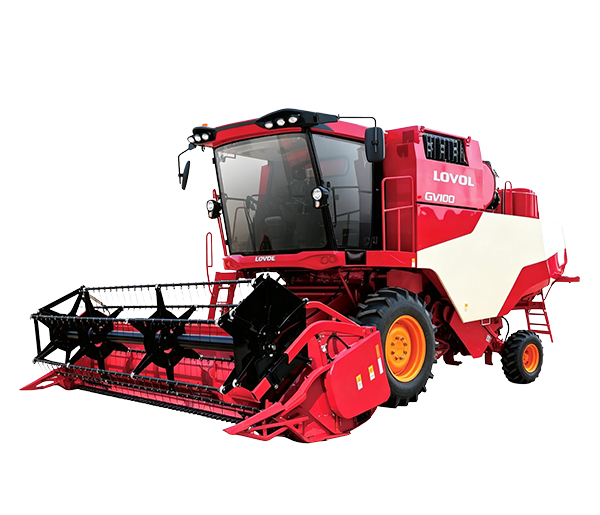
3. The Main Features I See in the GV100
4.57-Meter Cutting Width
One of the first specifications buyers notice is the 4,570 mm cutting width. That is a substantial header for a wheeled grain combine and gives the machine a broad working path.
In a large wheat field, every unnecessary pass takes time. A wider header can help the operator cover more land in each run. Of course, the field must be suitable for that working width, and the actual output will depend on crop conditions.
LOVOL's current Chinese GV5085 page, which uses the same 175 PS and 4.57 m class of configuration, also lists a 3.86 m optional header, showing that header configuration can vary according to the product version and market.
For this reason, when I prepare an international quotation, I confirm the exact header rather than assuming that every GV100 shipped to every country has identical equipment.
175 PS Class Power
The official GV100 page identifies the engine as WEICHAI WP4.1NG175E301. The published model is therefore positioned around the 175 PS class.
Engine power matters because harvesting is not a light job. The machine needs to move the header, feed crop, run the threshing and separation system, operate the cleaning system, and move through the field at the same time.
But I always tell buyers not to judge a combine only by horsepower. The right question is whether the power level matches the crop, header, field conditions, and intended working load.
Four-Key Straw Walker
The four-key straw walker is a central part of the GV100's harvesting design.
After the initial threshing process, some grain remains mixed with straw. The straw walker moves the material while helping recover grain that has not yet been separated. This gives the machine a dedicated separation stage rather than trying to complete the entire job in the threshing drum.
This design is also important for buyers who care about straw quality. Depending on crop conditions and machine settings, the way straw moves through the combine can affect the final straw material.
Air-and-Screen Cleaning
Clean grain is the goal at the end of the harvesting process. The GV100 uses an air-and-screen cleaning system.
The screens handle material separation while airflow helps carry away lighter unwanted material. The exact result depends on machine adjustment, crop moisture, crop type, and field conditions.
This is one reason experienced operators make small adjustments during the harvesting season. A setting that works well in dry wheat may not be the best setting for another crop.
4.5-Meter Unloading Height
LOVOL's official GV100 specification lists a grain unloading height of 4,500 mm.
This is useful when the harvester needs to unload grain into a relatively high receiving vehicle. For overseas buyers, I recommend checking the height and size of the local grain transport trucks before confirming the final configuration.
4. GV100 Compared with Other LOVOL Wheel Combine Harvesters
When a customer asks me whether the GV100 is the right machine, I do not immediately answer with a yes or no. I compare the actual working requirements.
For example, LOVOL's current range also includes the GM100 and GK120. These machines use different harvesting structures and are positioned at different capacity levels. Looking at the numbers side by side makes the difference easier to understand.
| Model | Engine Power | Cutting Width | Feed Capacity | Working Efficiency | Threshing Structure |
|---|---|---|---|---|---|
| GV100 | 175 PS class | 4,570 mm | 8 kg/s | 1.0–1.66 hm²/h | Tangential-flow drum + four-key straw walker |
| GM100 | 190 PS | 3,860 mm | 10 kg/s | 0.8–1.6 hm²/h | Longitudinal axial flow |
| GK120 | 260 PS class | 5,340 mm configuration | 12 kg/s | 1.0–2.0 hm²/h | Single longitudinal axial flow |
Source: LOVOL official published GV100, GM100 and GK120 product information. Values represent published configurations and should not be treated as universal specifications for every market.
There is no need to make the comparison more complicated than that.
The GV100 uses a straw-walker design and a 4.57 m header. The GM100 uses longitudinal axial-flow threshing and has a published 10 kg/s feed capacity. The larger GK120 moves into another capacity level, with a published 12 kg/s feed rate and 5.34 m cutting width in the listed configuration.
For a farm mainly harvesting wheat, barley, soybean, or oilseed rape, the GV100 can be considered as a practical grain harvesting platform. For customers looking for a different harvesting route or higher feed capacity, other LOVOL models may need to be considered.
5. Where I Would Use the GV100
Wheat Fields
Wheat is one of the main crops associated with the GV100.
For wheat harvesting, I pay attention to crop height, grain moisture, field size, straw condition, and expected yield. The 4.57 m cutting width can help reduce the number of passes, while the threshing and straw-walker system provides a dedicated separation process.
The operator still needs to adjust the machine to actual crop conditions. A combine cannot compensate for every field condition automatically.
Highland Barley
LOVOL specifically lists highland barley among the crops for the GV100.
For highland farming projects, I would also look at elevation, field access, terrain, transport routes, and local weather. These factors can be just as important as the machine specification itself.
Oilseed Rape
Oilseed rape is another crop listed in LOVOL's official GV100 description.
When a customer plans to harvest oilseed rape, I would confirm the required header and operating setup before shipment. Crop characteristics are different from wheat, so the harvesting configuration should be matched to the actual job.
Soybean
The GV100 is also listed for soybean harvesting. Soybean fields can vary considerably in plant height, moisture, soil condition, and crop density. The operator needs to work with the machine rather than simply driving at the same speed used for another crop.
Agricultural Contractors
I also see a possible fit for agricultural contractors who provide harvesting services to several farms.
A contractor normally cares about machine utilization. If one combine can cover several crop types with suitable attachments and settings, it may be useful across a longer working season.
However, contractors should calculate the complete business case, including annual working hours, transport distance, fuel, maintenance, operator costs, spare parts, and local service availability. Buying a combine is not only about the purchase price.
6. What I Check Before Exporting a GV100
International agricultural machinery orders require more preparation than simply confirming a model number.
My first step is to understand the customer's farm.
I ask what crop will be harvested, how many hectares need to be covered, how many working hours are expected each year, what the soil is like, and whether the machine needs to move between different farms.
Then I check the required header and attachments. This is particularly important for a multi-crop machine because the customer may have a plan to harvest more than one crop.
After that, I confirm the exact engine, header, threshing configuration, cleaning system, grain tank, unloading system, tires, cab, and other equipment included in the order.
I also compare the requested configuration with the specification available for the customer's market. LOVOL's official product pages show that related GV products can have different configurations. For example, the current GV5085 page lists 175 PS, a 4.57 m standard header, an optional 3.86 m header, a 4 m³ grain tank, and a 310 L fuel tank.
This is exactly why I do not copy one regional specification and assume it applies everywhere.
| Before Order | What I Confirm |
|---|---|
| Crop | Wheat, barley, oilseed rape, soybean or other target crops |
| Field conditions | Flat land, soft soil, terrain, field size and access |
| Header | Cutting width and crop-specific attachment |
| Machine configuration | Engine, threshing, cleaning, grain tank and unloading system |
| Inspection | Engine, hydraulics, electrical system, working functions and attachments |
| Documents | Commercial and machine-related documents required for shipment |
| Transport | Destination port, shipping method and loading requirements |
Source: Ganglong Heavy Industry Technology (Hefei) Co., Ltd. international machinery order and delivery process information supplied for this product page.
7. How I Handle GV100 Inspection, Packing and Shipping
One thing I have learned from international machinery work is that delivery does not start when the ship leaves the port. It starts much earlier.
For a GV100 Wheel Combine Harvester, I first make sure the machine configuration matches the confirmed order. This includes the harvesting attachment, machine equipment, loose accessories, documents, and any special requirements from the customer.
Before shipment, we can arrange checks on the engine, hydraulic system, electrical system, tires, harvesting functions, working controls, attachments, and required documents.
The purpose is simple. I want the customer to know what is being shipped before it leaves China.
For transportation, complete agricultural machinery is generally shipped by sea. Depending on the destination and transport arrangement, the machine is secured and protected for loading. Loose parts and smaller accessories can be packed separately in cartons or wooden cases where appropriate.
For spare parts or smaller accessories that need faster delivery, air freight or express transportation can be considered.
The final shipping method depends on machine size, destination, freight cost, delivery schedule, and customer requirements.
Payment is commonly arranged by T/T, with a deposit before order processing and the balance before shipment. The exact terms are agreed between the parties before the order is finalized.
The preparation period is also not a fixed number that I would promise to every buyer. It depends on the selected LOVOL model, exact configuration, order quantity, machine availability, inspection requirements, and shipping schedule.
8. Why I Choose a Practical Supply Approach at Ganglong
Ganglong Heavy Industry Technology (Hefei) Co., Ltd. was founded in 2013. Together with Hefei Ganglong International Trade Co., Ltd., we operate as a comprehensive industrial enterprise covering equipment R&D, manufacturing, testing, customization, sales, and international trade.
Our equipment business covers construction machinery, mining machinery, agricultural machinery, and matching attachments.
We have our own HKLOONG brand for Excavators, loaders, Backhoe loaders, and swamp excavators. At the same time, we provide complete machine sales and leasing services for several domestic and international brands, including Hitachi, SANY, Lonking, Hyundai, XCMG, SHANMON, and LOVOL.
For LOVOL products, I think it is important to explain our role honestly. We supply and arrange LOVOL machinery; we do not present LOVOL-branded equipment as a Ganglong-manufactured product.
That distinction may sound small, but it is important when an overseas customer needs clear information about the manufacturer, product model, technical specification, documentation, shipping, and service responsibilities.
Our international trade arm, Hefei Ganglong International Trade Co., Ltd., has experience in construction machinery, mining machinery, and agricultural machinery. The team has served customers in Asia, Africa, America, and other regions.
When a customer contacts me about a GV100 Wheel Harvester for sale, I try to make the conversation practical. I want to know the crop, farm size, country, working conditions, preferred configuration, attachments, shipping destination, and inspection requirements.
Once those details are clear, we can work toward a suitable machine configuration instead of simply sending a generic quotation.
Frequently Asked Questions About the Wheel Harvester GV100
1. What crops can the LOVOL GV100 harvest?
LOVOL's official GV100 page states that the machine mainly harvests wheat, highland barley, oilseed rape, soybean, and other crops.
2. What is the cutting width of the GV100?
The published GV100 (4LZ-8V) specification lists a cutting width of 4,570 mm. The exact header configuration should be confirmed before ordering.
3. What is the GV100 feed capacity?
LOVOL lists an 8 kg/s feed capacity for the GV100. Actual field throughput can vary according to crop yield, moisture, field conditions, operator settings, and working speed.
4. What threshing system does the GV100 use?
The GV100 uses a tangential-flow drum combined with a four-key straw walker system. This is different from the longitudinal axial-flow system used on some other LOVOL wheel combine models.
5. What cleaning system does the GV100 use?
The official GV100 specification lists an air-and-screen cleaning device. Its purpose is to separate cleaned grain from lighter material and other impurities after threshing and separation.
6. What is the GV100 working efficiency?
LOVOL's current English GV100 page lists a working efficiency of 1.0–1.66 hm²/h. Actual field efficiency depends on crop, field size, crop yield, moisture, terrain, machine settings, and operator experience.
7. What is the total weight of the GV100?
The official GV100 (4LZ-8V) product page lists a total weight of 8,600 kg and overall dimensions of 9,100 × 4,990 × 3,630 mm. These figures should be confirmed against the final configuration before transportation planning.
8. Is the GV100 suitable for wheat harvesting?
Yes. Wheat is one of the main crops listed for the GV100 by LOVOL. The machine's 4.57 m cutting width and straw-walker harvesting structure make it a practical option to consider for wheat harvesting projects.
9. Can the GV100 be used for soybean?
Yes. LOVOL's official GV100 description specifically includes soybean among its target crops. The final configuration and operating settings should be matched to the local soybean crop and field conditions.
10. Can you arrange international delivery?
Yes. Ganglong and Hefei Ganglong International Trade Co., Ltd. handle international machinery orders. We can discuss machine inspection, packing, shipping, documentation, and delivery arrangements according to the destination and customer's requirements.
11. Can the machine be inspected before shipment?
Yes. We can arrange checks on the engine, hydraulic system, electrical system, tires, working functions, attachments, and required documents before delivery according to the agreed requirements.
12. How is the GV100 shipped overseas?
Complete agricultural machinery is generally transported by sea. Suitable spare parts and smaller accessories can be shipped by air or express when required. The final method depends on the destination, machine dimensions, urgency, and shipping arrangement.
Final Thoughts: Choosing the Right GV100 Configuration
When I look at the Wheel Harvester GV100, I see a machine designed around a fairly clear purpose: practical grain harvesting with a wide header, a 175 PS-class power unit, 8 kg/s published feeding capacity, and a tangential-flow drum plus four-key straw walker system.
The 4,570 mm cutting width gives it a broad working path. The air-and-screen cleaning system handles the cleaning stage, while the four-key straw walker provides a separate grain recovery process after threshing. LOVOL's published data also gives the machine a 4,500 mm unloading height and a 1.0–1.66 hm²/h working efficiency range.
But I would not tell every customer that the same configuration is automatically suitable.
That is not how agricultural machinery works.
A farmer harvesting dry wheat in a large, flat field has different needs from a contractor working across several regions. A soybean grower may care about a different header setup. An oilseed rape operation may need different harvesting adjustments. A customer exporting the machine to another country also needs to consider transport dimensions, local road conditions, service support, spare parts, and import requirements.
So when someone asks me about a LOVOL GV100 Wheel Harvester, I start with the crop and the field, then work backward to the machine configuration.
That is the approach I use at Ganglong Heavy Industry Technology: understand the actual job first, confirm the equipment second, and only then arrange the international order, inspection, packing, and delivery.



 WhatsApp
 Phone
Phone E-mail
 Message