

When I talk with customers about large electric Excavators, I usually start with one simple question: what kind of work will the machine actually do every day?
That question matters more than it sounds. A 40-ton-class Excavator can be used for earthmoving, quarrying, mining, road construction, infrastructure work, demolition, bulk material handling and many other jobs. The machine may look similar from the outside, but the right energy system, bucket, battery capacity and working equipment can be very different from one project to another.
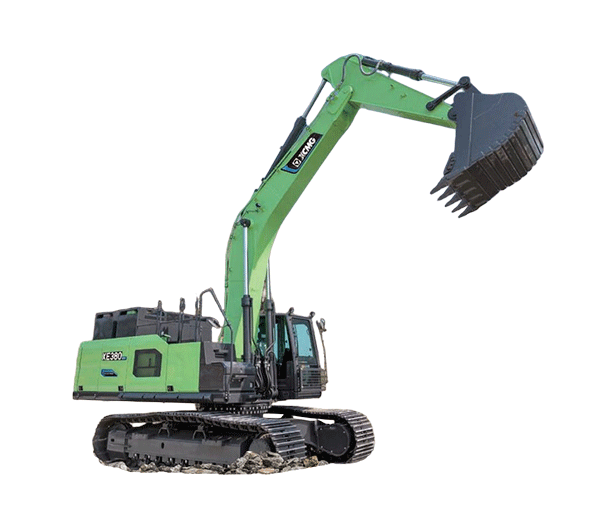
The XE380EV Crawler-type Battery-swapping Hydraulic Excavator is part of XCMG's move toward large electric construction equipment. Public information on the XE380EV identifies it as a pure electric crawler excavator, with published versions around 41.9 to 42.4 tonnes and battery capacity around 800 kWh. Other published material lists a 200 kW motor, while a European distributor lists a 300 kW rated power configuration, showing that specifications can vary by version and market.
For this reason, I do not treat one online specification sheet as the final purchasing document. For an actual order, I would confirm the final machine configuration, battery system, charging or swapping arrangement, working equipment and operating weight with the supplier.
What interests me about this machine is its overall concept. Instead of relying on diesel fuel, it uses electric energy to drive the hydraulic excavation system. For customers looking at battery electric construction machinery, this can change the way the entire job site is planned, from energy supply and daily operating costs to noise and local emissions.
XCMG has developed a broad new-energy equipment portfolio covering pure electric, battery-related energy systems and other alternative power technologies. Its current strategy also includes charging, energy storage and battery-swapping infrastructure, showing that the company is looking at new-energy construction equipment as a complete system rather than simply replacing a diesel engine with an electric motor.
If I strip away the technical language, the XE380EV is a large crawler excavator designed to perform the same basic jobs customers expect from a heavy hydraulic excavator while using electric power.
The crawler undercarriage gives the machine a stable platform. The upper structure can swing around the working area, while the boom, arm and bucket use hydraulic power to dig, lift and move material. The difference is the energy source. Instead of a conventional diesel engine providing the main power, the electric version uses a large battery and electric drive system.
One publicly listed XE380EV configuration has an operating weight of 41,900 kg, 200 kW motor power, 801.2 kWh battery capacity, a 1.9–2.1 m³ bucket and a maximum digging radius of 10,970 mm.
Another European distributor lists the XE380EV at 42,400 kg with an 800 kWh CATL battery, 300 kW rated power and a stated driving time of 6–8 hours.
I see these differences as a reminder that the exact specification needs to be matched to the target market and production version. They should not automatically be treated as contradictory machine data.
| Published XE380EV Reference | Specification |
|---|---|
| Operating weight | About 41,900–42,400 kg |
| Electric motor power | 200–300 kW depending on published version |
| Battery capacity | About 800 kWh |
| Bucket capacity | About 1.9–2.1 m³ |
| Maximum digging radius | About 10,970 mm in one published specification |
| Operating time | About 6–8 hours in published distributor information |
Source: published XE380EV specifications from XCMG-related equipment listings and European distributor information. Specifications vary by version and should be confirmed against the final technical document.
For a buyer, this is actually useful information. Instead of asking only, “What is the battery capacity?”, I would ask, “Which battery configuration will be supplied to my project, what is the rated motor output, what is the expected working cycle, and how will the energy system be replenished?”
That is especially important when the project is considering a battery-swapping solution. A battery-swapping excavator is not simply a machine with a removable battery. The machine, battery pack, swap equipment, electrical infrastructure and operating procedure all have to work together.
The easiest way to understand the concept is to compare it with a traditional diesel excavator.
On a diesel excavator, fuel is stored in a tank. The engine burns that fuel and creates mechanical power. That power is transferred through the hydraulic system to move the boom, arm, bucket, swing system and travel system.
On a battery-electric excavator, electrical energy is stored in a large battery pack. The battery supplies electrical power to the drive system, and the electric motor provides mechanical power for the hydraulic system and other machine functions.
With a battery-swapping approach, the idea is to separate the energy replenishment process from the machine's working cycle. Instead of waiting for a large battery to charge on the machine, a prepared battery can potentially be exchanged for another charged battery, allowing the excavator to return to work sooner.
This is where I think battery swapping becomes interesting for heavy construction equipment. A Large Excavator can consume a lot of energy during continuous work. If the machine is working one or two shifts a day at a fixed site, charging may be practical. But if the customer wants long working hours and very short energy replenishment downtime, a swapping system can offer another way to organize the operation.
XCMG has publicly demonstrated battery-swapping technology in its broader new-energy equipment ecosystem. In 2024, XCMG and ENNEAGON announced integrated battery packs and charging/swapping equipment, with swapping times of 1.5–4 minutes for the commercial-transport applications described in that announcement. The announcement also described battery-swap units and charging stations covering different power requirements.
I would not automatically apply those swap times to the XE380EV excavator. The commercial-vehicle battery system described in that announcement is not proof of a specific XE380EV excavator swap time. For the excavator, the actual battery replacement method and time need to be confirmed for the supplied configuration.
That distinction is important when buying equipment. Good technical information should tell us not only what is possible in a wider product ecosystem but also what has actually been confirmed for the specific machine being purchased.
From the operator's point of view, however, the basic idea is simple: electric energy powers the machine, and the energy supply method is designed around the working schedule.
The XE380EV is not a small electric excavator. At roughly 42 tonnes, it is intended for serious earthmoving and heavy construction work. That makes it particularly interesting for customers who have already accepted the electric concept but need more than a compact or medium-sized machine.
XCMG's broader electric excavator range includes models from small machines such as the XE19EV through larger models such as the XE380EV. A 2026 industry report on XCMG's new-energy excavator range describes the XE380EV as part of its large pure-electric lineup for heavy-duty applications.
Published XE380EV specifications show battery capacities around 800 kWh. One listing specifies 801.2 kWh, while another gives an 800 kWh CATL battery.
That is a very large battery compared with small electric excavators. It is necessary because the machine itself is large and the hydraulic work is demanding.
For me, the important point is not simply having a large number of kilowatt-hours. The real question is how efficiently the machine converts that stored energy into useful digging work. Motor efficiency, hydraulic matching, operator habits, soil conditions and work cycle all affect actual energy consumption.
Electric motors can produce high torque from low speed, which is useful for heavy machinery. XCMG-related XE380EV product information describes the machine as using a high-torque permanent magnet synchronous motor, with published material giving efficiency of up to 96.7%.
I would look at this feature from a practical angle. When the bucket enters hard soil or the machine needs to move a heavy load, immediate motor response can help the hydraulic system provide the required power without the same type of engine response delay associated with a conventional diesel powertrain.
A published XE380EV specification gives a maximum digging radius of 10,970 mm. Another European listing gives a digging range of about 11.1 metres.
That kind of reach is useful when loading trucks, moving soil, digging foundations or working around a quarry face. The actual working range naturally depends on the boom, arm and attachment configuration.
Electric equipment does not produce tailpipe exhaust during operation in the way a diesel engine does. That can be useful for construction sites near residential areas, indoor or semi-enclosed applications, and projects with strict local air-quality requirements.
XCMG's own electric excavator materials highlight zero-emission operation, lower noise and reduced vibration for its electric range.
Of course, “zero emissions” here refers to operation at the machine itself. The overall environmental impact of an electric machine also depends on how the electricity is generated, how batteries are produced and how they are eventually recycled.
| Feature | XE380EV Electric Concept | Traditional Diesel Excavator Concept |
|---|---|---|
| Primary energy source | Stored electrical energy | Diesel fuel |
| Power conversion | Battery + electric motor | Fuel + diesel engine |
| Tailpipe exhaust during operation | No tailpipe exhaust | Yes |
| Energy replenishment | Charging or applicable battery system | Fuel refilling |
| Typical maintenance focus | Electrical, battery, motor and hydraulic systems | Engine, fuel, exhaust, hydraulic and cooling systems |
| Best planning question | How will electrical energy be supplied? | How will diesel fuel be supplied? |
Source: general engineering comparison based on the published XE380EV electric configuration and conventional excavator operating principles. This is not a performance test between two specific machines. XE380EV electric characteristics are supported by published XCMG-related sources.
I would consider the XE380EV when the job needs a large excavator but the customer also wants to move away from diesel power.
Mining and quarrying are obvious applications for a machine in this size range. Excavation, loading, material preparation and earthmoving often require high power and long operating hours.
A recent report described the delivery of XE380EV electric excavators to a large quarry in Sichuan and positioned the machine for mining and quarry applications. That report claimed 6–8 hours of continuous operation and fast charging, although those operating figures should be treated as source-specific rather than universal guarantees.
For a quarry operator, I would calculate the full work cycle before selecting the machine. How much material is moved per hour? How far does the machine travel? How many truck loading cycles are completed? Is the machine working continuously? These numbers are more useful than simply saying the machine is “electric.”
Large building and infrastructure projects can also be suitable. Excavating foundations, moving soil, preparing roads and loading trucks all require the kind of power expected from a 40-ton-class excavator.
If the site has a suitable electrical infrastructure or a planned battery-swapping arrangement, an electric machine may fit the project better than a diesel unit in areas where local emissions and noise are important concerns.
Road projects often have long operating schedules and heavy material movement. The XE380EV can be considered for excavation, earthmoving and loading operations where its working range and machine size match the job.
Before using it on a moving construction corridor, I would pay close attention to energy logistics. A battery-swapping system is more useful when the swap station or prepared battery supply can be placed close enough to the active work area.
Electric excavators are also becoming interesting for recycling and industrial applications. XCMG's new-energy equipment information specifically identifies industrial and recycling scenarios as suitable environments for electric equipment.
In these locations, low local noise and the absence of tailpipe exhaust can be practical benefits. The customer may also have a fixed site, making energy infrastructure easier to plan than on a constantly moving project.
Large electric excavators can also be considered for selected urban projects where noise and local emissions are major concerns. The XE380EV is a large machine, so I would not recommend it simply because a project is located in a city. Site access, turning space, transportation and actual digging requirements still need to be checked.
| Application | Why the XE380EV May Fit | What I Would Check First |
|---|---|---|
| Quarrying | Large excavating capacity and electric power | Work cycle, charging or battery logistics |
| Mining | Heavy crawler platform and large battery system | Operating hours, haul distance, site infrastructure |
| Infrastructure | Suitable for large earthmoving projects | Transport, power supply and project schedule |
| Recycling | Electric operation can suit fixed industrial sites | Attachment, material type and energy supply |
| Urban construction | No tailpipe exhaust and lower local noise potential | Access, working space and local requirements |
Source: application references are based on XCMG's published new-energy excavator application information and current XE380EV distributor/product information. Application suitability depends on final machine configuration and site conditions.
This is the section I would spend the most time on with a serious buyer.
When a customer changes from diesel to electric equipment, the machine is only one part of the project. Energy becomes part of the construction plan.
For a conventional diesel excavator, the process is simple: bring diesel to the site, fill the tank and work.
For a battery electric excavator, I need to answer different questions. Where is electricity coming from? What charging equipment is available? What is the local electrical capacity? How long can the machine work between energy replenishment periods? Is there a backup plan?
With a battery-swapping model, another question appears: where are the charged batteries stored, and how are they moved safely into position?
This is why I would not describe battery swapping as a magic solution. It is a logistics system. If the system is well planned, it can help separate the machine's working time from the battery charging time. If the system is poorly planned, the customer may simply move the downtime from the excavator to the battery station.
XCMG has been developing charging and battery-swapping technologies as part of its broader new-energy strategy. Its 2024 announcement on integrated battery packs described multiple charging and swapping products and highlighted rapid swapping for the commercial transportation applications covered by that announcement.
For the XE380EV itself, however, I would confirm whether the purchased version is supplied as a standard charging model, a battery-swapping configuration, or a market-specific combination. Public sources currently describe the XE380EV primarily as a battery-electric excavator and publish charging information rather than a clearly documented standard excavator battery-swap specification.
That is exactly the kind of detail we should verify before signing a purchase contract.
When I handle construction machinery for overseas customers, I do not see manufacturing and delivery as two separate jobs. They are part of one process.
Ganglong Heavy Industry Technology was founded in 2013. Together with Hefei Ganglong International Trade Co., Ltd., we operate across equipment R&D, manufacturing, testing, customization and global sales.
Our equipment business covers construction machinery, mining machinery, agricultural machinery and matching attachments. We also offer HKLOONG excavators, loaders, Backhoe loaders and swamp excavators, while providing complete-machine sales and leasing services for brands including Hitachi, SANY, Lonking, Hyundai, XCMG, SHANMON and LOVOL.
For an electric excavator such as the XE380EV, I pay attention to several areas before shipment.
The first step is checking the actual configuration. The buyer should confirm the operating weight, motor power, battery capacity, bucket, boom and arm, undercarriage, cab, control system and other selected equipment.
The battery is obviously important, but I also want to confirm the complete energy system. This includes the battery specification, charging equipment, connector requirements and any battery-swapping equipment included in the contract.
The electric motor does not dig by itself. Hydraulic pumps, valves, cylinders and lines turn the available power into useful digging force and movement. During inspection, the hydraulic system needs the same attention as the electrical system.
A standard bucket is only one possibility. Depending on the project, customers may require Rock Buckets, heavy-duty buckets, breakers, demolition tools or other attachments. The attachment should be matched with the machine's hydraulic and structural limits.
Large excavators require careful transport planning. We need to consider machine dimensions, shipping method, destination port, customs documents, loading arrangements and spare parts.
Our international trade team has experience serving customers in Asia, Africa, America and other regions. That matters because overseas machinery supply is not just about finding a machine and putting it on a ship. The configuration, documents and logistics all need to match.
I also recommend keeping the final technical specification together with the purchase order. Public XE380EV sources currently show differences in motor power, operating weight and working-time claims. For example, one source lists 41,900 kg and 200 kW, while another lists 42,400 kg and 300 kW.
These differences do not necessarily mean that one source is wrong. They may reflect different production versions, market configurations or updates. The final supplier documentation should therefore be treated as the purchasing reference.
When a customer asks me for an XE380EV price, I understand why. Price is important. But for a large electric excavator, price alone does not tell me whether the machine is suitable.
I first want to understand the application.
What material are you digging?
How many hours will the machine work each day?
How hard is the ground?
What bucket size do you need?
How far must the machine reach?
Will the machine remain at one site?
What electricity is available?
Are you considering fixed charging or battery swapping?
What country will the machine operate in?
These questions may sound basic, but they can prevent expensive mistakes later.
Ganglong Heavy Industry Technology combines construction machinery sales with international trade experience. Our group supplies different types of machinery and attachments, while Hefei Ganglong International Trade focuses on overseas customers and international equipment transactions.
This allows us to look at the complete project rather than only one model number.
For customers interested in an XE380EV Crawler-type Battery-swapping Hydraulic Excavator, we can discuss machine configuration, battery requirements, charging or swapping arrangements, attachment selection, shipping and spare parts together.
I also prefer clear technical communication. If a specification has not been confirmed for a particular market version, I would rather tell the customer to confirm it than copy a number from an old webpage. This is especially important for new-energy machinery because battery systems and charging technologies are developing quickly.
Our experience with XCMG and other construction machinery brands also gives customers another useful option: if the XE380EV is not the right match for the job, we can discuss other excavator configurations instead of forcing the project into one model.
Yes, current public information describes the XE380EV as a pure electric or battery-electric crawler excavator. XCMG's new-energy excavator range includes the XE380EV among its large pure-electric models.
Published sources give different figures depending on the version. One specification lists 41,900 kg, while a European distributor lists 42,400 kg. I recommend confirming the exact operating weight of the machine being purchased in the final technical specification.
Public product information commonly places the battery capacity at around 800 kWh. One listing specifies 801.2 kWh, while another lists an 800 kWh CATL battery.
Published distributor information gives approximately 6–8 hours of operating time, while other sources give slightly different ranges. Actual working time depends on load, soil, operator behavior, temperature, work cycle and machine configuration.
The term “battery-swapping” is used for the configuration requested on this product page, but current public XE380EV sources I reviewed primarily describe the model as a battery-electric excavator with charging. XCMG does have broader battery-swapping technology and infrastructure, but I would confirm the exact battery-swapping configuration for the XE380EV being ordered before purchase.
Published specifications vary. One XE380EV listing gives 200 kW, while a European distributor gives 300 kW rated power. This is another specification that should be confirmed according to the final machine version and destination market.
One published specification gives a bucket capacity range of 1.9–2.1 m³. The actual bucket should be selected according to the working material, digging conditions and machine configuration.
I would consider it for large construction sites, quarrying, mining, infrastructure projects, recycling operations and other heavy earthmoving applications where the machine size and electric energy system match the project. XCMG's broader new-energy excavator information also identifies mining, industrial and recycling applications for its electric equipment.
Yes, the machine is positioned in the large electric excavator class and recent industry reporting has documented XE380EV deliveries to quarry operations. However, mining suitability depends on the rock type, duty cycle, working environment, attachment and required production rate.
I would compare the two systems based on working hours, site location, electrical capacity, machine utilization, available infrastructure and energy logistics. If the machine can charge during planned breaks, conventional charging may be enough. If the machine must return to work quickly and the project can support prepared battery packs, a swapping system may be worth evaluating.
Yes. Hefei Ganglong International Trade Co., Ltd. is the group's international trade arm and has experience with construction, mining and agricultural machinery for customers across Asia, Africa, America and other regions. We can discuss machine configuration, export preparation, shipping and related equipment requirements.
After looking at the XE380EV from the machine side and the project side, I see one clear lesson: an electric excavator should be selected as part of an energy system, not as an isolated piece of equipment.
The XE380EV sits in the large crawler excavator class, with published configurations around 42 tonnes and approximately 800 kWh of battery capacity. Depending on the version, published motor power ranges from 200 kW to 300 kW, while working-time claims are generally around 6–8 hours.
Its potential value comes from combining heavy excavation capability with electric power. For mining, quarrying, infrastructure, recycling and large construction projects, that can open a different way of planning machine operation.
For customers specifically looking for a XE380EV Crawler-type battery-swapping hydraulic excavator, the battery energy system deserves special attention. The wider XCMG ecosystem includes battery-swapping technologies, but the exact XE380EV battery-swapping configuration, battery pack and replacement procedure should be confirmed with the supplier before the purchase is finalized.
That is the approach I take at Ganglong Heavy Industry Technology. I do not want to sell a machine based on a model name alone. I want to understand the working condition, match the configuration, confirm the technical details and then organize the equipment and logistics around the customer's actual project.
If the job requires a large electric crawler excavator, the XE380EV is a model worth evaluating. The next step is not simply asking for a price. It is checking the working cycle, battery requirement, energy replenishment method, attachment, transport plan and final technical configuration together.
That is how I would approach an electric excavator purchase: start with the work, build the energy plan around it, and then choose the machine.
XCMG Global information on its new-energy excavator range and pure-electric XE380EV positioning.
Published XE380EV technical data including operating weight, motor power, battery capacity, bucket capacity and maximum digging radius.
European XE380EV distributor specifications covering 42,400 kg operating weight, 800 kWh battery, 300 kW rated power and 6–8 hour driving time.
XCMG official announcement concerning integrated battery packs and charging/swapping equipment.
Recent XE380EV industry information covering quarry delivery, battery capacity and operating-time claims.
Important specification note: New-energy equipment can have different specifications according to production version, market, battery configuration and working equipment. The figures on this page are based on currently available public sources and are provided for product research and SEO information. Before ordering, please confirm the final operating weight, motor power, battery capacity, charging method, battery-swapping system, bucket, dimensions and performance parameters with Ganglong and the final XCMG technical documentation.
2435092534@qq.com
86 158 5511 9567


©2026 HKLOONG Heavy Industry Technology (Hefei) Co., Ltd. All Rights Reserved.

This website uses cookies to ensure you get the best experience on our website.
 Español
 Pусский
 Français
 العربية
 WhatsApp
 Phone
Phone E-mail
 Message