


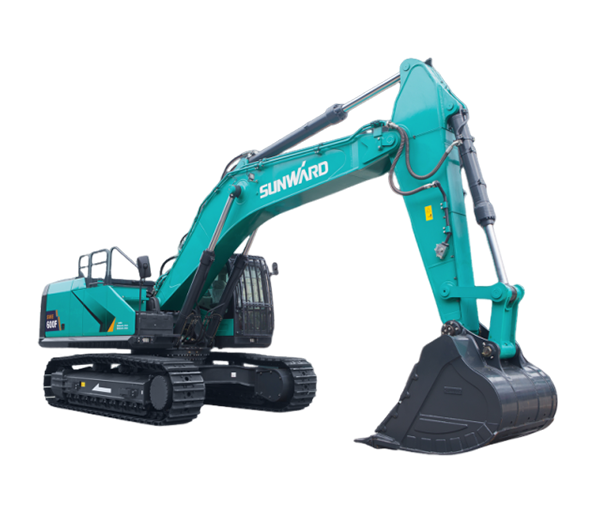
SWE600F Large Excavator for Heavy Construction, Mining and Earthmoving
When I talk with customers about a large Excavator, I do not start with the biggest number on the specification sheet. I start with the job. What material are you digging? How much do you need to move every day? Is the machine going to work in a quarry, mine, road project, industrial site, or large earthmoving project? What is the transport situation?
These questions matter because a large excavator is a serious investment. It needs to work hard, but it also needs to fit the project.
The SWE600F Large Excavator is a machine I would look at when a project needs substantially more digging and material-handling capacity than a conventional medium-size excavator can provide. Sunward's published specifications list the SWE600F at a working weight of 52,800 kg, with a standard bucket capacity of 3.2 m³ and engine power of 300 kW at 1,800 rpm.
At Ganglong Heavy Industry Technology (Hefei) Co., Ltd., our role is not simply to quote a machine and arrange shipment. We work with customers on equipment sourcing, configuration, inspection, international trade, transportation, and related machinery requirements. Together with Hefei Ganglong International Trade Co., Ltd., we serve customers across Asia, Africa, America, and other international markets.
For a customer searching for a SWE600F Excavator, my goal is to make the machine information easy to understand and, more importantly, useful for a real project. The following guide explains what the SWE600F is, how it works, where it can be used, what its published specifications tell us, and how we handle the supply process.
The SWE600F Large Excavator is a heavy crawler excavator designed for demanding excavation and material-handling work. Its size places it well above the typical machines used for small construction sites, landscaping, light utility work, or simple agricultural projects.
The official Sunward specification sheet gives the SWE600F a working weight of 52,800 kg. The same document lists a standard bucket capacity of 3.2 m³.
In practical language, this means the SWE600F is built for moving a lot of material. Instead of thinking only about digging one hole, I think about the complete working cycle: digging, filling the bucket, swinging, unloading, returning, and repeating the process.
That repeated cycle is where a large excavator earns its place on a large project.
Sunward currently lists the SWE600F in its excavator range and also includes it in its mine excavator application category. The company's mine excavator page describes this type of machine as being used to scoop dirt and rock, load material onto trucks, and support excavation work in mining areas.
For me, one of the useful things about the SWE600F is that it is not limited to one type of job. Depending on the bucket, attachment, site conditions, and project plan, the machine can be considered for mining, quarrying, major construction, earthmoving, road work, and other heavy-duty applications.
Of course, that does not mean every SWE600F configuration is suitable for every task. The attachment and working conditions always need to be checked before ordering.
| Specification | SWE600F | Source |
|---|---|---|
| Working weight | 52,800 kg | Sunward official technical specification |
| Standard bucket capacity | 3.2 m³ | Sunward official technical specification |
| Bucket digging force | 297 kN | Sunward official technical specification |
| Arm digging force | 261 kN | Sunward official technical specification |
| Maximum traction | 423 kN | Sunward official technical specification |
| Ground pressure | 87.8 kPa | Sunward official technical specification |
| Maximum travel speed | 5.2 km/h | Sunward official technical specification |
| Swing speed | 9.9 rpm | Sunward official technical specification |
Source: Sunward official SWE600F technical specification. Published specifications should be treated as reference values; final configuration and market version should be confirmed before purchase.
An excavator looks complicated from the outside, but its basic working idea is quite easy to understand.
The engine creates the power. The hydraulic system transfers that power into controlled movement. The boom lifts and lowers the working equipment. The arm moves the bucket closer to or farther from the machine. The bucket cuts into the material and carries it. The upper structure can swing to another position, and the crawler undercarriage moves the whole machine when it needs to travel.
When I explain this to a customer who is new to large construction machinery, I usually compare it with a very strong mechanical arm. The machine needs enough strength to push the bucket into the ground, enough hydraulic control to move the working equipment smoothly, and enough stability to handle the load without constantly repositioning itself.
The SWE600F's published bucket digging force is 297 kN, while its arm digging force is listed at 261 kN. Maximum traction is listed at 423 kN.
These figures give us a better picture of the machine than engine power alone.
Imagine a quarry where the excavator has to work with heavy material. The operator positions the bucket, cuts into the material, fills the bucket, raises the working equipment, swings toward the dump truck, unloads, and returns to the digging position. If this cycle continues for hours, the machine needs a complete system that can handle the workload.
This is why I do not recommend judging an excavator only by its engine power.
Hydraulic performance, bucket size, digging force, traction, swing speed, undercarriage design, operator control, and working range all influence how the machine performs on site.
| Working Range Item | SWE600F Published Value |
|---|---|
| Boom length | 6,400 mm |
| Arm length | 2,900 mm |
| Maximum digging height | 10,540 mm |
| Maximum dumping height | 7,190 mm |
| Maximum digging depth | 6,780 mm |
| Maximum vertical wall digging depth | 5,010 mm |
| Maximum digging reach | 11,040 mm |
| Maximum reach at ground level | 10,800 mm |
| Minimum swing radius at front | 4,560 mm |
Source: Sunward official SWE600F technical specification.
These dimensions are useful when planning the working area. For example, a customer can use the published digging depth and reach as a starting point when checking whether the machine fits a particular excavation task. But I always recommend checking the actual bucket, arm, boom, and configuration before using any figure for detailed project planning.
At 52,800 kg, the SWE600F is not a lightweight machine. That mass gives the excavator a substantial working platform for heavy digging and material handling.
For a large crawler excavator, weight is closely connected with the machine's overall structure and undercarriage. But more weight is not automatically better. It also means transport becomes more complicated, ground conditions need more attention, and the customer must plan loading and unloading carefully.
That is why I always consider machine size together with the jobsite.
The official specification lists a standard bucket capacity of 3.2 m³.
Bucket capacity has a direct relationship with material handling. A larger bucket can move more material per cycle, but the actual amount depends on the material density, bucket fill factor, digging conditions, and operator technique.
For loose earth, the bucket may behave very differently from hard rock. This is another reason I prefer to confirm the material type before discussing a final bucket configuration.
With a published bucket digging force of 297 kN and arm digging force of 261 kN, the SWE600F is designed for serious excavation work.
These numbers are especially relevant when the machine needs to cut into compact soil or handle demanding excavation conditions. The operator still needs to work within safe operating limits, but strong digging force gives the machine the ability to tackle heavier material than a small excavator.
Sunward's technical document lists maximum traction at 423 kN.
Traction matters when a large crawler excavator has to travel across the jobsite, especially on uneven or difficult ground. It does not mean the machine should travel anywhere without planning. A 52.8-ton machine still needs a suitable travel route and properly prepared ground.
The published maximum digging reach is 11,040 mm, while maximum digging depth is 6,780 mm. Maximum digging height is listed at 10,540 mm.
For a contractor, these numbers help when planning excavation depth, truck loading positions, slope work, and the overall machine position.
When a customer asks me, “Should I choose the SWE600F or a larger excavator?” I do not answer by simply pointing to the heavier machine.
The bigger machine may have more capacity, but it also needs more transport planning, more working space, and potentially more operating resources. The correct choice depends on the project.
Sunward's published large excavator range provides a useful reference. Current official listings show the SWE600F at 52,800 kg, the SWE700F at 66,700 kg, the SWE750F at 79,000 kg, and the SWE950E-3H at 93,800 kg.
| Model | Total / Working Weight | Engine Power | Published Position |
|---|---|---|---|
| SWE600F | 52,800 kg | 300 kW / 1,800 rpm | Large excavator |
| SWE700F | 66,700 kg | 563 kW / 2,100 rpm | Large excavator |
| SWE750F | 79,000 kg | 565 kW / 1,900 rpm | Large excavator |
| SWE950E-3H | 93,800 kg | 565 kW / 1,900 rpm | Large excavator |
Source: Sunward official large excavator product listing. Values are published reference specifications and may vary according to product version, configuration, and market.
There is a useful lesson here. The SWE600F is the lighter machine in this particular group. That does not make it unsuitable for large projects. In fact, for a project where a 52.8-ton machine provides enough production capacity, using a heavier excavator could create unnecessary transport and site requirements.
On the other hand, a very large mining operation may have a different material volume and truck fleet. In that situation, the customer may need to consider the larger models.
I always recommend looking at the complete production chain: excavator capacity, truck capacity, haul distance, loading time, working hours, fuel consumption, maintenance plan, and site conditions.
Mining is one of the clearest applications for the SWE600F. Sunward specifically includes the SWE600F in its mine excavator category. Its official mine excavator page describes excavation and loading of dirt and rock as core applications.
Mining conditions can vary greatly, so the actual machine setup matters. Loose overburden, compact soil, broken rock, and other materials may require different buckets or attachments.
For mining customers, I also pay attention to working hours. A machine that works several hours a week has a very different maintenance requirement from one working multiple shifts every day.
Quarry sites can be tough on equipment. Rock and abrasive materials can increase wear on buckets, teeth, undercarriage components, and other working parts.
A large excavator such as the SWE600F can be considered for excavation and material loading where the configuration is suitable for the quarry's material and working method.
Large foundation excavation, industrial construction, land development, infrastructure projects, and major earthmoving operations can all require high-capacity excavators.
The advantage is simple: when the project involves a large volume of material, a machine with a 3.2 m³ standard bucket can move substantial quantities during each working cycle. The actual production rate, of course, depends on many factors beyond bucket size.
Road projects often involve excavation, slope preparation, drainage, land shaping, and moving large quantities of soil.
On a large road project, the SWE600F can work as part of a larger equipment group. Excavators, dump trucks, loaders, compactors, graders, and other equipment need to work together. If one part of the process is much slower than the others, the whole operation can lose time.
Municipal projects vary widely, but large drainage projects, land preparation, major utility work, and infrastructure construction can involve substantial excavation.
The SWE600F may be considered where the project has enough working space for a large crawler excavator. In narrow urban areas, however, machine dimensions and access can become limiting factors.
Some projects are simply about moving a lot of earth. Land reclamation, site preparation, large embankments, and other bulk earthmoving tasks can benefit from a large excavator when the project scale justifies it.
Sunward also describes its large earthmoving equipment range as being intended for construction, mining, and other heavy industrial applications involving large quantities of earth and rock.
Buying a large excavator internationally is different from buying a small spare part online. There are many more details to coordinate.
At Ganglong Heavy Industry Technology (Hefei) Co., Ltd., we were founded in 2013 and work together with Hefei Ganglong International Trade Co., Ltd. Our business covers construction machinery, mining machinery, agricultural machinery, and matching attachments.
We supply equipment from domestic and international brands and also offer complete machine sales and leasing services. Our own HKLOONG product range includes excavators, loaders, Backhoe loaders, and swamp excavators.
For Sunward equipment, we act as a supplier and international trade partner. We help customers with equipment sourcing, configuration discussion, inspection, documentation, logistics, and delivery arrangements.
Before confirming an SWE600F order, I want to understand the customer's application. I usually need to know the material, working environment, expected working hours, attachment requirements, destination country, and transport conditions.
These details help us avoid a common mistake: buying a machine first and discovering later that the configuration does not fit the job.
The preparation or production time depends on the machine model, configuration, order quantity, customization requirements, and current availability.
For that reason, I do not use one fixed delivery promise for every SWE600F order. We confirm the schedule based on the actual order before production or preparation starts.
Before shipment, we inspect the machine according to the order requirements. The inspection can cover appearance, main functions, hydraulic systems, electrical systems, basic operating performance, working equipment, accessories, and documentation.
For a large excavator, visual inspection is important, but I also want the basic machine functions checked. A customer should have a clear picture of the machine's condition before it leaves for an overseas destination.
Standard documents and accessories are prepared according to the order requirements. If the customer has special documentation requirements for customs, registration, or project use, those requirements should be discussed as early as possible.
International machinery transactions commonly use T/T. A typical arrangement may involve a deposit before production or preparation and the remaining balance before shipment. The actual payment terms are confirmed between both parties for each order.
Because the SWE600F is a large crawler excavator, sea transportation is generally the practical choice for international delivery.
Shipping arrangements depend on the destination port, route, machine dimensions, weight, loading method, and local import requirements. Spare parts and suitable accessories can often be shipped separately by air or express.
Before shipment, the machine is protected and secured according to transportation requirements. Exposed surfaces can be protected with film, while loose parts and accessories are packed separately in cartons or wooden cases when appropriate.
The final packing and delivery method is adjusted according to the destination, shipping route, and customer's requirements.
For us, supplying a SWE600F Large Excavator is not just about sending a quotation.
Our group combines equipment-related business with international trade experience. Hefei Ganglong International Trade Co., Ltd. focuses on overseas machinery business and has served customers in Asia, Africa, America, and other regions.
That experience becomes useful when the order involves several moving parts.
For example, a customer may know that they need a 50-ton-class large excavator but may not yet know which bucket configuration makes sense. Another customer may already have a clear machine requirement but needs help with sea transportation. Another may need spare parts packed together with the main machine.
We can discuss these requirements before the transaction is finalized.
I also think it is important to be clear about our role. Sunward is the equipment brand. We are the supplier and international trade side helping customers source and arrange the equipment. We do not present ourselves as the original manufacturer of Sunward machines.
That clarity is important in international machinery business because customers need to know who is responsible for manufacturing, who is handling the trade process, and who is coordinating shipment.
| Customer Requirement | Our Support |
|---|---|
| Machine sourcing | Discuss suitable equipment and configuration |
| Application matching | Review working conditions and intended use |
| Inspection | Arrange pre-shipment inspection according to order requirements |
| Accessories | Discuss standard and project-related accessories |
| Documentation | Prepare standard documents according to the order |
| International shipping | Coordinate sea transportation and logistics arrangements |
| Spare parts | Discuss suitable parts and separate shipment options |
This is the part of our service that matters after the product name has been selected. A large excavator is expensive and complicated to move, so good preparation is worth the effort.
Sunward's official SWE600F technical specification lists a working weight of 52,800 kg.
The published standard bucket capacity is 3.2 m³. The actual bucket configuration should be confirmed according to the order and working material.
Sunward's published technical specification lists an ISUZU GH-6WG1 engine with a power rating of 300 kW at 1,800 rpm. The same document lists maximum torque of 1,932 N·m at 1,400 rpm.
The official specification lists bucket digging force at 297 kN and arm digging force at 261 kN.
The published maximum digging depth is 6,780 mm. The same specification lists a maximum digging reach of 11,040 mm and maximum digging height of 10,540 mm.
Yes. Sunward specifically includes the SWE600F in its mine excavator product category. The official application page describes mine excavators as machines used for digging and loading dirt and rock and for supporting mining operations.
Yes. Sunward lists the SWE600F within its general excavator range, and its excavator application information describes excavators as equipment used for construction, excavation, trenching, material handling, and other earthmoving work.
Yes. Through our international trade operation, we can coordinate complete-machine transportation by sea and discuss suitable shipping arrangements for spare parts and accessories. The final logistics plan depends on the destination and shipping route.
The schedule depends on configuration, order quantity, availability, customization requirements, and shipping arrangements. We confirm the expected preparation or production schedule before the order is finalized.
Suitable spare parts and accessories can be discussed together with the machine order. For customers working in remote mining or construction locations, preparing commonly needed parts in advance can be worth considering.
I recommend starting with the project rather than the model name. Consider material type, daily production target, working space, transportation restrictions, attachment requirements, operating hours, and supporting trucks. Sunward's published specifications show that the SWE600F is lighter than the SWE700F, SWE750F, and SWE950E-3H in its large excavator range.
When I look at the SWE600F Large Excavator, I see a machine designed around a straightforward purpose: handling serious excavation work at a much larger scale than ordinary Construction Excavators.
The published figures tell us quite a lot. The machine has a working weight of 52,800 kg, a standard bucket capacity of 3.2 m³, 300 kW engine power, 297 kN bucket digging force, 261 kN arm digging force, and 423 kN maximum traction. Its published working range includes a maximum digging depth of 6,780 mm and maximum digging reach of 11,040 mm.
But specifications are only the beginning.
The real question is whether those capabilities match your project.
If you are moving large quantities of soil, working in a quarry, supporting mining operations, building major infrastructure, or handling large earthmoving tasks, the SWE600F is a model worth putting into the project discussion.
At the same time, I would never recommend choosing a large excavator only because it has a large number on the specification sheet. The machine needs to match the jobsite, material, attachments, transportation conditions, operator requirements, and expected working hours.
That is how we approach equipment supply at Ganglong.
We can help customers discuss the machine configuration, intended application, inspection requirements, accessories, payment arrangement, packing, sea transportation, and delivery plan before the transaction is completed.
For international buyers searching for a SWE600F Excavator, SWE600F Large Excavator, large Mining Excavator, heavy-duty crawler excavator, or related construction machinery, we can discuss the project requirements and work through the practical details step by step.
A large excavator is a big purchase. In my experience, getting the small details right before shipment is just as important as choosing the machine itself.
 RELATED
 RELATED
 RELATED
 RELATED
info@hkloong.com
86 158 5511 9567


©2026 HKLOONG Heavy Industry Technology (Hefei) Co., Ltd. All Rights Reserved.

This website uses cookies to ensure you get the best experience on our website.
 Español
 Pусский
 Français
 العربية
 WhatsApp
 Phone
Phone E-mail
 Message