

Bidirectional Vibratory Plate Compactor: Practical Compaction for Tight Construction Areas
When I look at a compaction job, I do not start by asking how large the machine is. I start by asking a simpler question: can the machine reach the working area, compact the material evenly, and move back out without making the job harder?
That is where a Bidirectional vibratory plate compactor makes sense. Unlike a basic forward-only plate compactor, a bidirectional or reversible vibratory plate can travel forward and backward under operator control. This simple feature becomes very useful when I work in trenches, around foundations, along sidewalks, beside buildings, or in other places where turning a larger machine is difficult.
At HKLOONG, I approach small construction equipment with the same practical idea I use for our larger Excavators and loaders: match the machine to the real working condition. A compact machine should not simply be small. It should have a useful working layout, dependable power transmission, suitable vibration, easy controls, and a structure that can handle repeated site work.
A Reversible Plate Compactor is designed around exactly this kind of job. Its vibrating base plate transfers energy into soil, gravel, sand, paving materials, or other suitable surfaces. By changing the direction of travel, I can keep the machine working in a confined area without repeatedly lifting or turning it.
For contractors, rental companies, landscaping teams, road crews, utility installers, and general construction users, this can make daily compaction work much more manageable. The machine is compact enough for tight areas, but its reversible movement gives the operator more control over the work path.
I describe a Bidirectional Vibratory Plate Compactor as a compact machine that combines vibration with controlled forward and reverse movement. The basic idea is easy to understand. The engine provides power, the exciter creates vibration, and the base plate transfers that vibration into the material below.
The word “bidirectional” is important. A conventional forward plate compactor normally moves in one main direction. A reversible plate compactor can travel forward and backward. Depending on the machine design, the operator can also control movement for spot compaction and positioning.
That makes the machine particularly useful in narrow construction zones. Imagine compacting soil inside a utility trench. I may have only a limited path in front of me. With a reversible plate compactor, I can move forward for one pass and then reverse through the same area. I do not need the same turning space required by a larger roller.
The same principle works around foundations, paving projects, sidewalks, driveways, landscaping areas, and small road repairs.
The base plate is one of the most important components. It must be strong enough to handle repeated vibration and contact with the ground. The exciter system is equally important because vibration quality directly affects how compaction energy enters the material.
Modern reversible vibratory plates are available in different weight classes and force levels. For example, Wacker Neuson lists reversible plates across lightweight, medium-weight, and heavyweight categories, while its published WPU1550 data show a 15 kN centrifugal force and 103 kg operating weight for one compact model. :contentReference[oaicite:1]{index=1}
I would therefore never choose a plate compactor simply because the product name sounds powerful. The right choice depends on soil type, layer thickness, available working space, required compaction level, surface material, and transport requirements.
The working principle of a vibratory plate compactor is straightforward, but several parts have to work together correctly.
The engine provides the mechanical power needed to operate the exciter and move the machine. Gasoline engines are common in compact construction equipment because they offer a practical combination of power, portability, and easy refueling. Diesel configurations are also used on larger or heavier machines where higher continuous-duty requirements may justify them.
For me, the important point is not simply engine horsepower. I look at how the engine, exciter, drive system, frame, and base plate work together. Too much power without a suitable transmission and vibration system does not automatically produce better compaction.
The exciter creates a rapid rotating force that makes the base plate vibrate. When the plate moves across the soil, the repeated vibration helps rearrange soil particles and reduce air gaps between them.
For granular materials such as sand and gravel, vibration can help particles settle into a denser structure. Cohesive soils require a different approach, and the machine must be selected according to soil condition and project requirements.
This is why I pay attention to centrifugal force, vibration frequency, operating weight, plate size, and travel speed rather than looking at only one number.
The reversible drive system is what separates this machine from a simple forward plate. The operator can control the direction without physically turning the entire machine around.
Multiquip's published MVH158GH data, for example, show hydraulic controls that allow the operator to switch between forward and reverse and perform spot compaction. Its published specifications list 27 kN centrifugal force, 90 Hz exciter speed, 27 m/min maximum forward speed, and 148 kg operating weight. :contentReference[oaicite:2]{index=2}
For actual projects, this means fewer awkward movements. I can make a controlled pass, reverse, correct the position, and continue compacting without needing a large open turning area.
When I evaluate a reversible vibratory plate, I focus on practical features rather than a long list of marketing terms.
The biggest benefit is controlled forward and reverse movement. This makes the machine useful in trenches and confined work areas where turning space is limited.
The base plate receives repeated impact and vibration. I look for a robust structure with good resistance to wear and deformation. A well-designed plate should also be relatively easy to clean after working with soil or other materials.
Good vibration should be transferred through the working plate in a controlled way. The goal is not simply to create as much vibration as possible. The vibration system should match the machine's weight, plate dimensions, travel speed, and intended soil conditions.
I prefer controls that are easy to understand. On a busy construction site, the operator should not need a long learning process just to change travel direction or adjust machine movement.
A protective frame can help shield key components from accidental contact, loose material, and general site conditions. It can also provide practical lifting points when the machine needs to be loaded onto a vehicle.
Small machines still need regular service. Engine oil, filters, belts, exciter components, fasteners, and other wear points should be accessible enough for routine inspection.
For example, Multiquip's MVH158GH uses a fold-out front cover for access to maintenance points and a protective steel frame around the engine. :contentReference[oaicite:3]{index=3}
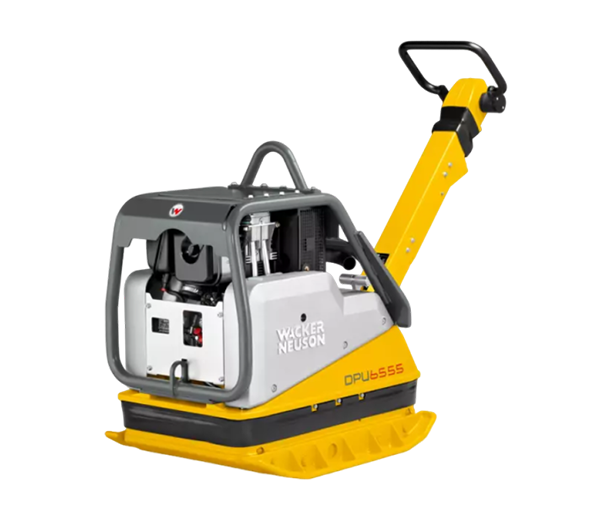
Specifications are useful when I know how to read them. The following figures are published industry reference data rather than HKLOONG specifications. They show the type of performance range available in commercial reversible plate compactors.
| Reference Machine | Operating Weight | Centrifugal Force | Working/Base Plate Width | Published Travel Speed |
|---|---|---|---|---|
| Wacker Neuson WPU1550 | 103 kg | 15 kN | 500 mm | 27 m/min forward |
| Multiquip MVH158GH | 148 kg | 27 kN | 430 mm plate width | 27 m/min forward |
| Wacker Neuson BPU 4045A | 339 kg | 40 kN | 440 mm plate width | 24 m/min forward |
Source: published technical data from Wacker Neuson and Multiquip. Figures are industry reference data only and are not HKLOONG product specifications.
The table also shows why I do not compare machines by weight alone. The WPU1550 is much lighter than the BPU 4045A, but the two machines serve different operating needs. A heavier machine can deliver higher centrifugal force, but it may also be harder to move and less convenient in very tight areas.
Wacker Neuson's published BPU 4045A data list 40 kN centrifugal force, 870 m²/h area capacity, 24 m/min forward running speed, and 339 kg operating weight. :contentReference[oaicite:4]{index=4}
| Selection Factor | What I Check | Why It Matters |
|---|---|---|
| Operating weight | Machine mass and transport method | Affects compaction energy, handling, and site mobility |
| Centrifugal force | Published force rating | Helps indicate the vibration energy available for compaction |
| Plate width | Working width and machine dimensions | Influences coverage and access in narrow areas |
| Travel direction | Forward/reverse control | Important for trenches and confined work zones |
| Engine type | Gasoline, diesel, or electric system | Affects fuel, maintenance, emissions, and operating conditions |
| Service access | Access to engine and exciter components | Reduces unnecessary downtime during routine maintenance |
I see the biggest value of this machine in jobs where the working area is too confined for a conventional roller but too demanding for hand tools alone.
After pipe installation, the surrounding backfill needs proper compaction. A reversible plate can move along a narrow trench and return through the same path. This makes it a practical trench compactor for suitable soil and backfill materials.
Before concrete or other construction stages begin, the ground around foundations may require controlled compaction. A compact plate machine can work close to structures where larger equipment may not have enough room.
Small road repairs, pavement preparation, shoulder work, and sidewalk construction often involve areas where a large roller would be inconvenient. A reversible plate compactor can handle these smaller work zones with less setup.
When installing paving blocks, the machine can help compact the prepared base and, when equipped with the correct protective accessory, can also be used for suitable paving applications. Surface requirements should always be checked before operation.
Landscaping projects often have narrow access paths, walls, gardens, and finished areas that are difficult for large equipment to reach. This is one reason compact construction equipment is useful for contractors who handle many different job types.
I would also consider a reversible plate for backfill, aggregate base preparation, small excavation restoration, and other site preparation work where the material and required compaction level match the machine.
Wacker Neuson describes its reversible vibratory plates as suitable for mixed soils, paving stones, and asphalt, while its WPU1550 is specifically positioned for confined-area work in gardening, landscaping, foundations, roads, sidewalks, and park areas. :contentReference[oaicite:5]{index=5}
| Application | Typical Working Condition | Why I Would Consider a Reversible Plate |
|---|---|---|
| Utility trench | Narrow soil or backfill zone | Forward and reverse movement reduces turning requirements |
| Foundation preparation | Confined area near structures | Compact dimensions allow closer access |
| Sidewalk construction | Long, narrow working path | Easy directional control supports repeated passes |
| Landscaping | Restricted access and small work zones | Compact design is easier to position and transport |
| Road repair | Small patches and base preparation | Useful where a large roller is not practical |
| Paving work | Prepared aggregate and suitable paving surfaces | Vibration helps consolidate compatible base materials |
At HKLOONG Heavy Industry Technology (Hefei) Co., Ltd., I do not see a small machine as a simplified version of a large machine. The design priorities are different, but the need for dependable manufacturing remains the same.
Our work covers equipment R&D, precision manufacturing, quality testing, customized modification, and global distribution. For a compact machine such as a Bidirectional Vibratory Plate Compactor, I pay particular attention to the relationship between structural strength, vibration behavior, operator control, and serviceability.
The first step is product definition. I consider the intended application, soil conditions, required working width, operating weight, power source, transport method, and working environment. These factors determine how the machine should be configured.
Next comes structural design. The frame has to support the engine, exciter, controls, and protective components while keeping the overall package compact. The base plate also needs a suitable geometry and material selection because it is continuously exposed to vibration and ground contact.
During manufacturing, I pay attention to welding quality, component alignment, fastener installation, surface treatment, and assembly accuracy. Vibration equipment is especially sensitive to poor alignment. A small problem in one component can become a larger problem when the machine operates continuously.
Quality testing should therefore cover more than whether the engine starts. I want to see whether the machine travels correctly, changes direction smoothly, produces stable vibration, and remains mechanically sound during operation.
I also consider maintenance from the beginning. A machine that is difficult to inspect can cost more time over its working life. Practical access to service points, clear controls, protected components, and straightforward maintenance procedures all matter to the people who use the equipment every day.
HKLOONG supplies a wider range of construction machinery, including crawler excavators, Wheel loaders, Backhoe loaders, and amphibious Wetland excavators. Alongside these larger machines, our small equipment line is intended for jobs where access and maneuverability are just as important as raw machine size.
I often think about the equipment selection process from the operator's side. If the machine has to pass through a narrow gate, work beside a building, enter a trench, or move between landscaping features, every millimeter can matter.
That is why I look at the complete working package rather than a single specification. Machine dimensions, operating weight, control layout, power source, compaction force, transport method, and maintenance access all have to fit the application.
Customization can also matter in B2B projects. Different contractors may need different engines, working configurations, accessories, labeling, packaging, or export requirements. The exact options depend on the final machine design and destination market.
For distributors and equipment buyers, I also understand that documentation and communication are part of the machine-buying process. Product information should be clear enough for technical teams, purchasing departments, operators, and service personnel to understand the same equipment from different angles.
My goal is simple: make the equipment practical to specify, practical to operate, and practical to maintain.
A bidirectional vibratory plate compactor is a vibrating ground compaction machine that can travel both forward and backward. It is commonly used for soil, aggregate, paving preparation, trenches, foundations, landscaping, and other compact work areas.
A forward plate compactor mainly travels in one direction. A reversible plate compactor can move forward and backward, which gives the operator more control in confined areas. The reversible design can be especially useful where turning space is limited.
The exact material depends on the machine and project. Common applications include suitable granular soils, sand, gravel, aggregate bases, paving preparation, and some asphalt-related work. Soil moisture, layer thickness, machine weight, vibration characteristics, and the required compaction result should all be considered.
Yes, this is one of its common application areas. The forward and reverse travel function allows the operator to work along a narrow trench without repeatedly turning the entire machine. However, the machine must always be used according to the site safety plan and the manufacturer's operating instructions.
I would start with the material and working area. Then I would compare operating weight, centrifugal force, plate width, travel speed, gradeability, engine type, maintenance access, and transport requirements. For a small landscaping project, a compact machine may be more practical. For deeper or heavier soil compaction, a higher-force model may be more appropriate.
No. Weight is only one part of the equation. A heavier machine may provide greater compaction capability, but it can also be harder to transport and less suitable for very restricted spaces. I always match operating weight and centrifugal force to the actual material and job conditions.
HKLOONG works with equipment R&D, manufacturing, quality testing, customized modification, and global distribution. For B2B projects, configuration and customization should be confirmed according to the required application, technical specification, market, and final machine design.
I would check the engine and fluid levels, fasteners, base plate condition, exciter system, controls, protective components, and surrounding work area. The operator should also use the required personal protective equipment and follow the machine's operating manual and site safety requirements.
When I choose a Bidirectional Vibratory Plate Compactor, I am not simply choosing a machine that vibrates. I am choosing a working tool for a specific ground condition and a specific space.
The reversible travel function is valuable because construction sites are rarely wide open. Trenches are narrow. Foundations have obstacles. Sidewalks have limited access. Landscaping projects often involve finished surfaces and tight corners. Small road repairs do not always justify bringing a large roller to the site.
A well-designed reversible plate compactor gives the operator a practical way to handle these conditions. The key is to match the machine's weight, vibration system, plate dimensions, travel control, power source, and maintenance requirements to the actual job.
That is the approach I take at HKLOONG. Our focus is not limited to large construction machinery. We also develop and supply compact equipment for applications where size, maneuverability, reliability, and practical operation matter. When the working area is tight and the compaction requirement is real, the right small machine can make the whole job easier to manage.
info@hkloong.com
86 158 5511 9567


©2026 HKLOONG Heavy Industry Technology (Hefei) Co., Ltd. All Rights Reserved.

This website uses cookies to ensure you get the best experience on our website.
 Español
 Pусский
 Français
 العربية
 WhatsApp
 Phone
Phone E-mail
 Message