

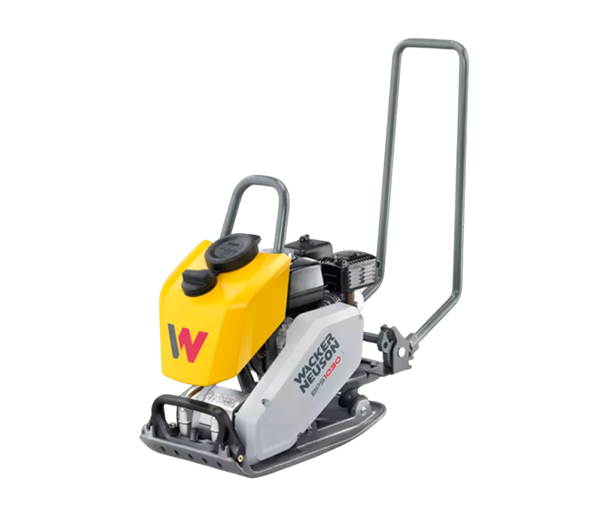
Unidirectional vibratory plate compactor for Practical Soil and Surface Compaction
When I choose a compaction machine, I always start with the working area rather than the machine name. A construction site may look simple on a drawing, but the actual job can involve narrow paths, fresh backfill, uneven ground, paving edges, foundations, landscaping areas, and places where large equipment simply does not fit.
This is where I see a clear role for a Unidirectional Vibratory Plate Compactor. It is a compact, walk-behind machine designed to move mainly in one forward direction while using vibration to compact suitable soil, aggregate, sand, paving bases, and other materials.
Compared with a Reversible Plate Compactor, the operating concept is simpler. I guide the machine forward, control the working path, and make repeated passes across the material. There is no need to build a complicated directional drive system into the machine. That can make a forward plate compactor a practical option when the job is straightforward and the working area gives me enough room to turn or reposition the equipment.
At HKLOONG Heavy Industry Technology (Hefei) Co., Ltd., I look at compact construction equipment from a very practical angle. Our wider equipment range includes crawler excavators, Wheel loaders, Backhoe loaders, and amphibious wetland Excavators. Alongside these larger machines, we also work with compact equipment intended for landscaping, construction, agriculture, municipal maintenance, and material handling.
The basic idea is simple: the machine should fit the job. A small compactor does not need to replace a road roller. It needs to do its own work well, especially where access, transport, maneuverability, and simple operation matter.
I use the term Unidirectional Vibratory Plate Compactor to describe a walk-behind compaction machine that combines a vibrating base plate with forward travel. The operator controls the machine from behind while the plate transfers vibration energy into the material below.
The machine normally includes several basic systems: an engine or electric power source, a vibration exciter, a base plate, a drive mechanism, an operator handle, and a protective frame or engine cover. Each part has a simple job, but they must work together correctly.
The engine supplies power to the exciter. The exciter generates the vibration. The base plate transfers that vibration into the ground. As the machine moves forward, repeated passes help reduce air gaps and bring suitable granular material into a denser condition.
This type of single direction vibratory plate is often used for smaller construction and maintenance projects. I would consider it for trench backfill, foundation preparation, landscaping, paving preparation, sidewalk work, driveway repair, and other jobs where a large roller is not practical.
One important point is that compaction performance does not come from machine weight alone. I need to consider the operating weight, centrifugal force, plate dimensions, vibration characteristics, travel speed, soil type, moisture, and layer thickness together.
For example, Wacker Neuson's published WP1550A data list a 94 kg operating weight, 15 kN centrifugal force, 500 mm base plate width, 29 m/min forward running speed, and a stated area capacity of 870 m²/h. These are manufacturer-published figures for that specific model, not HKLOONG specifications.
That example gives me a useful reference point. A compact forward plate does not need to be huge to be useful. Its value comes from having the right combination of size, vibration, travel, and handling for the work.
The working principle of a vibratory plate compactor is easier to understand than many people expect. I can break it into four basic steps: power, vibration, ground contact, and forward movement.
The engine is the main power source on many conventional compactors. Gasoline engines are common in this equipment class because they are relatively compact and easy to refuel on construction sites.
Electric versions are also becoming useful for jobs where low local emissions, reduced noise, or indoor operation is important. Wacker Neuson, for example, publishes an electric WP1550e with 15 kN centrifugal force, 500 mm base plate width, and published battery runtimes that vary according to the battery configuration and operating conditions.
The exciter is the part that creates the rapid vibrating motion. A rotating eccentric weight or similar mechanism generates force, which is transferred into the base plate.
When the plate vibrates against the ground, suitable loose material can settle and rearrange. For granular soil, sand, and aggregate, this repeated movement can help reduce voids and increase density.
I would not treat vibration as a magic solution for every soil condition, though. Very wet, highly cohesive, or unsuitable materials may require another compaction method. The machine should always be selected according to the material and project specification.
The base plate is the working surface that stays in contact with the ground. Its width affects how much area the machine covers during each pass, while its shape and construction influence how the machine moves over the surface.
A narrower plate can be useful in restricted areas. A wider plate may cover more area per pass. Again, I look for a balance rather than simply choosing the largest available plate.
Unlike a reversible plate compactor, a forward plate compactor is designed primarily to move in one direction. The operator guides it along the desired path and repositions the machine when the pass is complete.
This simpler travel concept can be useful when the work area has enough room for repositioning and when the operator does not need constant forward-and-reverse movement.
When I evaluate a single direction vibratory plate, I do not focus on one headline number. I look at the whole machine and ask how it will behave on a real construction site.
A compact machine can reach areas that larger equipment cannot. This is especially useful around buildings, sidewalks, landscaping features, utility work, and small foundations.
The machine should move forward in a predictable way. If the travel speed is too fast for the material or the operator has poor control, it becomes harder to achieve even coverage.
Centrifugal force is an important specification because it describes the force generated by the vibrating system. I use it together with operating weight, plate size, frequency, and material conditions rather than treating it as a stand-alone performance score.
The base plate works continuously against the ground. It needs suitable material, thickness, geometry, and surface treatment for the intended duty. A strong plate also helps the machine maintain its shape under repeated vibration.
Construction sites are not clean workshops. Loose materials, tools, transport operations, and accidental contact can expose the engine and controls to damage. A protective frame can help shield important components.
The operator stays behind the machine during normal operation, so handle design matters. I look for a layout that gives the operator useful control while keeping unnecessary vibration away from the hands as much as practical.
Routine service should not be a major project. Oil checks, filter replacement, belt inspection, fastener checks, and cleaning should be reasonably straightforward.
For a compact machine, serviceability is especially important because many buyers expect the equipment to work on different job sites with limited workshop support.
Specifications are helpful when they answer a real question. If I want to know whether a plate compactor is suitable for a particular project, I normally compare operating weight, centrifugal force, plate width, travel speed, engine power, gradeability, and area capacity.
The following table uses published Wacker Neuson WP1550A and WP1550Aw figures as an industry reference. The values belong to those models and should not be read as HKLOONG product specifications.
| Specification | WP1550A Published Data | What I Use It For |
|---|---|---|
| Operating weight | 94 kg | Transport and machine handling reference |
| Centrifugal force | 15 kN | Reference for vibration force |
| Base plate width | 500 mm | Access and coverage comparison |
| Forward running speed | 29 m/min | Pass speed reference |
| Area capacity | 870 m²/h | Published productivity reference |
| Gradeability | 36.4% | Reference for sloped working conditions |
| Engine | Honda gasoline engine, 163 cm³ | Example of conventional power configuration |
Source: Wacker Neuson published WP1550A technical data. These figures are third-party reference data only.
The most useful lesson here is that a compact plate compactor can combine relatively low machine weight with meaningful centrifugal force. That makes this equipment class easier to transport than a large roller while still providing mechanical compaction for suitable applications.
I also pay attention to the difference between theoretical productivity and actual productivity. A published area capacity is a useful reference, but real output depends on travel speed, overlap, soil condition, number of passes, operator technique, site layout, and project requirements.
Customers often ask me whether they should choose a forward plate or a reversible plate. I do not think there is one answer for every project.
| Factor | Unidirectional Vibratory Plate | Bidirectional/Reversible Plate |
|---|---|---|
| Travel direction | Mainly forward | Forward and reverse |
| Control system | Generally simpler | More complex directional control |
| Confined-area maneuvering | Good when there is room to reposition | More convenient where reversing is frequent |
| Typical machine concept | Simple and compact | More versatile directional movement |
| Small landscaping work | Often practical | Useful when the site is more restricted |
| Long straight passes | Well suited | Also suitable |
| Narrow trench work | Suitable when repositioning is possible | Often more convenient for repeated forward/reverse passes |
This is a functional comparison rather than a ranking. I would select the machine according to the site layout and the operator's working method.
If I have a relatively open landscaping area and need a compact machine for straightforward forward passes, a unidirectional vibratory plate compactor can be a sensible configuration. If I am working inside a narrow trench where reversing is part of nearly every pass, a reversible machine may make more sense.
The strength of a construction plate compactor is not its ability to replace every other machine. Its value comes from handling smaller compaction tasks quickly and with limited access requirements.
Landscaping projects often include narrow paths, garden edges, retaining wall areas, walkways, and prepared soil beds. A compact plate can move into these spaces without the access requirements of a larger roller.
When preparing a base beneath a sidewalk or pedestrian path, I can use a forward plate for suitable granular materials and base layers. The operator can make repeated passes along the working line.
Small repair areas do not always justify bringing a large roller onto the site. A plate compactor for soil and aggregate can be easier to transport and set up for localized work.
Before a foundation or slab is installed, suitable fill and granular base material may require compaction. The actual compaction method should follow the engineering requirements of the project, but a compact plate can be useful where its specifications match the task.
A forward plate can also be used around utility work when the trench layout allows the operator to reposition the machine safely. For very confined trenches, I would compare it carefully with a reversible plate or trench roller.
Small farm buildings, access paths, drainage improvements, and maintenance projects can involve areas where compact equipment is easier to transport than a large construction machine.
| Application | Typical Material | Why a Forward Plate Can Be Useful |
|---|---|---|
| Landscaping | Soil, sand, aggregate | Compact dimensions and easy transport |
| Sidewalks | Granular base material | Simple forward passes along narrow paths |
| Driveways | Gravel and aggregate | Suitable for localized preparation work |
| Foundation preparation | Selected fill and granular base | Can work close to structures where access allows |
| Utility work | Suitable backfill | Useful when trench layout permits forward operation |
| Municipal maintenance | Soil and aggregate | Easy to transport between small work areas |
At HKLOONG, I treat small equipment as working machinery, not as a lightweight product category that can ignore manufacturing discipline.
Our company integrates equipment R&D, precision manufacturing, quality testing, customized modification, and global distribution. For a compact machine such as a Unidirectional Vibratory Plate Compactor, I pay particular attention to the parts that experience repeated vibration and mechanical stress.
The base plate is one of the first areas I consider. Its material, thickness, shape, and connection to the vibration system all affect how the machine behaves during operation.
The exciter assembly is another key area. Because the machine operates through repeated vibration, component alignment and assembly quality matter. Poor alignment can create unnecessary vibration, noise, wear, or unstable operation.
The frame must also provide a suitable mounting structure for the engine and related components. At the same time, I want the machine to remain compact enough for transport and site access.
During assembly, I pay attention to welding, fasteners, component fit, protective structures, control connections, and moving parts. Quality inspection should not stop at visual appearance. A machine also needs functional testing.
That means checking whether the engine runs correctly, whether the exciter operates normally, whether the machine travels as intended, and whether the controls respond in a predictable way.
Maintenance is another part of the design process. A contractor may use the machine for many hours across different job sites. Easy access to routine service points can make a meaningful difference over time.
I also understand that B2B customers may have different requirements. Export markets, rental fleets, distributors, contractors, and municipal users can ask for different configurations. The final product specification should therefore be confirmed according to the actual project and market.
HKLOONG's equipment business covers both heavy machinery and compact equipment. That gives me a useful perspective when thinking about machine selection.
A Large Excavator may be the right choice for excavation, but it does not solve every compaction problem. A wheel loader can move material efficiently, but it is not a replacement for a dedicated vibratory plate. The right machine depends on the task.
For compact equipment, I focus on the balance between size, working ability, handling, and service requirements. I want the machine to be small enough to access difficult areas without making unnecessary compromises in its working structure.
For distributors and contractors, I also consider practical communication. Product information should clearly explain what the machine does, where it works, what material it can handle, and what specifications need to be confirmed before purchase.
Where customization is required, I can work from the application backward. Instead of starting with a fixed machine and asking the customer to adapt to it, the project can be evaluated around working conditions, dimensions, power requirements, accessories, transport, and local market requirements.
That approach is especially useful for customers purchasing compact construction equipment for several types of projects rather than one single application.
A unidirectional vibratory plate compactor is a walk-behind machine that uses vibration to compact suitable soil, sand, gravel, aggregate, paving bases, and similar materials while traveling mainly in one forward direction.
A forward plate is designed mainly for one-direction travel. A reversible plate can move forward and backward under operator control. A forward plate can be practical for straightforward jobs where the operator has enough room to reposition the machine.
These machines are commonly used with suitable granular soil, sand, gravel, aggregate, and base materials. The correct machine depends on soil type, moisture, layer thickness, required density, and project specifications. Highly cohesive or unsuitable wet materials may require another compaction method.
Yes. Landscaping is one of the applications where compact equipment can be useful. A small plate compactor can work on pathways, prepared ground, aggregate bases, and other suitable areas where a larger roller would be inconvenient.
It can be used in suitable trench applications when the machine dimensions and working layout allow safe forward operation and repositioning. For very narrow trenches requiring frequent reverse movement, I would also compare a reversible plate compactor or trench roller.
No. Operating weight is only one factor. Centrifugal force, vibration characteristics, plate width, travel speed, material type, and layer thickness also matter. I select the machine based on the complete working condition.
I would check the intended material, required compaction level, working area, machine weight, centrifugal force, plate width, travel speed, power source, maintenance requirements, transportation method, and available service support.
HKLOONG specializes in equipment R&D, precision manufacturing, quality testing, customized modification, and global distribution. For a specific compact equipment project, the final configuration should be discussed according to the application, technical requirements, destination market, and actual production model.
Maintenance intervals depend on the engine, machine design, working hours, operating environment, and manufacturer's instructions. I recommend following the actual maintenance schedule supplied with the machine and checking fluids, fasteners, belts, filters, vibration components, and the base plate regularly.
For me, the main value of a Unidirectional Vibratory Plate Compactor is its straightforward working concept. It provides mechanical vibration in a compact package and moves forward through the working area without requiring the more complex directional system found on a reversible plate.
That simplicity can be useful. On landscaping projects, sidewalk preparation, driveway repairs, foundation work, municipal maintenance, and suitable trench applications, I may not need a large roller. I need a machine that can reach the area, compact the material, and be transported without creating another problem.
The key is selecting the machine based on real working conditions. I look at material type, moisture, layer thickness, available space, required compaction level, operating weight, centrifugal force, plate width, travel speed, and maintenance needs together.
At HKLOONG, this practical approach also guides our compact equipment development. Our goal is to provide machinery that fits real construction, landscaping, agricultural, municipal, and material-handling conditions while maintaining a clear focus on manufacturing quality and serviceability.
A forward plate compactor will not replace every type of compaction machine. It does not need to. When the application calls for compact dimensions, straightforward forward travel, useful vibration, and easy site handling, it can be a very practical piece of construction equipment.
Important specification note: The technical figures used in this article are third-party published reference data from equipment manufacturers and are included for product education and equipment-selection comparison. They are not HKLOONG specifications. Final HKLOONG model parameters, engine options, dimensions, centrifugal force, travel speed, weight, and other performance data should be confirmed against the actual product documentation before ordering.
2435092534@qq.com
86 158 5511 9567


©2026 HKLOONG Heavy Industry Technology (Hefei) Co., Ltd. All Rights Reserved.

This website uses cookies to ensure you get the best experience on our website.
 Español
 Pусский
 Français
 العربية
 WhatsApp
 Phone
Phone E-mail
 Message