


Crawler Harvester RG108PLUS: A Practical Rice Combine Harvester for Wet and Demanding Fields
When I talk with customers about a crawler harvester, one question usually comes up very quickly: “Can this machine really work well when the field is wet, soft, or difficult to pass?”
That is a fair question. A combine harvester can look impressive on a clean and dry field, but real farming is rarely that simple. Rice fields can be muddy. Ground conditions can change during the same harvesting season. Some farms need a machine that can keep moving without putting too much pressure on the soil, while others care more about harvesting efficiency, grain handling, machine size, and transport.
This is where the Crawler Harvester RG108PLUS gets my attention.
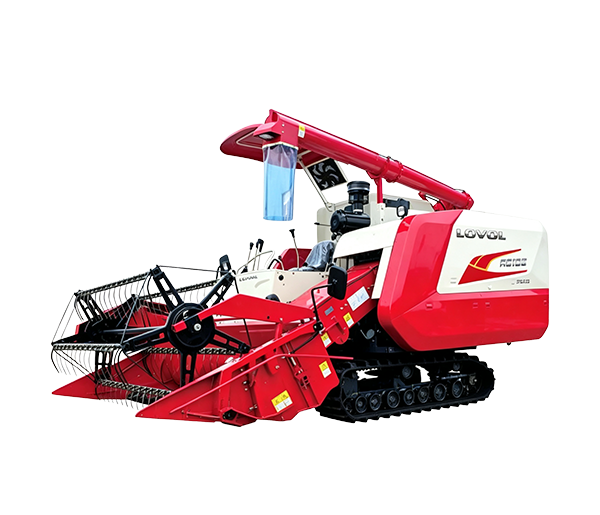
The LOVOL RG108PLUS is mainly developed for rice crops with yields of around 7,500 kg/ha and above. It uses a crawler chassis, a 100 PS power system, a 2.0 m standard cutting width with a 2.2 m option, and a harvesting system built around threshing, separation, cleaning, and grain collection. The official product data lists a machine weight of about 3,000 kg, a 2,050 mm threshing drum, 840 mm cleaning width, and a 1.6 m³ grain tank.
In simple words, this is a rice combine harvester designed with difficult field conditions in mind. It is not just about putting more horsepower into a machine. The crawler chassis, ground clearance, harvesting system, and grain handling system all have to work together.
At Ganglong Heavy Industry Technology (Hefei) Co., Ltd., we focus on supplying construction machinery, mining machinery, agricultural machinery, and matching attachments to customers in different markets. Through Hefei Ganglong International Trade Co., Ltd., our international trade team also handles overseas agricultural machinery business. So when a customer asks me about the RG108PLUS, I look at the machine not only from the product side, but also from the point of view of actual field use, configuration, inspection, shipping, and after-order support.
The LOVOL RG108PLUS Crawler Harvester is a crawler-type combine harvester mainly developed for rice harvesting. Compared with a normal wheeled machine, its crawler undercarriage is particularly useful in fields where the soil is soft or wet.
The basic idea is easy to understand. A crawler spreads the machine's weight over a larger contact area than a narrow wheel arrangement. This helps the machine maintain contact with the ground and improves its ability to move through challenging paddy fields. It does not mean the machine can travel through every kind of mud without limitation, of course. Field depth, moisture, soil structure, slope, crop condition, and operator technique still matter.
LOVOL's official product information describes the RG108PLUS as having an upgraded chassis module with strong passability and high harvesting efficiency. The machine is equipped with a 100 PS Quanchai engine in the published configuration, while the crawler width can be 500 mm or 550 mm depending on configuration.
| Item | RG108PLUS Published Data |
|---|---|
| Machine type | Crawler combine harvester |
| Main crop | Rice |
| Recommended crop yield range | About 7,500 kg/ha and above |
| Rated power | 100 PS |
| Machine weight | 3,000 kg |
| Overall dimensions | 5,200 × 2,545 × 2,800 mm |
| Cutting width | 2.0 m / 2.2 m optional |
| Threshing drum | 2,050 mm |
| Cleaning system | Air-and-screen cleaning |
| Cleaning width | 840 mm |
| Grain tank volume | 1.6 m³ |
| Ground clearance | 350 mm |
| Crawler width | 500 mm / 550 mm |
Source: LOVOL official RG108PLUS product specifications. Configuration and specifications should be confirmed for the actual order and destination market.
For me, the important point is that these numbers should not be viewed separately. A 100 PS engine alone does not tell you whether a crawler harvester will perform well. The power system has to work with the chassis, transmission, harvesting width, threshing system, cleaning system, and hydraulic system. That overall balance is what makes a machine useful in the field.
A rice combine harvester has one basic job: take standing rice from the field and turn it into relatively clean grain while reducing the amount of manual work needed.
That sounds simple until you look at what happens inside the machine.
First, the header cuts and gathers the rice crop. The harvested material is then fed into the threshing section. Here, the grain must be separated from the straw and other plant material. After that, the cleaning system removes lighter unwanted material from the grain. Finally, the cleaned grain is collected in the grain tank for unloading.
The RG108PLUS uses a 2.0 m cutting width as the published standard configuration, with a 2.2 m option. Its threshing drum is listed at 2,050 mm, while the air-and-screen cleaning system has an 840 mm cleaning width.
Why does this matter?
Because harvesting is not only about cutting faster. If cutting is fast but threshing is poor, grain losses can rise. If threshing works well but cleaning is not properly matched to the crop, the grain quality can suffer. If grain collection is too small, the operator may spend too much time stopping for unloading.
A good combine harvester is therefore more like a small production line moving through the field. Each stage needs to cooperate with the next one.
In actual operation, the operator also needs to adjust working speed according to crop density, moisture, lodging, field conditions, and machine load. This is one reason I always tell customers that machine specifications are only part of the story. Correct setup and operating habits are equally important.
Cutting: The header gathers and cuts the rice crop.
Feeding: The harvested crop moves into the threshing system.
Threshing: Grain is separated from the harvested plant material.
Cleaning: Air and screens help separate grain from lighter unwanted material.
Grain collection: Cleaned grain is stored in the grain tank.
Unloading: Grain is transferred out of the machine when required.
This complete process is why the RG108PLUS is more than simply a crawler rice Cutting machine. It is a full rice combine harvester designed to complete several harvesting steps in one pass.
If I had to choose one feature that deserves special attention on the RG108PLUS, I would talk about the crawler chassis first.
Rice farming often means dealing with soil that is very different from ordinary dry farmland. After irrigation or rain, a paddy field can become soft enough that ordinary wheeled equipment has difficulty maintaining stable movement. The machine may slip, sink, or lose traction.
The RG108PLUS uses a crawler system with a published track width of 500 mm or 550 mm. Its ground clearance is listed at 350 mm, and the published gauge is 1,250 mm.
| Chassis Feature | RG108PLUS | Why It Matters in Field Work |
|---|---|---|
| Drive type | Crawler | Useful for soft and wet field conditions |
| Crawler width | 500 / 550 mm | Configuration option for different operating needs |
| Ground clearance | 350 mm | Provides space between the lower machine structure and the field surface |
| Gauge | 1,250 mm | Supports the overall chassis layout and field movement |
| Crawler sections | 56 | Part of the crawler running system |
Source: LOVOL official RG108PLUS product specifications.
Of course, I would never tell a farmer that a crawler automatically solves every ground problem. That would be misleading. A crawler machine still has limits. Extremely deep mud, hidden obstacles, steep terrain, or unsuitable operating conditions can affect any harvester.
What the crawler design does is give the RG108PLUS a chassis better suited to the type of ground commonly found in rice production.
This is also why I would recommend checking the actual field before selecting a machine. If a customer tells me the farm has heavy wet soil, narrow access roads, deep paddy mud, or frequent transport between fields, those details are much more useful than simply saying, “I need a 100 HP harvester.”
The RG108PLUS combines several systems rather than relying on one headline specification.
The official LOVOL product page lists rated power at 100 PS. This gives the machine a practical power level for its intended harvesting work and supports the movement and harvesting systems as they operate together.
When discussing engine power with customers, I prefer to keep things realistic. More horsepower is not automatically better for every farm. The correct power level depends on crop density, field size, terrain, machine configuration, and working conditions.
The published cutting width is 2.0 m, with a 2.2 m option. This gives customers some flexibility when matching the machine to field conditions and harvesting requirements.
A wider header can increase the amount of crop handled in each pass, but field layout matters. In smaller or irregular fields, a wider working width is not always the easiest choice. This is why I prefer to confirm field conditions before discussing configuration.
The threshing system uses a drum listed at 2,050 mm. Threshing is one of the most important stages in combine harvesting because the machine needs to separate grain effectively without creating unnecessary losses or excessive damage.
Actual results will naturally depend on crop variety, moisture, crop density, machine adjustment, and operating speed. Good machinery still needs good settings.
The RG108PLUS uses an air-and-screen cleaning system with an 840 mm cleaning width in the published specifications.
The principle is straightforward. Screens help sort the material by size, while airflow helps move lighter unwanted material away from the grain. Together, these systems help produce cleaner harvested grain.
The grain tank is listed at 1.6 m³. For a rice harvesting machine, grain storage capacity affects how often the operator needs to stop or unload.
The RG108PLUS also has a published unloading height range of 0.9–4.2 m. This gives the operator a useful range when working with suitable grain receiving arrangements.
| Harvesting System | Published RG108PLUS Specification | Practical Meaning |
|---|---|---|
| Header | 2.0 / 2.2 m | Provides two cutting-width configuration choices |
| Threshing drum | 2,050 mm | Supports the grain separation process |
| Cleaning method | Air and screen | Separates grain from lighter unwanted material |
| Cleaning width | 840 mm | Defines the published cleaning section width |
| Grain tank | 1.6 m³ | Provides temporary grain storage during harvesting |
| Unloading height | 0.9–4.2 m | Supports different unloading situations |
Source: LOVOL official RG108PLUS product specifications.
Customers sometimes ask me to compare the RG108PLUS with another LOVOL crawler combine harvester. One useful comparison is the AF88 because both machines are presented by LOVOL as crawler combine harvesters and share several harvesting-system characteristics.
The following table uses published LOVOL specifications. It is not intended to say that one machine is suitable for every farm. The right choice depends on crop, field condition, configuration, budget, and local service requirements.
| Specification | RG108PLUS | AF88 |
|---|---|---|
| Machine type | Crawler combine harvester | Crawler combine harvester |
| Published weight | 3,000 kg | 2,970 kg |
| Overall dimensions | 5,200 × 2,545 × 2,800 mm | 5,160 × 2,750 × 2,750 mm |
| Cutting width | 2.0 / 2.2 m | 2.0 / 2.2 m |
| Threshing drum | 2,050 mm | 1,950 mm |
| Cleaning width | 840 mm | 840 mm |
| Grain tank | 1.6 m³ | 1.6 m³ |
| Ground clearance | 350 mm | 350 mm |
| Published power | 100 PS | 88 / 100 PS |
| Crawler width | 500 / 550 mm | 500 / 550 mm |
Source: LOVOL official RG108PLUS and AF88 product specifications. Specifications can vary by market and configuration.
What I find useful about this comparison is that it shows why buyers should not make a decision based on horsepower alone. The two machines have several similar specifications, but the overall machine dimensions, threshing drum, power configuration, chassis layout, and available options are different.
For a real quotation, I would normally ask about the crop, expected yield, field condition, farm size, transportation situation, destination country, and required configuration before confirming which model and specification should be supplied.
The main application for the RG108PLUS Rice Combine Harvester is rice harvesting, especially where crawler mobility is valuable.
LOVOL states that the machine is mainly designed for rice crops with yields of 7,500 kg/ha and above. That gives us a useful starting point when considering whether the machine fits a particular farm.
This is the most direct application. The machine combines cutting, threshing, cleaning, and grain collection in one harvesting process. For commercial rice farms, reducing manual harvesting work can make a major difference during a short harvesting window.
The crawler chassis makes the machine particularly relevant to wet-field operations. This is also why crawler combine harvesters are often considered when ordinary wheeled equipment has difficulty maintaining stable movement.
Because LOVOL specifically positions the RG108PLUS for rice crops with a yield of around 7,500 kg/ha and above, farms with relatively high crop output can be among the applications worth considering.
Through our international trade business, we work with customers from different regions. Agricultural machinery requirements can be very different from one country to another. Some buyers need complete machines, while others are more concerned about spare parts, shipping, documentation, inspection, or long-term machine support.
That is why we do not treat every international order as exactly the same. Before we prepare a quotation, we need to understand the actual destination and operating environment.
Buying a crawler combine harvester overseas is not the same as buying a small piece of equipment locally. The machine has to be selected correctly, inspected, prepared, documented, loaded, shipped, and received.
At Ganglong, I prefer to make this process clear from the beginning.
We first need basic information about the farm. What crop are you harvesting? What is the approximate yield? Is the field wet or dry? What is the field size? Are there narrow roads or transport restrictions? What working width do you need?
These questions help us understand whether the RG108PLUS configuration is suitable.
The standard published RG108PLUS configuration includes a 2.0 m cutting width, while 2.2 m is available as an option. Other equipment options may also depend on the market and order configuration.
I would rather confirm these details before an order than make assumptions and create problems later.
Before shipment, we can arrange checks covering the engine, hydraulic system, electrical system, crawler or running system, harvesting functions, attachments, and required documents.
For agricultural machinery, a pre-shipment check is especially useful because many machines travel a long distance by sea before reaching the final farm.
Complete agricultural machinery is generally transported by sea for international orders. Before loading, the machine needs to be properly secured and protected for transportation.
Loose parts, accessories, and documents can be packed separately according to the product and shipping requirements. The exact loading and packing method depends on the machine, destination, container or vessel arrangement, and customer requirements.
The final delivery schedule depends on the selected model, configuration, order quantity, machine availability, inspection arrangements, and shipping plan.
Our goal is to keep these details clear instead of simply giving a rough delivery promise that may change later.
There is an important distinction I want to make here.
Ganglong is not presenting itself as the manufacturer of every agricultural machinery brand we supply. We work as an equipment supplier, international trade partner, and machinery service provider. For branded equipment such as LOVOL, our role is to help customers source the appropriate machine, confirm configuration, arrange inspection and export preparation, and coordinate the international order.
Ganglong Heavy Industry Technology (Hefei) Co., Ltd. was founded in 2013. Together with Hefei Ganglong International Trade Co., Ltd., we operate as part of a broader industrial group structure and work across construction machinery, mining machinery, agricultural machinery, and related attachments.
Our own product range includes HKLOONG Excavators, loaders, Backhoe loaders, and swamp excavators. At the same time, we provide complete machine sales and leasing services involving a range of domestic and international machinery brands.
For agricultural machinery customers, this broader equipment background can be useful. Many customers do not buy a combine harvester in isolation. They may also need tractors, implements, trailers, spare parts, Excavators, loaders, or other machines for the same agricultural project.
Our international trade team has experience serving customers across Asia, Africa, America, and other regions. We understand that overseas buyers often care about more than the machine itself. They also want clear communication, reasonable documentation, proper loading, realistic lead times, and a straightforward purchasing process.
For an RG108PLUS order, we can help coordinate:
Model and configuration confirmation
Machine availability checking
Commercial quotation
Order and payment arrangements
Pre-delivery inspection
Machine and accessory checking
Export packing and loading preparation
Sea freight arrangements for complete machines
Air or express shipping for suitable spare parts and small accessories
Required shipping and machine documentation
Payment is commonly arranged by T/T, with a deposit before order processing and the balance before shipment. Exact payment terms are confirmed according to the individual order.
The RG108PLUS is mainly designed for rice harvesting. LOVOL states that the model is developed primarily for rice crops with yields of around 7,500 kg/ha and above.
The published RG108PLUS specification lists rated power at 100 PS. The exact engine and emissions configuration should be confirmed for the destination market and order.
It is a crawler combine harvester. The published crawler width is 500 mm, with a 550 mm option.
The standard published cutting width is 2.0 m, with a 2.2 m option.
The published grain tank volume is 1.6 m³.
The published threshing drum specification is 2,050 mm.
The machine uses an air-and-screen cleaning system. The published cleaning width is 840 mm.
The crawler chassis is designed to provide strong field passability and is particularly relevant to wet and soft paddy field conditions. However, actual performance depends on soil depth, moisture, terrain, crop conditions, and correct machine operation.
Yes, international supply can be arranged. We serve overseas customers and can coordinate the machine, configuration, inspection, export preparation, packing, and shipping according to the destination.
There is no single fixed delivery time for every order. Preparation depends on the selected model, configuration, order quantity, machine availability, inspection, and shipping schedule. We confirm the actual delivery arrangement before the order is finalized.
Complete agricultural machines are generally transported by sea. Smaller spare parts and suitable accessories may be shipped by air or express. The final shipping method depends on the product, destination, cost, and customer requirements.
Yes. We can arrange pre-delivery checks covering major systems, working functions, crawler condition, accessories, and required documents. The inspection scope can be discussed according to the order.
When I look at the Crawler Harvester RG108PLUS, I do not see it simply as a 100 PS agricultural machine. Its value comes from the combination of the crawler chassis, harvesting system, threshing drum, cleaning system, grain storage, and practical configuration options.
For rice farms dealing with wet or soft ground, crawler mobility can be an important consideration. For farms with relatively high rice yields, the 2.0 m or optional 2.2 m cutting width and integrated harvesting system provide a practical starting point for planning field operations.
At the same time, I always recommend looking beyond the brochure numbers. Field conditions, crop variety, moisture, yield, farm size, transportation access, operator experience, and local service conditions all influence how a combine harvester performs.
That is also how we approach an international machinery order at Ganglong. We do not want to simply quote a model number and leave the customer to figure out the rest. We want to understand what the machine will actually be used for, confirm the appropriate configuration, arrange the necessary inspection and preparation, and then organize the international delivery process.
If you are looking for a LOVOL RG108PLUS Crawler Harvester, RG108PLUS Rice Combine Harvester, or 100HP Crawler Harvester for an overseas agricultural project, the most useful starting information is your crop, expected yield, field condition, destination country, required quantity, and preferred configuration.
Once those details are clear, it becomes much easier to decide whether the RG108PLUS fits the job and which configuration should be prepared for your market.
2435092534@qq.com
86 158 5511 9567


©2026 HKLOONG Heavy Industry Technology (Hefei) Co., Ltd. All Rights Reserved.

This website uses cookies to ensure you get the best experience on our website.
 Español
 Pусский
 Français
 العربية
 WhatsApp
 Phone
Phone E-mail
 Message