

Diesel Vibratory Rammer for Reliable Soil Compaction
When I talk about small construction machinery, I always come back to one simple point: a machine does not have to be large to do an important job. A good Diesel Vibratory Rammer is a perfect example. It is compact, easy to move, and built for one very specific task—compacting soil where larger machines cannot work comfortably.
At Ganglong Heavy Industry Technology (Hefei) Co., Ltd., we work with construction machinery, mining machinery, agricultural machinery, and matching attachments. Through our international trade team, we also supply and arrange different types of complete machines for customers in Asia, Africa, America, and other markets. For customers looking for a diesel vibratory rammer, we focus on the practical details: machine configuration, working conditions, delivery requirements, inspection, packing, and after-sales support.
A vibratory rammer is not simply a small machine that jumps up and down. Its job is to transfer repeated impact and vibration into the ground so loose soil becomes denser and more stable. That matters when preparing a trench, building a road base, working around foundations, or compacting areas where a roller cannot easily reach.
In this product guide, I will explain how a diesel vibratory rammer works, where I would recommend using it, what I check before delivery, how it compares with other small compaction machines, and what international buyers should consider before placing an order.
A Diesel Vibratory Rammer, also called a Diesel Tamping Rammer or diesel jumping jack compactor, is a small soil compaction machine powered by a diesel engine. It uses a mechanical vibration and impact system to repeatedly press a narrow ramming shoe against the ground.
The basic idea is easy to understand. Imagine loose soil made up of many small particles with air spaces between them. When the rammer delivers repeated impacts, the particles move closer together. The air gaps become smaller, the soil becomes denser, and the working surface becomes more stable.
This is why a vibratory rammer is especially useful in narrow spaces. A road roller needs room to move forward and turn. A larger plate compactor also needs a reasonably open working area. A rammer, on the other hand, has a narrow foot and a small body. I can guide it into trenches, around pipes, beside foundations, and into other areas where space is limited.
Diesel power also makes sense for certain job sites. If a construction project already uses diesel-powered Excavators, loaders, generators, or other equipment, the operator may prefer to keep a diesel-powered compaction machine on site. There is no need to manage a separate gasoline machine simply for a small section of work.
Of course, the correct engine depends on the target market and local emission requirements. Engine availability and emission compliance can vary by country, so I always recommend confirming the destination, required standard, and exact engine configuration before an export order is finalized.
| Reference Item | Public Specification | What It Means in Practice |
|---|---|---|
| Wacker Neuson DS70 | Yanmar L48V6, 219 cm³, 3.4 kW | Compact diesel power suitable for a small vibratory rammer |
| Wacker Neuson DS70 | 21 kN impact power | Strong repeated impact for soil compaction |
| Wacker Neuson DS70 | 85 kg operating weight | Small enough for transport and work in restricted areas |
| Wacker Neuson DS70 | 8.8 m/min forward speed | Controlled movement during compaction work |
Source: Wacker Neuson DS70 published technical data. These figures are reference data from a publicly listed diesel rammer model and are not presented as Ganglong machine specifications.
The working principle is actually quite straightforward. The diesel engine provides mechanical power. That power is transferred through the rammer's drive system to create a repeated vertical movement in the ramming mechanism. The shoe then strikes the soil again and again while the machine moves slowly forward.
I normally explain the process in four simple steps.
First, the diesel engine produces power. The engine converts fuel energy into mechanical movement. A compact industrial diesel engine is commonly selected because it can provide useful torque while keeping the machine relatively small.
Second, the drive system transfers the power. The power reaches the vibration and impact mechanism through mechanical components designed for repeated movement. This part needs to be properly matched because a rammer works under continuous impact loads.
Third, the ramming shoe transfers energy to the soil. Instead of simply pressing down with static weight, the machine delivers repeated impact. The combination of machine weight, shoe movement, vibration, and impact helps rearrange soil particles.
Fourth, the operator controls the direction and travel. A good rammer should be predictable. The operator needs to guide it along the trench or working area without fighting the machine. This is particularly important when compacting around utility pipes or close to structures.
The actual result depends on much more than the machine itself. Soil type, moisture, layer thickness, number of passes, shoe size, working speed, and operator technique all affect compaction. Clay, mixed soil, sand, and granular materials behave differently. That is why I do not recommend judging a rammer only by engine horsepower.
For cohesive and mixed soils, a jumping rammer can be particularly useful because its impact action works well in narrow areas. For broad, relatively flat granular surfaces, a vibratory plate or roller may be more efficient. Choosing the right machine starts with understanding the soil and the working space.
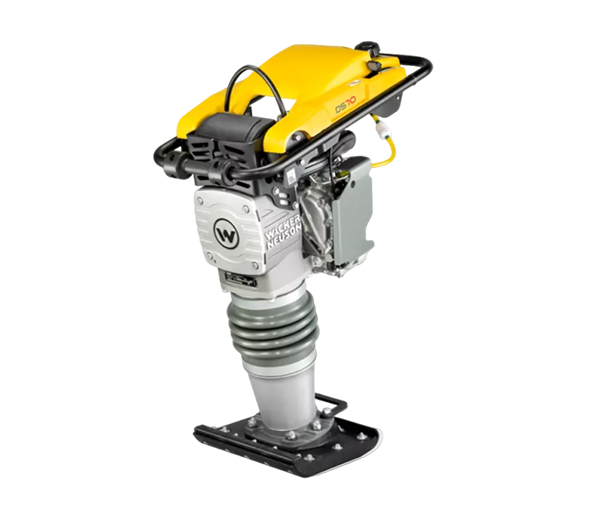
When I evaluate a diesel vibratory rammer machine, I do not look at one specification in isolation. I look at how the engine, compaction system, frame, shoe, controls, and transport design work together.
The first advantage is the compact structure. A narrow body and ramming shoe allow the machine to enter places that larger compaction equipment cannot easily reach.
This is especially useful in trenches for drainage, water supply, electrical cables, and other underground utilities. It can also be useful around building foundations, walls, curbs, and landscaping projects.
A diesel engine gives the machine an independent power source. Depending on the selected configuration and destination market, different engine models may be available.
For example, Yanmar's L48 series is a compact vertical-cylinder, four-cycle, air-cooled diesel engine family. Public specifications for the L48N show a 0.219-liter displacement and maximum rated output of 3.5 kW at 3,600 rpm. The L48V is available in an EU Stage V version, showing why the engine configuration must be matched to the destination market.
| Engine Reference | Displacement | Maximum Output | Cooling | Typical Consideration |
|---|---|---|---|---|
| Yanmar L48N | 0.219 L | 3.5 kW | Air-cooled | Lower-regulated markets, subject to local requirements |
| Yanmar L48V | 0.219 L | 3.4 kW | Air-cooled | EU Stage V configuration |
| Yanmar L70N | 0.320 L | 4.9 kW | Air-cooled | Higher-output compact engine option |
| Yanmar L100N | 0.435 L | 7.4 kW | Air-cooled | Larger compact-engine configuration |
Source: Yanmar published L-N/LV series engine specifications. These are engine reference figures only; the engine fitted to a particular Ganglong-supplied rammer depends on the confirmed configuration.
Engine power alone does not tell me how well a rammer compacts soil. The impact system is equally important. The rammer needs to convert engine power into repeated, controlled movement at the shoe.
A public example is the Wacker Neuson DS70, which lists a percussion rate of about 667 impacts per minute, a 75 mm stroke at the rammer, and 21 kN impact power. These figures give buyers a useful idea of the type of performance that a professional diesel rammer can provide.
A small machine is often used by operators who need to move quickly from one work area to another. Controls should therefore be easy to understand. The throttle, stop control, and operating handle should be placed where the operator can reach them naturally.
The handle also needs to help control vibration. The operator should be able to guide the rammer without unnecessary effort, especially during long working periods.
The shoe is one of the hardest-working parts of the entire machine. Every impact goes through it and into the soil. A well-designed shoe should resist wear while maintaining stable contact with the ground.
For buyers who expect frequent work in abrasive soil, I recommend paying close attention to shoe material, thickness, dimensions, and replacement availability.
One of the questions I hear from buyers is simple: “Why should I choose a rammer instead of a plate compactor?” My answer is that these machines are designed for different jobs.
A diesel vibratory rammer is strongest when the working area is narrow and the soil needs repeated impact. A plate compactor is generally better when the surface is wider and relatively flat. A small roller becomes more attractive when the job covers a larger open area and continuous rolling is more efficient.
| Equipment | Main Working Action | Best Working Area | Typical Application |
|---|---|---|---|
| Diesel Vibratory Rammer | Repeated impact and vibration | Narrow or restricted areas | Trenches, cohesive soil, foundations, utility work |
| Vibratory Plate Compactor | Vibration and downward pressure | Open, relatively flat areas | Walkways, paving, granular base, landscaping |
| Small Vibratory Roller | Rolling plus vibration | Broader open surfaces | Roads, parking areas, larger soil or aggregate surfaces |
Source basis: equipment operating principles and published specifications from Wacker Neuson product information. The comparison is a practical application guide rather than a laboratory performance ranking.
For example, if I need to compact a narrow trench beside a newly installed pipe, I would not bring a large roller simply because it has more weight. It would be difficult to position and could be unsuitable for the available space. A rammer is much easier to control there.
If I need to prepare a broad area for paving, however, a plate compactor may cover the ground faster. And if the project involves a large road base, a roller can provide much higher area coverage.
So the right question is not “Which machine is stronger?” The better question is “Which machine matches the soil, space, and work volume?”
The application range of a Diesel Soil Compactor is wider than many buyers expect. Because the machine is small and easy to move, it fits naturally into projects where access is restricted.
During building work, soil around foundations often needs careful compaction. A rammer can work in spaces that are too narrow for larger machines.
It can also be used for backfilled soil around foundation structures, depending on the project requirements and the material being compacted.
This is one of the most natural applications for a diesel tamping rammer. After a pipe or cable is installed, the surrounding backfill needs to be compacted in controlled layers.
The narrow shoe allows the operator to work along the trench while keeping the machine close to the area that needs attention.
Small road repair projects often have limited working space. A rammer can help compact soil and base material around damaged sections, edges, drainage structures, and other locations where a large roller cannot operate conveniently.
Landscaping work frequently involves narrow paths, garden edges, retaining walls, paving preparation, and small foundations. A compact rammer is easy to transport between different working areas.
Farm construction is another practical application. The machine can be used around agricultural buildings, drainage projects, farm roads, small foundations, and other civil works where compacting equipment is required.
Municipal repair teams may work around sidewalks, drainage systems, utility lines, road edges, and public infrastructure. A small diesel compactor can be useful because it does not require the open space needed by larger road equipment.
At Ganglong, I do not look at a construction machine as just a product sitting in a warehouse. For an international order, the machine is part of a complete process. The right model, configuration, inspection, documentation, packing, transport, and communication all matter.
For a Diesel Vibratory Rammer, the production and preparation period is normally around 15–30 days depending on the confirmed model, engine, configuration, order quantity, and machine availability. For stock machines, the actual delivery preparation may be shorter. For customized or larger orders, I confirm the schedule before the order is processed.
During preparation, I pay attention to several basic areas.
Diesel engine starting and running condition
Fuel system and basic engine operation
Vibration and impact mechanism
Ramming shoe condition
Handle and operating controls
Fasteners and protective components
Working performance
Accessories and spare parts
Product documentation
Export packing condition
For international buyers, this inspection step is important because the machine may travel thousands of kilometers before reaching the final job site. It is much easier to solve a configuration or packing problem before loading than after the machine arrives.
Our group has experience in construction machinery, mining machinery, agricultural machinery, and related equipment. Hefei Ganglong International Trade Co., Ltd. acts as our professional international trade arm and supports customers across different regions.
For international orders, T/T is a common payment method. A typical arrangement is a deposit before order processing or production, followed by the balance before shipment. However, I do not treat one payment structure as suitable for every customer. The final terms depend on the machine, order quantity, destination, and agreement between both parties.
For a small diesel rammer, sea transportation is normally practical for international bulk or regular orders. Depending on the destination, urgent spare parts and smaller accessories can also be shipped by air or express.
Before loading, we check the machine's condition and secure it properly. The goal is simple: prevent unnecessary movement, protect vulnerable parts, and make unloading easier for the customer.
Depending on the order and shipping method, the machine can be protected with suitable wrapping and external packing. Loose accessories, spare parts, and small components can be packed separately in cartons or wooden cases.
For container shipments, packing and loading are arranged according to the actual machine dimensions and container space. The final packing method is confirmed before shipment rather than using the same packing method for every order.
Ganglong Heavy Industry Technology (Hefei) Co., Ltd. was founded in 2013. Together with Hefei Ganglong International Trade Co., Ltd., we are affiliated with China Construction Machinery (Group) Co., Ltd.
Our business covers several parts of the construction machinery supply chain. We have our own HKLOONG range, including Excavators, loaders, Backhoe loaders, and swamp excavators. At the same time, we provide complete machine sales and leasing services involving domestic and international brands such as Hitachi, SANY, Lonking, Hyundai, XCMG, SHANMON, and LOVOL.
For clarity, when a customer asks us about a third-party brand, our role is to supply, arrange, source, or provide related sales and service support. We do not present another manufacturer's machine as our own manufactured product.
That distinction matters to me because international machinery buyers need to know exactly who is responsible for what.
For a small machinery supplier, product knowledge is only part of the job. I also need to understand what happens after the machine leaves the factory.
That includes:
Confirming the exact machine model
Checking engine and emission requirements
Matching the configuration to the customer's work
Confirming accessories and spare parts
Arranging pre-delivery inspection
Preparing documents
Choosing a suitable transport method
Protecting the machine during shipping
Communicating the delivery schedule
This is especially useful for overseas buyers who may not have a local supplier nearby. A machine can be technically good and still create problems if the wrong configuration is ordered or important accessories are left out.
A diesel vibratory rammer is mainly used to compact soil and backfill in narrow or restricted areas. Common applications include trenches, foundations, utility projects, road repair, landscaping, agricultural construction, and municipal maintenance.
Diesel power provides an independent power source and can fit well on construction sites where other diesel equipment is already being used. It can also be useful for customers who prefer diesel-powered equipment for their working environment. Engine choice should always consider local fuel, service, and emission requirements.
Yes, vibratory rammers are commonly used for cohesive and mixed soils, including clay-based materials. However, the actual result depends on soil moisture, layer thickness, machine settings, and the number of passes. I recommend testing the material when the soil condition is unusual.
It can work on some granular materials, but a vibratory plate or roller may be more efficient when the working area is broad and open. The choice depends on the material and the available working space.
A rammer uses repeated impact and vibration with a relatively narrow shoe, making it useful for trenches and restricted spaces. A plate compactor uses a larger vibrating plate and is generally more suitable for broader, flatter working areas.
For our international machinery orders, production and preparation commonly take around 15–30 days, depending on the model, configuration, quantity, and availability. The exact schedule is confirmed before the order is finalized.
T/T is commonly used for international orders. A deposit is normally arranged before production or order processing, with the balance paid before shipment. Exact payment terms are confirmed according to the order.
Sea freight is generally suitable for international machinery orders. Depending on the destination and urgency, smaller accessories and spare parts can be shipped by air or express. The final method depends on the order size, destination, and shipping cost.
The machine is protected and secured according to the selected transportation method. Loose accessories and spare parts can be packed separately in cartons or wooden cases. The final packing arrangement is confirmed according to the machine and destination.
In many cases, configuration can be discussed before the order is confirmed. Engine model, emission requirements, accessories, spare parts, and other details should be checked against the destination market. I recommend confirming these items before production begins.
When I choose a Diesel Vibratory Rammer, I do not start with the biggest engine or the highest number on a specification sheet. I start with the actual job.
Where will the machine work? Is the soil cohesive or granular? How narrow is the trench? How much area needs to be compacted? How many hours will the machine operate each day? What emission standard is required? Are spare parts easy to obtain? How will the machine be shipped?
These questions usually tell me much more than horsepower alone.
A compact diesel rammer makes sense when the job requires controlled impact compaction in places where larger equipment is difficult to use. Its narrow working shoe, compact body, diesel power, and simple operating method make it a useful part of a small construction machinery fleet.
At Ganglong, I focus on making the whole purchasing process practical for our customers. From model selection and configuration confirmation to inspection, payment, packing, and international transportation, we handle the details step by step.
Whether the requirement is for one diesel vibratory rammer, a batch of small construction machines, spare parts, or a mixed machinery order, I believe the most important thing is to make sure the equipment matches the real working conditions before it is shipped.
That is the approach we bring to every international machinery order: understand the application, confirm the machine, check the details, prepare it properly, and deliver it according to the agreed requirements.
2435092534@qq.com
86 158 5511 9567


©2026 HKLOONG Heavy Industry Technology (Hefei) Co., Ltd. All Rights Reserved.

This website uses cookies to ensure you get the best experience on our website.
 Español
 Pусский
 Français
 العربية
 WhatsApp
 Phone
Phone E-mail
 Message