
 Español
 Pусский
 Français
 العربية

When I work with fresh concrete, I pay close attention to one simple problem: trapped air. Concrete may look dense from the outside, but air pockets can remain inside the mix after placement. If those voids are not removed properly, they can affect the final surface, strength, and overall quality of the concrete structure. This is where an Immersion Vibrator becomes a practical tool on the jobsite.
At HKLOONG, I see an immersion vibrator as more than a vibrating tool. It is a compact concrete compaction machine designed to transfer controlled vibration directly into fresh concrete. The vibrating head is placed into the concrete, where rapid movement helps the mix settle around reinforcement, inside formwork, and into difficult corners.
I focus on equipment that is easy to understand and practical to use. For contractors, precast manufacturers, concrete workers, and equipment distributors, an internal concrete vibrator needs to balance vibration performance, head diameter, flexible shaft length, operating comfort, durability, and maintenance requirements. A good machine should fit the concrete job instead of making the job harder.
HKLOONG Heavy Industry Technology (Hefei) Co., Ltd. works across equipment R&D, precision manufacturing, quality testing, customized modification, and global distribution. Alongside our larger construction machinery, we also develop and supply compact equipment for applications where space, mobility, and practical operation matter. Our approach to the concrete immersion vibrator follows the same idea: match the machine configuration to the real working condition.
1. What Is an Immersion Vibrator and Why Do I Use One?
An immersion vibrator, also called an internal vibrator, poker vibrator, or concrete vibrator, is used to consolidate freshly placed concrete. Unlike an external vibrator, which transfers vibration through the formwork, an immersion vibrator puts the vibrating head directly into the concrete mix.
I find this direct method especially useful when concrete contains reinforcement bars, narrow sections, columns, beams, foundations, walls, or other areas where the mix needs help moving into small spaces. The vibrating head creates rapid mechanical movement inside the concrete. This helps reduce trapped air and allows the cement paste and aggregate to settle more evenly.
The basic operation is quite straightforward. I place the vibrating head vertically into fresh concrete, allow the vibration to work for the required time, and then withdraw it carefully before moving to the next point. The goal is not to vibrate as long as possible. The goal is controlled consolidation.
In practical work, I also pay attention to the diameter of the vibrating head. A smaller head can enter tighter reinforcement and narrow formwork, while a larger head can cover a wider area and suit larger concrete sections. Wacker Neuson, for example, publishes internal vibrator configurations with head diameters ranging from 30 mm to 58 mm in its product guidance, showing how head size can be matched to different component conditions.
For this reason, I would not select a concrete immersion vibrator based only on motor power. I would first look at the concrete mix, reinforcement density, form dimensions, required reach, power supply, working environment, and expected operating time.
2. How I Understand the Working Principle
The working principle of an immersion vibrator is simple but important. A motor drives an eccentric or unbalanced mechanism inside the vibrating head. As the mechanism rotates, it creates rapid vibration. That vibration is transferred through the head into the fresh concrete.
Fresh concrete contains cement, aggregate, water, and often entrapped air. During placement, the mix does not always settle perfectly by itself. Air can remain between particles, around reinforcement, or close to the surface of the form. Internal vibration temporarily reduces friction between particles, allowing the concrete to move and settle more easily.
I think of the process as helping the concrete find its own level of density. The vibrator does not replace correct concrete mixing or placement. Instead, it supports the consolidation stage after the concrete has been placed.
The position of the vibrator also matters. I normally recommend inserting the head vertically rather than dragging it through the concrete. The insertion points should be arranged so that the vibration zones overlap. Wacker Neuson recommends changing immersion points at approximately 8–10 times the vibrator head diameter and warns against excessive vibration at one point because it can contribute to segregation.
This gives me a useful rule when training operators: move the vibrator systematically instead of randomly. The machine provides the vibration, but the operator still controls the quality of the process.
Typical Immersion Process
Step 1: Place the fresh concrete correctly inside the form.
Step 2: Select a suitable vibrator head diameter for the reinforcement and formwork.
Step 3: Insert the vibrating head into the concrete vertically.
Step 4: Allow the vibration to consolidate the surrounding concrete.
Step 5: Withdraw the head slowly and move to the next immersion point.
Step 6: Continue until the required concrete section has been properly consolidated.
I always treat the operator's working method as part of the equipment solution. Even a powerful concrete vibrator cannot compensate for poor insertion, excessive vibration, or unsuitable positioning.
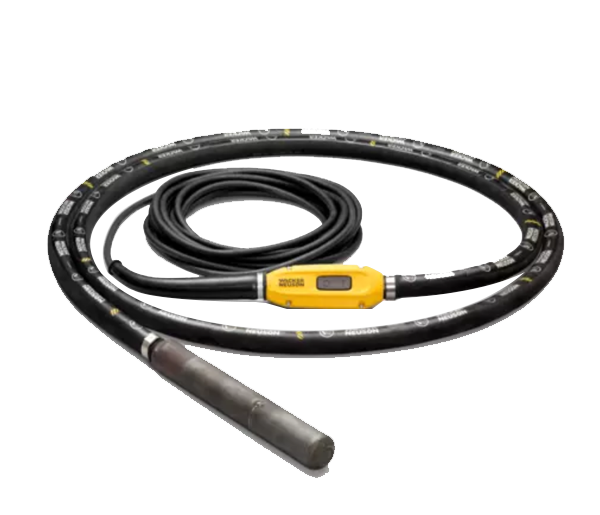
3. Main Features I Look For in an Internal Concrete Vibrator
When I evaluate an internal concrete vibrator, I usually divide the machine into several practical areas: the motor, vibrating head, flexible shaft, protective hose, electrical system, handle, and service components. Each part affects the overall working experience.
Vibrating Head Diameter
The head diameter is one of the first specifications I check. A compact head is easier to insert between closely spaced reinforcement bars. A larger head can deliver a broader vibration zone and can be useful for larger concrete sections.
There is no universal head size for every job. I prefer to match the head to the concrete structure instead of simply choosing the largest available option.
High-Speed Vibration
Many professional immersion vibrators operate at high vibration rates. For example, Wacker Neuson's published IEC and IE internal vibrator data include configurations operating at 12,000 vibrations per minute, while its high-frequency systems use a 200 Hz electrical frequency.
These numbers are useful for understanding the market, but I do not treat frequency as the only measure of performance. The relationship between vibration speed, head design, motor output, concrete mix, and operating method matters just as much.
Flexible Shaft and Hose
The flexible shaft gives the operator reach and movement. I prefer a hose and shaft arrangement that allows the operator to reach different sections of the form without constantly repositioning the power unit.
At the same time, flexibility should not come at the cost of poor handling. The shaft needs to transmit rotational movement smoothly while remaining practical for repeated use.
Practical Protection
Concrete work is a demanding environment. Dust, moisture, cement paste, impact, and repeated movement are normal parts of the job. For electric equipment, I pay attention to protection ratings, cable quality, connector design, and the condition of the protective hose.
For example, Wacker Neuson's published IEC internal vibrator data list IP67 protection for several configurations. I treat this as useful reference information when comparing product architectures, rather than assuming every immersion vibrator has the same protection level.
Operator Handling
A concrete vibrator may be technically strong but still uncomfortable if the operator has difficulty controlling it. I therefore look at grip position, hose flexibility, overall weight, balance, cable arrangement, and access to service points.
For construction crews working for several hours at a time, these details can make a real difference to productivity.
4. Technical Reference Data: How I Compare Concrete Vibrators
When I compare an immersion vibrator with other products on the market, I prefer to look at several specifications together. The following figures are published industry reference data from Wacker Neuson. They are not HKLOONG product specifications and should not be treated as a direct specification sheet for a HKLOONG model.
| Reference Configuration | Head Diameter | Vibration Rate | Power | Weight | Source |
|---|---|---|---|---|---|
| Wacker Neuson IEC38/230/5 | 38 mm | 12,000 rpm | 0.42 kW | 11.3 kg | Wacker Neuson official technical data |
| Wacker Neuson IEC45/120/3 US | 45 mm | 12,000 rpm | 0.56 kW | 10.8 kg | Wacker Neuson official technical data |
| Wacker Neuson IEC58/120/3 US | 58 mm | 12,000 rpm | 0.72 kW | 14.1 kg | Wacker Neuson official technical data |
The table shows an important point: increasing the head diameter can also come with changes in power and equipment weight. That is why I do not recommend choosing a vibrator only by the headline vibration rate.
Another useful comparison is between conventional electric internal vibrators and high-frequency systems.
| System Type | Example Head Size | Vibration Rate | Typical Electrical Arrangement | Source |
|---|---|---|---|---|
| Standard electric internal vibrator | 38 mm | 12,000 rpm | 220–240 V, 0.42 kW reference configuration | Wacker Neuson IEC Series |
| High-frequency internal vibrator | 38 mm | 12,000 rpm | 42 V, 200 Hz, 0.29 kW reference configuration | Wacker Neuson IE Series |
| Battery-powered internal vibrator | 38 mm | 12,000 rpm | 34 V, 200 Hz, 0.29 kW reference configuration | Wacker Neuson ACBe Series |
These figures show why the power source is an important part of equipment selection. A jobsite with reliable mains power may favor one configuration, while remote construction work may need another arrangement. The right choice depends on the site rather than a single specification.
5. Where I Would Use an Immersion Vibrator
I would use an immersion vibrator for concrete anywhere fresh concrete needs controlled internal consolidation. The exact head size and power configuration would depend on the structure.
Building Construction
Columns, beams, walls, foundations, stairs, and other reinforced concrete structures can all require internal vibration. In these applications, I focus on getting the vibrator head into the concrete without disturbing reinforcement or formwork.
Precast Concrete
Precast production often requires repeatable concrete placement. Concrete products may include panels, blocks, pipes, beams, architectural elements, and other molded components. A suitable internal vibrator can help workers achieve more consistent consolidation during production.
Road and Civil Engineering
Concrete used for road structures, drainage systems, retaining structures, bridge components, and municipal works can also benefit from internal vibration. The equipment needs to be selected according to the section size, reinforcement, concrete consistency, and available power.
Foundations and Structural Repair
When I work around foundations or repair areas, access can be limited. A compact immersion vibrator with an appropriate head diameter can make it easier to reach concrete sections where larger equipment is not practical.
Small Construction Projects
This is also where compact equipment becomes useful. HKLOONG provides small equipment for narrow and difficult working environments, including construction, landscaping, agriculture, municipal maintenance, and material handling. I take the same practical approach when considering concrete equipment: the machine should fit the work area, not force the work area to fit the machine.
6. How I Approach Immersion Vibrator Manufacturing and Quality
For me, manufacturing a reliable concrete immersion vibrator starts long before final assembly. The design needs to consider how the machine will actually be used on a construction site.
I begin with the working requirements. What type of concrete will the operator consolidate? How large is the form? How dense is the reinforcement? What power source is available? How far does the operator need to reach? How many hours will the equipment work each day?
These questions help define the suitable configuration.
The vibrating head is especially important. Internal components need to work at high speed while handling repeated vibration. Material selection, machining accuracy, bearing arrangement, sealing, shaft connection, and balancing all influence the working behavior of the machine.
The flexible shaft also deserves attention. It is repeatedly bent and moved by the operator, so the design needs to support smooth power transmission and practical handling. I also pay attention to the protective hose because it is the operator's main physical barrier around the moving shaft.
During assembly and quality control, I would check electrical connections, mechanical movement, vibration behavior, component fit, cable condition, protective elements, and overall operation. For customized orders, I can also consider different working lengths, head configurations, power arrangements, and application requirements where the product platform allows it.
HKLOONG's wider manufacturing capability covers equipment R&D, precision manufacturing, quality testing, customized modification, and global distribution. That gives me a practical framework for developing compact equipment around real customer requirements instead of treating every order as exactly the same.
7. Why I Choose a Practical HKLOONG Approach
When I select construction equipment, I do not want a complicated machine simply because it has more specifications. I want to know whether it will work reliably in the conditions where my team actually operates.
That is the approach I bring to HKLOONG.
HKLOONG Heavy Industry Technology (Hefei) Co., Ltd. is based in Hefei, China, and works across equipment research and development, precision manufacturing, quality testing, customized modification, and global distribution. The HKLOONG product range covers crawler excavators, Wheel loaders, Backhoe loaders, amphibious wetland Excavators, and a range of compact equipment.
For an Immersion Vibrator, I focus on practical configuration. Different construction teams may need different head diameters, hose lengths, electrical arrangements, or operating solutions. Instead of assuming that one specification works for every project, I look at the actual application first.
I also understand that many B2B buyers are not purchasing one machine for one project. Distributors may need repeatable configurations. Contractors may need equipment that is easy for different operators to understand. Rental companies may care about service access and durability. Export customers may have different power standards and jobsite conditions.
These factors influence how I approach product design, configuration, packaging, quality control, and technical communication.
My goal is simple: make the equipment understandable, practical, and suitable for the job. Whether the application involves building construction, precast production, municipal engineering, foundations, or smaller concrete work, I want the buyer to be able to connect the machine specifications with the real working conditions.
8. Immersion Vibrator FAQ
What is an immersion vibrator?
An immersion vibrator is a concrete consolidation tool with a vibrating head that is inserted directly into fresh concrete. It helps reduce trapped air and allows the concrete mix to settle more evenly around reinforcement and inside formwork.
What is another name for an immersion vibrator?
Common names include internal concrete vibrator, poker vibrator, concrete poker, concrete vibrator, internal vibrator, and concrete immersion vibrator. The exact name can vary by market and equipment supplier.
How do I choose the right vibrator head diameter?
I normally start with the reinforcement spacing and formwork dimensions. A smaller head is generally easier to position in narrow or heavily reinforced areas, while a larger head may be suitable for larger concrete sections. Wacker Neuson's published guidance also shows different head diameters for different component sizes.
How long should I vibrate concrete in one position?
There is no single time that works for every concrete mix and structure. I recommend following the concrete supplier's method and the equipment manufacturer's operating guidance. The operator should avoid excessive vibration because it can contribute to segregation.
Can an immersion vibrator be used around reinforcement bars?
Yes. This is one of the main reasons internal vibrators are useful. The operator can select a suitable head diameter and position the vibrator between reinforcement areas. Careful operation is important so the vibrator does not unnecessarily disturb reinforcement or formwork.
What is the difference between an internal vibrator and an external vibrator?
An internal vibrator places the vibrating head directly into fresh concrete. An external vibrator is mounted against or onto the formwork and transfers vibration through the mold. I choose between them according to the concrete structure, form design, access conditions, and production method.
Is a high-frequency concrete vibrator better?
High-frequency equipment can be useful for professional concrete placement, but I would not call one frequency universally better. The correct choice depends on the concrete mix, component size, reinforcement, power source, head diameter, and required working method.
Can HKLOONG provide customized immersion vibrator configurations?
Configuration depends on the specific product platform and project requirements. I can evaluate requirements such as application, head diameter, working reach, power supply, operating environment, and quantity before recommending a suitable configuration.
What should I check before purchasing an immersion vibrator?
I recommend checking the vibrator head diameter, vibration rate, motor or power configuration, hose length, cable arrangement, equipment weight, protection level, service requirements, spare parts availability, and compatibility with your concrete placement method.
Final Thoughts
An Immersion Vibrator is a relatively compact piece of construction equipment, but its role in concrete placement is important. When I select one, I look beyond the motor rating and vibration number. I consider the concrete structure, reinforcement density, head diameter, working reach, power source, operator handling, and service requirements as one complete system.
For contractors, precast manufacturers, construction equipment distributors, and engineering teams, the right internal concrete vibrator can make concrete consolidation easier and more controlled. At HKLOONG, I apply a practical manufacturing approach based on equipment development, precision manufacturing, quality testing, customization, and global supply.
If you are comparing a concrete immersion vibrator, internal concrete vibrator, or concrete poker vibrator, I recommend starting with your actual job conditions. Tell me the concrete application, reinforcement spacing, required working reach, power supply, and expected workload. From there, I can help match the equipment configuration to the work instead of choosing a machine based on specifications alone.



 WhatsApp
 Phone
Phone E-mail
 Message