
 Español
 Pусский
 Français
 العربية

When I look at a road roller, I do not judge it by the size of the machine alone. I look at what the roller needs to do on the actual job site. Does it need to work on a new asphalt road? Is the project inside a parking area? Does the machine need to move around curbs, buildings and narrow access points? How much compaction force is required?
These questions are important when selecting a Double-drum roller RD28. A compact tandem roller is designed around a simple idea: use two drums, controlled machine weight and vibration to compact the surface evenly and efficiently.
At HKLOONG Heavy Industry Technology (Hefei) Co., Ltd., I work with construction equipment from both the heavy-duty and compact sides. Our main product range includes crawler excavators, Wheel loaders, Backhoe loaders and amphibious wetland Excavators. We also develop and supply smaller machines for landscaping, construction, agriculture, municipal maintenance and material handling.
For me, the value of a compact road roller is its ability to bring controlled compaction into places where a larger machine may be difficult to use. A double drum vibratory roller can be useful for asphalt paving, road repair, parking lots, sidewalks, driveways and other projects where surface quality and maneuverability both matter.
In this page, I will explain how I understand the RD28 roller concept, how the compaction system works, what features I look for, how I compare similar equipment, where I would use this type of roller and what I consider during manufacturing and equipment selection.
Important: Because no HKLOONG RD28 technical datasheet was supplied for this page, I do not present unverified engine power, operating weight, drum width or vibration figures as HKLOONG specifications. Where numerical comparison is useful, I clearly identify published third-party data as industry reference information.
1. What Is a Double-drum Roller RD28?
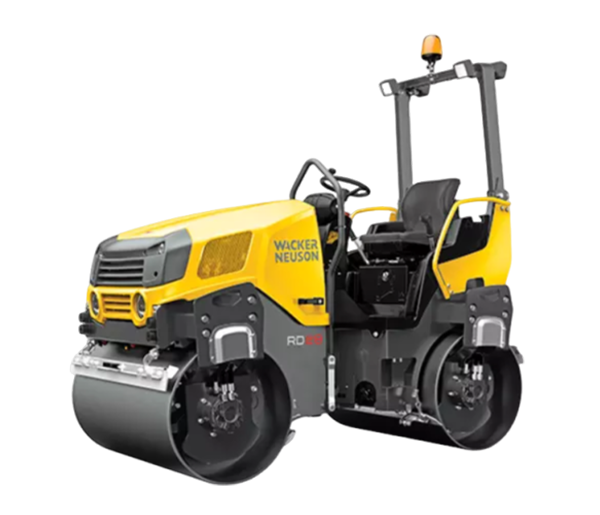
A Double-drum roller RD28 is a tandem road roller concept that uses a steel drum at the front and another steel drum at the rear. Depending on the exact configuration, both drums can provide vibration for compaction.
The word “double-drum” is important because both ends of the machine contribute to the compaction process. Instead of having one vibrating drum and pneumatic tires, a tandem roller normally uses two steel drums to create a consistent rolling pattern across the working surface.
The “RD28” name can refer to a specific model designation used in the market, so buyers should always confirm the manufacturer and exact configuration before comparing specifications. For example, Wacker Neuson currently lists several RD28 variants, including the RD28-120 as a two-vibratory-drum tandem roller, alongside combination and oscillation versions. :contentReference[oaicite:1]{index=1}
That is a good reminder for me when comparing road rollers: the model name alone is not enough. Drum type, vibration system, operating weight, width, frequency, amplitude and powertrain can all vary.
The main purpose of an RD28-style tandem roller is surface compaction. On asphalt, the machine applies pressure and vibration to help reduce air voids and create a denser, smoother pavement layer. On suitable granular materials, vibration can help particles move closer together and improve the compacted structure.
I especially like this machine class for projects where a roller needs to be compact without becoming difficult to control. A large road roller can deliver substantial compaction, but it may not be the most convenient option for every job. A compact tandem roller gives the operator a smaller footprint and easier maneuverability.
Published RD28 Industry Reference Data
| Reference Model | Operating Weight | Drum Width | Travel Speed | Engine Output | Source |
|---|---|---|---|---|---|
| Wacker Neuson RD28-120 | Approx. 2,695 kg | 1,200 mm | Up to 10.2 km/h | 24.8 hp / 18.5 kW | Wacker Neuson official technical data |
| Wacker Neuson RD28-120c | Approx. 2,595 kg | 1,200 mm front drum | Up to 9.6 km/h | 24.8 hp / 18.5 kW | Wacker Neuson official technical data |
| Wacker Neuson RD28-120o | Approx. 2,695 kg | 1,200 mm | Published by manufacturer | 24.8 hp / 18.5 kW | Wacker Neuson official technical data |
The figures above are published reference data from Wacker Neuson. They describe specific RD28 configurations from that manufacturer and are not HKLOONG specifications. The official technical data also list a 2.8-ton-class machine, approximately 1,200 mm drum width and a Kubota D1703 diesel engine rated at 18.5 kW for the cited configuration. :contentReference[oaicite:2]{index=2}
2. How I Understand the Working Principle of an RD28 Tandem Roller
The working principle is easy to understand. The machine moves over the surface while its drums apply weight. When vibration is activated, an eccentric mechanism inside the drum creates rapid movement. This adds dynamic force to the static weight of the machine.
In simple terms, the drum does not just roll over the surface. It also vibrates against it.
This repeated movement helps compact suitable materials more effectively than static rolling alone. The exact result depends on the material, moisture, layer thickness, machine weight, vibration frequency, amplitude and number of passes.
For asphalt, I pay particular attention to temperature and timing. Asphalt behaves differently depending on its temperature and mix characteristics. A roller should work within the paving crew's planned compaction window rather than simply making random passes.
The operator also needs to control travel speed and vibration settings. Too little compaction may leave the pavement under-dense. Too much vibration or an unsuitable operating pattern can create other problems. This is why I see the roller operator as an important part of the compaction system.
The two drums also create a continuous contact path. When the machine moves forward, the rear drum follows the front drum. This helps the roller maintain a relatively consistent working pattern.
On an articulated design, the joint between the front and rear sections can help the roller follow changes in direction and surface position. Wacker Neuson's published RD28 information describes a three-point articulated pendulum joint that distributes weight between the front and rear sections and supports maneuverability and stability. :contentReference[oaicite:3]{index=3}
That design idea is especially useful when the machine needs to turn within limited space. It can also help the operator maintain a predictable path around edges and obstacles.
3. Main Features I Look For in a Double-drum Vibratory Roller
When I evaluate a double drum vibratory roller, I look beyond engine power. A road roller is a complete compaction system, and several details affect its actual performance.
Two steel drums
The two-drum layout gives the machine a stable contact pattern. Both drums can contribute to compaction when the machine is configured as a tandem vibratory roller.
This makes the design particularly suitable for asphalt paving and surface finishing work. The smooth steel drum can leave a relatively uniform surface when operated correctly.
Adjustable vibration
Different materials and layer conditions may require different vibration settings. I prefer a machine design that allows the operator to select a suitable vibration level rather than forcing one fixed setting for every job.
Published RD28 data from Wacker Neuson show multiple vibration levels. The cited RD28-120 specification lists 65 Hz and 51 Hz vibration frequencies, with corresponding amplitude and centrifugal-force settings. :contentReference[oaicite:4]{index=4}
Compact dimensions
A compact roller can work in locations where a larger road roller may have limited room. Parking areas, small streets, driveways, paths and urban repair projects can all benefit from a machine with manageable dimensions.
Good visibility
I consider operator visibility very important. The operator needs to see the compaction path, drum edges and nearby obstacles. This becomes even more important around curbs, buildings and other fixed structures.
Edge access
When paving near walls or curbs, the machine needs to work as close to the edge as practical. A roller with limited side clearance can leave uncompactable strips that require additional work.
Wacker Neuson's RD28 documentation highlights high curb clearance as one of the design features intended to support compaction close to higher walls. :contentReference[oaicite:5]{index=5}
Simple controls
I prefer an operator control layout that does not require constant reference to a manual for basic driving and vibration functions. Clear controls can make training easier and reduce unnecessary mistakes during repetitive work.
4. Technical Advantages and Compaction Performance
For me, the main technical advantage of a tandem roller is the combination of static load and dynamic vibration. Static weight provides pressure. Vibration adds repeated dynamic energy. Together, they help compact the working layer.
However, more force is not automatically better. Compaction needs to match the material and layer. The goal is to achieve the required density and surface condition with a sensible number of passes.
This is why I pay attention to four main parameters: operating weight, vibration frequency, amplitude and centrifugal force.
Operating weight: affects the static load applied through the drums.
Vibration frequency: describes how frequently the drum generates vibration.
Amplitude: describes the size of the drum's vibration movement.
Centrifugal force: indicates the dynamic force generated by the vibration system.
These figures should always be read together. A high centrifugal-force number without considering frequency, amplitude and operating weight does not tell me how the machine will behave on a particular asphalt layer.
Reference Comparison: RD28 and Other Wacker Neuson Tandem Rollers
| Model | Operating Weight | Drum Width | Engine Output | Travel Speed | Source |
|---|---|---|---|---|---|
| RD28-120 | 2,695 kg | 1,200 mm | 18.5 kW | 10.2 km/h | Wacker Neuson |
| RD40-130 | Approx. 5,360 kg | 1,300 mm | Published by manufacturer | Published by manufacturer | Wacker Neuson |
| RD45-140 | Approx. 5,630 kg | 1,400 mm | Published by manufacturer | Published by manufacturer | Wacker Neuson |
The comparison shows the basic positioning of the RD28 within Wacker Neuson's tandem roller range: it is a smaller, more compact machine class than the RD40 and RD45 models. The manufacturer's published product guide lists the RD28-120 at 7,518 lb operating weight, compared with 11,816 lb for the RD40-130 and 12,412 lb for the RD45-140. :contentReference[oaicite:6]{index=6}
I would not interpret these figures as saying that one machine is automatically suitable for every project. A smaller roller can be much easier to use on a restricted site, while a heavier roller may be more appropriate when higher machine mass and larger working width are required.
5. Where I Would Use a Double-drum Roller RD28
I see the RD28 road roller concept as particularly useful for medium and smaller compaction projects where maneuverability matters.
Asphalt Road Construction
Asphalt paving is one of the most obvious applications. The smooth steel drums provide a continuous contact surface, while vibration helps achieve the required compaction.
I would use the roller as part of a paving train, working with the paver and other compaction equipment according to the project's paving plan.
Road Repair
Road maintenance often involves smaller work zones. A compact tandem roller can move into repair sections without occupying as much space as a larger machine.
Parking Lots
Parking areas can contain tight turns, curbs, light poles and other obstacles. A compact roller with good visibility and maneuverability can make these projects easier to manage.
Driveways and Access Roads
Residential and commercial access roads may not require a very large roller. A compact double-drum roller can provide a useful balance between compaction capability and machine size.
Sidewalks and Pathways
For suitable paving and base materials, compact rollers can support construction of pedestrian paths and other narrow paved areas. The exact machine selection depends on width and access.
Urban Construction
Urban projects often have limited working space. Buildings, parked vehicles, curbs and traffic restrictions can make large machines difficult to position. A smaller road roller can be easier to transport and maneuver.
Landscaping and Site Development
HKLOONG's compact equipment approach also fits landscaping and site development work. Where soil, gravel or suitable paving layers need controlled compaction, a compact roller can complement Mini Excavators and loaders.
I always recommend checking the material and required density before choosing the roller. Not every material should be compacted with the same vibration setting or number of passes.
6. How I Approach Manufacturing and Quality Control at HKLOONG
A road roller spends its working life dealing with vibration, dust, uneven ground and repeated loading. That means manufacturing quality matters in areas that may not be obvious from a product photograph.
At HKLOONG, our company integrates equipment R&D, precision manufacturing, quality testing, customized modification and global distribution. I approach the Double-drum roller RD28 from the same practical engineering perspective that we use across our equipment range.
Frame and structural design
The frame needs to support the engine, hydraulic system, drums, operator platform and other components while handling repeated vibration. Good structural design starts with understanding the loads the machine will experience during actual work.
Drum system
The drums are the main contact point between the machine and the ground. I pay attention to drum construction, surface condition, alignment and vibration-system integration.
For an asphalt roller, drum condition is particularly important because the drum directly affects the finished surface. Water spray or other drum-wetting arrangements may also be used depending on the machine design and application.
Vibration system
The vibration system needs to produce consistent movement. An eccentric weight or similar mechanism creates the vibration inside the drum. Proper balance and assembly are important for smooth operation.
Hydraulic and drive systems
Many modern tandem rollers use hydraulic systems for travel, steering and vibration-related functions. I pay attention to hose routing, connection quality, protection from damage and access for maintenance.
Operator station
A road roller operator may spend many hours repeating the same driving and compaction pattern. Visibility, seat or platform design, control layout and vibration isolation can therefore affect daily working comfort.
Quality testing
Before equipment is shipped, inspection should cover the major mechanical, hydraulic, electrical and structural systems. For customized equipment, testing can be adjusted around the customer's required configuration and operating conditions.
This is especially important for export customers. Equipment may be working far from the manufacturing site, so basic reliability, service access and spare-parts planning should be considered before shipment.
7. Why I Work With Customers on the Complete Compaction Solution
When a customer asks me for an RD28 roller, I do not want to discuss only the roller. I want to understand the whole project.
What material are you compacting? What is the layer thickness? How wide is the working area? How much room is available for turning? Is the job mainly asphalt, granular base material or another suitable surface? How many hours will the machine work each day?
These questions can change the equipment recommendation.
For example, a narrow urban repair project may benefit from a compact tandem roller because the machine can move around existing structures. A large highway project may require a much heavier roller fleet with different drum widths and compaction systems.
HKLOONG's broader machinery portfolio also allows us to consider the relationship between different machines. A crawler Excavator can prepare the site. A wheel loader can handle aggregate. A small machine can work in restricted areas. A tandem roller can then compact the prepared layer.
This is why I prefer application-based equipment selection. The product should fit the project instead of forcing the project to fit the product.
For international buyers, I also consider shipping dimensions, local regulations, engine requirements, spare parts, operator training and after-sales support. These details are easy to ignore during the initial purchase discussion but can have a real effect once the machine reaches the job site.
8. Double-drum Roller RD28 FAQ
What is a Double-drum roller RD28?
It is a tandem roller concept using two drums for road and surface compaction. Depending on the exact manufacturer and configuration, both drums may use vibration for dynamic compaction.
What is an RD28 tandem roller mainly used for?
Typical applications include asphalt compaction, road construction, road repair, parking lots, access roads, pathways and other projects where a compact tandem roller is suitable.
What is the difference between a double-drum roller and a combination roller?
A conventional double-drum tandem roller normally uses steel drums at both the front and rear. A combination roller typically combines a vibrating steel drum at one end with rubber tires at the other. The choice depends on the desired surface finish, traction and application.
Why are two vibrating drums useful?
Two vibrating drums allow both the front and rear sections to contribute to compaction. This creates a continuous tandem rolling pattern and can be useful for asphalt surfaces.
Is an RD28 suitable for asphalt?
Yes, the RD28 class is strongly associated with asphalt compaction. However, the correct machine configuration, vibration setting, operating speed and number of passes should be selected according to the asphalt mix and project requirements.
Can a compact tandem roller work in narrow areas?
That is one of the main reasons I consider this machine class useful. A compact roller generally requires less space than a larger road roller and can be easier to maneuver around buildings, curbs and other obstacles.
How does vibration improve compaction?
Vibration adds dynamic force to the static weight of the machine. This repeated movement helps particles in suitable materials move closer together and can improve density. The correct frequency and amplitude depend on the material and working conditions.
What should I check before buying an RD28 road roller?
I recommend checking operating weight, drum width, vibration frequency, amplitude, centrifugal force, travel speed, engine output, turning radius, gradeability, drum type, water-spray system, operator visibility and service requirements.
Can HKLOONG customize a tandem roller configuration?
HKLOONG provides customized equipment solutions across its machinery portfolio. For a specific RD28 configuration, the final specification should be confirmed according to the customer's working conditions, market requirements and selected components.
Is operating weight the same as compaction force?
No. Operating weight is the machine's mass under a defined operating condition. Compaction force can include the dynamic force generated by vibration. A proper comparison needs to consider operating weight, static linear load, vibration frequency, amplitude and centrifugal force together.
Conclusion: Compact, Controlled Compaction for Modern Construction Sites
For me, the main attraction of the Double-drum roller RD28 concept is its balance. It is compact enough for many restricted construction areas while still providing the controlled drum pressure and vibration needed for serious compaction work.
On asphalt, road repair projects, parking areas, access roads and suitable granular surfaces, a tandem roller can become an important part of the construction process. The machine does not simply drive back and forth. Its performance depends on drum design, machine weight, vibration settings, travel speed, material conditions and the operator's working method.
I also believe that choosing a road roller should start with the project rather than the model name. The required compaction level, working width, material, site access and production volume all matter.
At HKLOONG Heavy Industry Technology (Hefei) Co., Ltd., I combine equipment R&D, precision manufacturing, quality testing and customized modification with a broader understanding of construction machinery. Our product range covers both heavy machinery and compact equipment, allowing us to consider different machine combinations for different site conditions.
If you are sourcing an RD28 tandem roller, double drum vibratory roller, compact asphalt roller or road compaction roller, I recommend starting with your actual project requirements. Once I understand the material, layer thickness, working width, site access and expected workload, I can work toward a machine configuration that makes practical sense for the job.



 WhatsApp
 Phone
Phone E-mail
 Message