

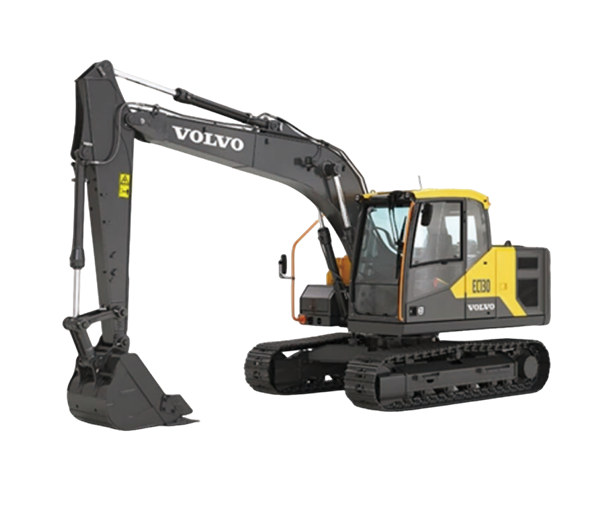
EC130F Crawler Excavator for Construction, Road Building and Earthmoving
When I talk about the EC130F crawler excavator, I usually start with a simple question: what kind of work will the machine actually do? A crawler Excavator is not something I would choose only by looking at engine power or a product name. On a real jobsite, digging depth, machine weight, track width, bucket size, working range, hydraulic response, transport width, and maintenance condition all matter.
The EC130F Crawler excavator belongs to the practical medium-size excavator class that many contractors look at for construction, road work, drainage, agriculture, land development, utility installation, and general earthmoving. Its crawler undercarriage gives the machine a stable working base, while the hydraulic boom, arm, and bucket provide the digging and material-handling capability needed for everyday site work.
There is one point I always make clear when discussing this product name. Volvo's public historical archive includes an Åkerman EC130 from the 1993–1995 production period, with 13.1–13.8 tonnes operating weight, a 103 hp Volvo TD40GB engine, 0.6 m³ bucket capacity, and 8.5 m maximum reach. Volvo's current public medium crawler excavator range includes models such as the EC140E and EC210, rather than presenting EC130F as a current universal model designation.
So when I use the keyword EC130F Crawler excavator on this page, I am using it as the customer's search and product reference. The exact machine should always be confirmed by model plate, serial information, production year, market, and configuration before an order is finalized.
That small distinction is important in international construction machinery trading. Two Excavators can look almost identical but have different engines, hydraulic systems, emissions standards, undercarriages, working equipment, and specifications.
At Ganglong Heavy Industry Technology (Hefei) Co., Ltd., this is how we approach machinery supply. We do not simply match a model name with a quotation. We first understand the customer's project, then confirm the available machine and configuration, arrange inspection, prepare the agreed accessories and documents, and coordinate international transportation.
The EC130F Crawler excavator can be understood as a crawler excavator in the roughly 13-ton class associated with the EC130 name. A crawler excavator is built around several major systems: the engine, hydraulic system, upper structure, crawler undercarriage, boom, arm, bucket, cab, and control system.
The crawler tracks are especially important. They allow the machine to move around a construction site while providing a wide and stable base for digging. When the bucket enters the ground, the machine needs to resist the digging force without moving around too much. The undercarriage and machine weight help create that stability.
Volvo's archived EC130 specification provides a useful historical reference. The Åkerman EC130 was produced from 1993 to 1995 and had an operating weight of 13.1–13.8 tonnes, 103 hp rated output, a 0.6 m³ bucket, and 8.5 m maximum reach.
I would not use those figures as universal specifications for every machine carrying an EC130-related name. They belong to a specific historical Volvo model and production period.
This is one of the reasons I prefer to identify construction equipment from the actual machine rather than from an online listing title alone.
A machine in this size class is useful because it can cover many ordinary jobs without being excessively large.
For example, I may see the same type of crawler excavator used for foundation excavation in the morning, drainage work in the afternoon, and material handling on another project the following week.
With a suitable attachment, the machine can also be adapted for trenching, grading, breaking, land preparation, or other site work.
That flexibility is one of the main reasons medium crawler excavators remain common in construction and infrastructure projects.
The basic working principle is quite easy to understand.
The engine generates mechanical power. The hydraulic system turns that power into hydraulic flow and pressure. Hydraulic cylinders then move the boom, arm, and bucket, while hydraulic motors control travel and upper-structure swing.
The operator controls these functions from the cab.
Suppose I need to dig a trench. I first position the excavator so that the tracks provide a stable working base. I lower the boom and arm, place the bucket into the soil, curl the bucket to collect material, and lift it out of the trench.
After that, the upper structure swings toward the dumping area. The bucket opens and releases the material. The machine then swings back to the trench and starts another cycle.
It sounds simple, but this cycle is repeated over and over again during a working day. Small differences in hydraulic response, operator control, machine stability, and attachment selection can therefore have a noticeable effect on actual productivity.
The engine provides the basic power source, but the hydraulic system is what turns that power into useful working movement.
When I inspect an excavator, I therefore pay attention to more than engine starting. I also look at hydraulic response, abnormal noise, oil leakage, cylinder condition, hose condition, swing operation, travel operation, and the way the boom and arm move under load.
The bucket is the part that directly contacts the soil or material. Bucket shape, capacity, teeth, cutting edge, and condition all influence the job.
A smaller bucket may be more suitable for harder digging or narrow trench work. A larger bucket can move more loose material per cycle when the machine and soil conditions allow it.
I always prefer matching the bucket to the work rather than simply choosing the largest available bucket.
The crawler undercarriage gives the excavator its mobility around the jobsite. It is designed for construction ground rather than normal road travel.
Track condition is important on a used machine. I check the track shoes, links, rollers, idlers, sprockets, and overall undercarriage condition because these components experience a lot of wear.
A 13-ton-class machine sits in a useful position between Compact Excavators and larger 20-ton machines.
It can handle meaningful excavation work while remaining easier to move and position than a much larger machine. This can be useful for contractors working on smaller construction sites, urban projects, agricultural land, utility work, and road projects.
For comparison, Volvo's current EC140E is a medium crawler excavator with an official operating weight range of 13,170–16,980 kg, gross power of 90 kW, and bucket capacity of 0.33–1.01 m³.
This gives us a useful modern reference point for the size class, although EC140E specifications should not be presented as specifications for an EC130F.
The crawler system is one of the most important parts of the machine.
When I look at an excavator, I want to know whether the undercarriage matches the working environment. A machine used on normal construction ground has different requirements from one working on soft soil, steep terrain, or rough quarry ground.
Track shoe width also affects machine width and ground contact. Wider shoes can spread the machine load over a larger area, but they can also increase transportation width.
The EC130 name is associated with machines designed for practical excavation work. Volvo's historical EC130 specification lists 8.5 m maximum reach.
For a current reference in a similar class, Volvo's EC140E lists up to 8,360 mm maximum digging reach and 5,560 mm maximum digging depth in the published configuration.
The actual working range of any excavator depends on boom length, arm length, bucket, and configuration. I therefore avoid taking a single number from one machine and applying it to every EC130-related excavator.
A crawler excavator becomes much more useful when the working equipment matches the project.
Depending on hydraulic compatibility and machine configuration, possible attachments can include digging buckets, Grading Buckets, Hydraulic Breakers, grapples, and other tools.
If the customer works mainly on drainage, for example, a suitable trenching or grading bucket may be more useful than a heavy Rock Bucket.
Excavators work in dust, mud, rain, heat, and vibration. Maintenance is therefore not something I would leave until the machine develops a problem.
Daily inspection of fluids, hoses, tracks, working equipment, and visible leaks can catch small problems before they become expensive repairs.
When we prepare a machine for export, these basic checks are part of the inspection process.
Because the EC130F name can refer to a search term rather than one universally published current Volvo specification, I prefer to show the data with the model and source clearly identified.
| Specification | Historical Volvo EC130 | Current Volvo EC140E Reference |
|---|---|---|
| Production / model period | 1993–1995 | Current published model |
| Operating weight | 13.1–13.8 t | 13,170–16,980 kg |
| Engine / gross power | Volvo TD40GB / 103 hp | 90 kW |
| Bucket capacity | 0.6 m³ | 0.33–1.01 m³ |
| Maximum reach | 8.5 m | 8,360 mm |
Source: Volvo Construction Equipment historical EC130 archive and current EC140E official product information. These are different machines and generations; the table is provided for reference only and should not be read as one combined specification.
This distinction is particularly important for buyers looking at used construction machinery. Older machines can have very different specifications from newer equipment even when the model number looks similar.
Volvo's official EC140E documentation gives several boom and arm combinations. With the 4.6 m mono boom, maximum digging reach ranges from 7,980 mm with a 2.1 m arm to 8,850 mm with a 3.0 m arm. Maximum digging depth ranges from 5,160 mm to 6,060 mm across those configurations.
| EC140E L configuration | 2.1 m arm | 2.5 m arm | 3.0 m arm |
|---|---|---|---|
| 4.6 m mono boom | Yes | Yes | Yes |
| Maximum digging reach | 7,980 mm | 8,360 mm | 8,850 mm |
| Maximum digging depth | 5,160 mm | 5,560 mm | 6,060 mm |
| Maximum reach on ground | 7,840 mm | 8,220 mm | 8,720 mm |
Source: Volvo Construction Equipment EC140E official brochure. These figures demonstrate how boom and arm selection changes working range and are not presented as EC130F specifications.
The physical size of a crawler excavator matters when it has to enter a narrow site or travel between jobs. Volvo's EC140E L documentation lists 2,590 mm overall width, 600 mm track shoe width, 3,760 mm track length, 1,990 mm track gauge, and 436 mm minimum ground clearance for the stated configuration.
| Dimension | Volvo EC140E L reference |
|---|---|
| Overall width | 2,590 mm |
| Track shoe width | 600 mm |
| Track length | 3,760 mm |
| Track gauge | 1,990 mm |
| Minimum ground clearance | 436 mm |
| Tail swing radius | 2,200 mm |
Source: Volvo Construction Equipment EC140E official technical brochure. Exact dimensions vary with machine configuration.
Foundation excavation is one of the most familiar applications for a crawler excavator.
The machine can remove soil, prepare trenches, handle excavated material, and help prepare the site before the next stage of construction begins.
For urban projects, machine size matters. A contractor may need enough digging power without bringing a very Large Excavator into a restricted site.
Road work often involves excavation, drainage, shoulder preparation, embankment work, and material handling.
A crawler excavator can move around an unfinished road surface without depending on a paved road. It can also work beside the road when drainage or utility trenches need to be prepared.
Drainage work requires controlled excavation. The operator may need to maintain a particular trench width and depth while working along a long section of land.
A properly configured medium crawler excavator is well suited to this kind of repetitive work.
Farm and agricultural projects can involve irrigation channels, drainage ditches, ponds, land preparation, and material handling.
These jobs are often spread over large areas, so crawler stability and reliable travel are useful.
Municipal projects can be surprisingly varied. One project may involve sewer pipes, another road drainage, and another land preparation.
A medium excavator is useful because it can move between different tasks without needing a completely different machine for every job.
Water pipes, electrical cables, communication lines, and drainage systems often require trench excavation.
In this kind of work, control is just as important as raw digging force. The operator needs to place the bucket accurately and avoid unnecessary damage to nearby structures or existing utilities.
Before construction begins, land often needs clearing, excavation, drainage, grading, and preparation.
A crawler excavator can perform several of these tasks, particularly when matched with the correct bucket or attachment.
At Ganglong Heavy Industry Technology (Hefei) Co., Ltd., we have been involved in machinery supply since 2013. Together with Hefei Ganglong International Trade Co., Ltd., we work across construction machinery, mining machinery, agricultural machinery, and related attachments.
When a customer asks us about an EC130F excavator, I first want to know what machine they are actually looking for.
I check the model plate, serial information, production year, photographs, and available technical documents whenever possible.
This is especially important when the customer uses a search term such as “EC130F Crawler excavator” but the available machine may be an EC130, EC140E, or another regional model.
I ask about the working environment and the main job.
Is it road construction? Agriculture? Foundation excavation? Drainage? Quarry support? Municipal engineering?
The answer affects the recommended bucket, attachments, track configuration, and machine condition requirements.
Before delivery, we arrange inspection of the machine appearance, engine, hydraulic system, undercarriage, working equipment, and basic operating functions.
For the hydraulic system, I pay attention to visible leaks, cylinder condition, hose condition, abnormal noise, and the response of the working equipment.
For the undercarriage, I check the tracks and related components because wear in this area can become a significant cost for a used machine.
The boom, arm, bucket, pins, bushes, cylinders, and attachment points need to match the intended application.
If a customer needs a machine for heavy digging, I want to know what bucket is supplied. If the customer needs trenching or grading, the attachment requirements may be different.
Standard accessories, operation manuals, spare parts, and required documents are prepared according to the order.
If the buyer has special documentation requirements, we confirm them before shipment rather than trying to solve the issue after the machine has left China.
Payment is commonly arranged by T/T, with a deposit before preparation and the balance before shipment. Exact terms are confirmed in the commercial agreement.
Complete excavators are normally transported by sea. Spare parts and smaller accessories can be shipped by air or express when appropriate.
Heavy equipment does not need decorative packaging. It needs secure packaging.
We secure the machine according to transportation requirements and protect exposed areas as appropriate. Loose parts and accessories are packed separately in cartons or wooden cases.
The purpose is simple: the machine should arrive in the condition agreed with the customer.
Buying an excavator internationally involves much more than finding a machine photograph and asking for a price.
The customer also needs to think about model identification, machine condition, inspection, attachments, spare parts, documentation, payment, loading, shipping, and after-delivery support.
Ganglong supplies construction machinery, mining machinery, agricultural machinery, and matching attachments.
We also offer our self-branded HKLOONG excavators, loaders, Backhoe loaders, and swamp excavators.
For international and domestic branded machinery, we provide complete machine sales and leasing services involving brands including Hitachi, SANY, Lonking, Hyundai, XCMG, SHANMON, and LOVOL, depending on availability and customer requirements.
For Volvo equipment, our role is as a machinery supply and international trade partner. We do not claim to manufacture Volvo machines.
Hefei Ganglong International Trade Co., Ltd. serves as the group's professional international trade arm. The team has experience serving customers across Asia, Africa, America, and other regions.
That experience matters because international machinery orders involve many small details that domestic purchases may not require.
A customer may start by asking for an EC130F Crawler excavator, but the real requirement may be a machine with a certain bucket, track width, hydraulic attachment, shipping arrangement, or spare parts package.
We can discuss these details together instead of treating the excavator as a single isolated product.
We arrange inspection before delivery so that the customer has a clearer understanding of the machine being shipped.
For overseas buyers, this is especially useful because the customer may not be able to inspect the machine personally before loading.
Depending on the machine and market, Ganglong can provide complete machine sales and leasing services.
The exact terms depend on the equipment, location, project requirements, and agreement.
Volvo's current public product range does not present EC130F as a universal current model designation. Volvo's historical archive does list an Åkerman EC130 produced from 1993 to 1995, while current Volvo medium crawler excavators include models such as EC140E and EC210. For an EC130F inquiry, I recommend confirming the exact machine identification before purchase.
Volvo's historical Åkerman EC130 specification lists an operating weight of 13.1–13.8 tonnes. This is a historical specification and should not be applied automatically to another EC130-related machine.
The Volvo archive lists a Volvo TD40GB engine with 103 hp rated output for the 1994 EC130 specification. Again, this applies to that specific historical model and production period.
The historical EC130 specification lists a 0.6 m³ bucket capacity. Actual bucket options on other EC130-related machines may differ.
Volvo's archived EC130 information lists a maximum reach of 8.5 m. The working range of other machines depends on boom, arm, bucket, and configuration.
A crawler excavator in this size class can be used for road excavation, drainage, site preparation, trenching, and material handling, provided the machine configuration matches the project.
Yes. Typical applications can include drainage channels, irrigation work, pond excavation, land preparation, and material handling. Ground conditions should be checked before selecting the machine.
Depending on the exact excavator and hydraulic configuration, a hydraulic breaker may be possible. The breaker weight, oil flow, pressure, mounting system, and machine structure all need to be compatible.
We arrange inspection of the machine appearance, engine, hydraulic system, undercarriage, working equipment, and basic operating functions. We also prepare standard accessories, manuals, spare parts, and required documents according to the order.
Preparation and delivery time depend on the selected machine, configuration, order quantity, customization requirements, machine availability, inspection, and shipping schedule. We confirm the delivery schedule before production or sourcing.
Complete machines are normally transported by sea. Spare parts and smaller accessories can be shipped by air or express. The final method depends on the destination, machine dimensions, shipping route, and customer requirements.
Payment is commonly arranged by T/T, with a deposit before preparation and the balance before shipment. Specific payment terms are confirmed in the commercial agreement for each order.
Yes. Ganglong provides complete machine sales and leasing services involving domestic and international brands such as Hitachi, SANY, Lonking, Hyundai, XCMG, SHANMON, and LOVOL, subject to machine availability and customer requirements.
When I look at an EC130F Crawler excavator, I do not want to judge it from the product name alone.
I want to know what machine is actually standing in front of me.
I check the model, production year, serial information, engine, undercarriage, boom, arm, bucket, hydraulic system, working hours, overall condition, and intended application.
That is especially important for Volvo equipment because the company has produced different excavator generations over many years. Volvo's historical archive shows the Åkerman EC130 from 1993–1995, while the current Volvo range has moved to newer medium excavator models such as the EC140E and EC210.
For a modern machine in the same general size class, Volvo's EC140E provides a useful technical reference, with 13,170–16,980 kg operating weight, 90 kW gross power, 0.33–1.01 m³ bucket capacity, up to 8,360 mm maximum digging reach, and up to 5,560 mm maximum digging depth in the published configuration.
But I would never take those EC140E figures and label them as EC130F specifications. The exact machine always comes first.
That is also how we handle international machinery supply at Ganglong Heavy Industry Technology (Hefei) Co., Ltd.
We can discuss the customer's actual job, identify the available machine, confirm the configuration, arrange inspection, prepare accessories and documents, and coordinate shipment. Our international trade team also has experience serving customers across Asia, Africa, America, and other regions.
For contractors working in construction, road building, agriculture, drainage, municipal engineering, utilities, land development, and general earthmoving, a properly selected medium crawler excavator can cover a lot of ground.
The important part is not simply finding an excavator with the right number in its name.
It is finding the right machine for the work.
That means checking the real specifications, understanding the working environment, selecting the right bucket or attachment, inspecting the major systems, and preparing the machine properly before international delivery.
That practical approach is what I recommend whenever I discuss an EC130F Crawler excavator with an overseas customer.
 RELATED
info@hkloong.com
86 158 5511 9567


©2026 HKLOONG Heavy Industry Technology (Hefei) Co., Ltd. All Rights Reserved.

This website uses cookies to ensure you get the best experience on our website.
 Español
 Pусский
 Français
 العربية

 WhatsApp
 Phone
Phone E-mail
 Message