

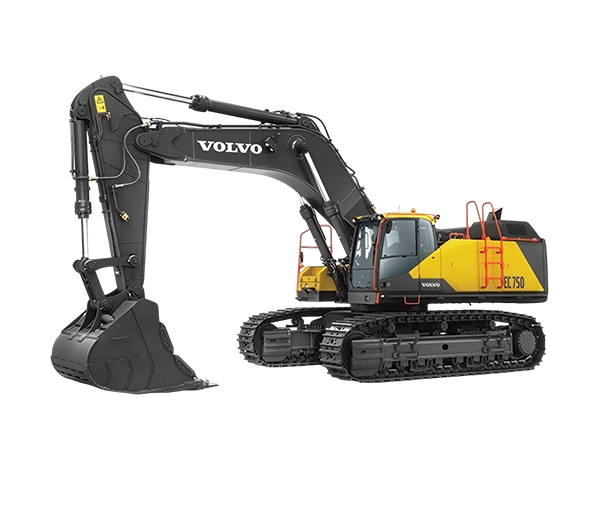
Wheel Excavator EC750: Volvo EC750 Large excavator for mining and Heavy Construction
When I first look at a machine such as the wheel excavator EC750, I do not start with the horsepower number. I start with the work the machine is expected to do. A 75-ton-class Excavator is not bought for light digging around a small building site. It is built for serious earthmoving, mining, quarrying, large infrastructure work and other jobs where the amount of material handled every hour really matters.
There is also one important point I want to make clear from the beginning. The Volvo EC750 is officially a large crawler excavator, not a Wheeled Excavator. Some buyers search for “Wheel Excavator EC750” because of the keyword they have in mind, but the actual Volvo EC750 product family uses a crawler undercarriage. I keep the requested keyword in this page for search purposes, while using the correct technical description throughout the product information.
Volvo has produced different generations of the EC750, including the EC750D and EC750E. Their specifications are not identical. For example, Volvo's official information lists the EC750D at an operating weight of approximately 72,700–74,700 kg, while the EC750E is listed at approximately 73,500–75,300 kg depending on configuration. Bucket capacity and engine specifications also vary by generation and market.
From my experience working with construction machinery buyers, this distinction is important. A customer looking for a Volvo EC750 Excavator for Sale should not compare machines by model name alone. I always check the exact generation, year, configuration, operating condition, bucket, boom, arm, counterweight and destination requirements before treating the machine as a final match.
The Volvo EC750 belongs to the Large Excavator class. This is a machine designed around high production rather than compact size. The idea is simple: put a large working tool in front of a stable machine, give it enough hydraulic power to move that tool effectively, and use a strong engine and undercarriage to support repeated heavy work.
The EC750D published by Volvo has an operating weight of 72,700–74,700 kg and bucket capacity ranging from 3.3 to 6.1 m³. Volvo lists a maximum digging reach of 11,460 mm and a maximum digging depth of 7,210 mm for the stated configuration. Its normal breakout force is listed at 325 kN. These numbers put the machine firmly into the heavy-duty excavation category.
The later EC750E keeps the same basic 75-ton-class concept but offers updated specifications. Volvo lists an operating weight of 73,500–75,300 kg, gross power of 385 kW and bucket capacity of 3.3–5.16 m³ on its Japanese product page. The official data also lists maximum digging reach of 11,460 mm and maximum digging depth of 7,210 mm.
| Model | Machine Type | Operating Weight | Bucket Capacity | Max. Digging Reach | Max. Digging Depth |
|---|---|---|---|---|---|
| Volvo EC750D | Large crawler excavator | 72,700–74,700 kg | 3.3–6.1 m³ | 11,460 mm | 7,210 mm |
| Volvo EC750E | Large crawler excavator | 73,500–75,300 kg | 3.3–5.16 m³ | 11,460 mm | 7,210 mm |
Source: Volvo construction equipment official EC750D and EC750E technical specifications. Actual figures depend on machine configuration, boom, arm, bucket, counterweight and market.
When I compare these two generations, I do not simply say that one number is bigger or smaller. The correct way is to look at the entire machine package. The EC750 is used in jobs where production, stability, digging force and attachment matching are more important than simply having a low purchase price.
Another point worth remembering is that a 75-ton excavator is a different kind of investment from a 20-ton excavator. The transport plan is different. The working area needs to be prepared differently. Fuel consumption, attachment weight, ground conditions and maintenance planning all become more important.
The basic working principle is the same as other hydraulic Excavators, but the scale is much larger. The engine provides power. The hydraulic system converts that power into controlled movement. Hydraulic cylinders move the boom, arm and bucket, while the crawler undercarriage provides stability and travel.
Think about a quarry face. The operator needs to push the bucket into material, fill it, lift it, swing the upper structure and place the material into a haul truck. The machine repeats this cycle hundreds or thousands of times during a working period.
That is where the EC750's size becomes useful. The large bucket options allow the excavator to move a substantial amount of material in one cycle. Volvo's EC750D documentation lists general-purpose bucket capacities from 3.3 m³ up to 6.1 m³ depending on configuration and working equipment. The same documentation shows different bucket options for different boom and arm combinations.
I always pay attention to that last point. A bigger bucket is not automatically better. The bucket has to match the boom, arm, material density and working conditions. Volvo's own bucket selection guide uses different material-density classes and configuration recommendations, which is a good reminder that attachment selection is part of the engineering decision rather than an afterthought.
The hydraulic system controls the digging force and working speed. When the operator moves the joystick, hydraulic oil flows to the required actuator. The boom can rise, the arm can move inward and the bucket can curl. The upper structure then swings to move the loaded bucket toward the dump location.
For mining and quarry work, the cycle needs to be predictable. If the machine is powerful but difficult to control, some of that potential productivity is lost. That is why I look at the complete hydraulic and control system rather than just one pressure or flow figure.
The crawler undercarriage also plays a major role. A machine weighing more than 70 tonnes needs a strong base. The tracks spread the machine's weight across a large ground area and provide the traction needed to work on prepared jobsite surfaces.
The first feature is simply scale. The EC750 is designed for large excavation work. Volvo's published EC750E specification lists a 73,500–75,300 kg operating weight and 385 kW gross power. That is enough machine for applications where smaller excavators would require too many cycles to achieve the same output.
Bucket choice is another major advantage. Depending on the model and configuration, the EC750 can use buckets ranging from around 3.3 m³ to more than 6 m³. The right bucket depends on the material and working equipment.
The EC750D has a published normal breakout force of 325 kN. The EC750E is listed at 323 kN normal and 342 kN boost in the referenced Volvo configuration. That level of force is useful when the machine works in dense soil, rock-related applications or other demanding excavation conditions.
The crawler design gives the machine a wide and stable base. Volvo's EC750E brochure lists different track shoe widths, including 650 mm, 750 mm and 900 mm options. These configurations change operating weight, ground pressure and overall width.
| EC750E Configuration Example | Track Shoe | Operating Weight | Ground Pressure | Overall Width |
|---|---|---|---|---|
| 6.6 m boom / 2.9 m arm | 650 mm | 73,500 kg | 106.8 kPa | 4,185 mm |
| 6.6 m boom / 2.9 m arm | 750 mm | 74,200 kg | 93.5 kPa | 4,190 mm |
| 6.6 m boom / 2.9 m arm | 900 mm | 75,300 kg | 79.0 kPa | 4,340 mm |
Source: Volvo Construction Equipment EC750E official brochure. Values shown for the stated boom, arm, bucket and counterweight configuration.
This table is a good example of why configuration matters. Wider shoes can reduce ground pressure, but they can also change transport width. If I were preparing an EC750 for an international customer, I would check both the jobsite and transport requirements before confirming the final undercarriage configuration.
Volvo lists a maximum digging reach of 11,460 mm for both the EC750D and EC750E configurations referenced above. That reach gives the operator room to work around large excavation areas without constantly repositioning the machine.
When I explain a large excavator to a customer who is not a machinery specialist, I usually avoid throwing ten technical terms at them. The important question is simple: what does the machine help you do faster?
For the EC750, the answer is mainly moving large amounts of material with controlled power.
In quarrying, for example, the machine can excavate and load material into haul trucks. In large earthmoving projects, it can remove soil and load it into transport equipment. In infrastructure construction, it can support deep excavation and large-scale site preparation.
The first advantage is digging force. A heavy excavator needs enough breakout and tear-out force to work effectively in difficult material. The EC750D lists 325 kN normal breakout force, while the EC750E lists 323 kN normal and 342 kN boost in Volvo's published configuration.
The second advantage is bucket volume. If the material density and attachment match the machine, a large bucket can reduce the number of cycles needed to fill a haul truck. That can have a direct effect on site productivity.
The third advantage is stability. Heavy excavation creates large forces. A stable crawler base helps the machine handle those forces while digging and swinging.
The fourth advantage is working reach. With a maximum digging reach of 11.46 metres in the referenced configuration, the EC750 can work across a substantial area without constantly moving its base position.
The fifth advantage is attachment flexibility. The EC750 platform can be configured for different buckets and heavy-duty applications. For demolition, Volvo also offers the EC750E HR high-reach demolition version, which is a separate specialized configuration and should not be confused with the standard EC750E excavation machine.
That last distinction is important when buying used equipment. I never assume that two machines with the same basic model number have the same working equipment.
| Performance Item | EC750D | EC750E |
|---|---|---|
| Operating Weight | 72,700–74,700 kg | 73,500–75,300 kg |
| Bucket Capacity | 3.3–6.1 m³ | 3.3–5.16 m³ |
| Max. Digging Reach | 11,460 mm | 11,460 mm |
| Max. Digging Depth | 7,210 mm | 7,210 mm |
| Normal Breakout Force | 325 kN | 323 kN |
| Boost Breakout Force | Not listed in the referenced specification | 342 kN |
Source: Volvo Construction Equipment official EC750D and EC750E product specifications.
Mining is one of the clearest applications for a large excavator like the EC750. Mining sites often involve large quantities of material, long working hours and heavy-duty excavation. The machine's large bucket options and strong digging force make it suitable for large-scale material removal and loading operations when matched with the correct jobsite equipment.
Quarry work can involve hard and dense material, large stockpiles and continuous truck loading. The EC750's size allows it to work with large haulage equipment instead of operating like a small Construction Excavator.
Large earthmoving projects can include land development, major site preparation, embankment work and other projects where a high volume of soil must be moved. The EC750 can be used as part of a larger production system involving haul trucks, dozers and other equipment.
Large highway, bridge and infrastructure projects can require deep excavation, bulk material removal and foundation preparation. The EC750 can support these operations where its size and transport requirements are practical.
Large factories, power projects, ports and other industrial facilities often require significant earthmoving before construction begins. The machine can handle large excavation tasks and load material for removal.
The standard EC750 can support certain demolition-related excavation and material handling tasks when properly configured. For high-reach demolition, Volvo offers the EC750E HR, a specialized machine with a different working configuration. I would always confirm the exact demolition requirements before selecting the machine.
For a machine this large, I believe the buying process should be more detailed than simply sending a few photographs and asking for a deposit.
Ganglong Heavy Industry Technology (Hefei) Co., Ltd. was founded in 2013. Together with Hefei Ganglong International Trade Co., Ltd., our group works across construction machinery, mining machinery, agricultural machinery and matching attachments. Our business also covers equipment R&D, manufacturing, testing, customization, sales and international trade.
Our own HKLOONG product range includes excavators, loaders, Backhoe loaders and swamp excavators. At the same time, we provide complete machine sales and leasing services for domestic and international brands according to customer requirements.
For a Volvo EC750 project, our role is to act as a machinery supplier and international trade partner. Volvo remains the manufacturer of the Volvo-branded equipment. I think being clear about this is important because buyers should know exactly who manufactures the machine and who is supplying it.
When I inspect or discuss a large excavator, I start with the identity of the machine. I want to confirm the exact model, production year, serial information where available, engine details, operating hours where available, boom and arm configuration, counterweight, bucket type and undercarriage condition.
Then I look at the machine itself.
The engine is checked for operating condition and obvious issues. The hydraulic system is important because the excavator's working ability depends heavily on it. I also pay attention to hydraulic cylinders, hoses, pumps, valves and possible oil leakage.
The undercarriage deserves special attention on a 70-ton-class crawler excavator. Track shoes, rollers, idlers, sprockets, chains and frames experience serious loads. Wear in these areas can become an expensive issue if it is ignored during the buying process.
The working equipment also needs to be checked. I look at the boom, arm, bucket, pins and bushings, as well as visible cracks, deformation or abnormal wear. The exact inspection list can be adjusted according to the customer's requirements.
Electrical and control systems should also be checked. Modern excavators rely on electronic monitoring and control functions, so these systems are part of the machine rather than an optional extra.
Once the machine is confirmed, we can arrange the documentation, payment and logistics process. Production or delivery timing depends on the selected model, configuration, quantity and actual machine availability. For available used equipment, the schedule is based on the specific unit rather than a generic production cycle.
International payment is commonly arranged by T/T, with a deposit before order processing and the balance before shipment. The exact payment terms are agreed by both parties.
For transportation, complete EC750 excavators are generally shipped by sea for international orders. Because this is a very large machine, transport planning needs to consider machine dimensions, weight, loading equipment, port requirements and destination regulations.
Loose parts, accessories and suitable spare parts can be packed separately in cartons or wooden cases when appropriate. The machine itself is securely fixed and protected according to the shipping method. Final loading, packing and delivery arrangements are confirmed according to the destination and customer requirements.
When someone searches for “Volvo EC750 price” or “Volvo EC750 for sale,” the cheapest machine is not automatically the lowest-cost machine to own.
I prefer to compare the complete package.
First, look at the machine year and generation. An EC750D and EC750E are not the same machine. Their engine, hydraulic and equipment specifications can differ.
Second, look at operating hours and maintenance history where available. A machine that has worked hard but has been properly maintained may be more useful than one with an unclear history.
Third, check the undercarriage. On a crawler excavator of this size, undercarriage wear can have a significant effect on repair cost.
Fourth, check the bucket. A mining or quarry bucket may be very different from a general-purpose excavation bucket. The bucket must match the material and working conditions.
Fifth, consider transport. A 75-ton excavator is not a machine that can simply be put on any standard trailer. The shipping plan should be confirmed before the order is finalized.
Finally, think about the complete jobsite. If the project needs a 75-ton excavator, there should also be a suitable truck fleet, loading plan, site access and ground conditions. The excavator is one part of a production system.
That is how I normally approach a Volvo EC750 crawler excavator inquiry. I would rather spend more time confirming the details before the order than solve avoidable problems after the machine reaches the destination.
No. The Volvo EC750 is officially a large crawler excavator. The term “Wheel Excavator EC750” can appear as a search keyword, but the EC750 product itself uses a crawler undercarriage.
It depends on the model and configuration. Volvo lists approximately 72,700–74,700 kg for the EC750D and 73,500–75,300 kg for the EC750E. Boom, arm, bucket, counterweight and track shoe configuration can affect the final operating weight.
The published range depends on the generation and configuration. Volvo lists 3.3–6.1 m³ for the EC750D and 3.3–5.16 m³ for the EC750E on the referenced official pages.
The referenced Volvo specifications list a maximum digging depth of 7,210 mm for both the EC750D and EC750E configurations shown. The actual figure should be confirmed against the exact boom and arm combination.
Volvo lists a maximum digging reach of 11,460 mm for the referenced EC750D and EC750E configurations.
Yes. Its large operating weight, large bucket options, strong digging performance and crawler stability make the EC750 suitable for heavy excavation and material-handling work in mining and quarry environments when correctly configured.
Yes. Quarrying is a natural application for this class of excavator. The machine can be used for excavation, loading and material handling, with the bucket and working equipment selected according to the material.
I would check the exact model and year, operating hours where available, engine, hydraulic system, electrical system, boom and arm, bucket, undercarriage, track components, cylinders, pins and bushings, maintenance history and available documents. I would also confirm the machine's actual configuration before comparing technical specifications.
Complete machines are generally transported by sea for international orders. Because the EC750 is a large crawler excavator, shipping requires careful planning around weight, dimensions, loading equipment and destination port requirements. Smaller suitable parts and accessories may be shipped by air or express.
No. Ganglong supplies construction machinery and provides international trade services. Volvo is the manufacturer of Volvo-branded EC750 equipment. Our role is to help customers source, inspect, arrange and deliver the machine according to the agreed order.
For me, the Volvo EC750 is best understood as a production machine rather than simply a large excavator. Its 70-ton-plus operating weight, large bucket options, strong digging force and stable crawler platform are designed for jobs where large amounts of material need to be moved repeatedly.
The EC750D and EC750E show why the exact model matters. Volvo's official specifications give different operating weights, bucket ranges and power figures depending on generation and configuration. The same is true for boom, arm, track shoe and counterweight combinations.
If a customer is searching for a Wheel Excavator EC750, I would first correct the product classification: the Volvo EC750 is a crawler excavator. After that, I would focus on the actual job. Is the machine for mining? Quarrying? Large earthmoving? Road construction? Industrial site preparation? The answer determines the right bucket, boom, arm and supporting equipment.
At Ganglong, our approach is practical. We confirm the machine details, check the important working systems, discuss the attachment and configuration, arrange the agreed inspection, prepare the documents and organize international transportation according to the destination.
A large excavator is a major investment, so I believe the best buying process starts with accurate information. Instead of looking only at horsepower or price, I compare the complete machine: working range, bucket capacity, digging force, operating weight, undercarriage, machine condition, attachments, transport requirements and total project needs.
That is the approach I would use when sourcing a Volvo EC750 for a serious construction, mining or quarrying project. Get the model right, get the configuration right, check the actual machine carefully, and then build the delivery plan around the customer's real jobsite.
 RELATED
2435092534@qq.com
86 158 5511 9567


©2026 HKLOONG Heavy Industry Technology (Hefei) Co., Ltd. All Rights Reserved.

This website uses cookies to ensure you get the best experience on our website.
 Español
 Pусский
 Français
 العربية


 WhatsApp
 Phone
Phone E-mail
 Message