


EC210F Crawler Excavator for Construction, Road Work and Heavy-Duty Applications
When I talk about the EC210F Crawler excavator, I usually start with one simple point: an Excavator needs to work well in the real world, not just look good on a specification sheet. A construction site can be hard ground, soft soil, narrow roads, farmland, a developing infrastructure project, or a busy municipal jobsite. The machine needs to move, dig, load, and keep working without making the operator fight with it all day.
The Volvo EC210F is a medium-class crawler excavator built around this practical idea. Depending on the market and configuration, the EC210 family is offered with different undercarriage, boom, arm, bucket, engine-emission, and operating-weight specifications. Volvo's current EC210 information lists operating weights of approximately 20,479–24,014 kg, gross power of 115 kW, and bucket capacities ranging from 0.48 to 1.44 m³.
That range is worth paying attention to. It tells us that the name EC210F Crawler excavator does not describe one machine with one fixed specification in every country. Configuration matters. The machine shown in a European or Australian specification can be different from one supplied in an Asian market, and older EC210F documents can also use different emission standards or undercarriage combinations.
At Ganglong Heavy Industry Technology (Hefei) Co., Ltd., this is how I prefer to handle equipment inquiries. Instead of simply asking, “Do you need an EC210F?”, I want to know what the machine will actually do. Excavation? Road construction? Agriculture? Utility work? Quarry support? Material handling? Rental? Once I understand the job, I can discuss the right configuration, attachments, inspection requirements, shipping method, and spare parts with the customer.
The EC210F Crawler excavator is a medium-size crawler excavator in Volvo construction equipment's EC210 family. It combines a tracked undercarriage, diesel engine, hydraulic system, rotating upper structure, boom, arm, and bucket into one machine that can handle a wide range of earthmoving tasks.
The crawler design is one of the reasons this type of machine is useful on construction sites. Unlike a Wheeled Excavator, it travels on tracks and spreads its weight across the ground. This gives the machine a stable working platform while digging, swinging, lifting, and loading.
Volvo's current EC210 information describes the machine as suitable for agricultural applications and supporting work, while also listing building, road work, and utilities among its applications. Volvo also highlights improved fuel efficiency and longer service intervals as part of the machine's operating-cost approach.
In simple terms, I see the EC210F as a practical all-round excavator. It is not a tiny machine designed only for light work, and it is not an oversized Mining Excavator that needs a huge site just to turn around. The 210-class size gives it enough working ability for serious earthmoving while remaining useful on many ordinary construction projects.
The exact machine, of course, depends on the configuration.
For example, Volvo's published EC210F L dimensions show an 800 mm shoe width, an overall width of 3,190 mm in one specification, a 5.7 m boom, a 2.9 m arm, and a minimum ground clearance of 455 mm. Another official product guide covering EC210F and EC210F L configurations shows different overall widths and undercarriage dimensions depending on shoe and long-undercarriage selection.
This is why I always recommend checking the exact machine configuration before arranging a purchase.
The basic working principle is easy to understand.
The engine produces power. The hydraulic system turns that engine power into controlled movement. Hydraulic pumps send oil through the system to operate the boom, arm, bucket, swing mechanism, and travel motors. The crawler undercarriage moves the machine around the site.
When the operator pushes the control lever, the hydraulic system responds. The boom can rise or lower. The arm moves toward or away from the machine. The bucket curls to collect soil and opens to release it. The upper structure can rotate while the undercarriage stays in position.
It sounds simple, but smooth control is important.
Imagine loading soil into a truck. The excavator needs to dig into the pile, lift the bucket, rotate toward the truck, position the bucket, unload the material, and return to the digging area. The faster this cycle can be performed without unnecessary movement, the more useful the machine becomes.
Volvo's current EC210 page lists a gross power of 115 kW and a bucket capacity range of 0.48–1.44 m³, depending on configuration. The same page lists maximum digging reach of 9,995 mm and maximum digging depth of 6,825 mm for its published configuration.
Older or different-market EC210 specifications can be different. For example, Volvo's Asia page for a Tier 2–3 EC210 lists 123 kW gross power, 20,600 kg operating weight, a 1.12 m³ bucket, 9,930 mm maximum digging reach, and 6,744 mm maximum digging depth.
So when I use these numbers in a product discussion, I treat them as configuration references rather than pretending they all belong to one identical machine.
The crawler undercarriage supports the machine while it is travelling and digging. Track width, machine weight, track length, and ground condition all affect how the excavator behaves on the site.
Volvo's EC210F product guide provides several ground-pressure combinations. In one published EC210F configuration, a 600 mm shoe corresponds to approximately 20,600 kg operating weight and 43.5 kPa ground pressure, while an 800 mm shoe corresponds to approximately 20,990 kg and 33.7 kPa.
That difference is useful to understand. A wider shoe increases the contact area with the ground. It can reduce ground pressure, although it also changes overall machine width and transport requirements.
| Track shoe width | Example operating weight | Ground pressure | Overall width |
|---|---|---|---|
| 600 mm | 20,600 kg | 43.5 kPa | 2,800 mm |
| 700 mm | 20,730 kg | 38.0 kPa | 2,900 mm |
| 800 mm | 20,990 kg | 33.7 kPa | 3,000 mm |
Source: Volvo Construction Equipment EC210F product guide. These figures are from a specific published configuration and should not be treated as universal values for every EC210F machine.
For many excavator buyers, reach and digging depth are among the first specifications they check. That makes sense. A machine can have plenty of engine power, but if it cannot reach the required excavation point, the extra power does not solve the problem.
The current Volvo EC210 specification lists a maximum digging reach of 9,995 mm and a maximum digging depth of 6,825 mm for its stated configuration.
Volvo's technical product guide for the EC210F L also provides detailed dimensions based on a 5.7 m boom and 2.9 m arm.
Bucket size needs to match the work. A small bucket can be useful when digging dense material or working in a narrow area. A larger bucket can help move more loose material per cycle.
Volvo currently lists a bucket capacity range of 0.48–1.44 m³ for the EC210. That wide range reflects the fact that bucket selection depends on application and machine configuration.
I would not tell a customer to simply choose the biggest bucket available. The bucket has to work with the material, boom and arm combination, machine stability, and hydraulic system.
A crawler excavator spends much of its working life sitting on its tracks. Stability is important during digging and lifting because the upper structure rotates while the machine remains supported by the undercarriage.
Track width is therefore more than a simple dimension on a drawing. It affects ground pressure, overall width, transport, and jobsite access.
Volvo's published EC210F L dimensions show a minimum ground clearance of 455 mm for the stated configuration.
This can be useful when travelling across uneven construction areas, although actual suitability depends on the complete undercarriage and site conditions.
The hydraulic system is what gives an excavator its working movement. Good hydraulic response means the operator can control the bucket, arm, and boom with less unnecessary movement.
For jobs such as trench excavation, truck loading, road construction, and material handling, smooth hydraulic operation can make the machine easier to use during long working days.
An excavator operator spends many hours inside the cab. Small details can become important after several hours of work. Clear controls, good visibility, predictable machine response, and sensible maintenance access all affect the working experience.
For me, this is one of the practical reasons to look beyond horsepower. A machine is a working tool. If the operator can use it comfortably and consistently, that matters.
One of the most common questions I receive is, “What are the exact specifications of the EC210F?” My answer is usually: “Which EC210F specification?”
Volvo has published EC210 information for different regions and emission standards. The current Stage V/Tier 4f version has different published figures from older Tier 2–3 versions. The undercarriage, shoe width, counterweight, boom, arm, and bucket can also change the operating weight and dimensions.
| Item | Current Volvo EC210 reference | Volvo EC210 Asia reference |
|---|---|---|
| Emission standard | Stage V / Tier 4f | Stage IIIA / Tier 3 |
| Operating weight | 20,479–24,014 kg | 20,600–21,640 kg |
| Gross power | 115 kW | 123 kW |
| Bucket capacity | 0.48–1.44 m³ | 1.12 m³ listed |
| Maximum digging reach | 9,995 mm | 9,930 mm |
| Maximum digging depth | 6,825 mm | 6,744 mm |
| Tail swing radius | 2,870 mm | 2,870 mm |
Source: Volvo Construction Equipment regional EC210 product pages. The figures represent different regional and configuration references and are not intended to describe one single machine.
This kind of comparison is important when buying construction machinery internationally. A customer may find one EC210F specification online and another from a local dealer. Both can be genuine. The difference may simply come from market requirements or machine configuration.
For example, Volvo's current Australian specification lists 20,479–24,014 kg operating weight, 115 kW gross power, 0.48–1.44 m³ bucket capacity, 9,995 mm maximum digging reach, and 6,825 mm maximum digging depth.
Volvo's current Japan page presents the same basic current EC210 figures, which is useful confirmation that the published Stage V/Tier 4f product is a current regional offering rather than only an old archived machine.
The long-undercarriage EC210F L is another configuration worth understanding. Volvo's product guide lists a 5.7 m boom, 2.9 m arm, 3,190 mm overall width in the referenced L configuration, 800 mm shoe width, 4,455 mm track length, and 455 mm minimum ground clearance.
| EC210F L dimension | Published value |
|---|---|
| Boom | 5.7 m |
| Arm | 2.9 m |
| Overall width | 3,190 mm |
| Track shoe width | 800 mm |
| Track length | 4,455 mm |
| Track gauge | 2,390 mm |
| Minimum ground clearance | 455 mm |
| Tail swing radius | 2,870 mm |
Source: Volvo Construction Equipment EC210F product guide.
These figures are particularly useful when planning transportation. Machine width is not just a technical number. It can affect loading, road permits, container or flat-rack arrangements, and access to the final jobsite.
Building sites need excavation, foundation preparation, soil removal, trenching, loading, and general material handling. A medium crawler excavator can handle many of these jobs without requiring the footprint of a much larger machine.
The EC210 class is especially useful when the contractor wants one machine that can perform several tasks with different attachments.
Road projects often involve cutting, filling, drainage, trenching, shoulder preparation, and material handling. The crawler undercarriage makes the machine suitable for travelling around changing ground conditions on a construction site.
Volvo itself lists road work among the applications of the EC210.
Water pipes, drainage systems, electrical infrastructure, and other utility work require controlled excavation. Reach and bucket control are important because operators often need to dig close to existing structures or services.
Agricultural projects can include drainage channels, pond construction, land preparation, irrigation work, and material handling. Volvo specifically identifies agricultural applications as an area where the EC210 can be used.
Depending on the configuration and material, the EC210 can also support quarry and aggregate handling operations. Bucket selection becomes particularly important here because abrasive materials can cause faster wear.
A 210-class excavator is not intended to replace a large mining excavator, but it can be useful for support tasks such as drainage, road maintenance, material handling, trenching, and general site preparation.
Municipal projects often involve drainage channels, road repairs, utility work, land preparation, and maintenance. A medium crawler excavator gives contractors a flexible machine that can move between different tasks.
At Ganglong Heavy Industry Technology (Hefei) Co., Ltd., we work across equipment R&D, manufacturing, testing, customization, sales, and international trade. Our group was founded in 2013, and our international trade arm, Hefei Ganglong International Trade Co., Ltd., focuses on overseas machinery business.
We supply our own HKLOONG Excavators, loaders, Backhoe loaders, and swamp excavators. At the same time, we provide complete machine sales and leasing services involving domestic and international brands such as Volvo, Hitachi, SANY, Lonking, Hyundai, XCMG, SHANMON, and LOVOL, according to availability and customer requirements.
So when a customer contacts me about an EC210F Crawler excavator, I do not describe Ganglong as the manufacturer of Volvo equipment. I treat the machine as equipment we can source and supply according to the confirmed specification.
This distinction is important, especially on an international B2B website.
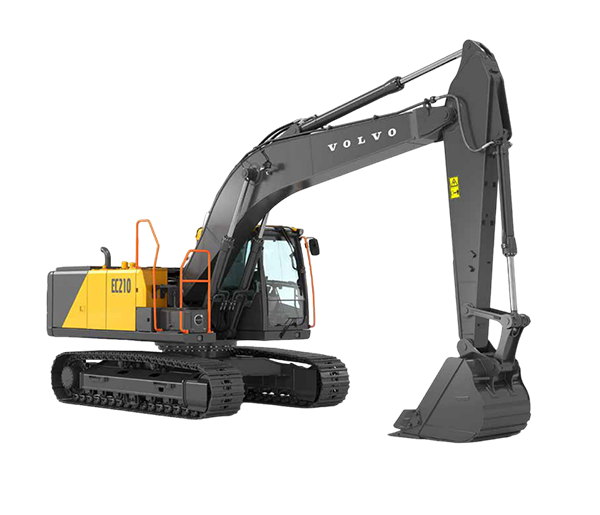
I want to know what the machine will do. A contractor building roads has different requirements from an agricultural customer cleaning irrigation channels. A quarry customer may need a different bucket and undercarriage setup from a utility contractor.
I normally confirm:
Exact EC210F model and market specification
New or used machine requirement
Operating weight
Track shoe width
Boom and arm configuration
Bucket capacity and type
Hydraulic attachment requirements
Engine emission standard
Required documents
Destination country
Shipping port
Spare parts requirements
Before shipment, we arrange inspection of the machine's appearance, engine, hydraulic system, undercarriage, working equipment, and basic operating functions.
I consider this step very important for international buyers. Once the machine leaves the port, solving a small issue can become much more expensive and time-consuming. It is better to check the details before shipment.
Standard accessories, manuals, spare parts, and required documents are prepared according to the confirmed order. If the customer has special documentation requirements, those details should be discussed before the machine is prepared.
For international machinery orders, T/T is commonly used. A typical arrangement includes a deposit before preparation and the balance before shipment, with the exact terms confirmed in the commercial agreement.
Complete crawler excavators are normally transported by sea. Depending on machine dimensions and destination, the transportation arrangement may involve suitable heavy-equipment shipping methods.
Smaller spare parts and accessories can generally be shipped by air or express when practical.
The machine is securely fixed and protected according to transportation requirements. Loose parts and accessories are packed separately, using cartons or wooden cases where suitable.
Our international trade team has experience serving customers across Asia, Africa, America, and other overseas markets. That experience helps us handle the less exciting but very important parts of a machinery order: documents, loading, inspection, transport coordination, spare parts, and communication.
Buying construction equipment from another country can feel very different from buying a machine locally. There may be language differences, shipping questions, payment arrangements, machine inspection, customs documents, and spare parts to consider.
This is where our role becomes practical.
Our business is not limited to one type of excavator. We work with construction machinery, mining machinery, agricultural machinery, and matching attachments.
That wider product background is useful when a customer is not completely sure which machine configuration is appropriate.
Sometimes the customer knows the model but not the configuration. Sometimes the customer knows the job but not the exact machine. We can work from either direction.
For example, a customer may simply say, “I need a 20-ton crawler excavator for road construction.” From there, we can discuss operating weight, bucket size, undercarriage, working equipment, attachments, transport, and budget.
Hefei Ganglong International Trade Co., Ltd. serves as our professional international trade arm. The team has experience in construction machinery, mining machinery, and agricultural machinery and has served customers in Asia, Africa, America, and other regions.
That means the discussion does not stop at the machine itself.
We understand that an overseas buyer cannot simply walk into the yard and check the excavator personally. Inspection before shipment therefore becomes an important part of the process.
We check the major systems and prepare the required accessories and documents according to the order.
For customers who do not want to purchase equipment outright, Ganglong also provides complete machine leasing services. Availability and terms depend on the specific machine, location, and project.
I think this flexibility is useful because not every contractor has the same purchasing plan.
The EC210F can be used for building construction, road work, utilities, agriculture, supporting work, material handling, and other earthmoving applications. Volvo's current EC210 information specifically identifies agricultural applications, building, road work, and utilities.
The answer depends on the exact configuration and market. Volvo's current EC210 information lists an operating weight range of approximately 20,479–24,014 kg. Older and other-market EC210 configurations can have different values.
Volvo's current Stage V/Tier 4f EC210 specification lists 115 kW gross power. An Asia-market Tier 2–3 specification lists 123 kW. This difference shows why the exact market version should be confirmed before purchase.
Volvo's current EC210 page lists a bucket capacity range of 0.48–1.44 m³. The actual bucket used depends on the machine configuration and application.
Volvo's current published EC210 specification lists a maximum digging depth of 6,825 mm. Other EC210 configurations can have different working ranges, so the exact machine specification should be checked before placing an order.
The current Volvo EC210 specification lists a maximum digging reach of 9,995 mm. The exact reach depends on boom, arm, bucket, and other configuration details.
Volvo's EC210F product guide provides configurations using 600 mm, 700 mm, and 800 mm shoes in its published ground-pressure data. Different configurations can have different overall widths and operating weights.
Yes. Volvo specifically identifies agricultural applications as one of the uses of the current EC210. Suitable attachments can make the machine useful for drainage, land preparation, pond work, material handling, and related agricultural tasks.
Yes. Volvo lists road work among the applications of the EC210. The machine can be used for excavation, trenching, drainage, material handling, site preparation, and other road-building tasks depending on the configuration.
Attachment availability depends on the exact machine and customer requirements. We can discuss bucket type, bucket capacity, hydraulic attachments, and other matching equipment before confirming the order.
There is no fixed delivery time for every EC210F Crawler excavator. Timing depends on machine availability, exact configuration, order quantity, inspection, customization, and shipping schedule. We confirm the expected delivery schedule before production or sourcing.
We arrange checks covering machine appearance, engine, hydraulic system, undercarriage, working equipment, and basic operating functions. Standard accessories, manuals, spare parts, and required documents are also prepared according to the order.
Complete excavators are normally transported by sea. Spare parts and smaller accessories can be shipped by air or express when appropriate. The final transportation plan depends on machine size, destination, shipping arrangements, and customer requirements.
Yes. Our business covers a range of construction, mining, and agricultural machinery. We can discuss excavators, loaders, attachments, and other equipment according to project requirements and machine availability.
After working with construction machinery requirements for different markets, I have learned that a good excavator is not simply the machine with the largest engine or biggest bucket.
The right machine is the one that fits the job.
The EC210F Crawler excavator is useful because it sits in a practical medium-size class. Volvo's published specifications show a current operating-weight range of 20,479–24,014 kg, 115 kW gross power, and bucket capacities from 0.48 to 1.44 m³, while regional and older EC210 specifications can differ.
Its crawler undercarriage provides a stable platform for excavation and material handling. Its working range makes it suitable for many construction tasks. Different track, boom, arm, and bucket configurations allow the machine to be matched to different jobsites.
But I would not stop at the model name.
If you are looking for an EC210F Crawler excavator, I recommend checking the exact model year, market specification, engine emission standard, operating weight, track width, boom and arm combination, bucket capacity, working range, and machine condition before making a purchasing decision.
For an international purchase, I would also check inspection arrangements, spare parts, documents, payment terms, packing, and shipping before confirming the order.
At Ganglong Heavy Industry Technology (Hefei) Co., Ltd., this is how we approach machinery supply. We do not simply send a model name and a price. We discuss the application, confirm the configuration, arrange inspection, prepare the required accessories and documents, and coordinate transportation according to the order.
Whether you need a Volvo EC210F excavator for construction, a 210 class crawler excavator for road work, an excavator for agricultural projects, or medium crawler equipment for general earthmoving, the starting point is always the same: understand the job first, then choose the machine.
That simple approach saves a lot of trouble later.
 RELATED
2435092534@qq.com
86 158 5511 9567


©2026 HKLOONG Heavy Industry Technology (Hefei) Co., Ltd. All Rights Reserved.

This website uses cookies to ensure you get the best experience on our website.
 Español
 Pусский
 Français
 العربية

 WhatsApp
 Phone
Phone E-mail
 Message