

Single-cylinder hydraulic cone crusher for Mining, Quarrying and Aggregate Production
When I talk with customers about a single-cylinder hydraulic cone crusher, I usually start with a simple question: what are you trying to crush, and what do you want to get at the end?
It sounds obvious, but this question saves a lot of trouble. A cone crusher is not something I recommend only by looking at its motor power or hourly capacity. The material, feed size, required output size, crushing stage, site conditions and equipment working before and after the crusher all affect the final choice.
At Ganglong Heavy Industry Technology (Hefei) Co., Ltd., we work with customers on construction machinery, mining machinery, agricultural machinery and related equipment. Together with Hefei Ganglong International Trade Co., Ltd., our team also handles international equipment sales and project-related trade services.
For customers looking for a hydraulic cone crusher, we can help review the application and arrange suitable equipment according to the project requirements. Our equipment supply covers different crushing and screening solutions, and we can also discuss complete production lines when a single machine is not enough.
In this article, I will explain how a single-cylinder hydraulic cone crusher works, where it fits in a crushing line, what features I pay attention to, how it compares with other cone crusher designs, and what customers should know before buying one.
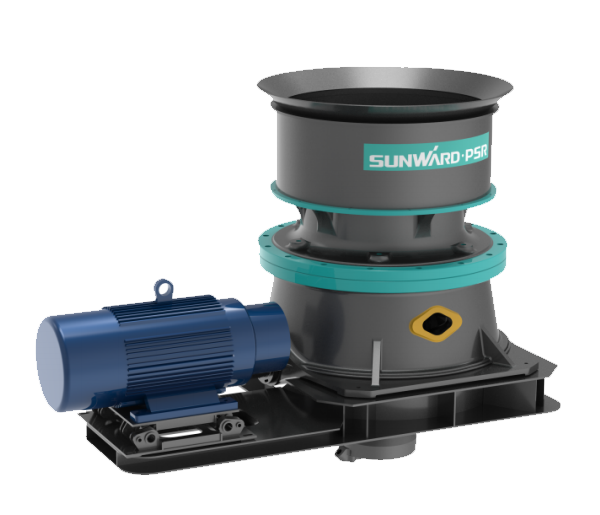
A single-cylinder hydraulic cone crusher is a cone-type crushing machine that uses hydraulic control to adjust the crushing chamber and support important operating functions.
The basic crushing idea is quite simple. Material enters the top of the crusher and moves into the crushing chamber. Inside the chamber, a moving cone works against a fixed concave surface. The material is compressed and broken as the gap between these surfaces changes during operation.
The crushed material then moves downward and exits through the discharge opening.
Compared with the very simple description of “rock goes in and smaller rock comes out,” there is actually quite a lot happening inside the machine. The crushing chamber profile, eccentric movement, feed distribution, closed-side setting, material hardness and moisture all affect the result.
This is why I normally consider a cone crusher as part of a process rather than an independent piece of equipment.
In a typical aggregate line, the process may look like this:
Raw material → Primary Jaw Crusher → Secondary cone crusher → Screening → Finished aggregate
In some applications, a cone crusher can also be used in a tertiary crushing stage. The exact arrangement depends on the required product size and the characteristics of the material.
Sunward PSR currently lists the SPS SC series as a single-cylinder hydraulic cone crusher series, with different models and crushing configurations. Published material describes the series as suitable for two-stage and three-stage crushing and highlights hydraulic adjustment, PLC control, easy operation and convenient maintenance.
I like to explain the working principle in plain language because the machine can look complicated from the outside.
Imagine two surfaces forming a narrow space. The material enters from above, and the moving crushing member repeatedly approaches the fixed surface. Rock caught between them is compressed and broken.
As the crushing cycle continues, smaller pieces move downward through the chamber until they are small enough to pass through the discharge opening.
The hydraulic system plays an important role in controlling the crusher.
One major job is helping adjust the C.S.S., or closed-side setting. This setting has a direct relationship with the size of the crushed material. Changing it allows the operator to adjust the crushing process according to the required product.
For example, if a customer needs a smaller product for a fine aggregate application, the crusher may need to operate with a different setting from a project producing a coarser intermediate material.
The hydraulic system can also support overload protection and maintenance-related functions, depending on the specific machine configuration.
This is one of the reasons I often describe hydraulic cone crushing as a practical step forward from older adjustment methods. Instead of relying only on manual mechanical adjustment, hydraulic systems can make setting changes and certain operating procedures more convenient.
The crushing setting is not simply a number on a specification sheet.
If the setting is too large, the product may be too coarse for the next process. If it is too small, production may fall and the crushing load may increase.
That is why we look at the required final product together with the feed material and production target.
For a customer ordering a Single-cylinder cone crusher for aggregate production, I would rather spend time understanding the desired aggregate sizes than immediately recommend a model based only on horsepower.
One of the main practical advantages of hydraulic cone crusher equipment is hydraulic adjustment of the crushing setting.
This allows the operator to control the crusher according to the required product and working conditions. It can also make adjustment more convenient during production.
In real work, this matters because material conditions do not always stay exactly the same. Feed gradation can change. The hardness of the rock can change. The required product may also change between projects.
Crushing equipment sometimes faces unplanned material entering the chamber. A hydraulic protection system can help deal with overload conditions according to the machine design.
I would never describe this as a reason to ignore proper feeding, however. Good feeding practice is still essential. Protection is there to reduce risk, not to replace correct operation.
The SPS SC series published by Sunward PSR uses a PLC control system. In simple terms, PLC control helps monitor and manage machine functions through a programmed control system.
For operators, the practical benefit is easier control and more consistent operation. For maintenance teams, a clear control system can also make troubleshooting more organized.
Lubrication is one of those topics that may not sound exciting, but it has a direct relationship with equipment life.
Sunward's published information for its single-cylinder hydraulic cone crusher describes a dedicated oil-station lubrication system. Keeping lubrication clean and stable helps protect important internal components and supports continuous operation.
Mining and quarry equipment does not get an easy working environment. Dust, vibration, hard rock and long operating hours are normal.
For that reason, I always look at maintenance access when discussing a crusher.
A machine that performs well but takes too long to inspect or service can still create problems for the customer. Easy access to service points, clear maintenance procedures and practical component layout all matter.
Customers often ask me whether a hydraulic cone crusher can replace a jaw crusher or impact crusher.
Usually, that is not the right way to look at it.
Different crushers perform different jobs.
| Equipment | Typical Role | Common Crushing Principle | Typical Position in a Line |
|---|---|---|---|
| Jaw Crusher | Large feed reduction | Compression | Primary crushing |
| Single-Cylinder Hydraulic Cone Crusher | Medium/fine reduction | Compression and laminated crushing | Secondary or tertiary crushing |
| Impact Crusher | Reduction and shaping | Impact | Primary or secondary, depending on model |
| VSI Crusher | Fine crushing and shaping | High-speed impact | Fine crushing / manufactured sand |
Source: Equipment roles are summarized from standard crushing-process practice and Sunward PSR product information.
The important point is that a complete plant may use several of these machines together.
For example, a jaw crusher can reduce large quarry rock first. A cone crusher can then handle the smaller material in the second stage. A screening plant separates the finished sizes. If the project requires additional shaping or manufactured sand, a VSI crusher may be added later.
This staged approach gives each machine a job it is designed to do.
This is another comparison that comes up regularly.
Both are hydraulic cone crusher designs, but their structures and intended applications can be different. Sunward PSR lists separate single-cylinder SC and multi-cylinder MC product series in its product range.
| Comparison Point | Single-Cylinder Hydraulic Cone Crusher | Multi-Cylinder Hydraulic Cone Crusher |
|---|---|---|
| Hydraulic structure | Single-cylinder design | Multiple-cylinder design |
| Adjustment | Hydraulic adjustment | Hydraulic adjustment |
| Typical use | Secondary and tertiary crushing | Medium, fine and higher-load crushing applications |
| Control | Hydraulic / PLC control depending on configuration | Hydraulic / intelligent control depending on configuration |
| Maintenance focus | Simple access and hydraulic system maintenance | Hydraulic system, crusher chamber and multiple support components |
Source: Sunward PSR product-category information and published single-cylinder cone crusher material. Exact specifications vary by model.
I would not say that one design is automatically suitable for every project.
If a customer needs a relatively straightforward secondary or tertiary crushing arrangement, a single-cylinder hydraulic cone crusher can be a practical option. If the production target, crushing duty and material conditions call for another configuration, a multi-cylinder cone crusher may also be considered.
The correct answer comes from the application.
One thing I always tell customers is not to treat a capacity figure as a guaranteed production number for every material.
Published capacity tables are normally based on specific conditions. Material density, feed size distribution, moisture, hardness, crushing chamber, C.S.S. and feeding method can all change actual output.
For example, technical information published for the SPS SC series gives different capacity ranges at different C.S.S. settings and cavity profiles. The published table also notes that actual output can vary according to material properties and feeding conditions.
| Model Example | Power | Cavity Profiles Listed | Published Capacity Data |
|---|---|---|---|
| SPS820SC | 90 kW | EC, C, M, S, MF, F, EF | Varies by C.S.S. and cavity profile |
| SPS980SC | 160 kW | EC, C, MC, M, MF, F, EF | Varies by C.S.S. and cavity profile |
| SC series technical table | Model dependent | Multiple chamber profiles | Different capacities according to setting |
Source: Published Sunward PSR single-cylinder hydraulic cone crusher technical information. Actual production depends on feed conditions and material properties.
This is why I prefer to ask for the customer's actual material information before giving a recommendation.
For example, if you tell me only “I need 200 tons per hour,” I still do not know enough.
I also need to know what the 200 tons are.
Is it limestone? Granite? Basalt? Iron ore? What is the maximum feed size? What is the desired final size? How much fine material is required? Is the crusher working alone or after a jaw crusher?
Those details can change the recommended configuration.
Quarrying is one of the most common areas for cone crusher equipment.
After large rock is reduced by a primary crusher, the cone crusher can further reduce the material to sizes suitable for aggregate production.
For hard stone such as granite and basalt, the crushing process needs to be planned carefully because wear can be significant. Feed control, suitable liners and regular maintenance all matter.
In mining applications, a single-cylinder hydraulic cone crusher for mining can be used for secondary or tertiary crushing of suitable ore.
The exact configuration depends on the ore characteristics and the downstream process. Crushing is often only one step before screening, separation or other mineral-processing stages.
Aggregate producers normally care about two things at the same time: output and product size.
A crusher that produces plenty of tonnes but does not give the required product distribution may not solve the real problem.
Hydraulic C.S.S. adjustment can therefore be useful when the operator needs to change the crushing setting according to the target product.
Road projects often require large quantities of graded aggregate and base material.
A cone crusher can be used after primary crushing to reduce the material further. The final screening stage then separates the products according to the project specification.
Infrastructure work can involve large amounts of rock and excavated material. Depending on local requirements and material quality, crushing and screening equipment can help turn suitable rock into usable construction material.
For mobile projects, equipment movement and transport dimensions become especially important. For fixed sites, power supply and plant layout may receive more attention.
At Ganglong, we do not want the equipment selection process to be a guessing game.
When a customer contacts us about a Hydraulic cone crusher machine, we normally start by understanding the project.
I would first ask about the raw material. Then I would check the maximum feed size, expected capacity and target product size.
Next comes the production line.
If the customer already has a jaw crusher, screen or conveyor, I want to know the model and main specifications. A new cone crusher should work with the existing equipment rather than becoming the bottleneck of the line.
Power supply is another important point. Some sites have stable grid electricity. Others are in remote mining areas where diesel-electric or other power arrangements may be needed.
We also look at mobility.
A stationary plant may be suitable for a permanent quarry. A mobile or modular solution can be more useful when the project moves between working areas or when fast deployment matters.
Once the model and configuration are confirmed, production time depends on the equipment model, configuration, order quantity and customization requirements.
Before shipment, the machine is inspected according to the agreed requirements. This normally includes checking appearance, main functions, hydraulic and electrical systems where applicable, and basic operating performance.
Standard documents and accessories are prepared according to the order.
For international orders, T/T is a common payment arrangement, such as a deposit before production and the balance before shipment. The exact terms are confirmed between the two parties before the order moves forward.
Complete machines are commonly transported by sea. Suitable parts and accessories can be shipped by air or express when appropriate.
Machines are protected with film, fixed securely and packed according to shipping requirements. Spare parts and loose accessories are normally packed separately in suitable cartons or wooden cases.
We also consider the destination, shipping route and customer requirements when arranging the final packing and delivery method.
Ganglong Heavy Industry Technology (Hefei) Co., Ltd. was founded in 2013. Together with Hefei Ganglong International Trade Co., Ltd., we serve customers across construction machinery, mining machinery, agricultural machinery and related equipment.
Our group offers self-branded HKLOONG Excavators, loaders, Backhoe loaders and swamp excavators. We also provide machine sales and leasing services involving a range of domestic and international brands.
For customers buying crushing equipment, our value is not simply putting a machine on a quotation.
We help connect the machine with the project.
That means looking at feed material, production requirements, equipment matching, transportation, documents, payment arrangements and delivery planning.
Our international trade team has experience serving markets across Asia, Africa, America and other regions. This international experience is useful because construction machinery orders involve more than technical specifications.
A machine also needs to arrive at the right destination, with suitable packing, correct documents and a clear delivery plan.
If a customer needs more than one machine, we can also discuss a complete crushing and screening combination. For example, a jaw crusher can be used for primary crushing, a cone crusher for secondary crushing and a screening plant for final size separation.
We can also discuss equipment leasing requirements when leasing is more suitable for the customer's project plan.
It is mainly used for secondary and tertiary crushing of suitable rock, ore and aggregate materials. Sunward PSR describes its SPS SC single-cylinder hydraulic cone crusher series as suitable for two-stage and three-stage crushing applications.
The crushing setting, commonly discussed as C.S.S., can be adjusted through the hydraulic system. Changing the setting affects the size of material leaving the crusher. The exact adjustment range depends on the model and cavity configuration.
The main structural difference is the hydraulic support and adjustment arrangement. Both can be used for cone crushing, but their design, capacity range and suitable applications vary by model. Sunward PSR lists separate SC single-cylinder and MC multi-cylinder product series.
It can be used for suitable granite crushing applications when the selected model, chamber and wear parts match the material and required production. Granite is hard and abrasive, so feed size, capacity and wear considerations should be checked before equipment selection.
Yes. This is a common crushing arrangement. The jaw crusher performs primary size reduction, while the cone crusher handles further reduction. A screening plant can then separate the final products.
I normally need the material type, maximum feed size, required capacity, target output size, power conditions and information about the existing or planned crushing and screening equipment.
No. Published capacity is normally based on specified test or operating conditions. Actual production can change with material hardness, feed gradation, moisture, density, feeding method, crushing chamber and C.S.S. Sunward's published technical material also notes that actual output may vary according to material properties and feeding conditions.
Yes. Ganglong and its international trade arm handle overseas equipment sales and related trade arrangements. Complete machines can generally be shipped by sea, while suitable parts and accessories may be transported by air or express.
Yes. We can discuss a complete configuration involving primary crushing, secondary crushing, screening and related equipment. The final arrangement depends on the raw material, capacity, product sizes and site conditions.
A single-cylinder hydraulic cone crusher can be a useful part of a quarrying, mining or aggregate production line, especially when the project needs controlled secondary or tertiary crushing.
But I would not choose one simply because the specification sheet shows a high capacity.
The real starting point is the material.
Once we know what you are crushing, how large the feed is, how much material you need per hour and what final sizes you want, we can work backward and build the crushing process around those requirements.
Hydraulic C.S.S. adjustment, PLC control, hydraulic protection, dedicated lubrication and practical maintenance are all useful features, but they only make sense when they match the actual job.
Sunward PSR's SPS SC series provides a published single-cylinder hydraulic cone crusher platform with different models and cavity profiles for different crushing requirements. Its technical information also shows that capacity changes with model, chamber profile and C.S.S., which is exactly why application-based selection matters.
At Ganglong, I approach equipment selection from the same practical angle. We look at the whole project, not only one machine. We can discuss the crusher itself, matching equipment, inspection, documentation, payment, packing, shipping and overseas delivery arrangements.
If you are looking for a single-cylinder hydraulic cone crusher for mining, quarrying, aggregate production, road construction or infrastructure projects, send us the material type, maximum feed size, required capacity and target product size. Those four pieces of information are a good starting point for discussing the right crushing solution.
2435092534@qq.com
86 158 5511 9567


©2026 HKLOONG Heavy Industry Technology (Hefei) Co., Ltd. All Rights Reserved.

This website uses cookies to ensure you get the best experience on our website.
 Español
 Pусский
 Français
 العربية
 WhatsApp
 Phone
Phone E-mail
 Message