

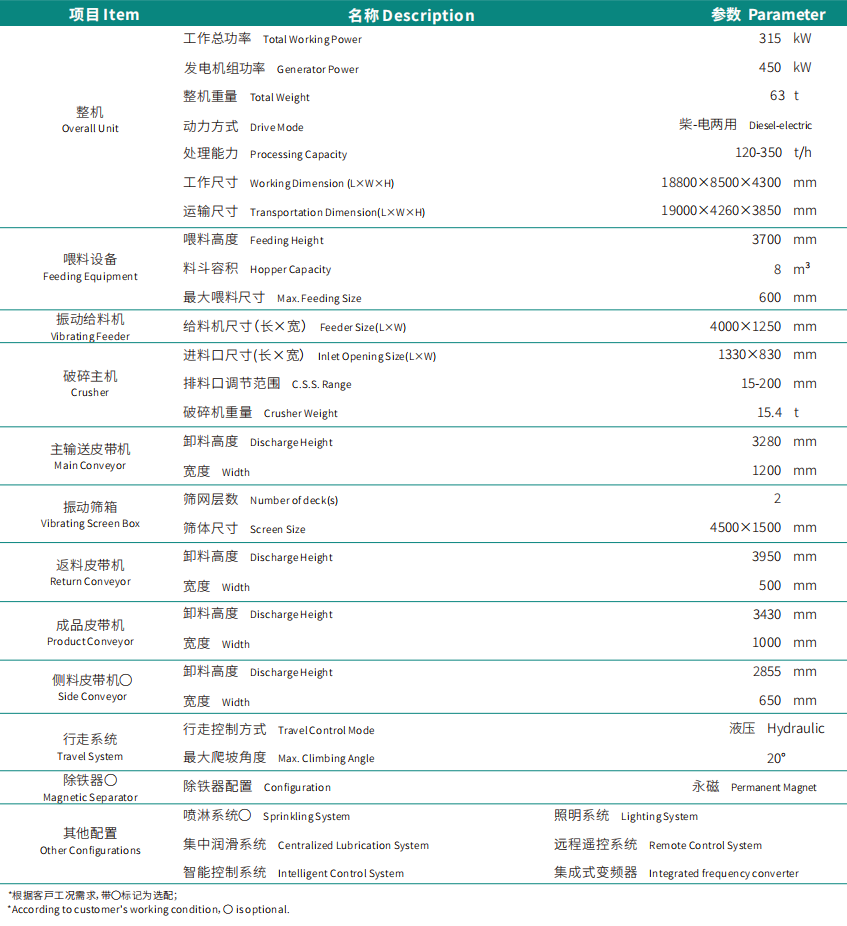
SP1213ITD crawler impact crushing plant (Diesel-Electric)
When a crushing job keeps moving from one working area to another, a fixed crushing line is not always the easiest answer. This is where I would look at a crawler impact crushing plant. The machine can move with the project, handle large feed material, and reduce the need for repeated fixed-site installation work.
The SP1213ITD crawler impact crushing plant is a diesel-electric mobile crushing solution designed for demanding material processing work. It combines crawler mobility, impact crushing, and two power methods. According to the official Sunward specifications, the machine has a total weight of 63 t, a processing capacity of 120–350 t/h, a maximum feeding size of 600 mm, and a C.S.S. range of 15–200 mm. Its transport dimensions are 19,000 × 4,260 × 3,850 mm.
From our side at Ganglong Heavy Industry Technology (Hefei) Co., Ltd., we focus on helping customers choose, purchase, arrange, and deliver suitable construction and mining machinery. We work with different equipment requirements rather than simply pushing one machine to every customer. For overseas projects, our international trade team can also coordinate communication, documents, inspection, packing, shipping, and related service arrangements.
So, if you are searching for a diesel-electric impact crusher, crawler impact crushing plant, mobile impact crusher for quarrying, or SP1213ITD crushing plant supplier, this page gives you a practical look at where this machine fits and what you should check before ordering.
In simple terms, the SP1213ITD is a tracked mobile impact crusher that uses a diesel-electric power system. Instead of building the complete crushing equipment on a fixed foundation, the crushing unit is installed on a crawler chassis. That makes it easier to move between working areas when the job changes.
The “ITD” configuration is important because this is not simply an electric crusher with a cable connection. The official specification lists a diesel-electric drive mode and two power methods: external electricity and the equipped generator. This gives the machine more flexibility when the site has limited or unstable access to grid power.
For a contractor, quarry operator, recycling company, or aggregate producer, this flexibility can matter a lot. One project may have reliable external power. Another may be far away from the grid. With a diesel-electric configuration, the operating plan can be adjusted to suit the actual site instead of forcing the site to suit the machine.
The machine uses an impact crusher with a heavy rotor and high kinetic energy. The official product information describes the crushing system as using Atlas Copco-derived crushing technology and highlights high crushing ratio, large output, and good particle shape.
I would not describe an impact crusher as a magic machine that can solve every material problem. Material hardness, moisture, feed grading, final product requirements, and feeding method still matter. But when the material and process are properly matched, the SP1213ITD gives operators a useful combination of mobility, impact crushing, and flexible power.
| Key Parameter | SP1213ITD |
|---|---|
| Total Weight | 63 t |
| Processing Capacity | 120–350 t/h |
| Drive Mode | Diesel-electric |
| Total Working Power | 315 kW |
| Generator Power | 450 kW |
| Maximum Feeding Size | 600 mm |
| C.S.S. Range | 15–200 mm |
| Transportation Dimension | 19,000 × 4,260 × 3,850 mm |
Source: Sunward official SP1213ITD product specifications.
The basic working process is easier to understand than the technical name might suggest.
First, raw material is loaded into the hopper. The SP1213ITD has a 10 m³ hopper and a 4,000 × 1,250 mm vibrating feeder according to the current Sunward PSR specification. The feeder sends material into the crushing chamber at a controlled rate rather than simply dropping everything into the crusher at once.
The maximum listed feed size is 600 mm. Once material enters the impact crusher, the high-energy rotor creates the main impact force. Material is struck and broken against the crushing surfaces inside the chamber. The repeated impact reduces larger pieces into smaller material.
The C.S.S., or closed-side setting, is listed at 15–200 mm. In everyday language, this setting helps control how much the material can be reduced before leaving the crushing chamber. The exact finished product still depends on the material, feed grading, machine configuration, and operating conditions.
After crushing, the material can move onto the conveyor and, depending on the selected configuration, through screening and return processes. The current specification includes a two-deck 4,000 × 1,500 mm vibrating screen, return conveyor, product conveyor, and side conveyor. A permanent-magnet magnetic separator is also listed as a configuration option.
This is useful when the customer does not simply want “smaller rock.” In real aggregate production, you normally want a particular range of material. A road base project, for example, may need a different product grading from a concrete aggregate project. The crushing and screening process therefore needs to be treated as one system.
The diesel-electric design is one of the most practical parts of the SP1213ITD. The official specification lists 315 kW total working power and a 450 kW generator. It also states that the machine supports external electricity and its equipped generator as two power methods.
That means the customer has more than one way to plan power supply. Where suitable external electricity is available, it can be used. Where the site needs independent power, the onboard generator can provide another option.
This is particularly useful for remote quarrying, infrastructure projects, road construction, and mobile aggregate operations where the work area may change over time.
A crawler chassis changes the way the crusher is used. Instead of treating the crushing plant as a piece of equipment that stays in one place, the operator can move it around the work area according to the production plan.
This is helpful on large earthmoving projects, road construction sites, quarry areas, mining operations, and recycling projects where material is not always concentrated in one location.
The official specification lists hydraulic travel control and a maximum climbing angle of 20°. Actual movement performance will still depend on ground conditions, slope, material around the tracks, and site safety requirements.
The impact crusher is built around a heavy rotor with high kinetic energy. The purpose is straightforward: deliver enough impact force to break incoming material effectively.
For customers looking for a high-capacity mobile impact crusher, the listed 120–350 t/h processing range provides a useful reference. But I always recommend looking at the actual feed material before treating capacity as a guaranteed production number. Capacity can change with rock type, moisture, feed size, feed consistency, product size, and operator settings.
The maximum listed feeding size is 600 mm. That gives the SP1213ITD a useful working range for large incoming material, but the feed should still be prepared properly.
If oversized material is continuously sent into a crusher without considering the machine's specifications, production becomes less predictable and wear can increase. Good crushing starts before the material reaches the crusher.
The 15–200 mm C.S.S. range gives operators a broad adjustment window. This is useful when one machine needs to support different project requirements.
However, setting a crusher is not just a matter of turning a knob to the smallest number possible. The right setting depends on the material and target product. A smaller setting may increase reduction but can also change throughput and wear conditions. In a real project, production balance is usually more important than chasing one specification number.
The official product information highlights an integrated variable-frequency system with dust-proof, cooling, vibration-isolation, and water-proof functions.
For operators, the point is simple: the electrical system needs protection because mobile crushing sites are not clean indoor factory environments. There is dust, vibration, temperature variation, water, and heavy equipment movement.
A properly protected electrical system helps support reliable operation in those conditions. Of course, regular inspection and maintenance are still necessary.
Another useful detail is the high-power engine's ability to provide power for a screening plant used in combination. This makes the SP1213ITD more interesting when the project requires a complete crushing and screening process rather than crushing alone.
For customers building a mobile processing line, this can help reduce the need to think about every machine as an entirely separate power problem.
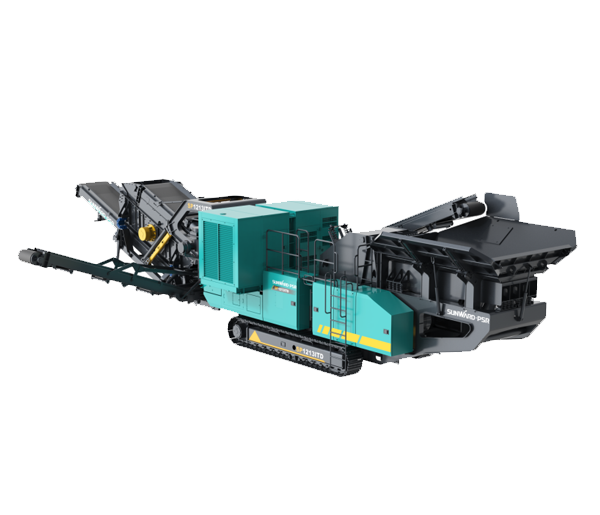
When I compare mobile crushers, I do not look only at the biggest capacity number. I normally check four things first: feed size, output range, power system, and transport dimensions. These four points tell me whether the machine is even a sensible match for the project.
| Specification | SP1213ITD | SP1213IE |
|---|---|---|
| Crusher Type | Impact crusher | Impact crusher |
| Drive Mode | Diesel-electric | Electric |
| Total Working Power | 315 kW | 318 kW |
| Total Weight | 63 t | 57 t |
| Processing Capacity | 120–350 t/h | 120–350 t/h |
| Maximum Feeding Size | 600 mm | 600 mm |
| C.S.S. Range | 15–200 mm | 15–200 mm |
| Transportation Dimension | 19,000 × 4,260 × 3,850 mm | 19,000 × 4,260 × 3,850 mm |
Source: Sunward official SP1213ITD and SP1213IE product specifications.
The comparison shows something important. The basic crushing capacity and maximum feed size are similar, while the major difference is the power arrangement and machine weight. The SP1213ITD is designed for customers who need diesel-electric flexibility, while the SP1213IE is an electric-drive configuration.
So I would not simply ask, “Which crusher is bigger?” I would ask, “What power supply does my site actually have?” That question usually gives a much more useful answer.
Impact crushers and jaw crushers have different crushing characteristics. The SP1213ITD is an impact crusher, while the SP127JTD is a diesel-electric crawler jaw crushing plant. The official specifications provide the following figures.
| Specification | SP1213ITD | SP127JTD |
|---|---|---|
| Crusher Type | Impact crusher | Jaw crusher |
| Drive Mode | Diesel-electric | Diesel-electric |
| Total Weight | 63 t | 60 t |
| Processing Capacity | 120–350 t/h | 170–520 t/h |
| Maximum Feeding Size | 600 mm | 700 mm |
| Transportation Dimension | 19,000 × 4,260 × 3,850 mm | 16,700 × 3,600 × 3,950 mm |
Source: Sunward official SP1213ITD and SP127JTD specifications.
This table is not about declaring one crusher better than another. They are designed around different crushing methods. A jaw crusher is often considered for primary crushing, while an impact crusher can be useful where impact reduction and product shape are important parts of the process.
The correct choice depends on what enters the machine and what needs to come out.
There is also a useful real-world reference from Sunward's published project cases. In a weathered granite project on the Qinghai-Tibet Plateau, the SP1213ITD was used together with an SP2065SE screening plant. The reported feed size was up to 600 mm, the final products were 0–10 mm and 10–20 mm, and the reported capacity was 120–150 t/h.
| Project Item | Published Data |
|---|---|
| Project | Qinghai-Tibet Plateau Weathered Granite Project |
| Crusher | SP1213ITD Crawler Impact Crusher |
| Screen | SP2065SE Screening Plant |
| Feed Size | ≤600 mm |
| Final Products | 0–10 mm, 10–20 mm |
| Reported Capacity | 120–150 t/h |
Source: Sunward PSR published project case.
I like this kind of project information because it gives a better picture than a catalogue number alone. A machine rated at 120–350 t/h does not mean every material will always run at 350 t/h. Real production depends on the entire process.
Quarries are one of the natural application areas for a crawler impact crushing plant. The machine can move around the working area and process material closer to where it is needed.
For aggregate production, the crusher may be used as part of a larger crushing and screening system. The final process should be designed around the required aggregate sizes, raw material characteristics, and daily production target.
Road projects often involve large quantities of material, changing working areas, and temporary production locations. A mobile crushing plant can be useful when material needs to be processed close to the road construction area.
The diesel-electric power system is also worth considering when a project moves through areas where permanent grid power is not available.
Mining sites can have difficult access, large working areas, and changing material locations. The crawler structure provides useful mobility, while the impact crusher handles material reduction.
Still, mining materials can vary greatly. Hardness and abrasiveness should be checked before selecting an impact crusher. If the feed material is especially abrasive, wear parts and maintenance requirements need to be considered from the beginning.
Mobile impact crushers are also relevant to construction waste and demolition material processing. Concrete, masonry, and mixed construction materials may be processed after suitable sorting and preparation.
For mixed material, metal removal can become important. The SP1213ITD specification includes a permanent-magnet magnetic separator configuration, which can help separate ferrous metal from the processed material when properly integrated into the system.
Infrastructure projects often have temporary material processing needs. Instead of transporting every load of raw material to a distant fixed plant, a mobile crushing solution can sometimes process material closer to the project.
This does not automatically mean lower total cost. Transport distance, fuel, labor, site preparation, local regulations, and production requirements all need to be calculated. But the mobility of a crawler crushing plant gives project planners another option.
A crushing plant is a serious investment, so I recommend preparing the project information before asking for a quotation. The more complete the information is, the easier it is to determine whether the SP1213ITD configuration actually fits.
Tell us what material you plan to crush. Limestone, granite, basalt, concrete waste, construction waste, and other materials can behave very differently.
If possible, provide information about hardness, abrasiveness, moisture, and feed grading. Photos or test material information can also help with the initial discussion.
The SP1213ITD has a listed maximum feeding size of 600 mm.
If your incoming material is larger than this, upstream breaking or another primary crushing process may be required. This is exactly why I prefer to discuss the whole process rather than look at one machine in isolation.
The listed processing capacity is 120–350 t/h.
Tell us your actual target, such as 150 t/h, 250 t/h, or 300 t/h. Also tell us whether that figure means peak production or normal continuous production. These are not the same thing.
Give us the required output sizes. For example, you may need road base material, several aggregate fractions, or recycled construction material.
This information affects the crushing setting, screening arrangement, return flow, and possibly the complete equipment combination.
This is especially important for the SP1213ITD. The machine supports external electricity and its equipped generator, so we need to understand the actual power conditions at your site.
If external power is available, provide the relevant site information. If the machine needs to operate independently, the diesel-electric configuration becomes an important part of the project discussion.
The listed transport dimensions are 19,000 × 4,260 × 3,850 mm.
Before shipment, I would also recommend checking the transport route, loading restrictions, port requirements, road conditions, and destination regulations. A machine can be perfect for production and still create headaches if nobody checks the transport route early enough.
At Ganglong Heavy Industry Technology (Hefei) Co., Ltd., our role is broader than simply sending a product name and price. We work with construction machinery, mining machinery, agricultural machinery, and related attachments, while our international trade team supports customers across Asia, Africa, America, and other overseas markets.
For equipment such as the SP1213ITD, we first focus on project information. Model selection should be based on material, feed size, required output, working environment, power availability, and transportation conditions.
Production time can vary according to the selected model, configuration, order quantity, and customization requirements. Instead of giving a random delivery promise, the schedule should be confirmed according to the actual order before production.
This matters for contractors because the crushing plant is usually connected to a wider project schedule. Delays in equipment delivery can affect the whole operation.
Before shipment, equipment can be checked according to the order requirements. Our general inspection process focuses on appearance, main functions, hydraulic and electrical systems, and basic operating performance.
Standard documents and accessories are prepared according to the agreed order. If the customer has additional documentation requirements, these should be discussed before shipment rather than after the machine has already left the factory.
For international orders, payment is commonly arranged by T/T, such as a deposit before production and the balance before shipment. The exact payment structure should be confirmed between both parties according to the order and commercial agreement.
For complete heavy machines, sea transportation is generally the practical choice for international delivery. Suitable spare parts and accessories may be shipped by air or express when speed and package size make that option reasonable.
We also consider the destination, shipping route, port requirements, and customer's delivery plan before confirming the final logistics arrangement.
Large machinery needs more than a simple box. Machines are generally protected with film, fixed securely, and packed according to shipping requirements. Loose accessories and spare parts are packed separately in suitable cartons or wooden cases.
The final packing method can be adjusted according to the destination, transportation route, and customer requirements.
The SP1213ITD is a crawler-mounted impact crushing plant with a diesel-electric drive system. It is designed for mobile material processing and supports external electricity as well as the equipped generator. Its official listed processing capacity is 120–350 t/h.
The official specification lists a maximum feeding size of 600 mm. Actual feeding should still be controlled according to material characteristics and operating requirements.
The listed processing capacity is 120–350 t/h. Actual production can vary depending on raw material, feed grading, moisture, crusher settings, product requirements, and overall process design.
It is a diesel-electric crawler impact crushing plant. The official product information states that it supports two power methods: external electricity and the equipped generator.
The listed C.S.S. range is 15–200 mm. The appropriate setting should be selected according to the feed material and required product size rather than simply using the smallest or largest available setting.
Yes. The official product information states that the high-power engine can provide power for a screening plant used in combination. Sunward also publishes a project case where SP1213ITD was used together with an SP2065SE screening plant for weathered granite processing.
Typical applications include quarrying, aggregate production, road construction, infrastructure projects, mining, construction waste recycling, and general mobile material processing. The actual application should be checked against the properties of the raw material and the required final product.
The official listed transportation dimensions are 19,000 × 4,260 × 3,850 mm. Before shipment, the transportation route and destination requirements should be checked carefully.
I would start with five questions: What material are you crushing? What is the maximum feed size? What capacity do you need? What final product size do you want? And what power supply is available at the site?
Once those answers are clear, we can discuss whether SP1213ITD is suitable or whether another crushing configuration makes more sense.
For me, the main value of the SP1213ITD crawler impact crushing plant is not one isolated specification. It is the combination of crawler mobility, impact crushing, diesel-electric power flexibility, integrated conveying and screening options, and a 120–350 t/h listed processing range.
The machine offers a 600 mm maximum feeding size, 15–200 mm C.S.S. range, 315 kW total working power, 450 kW generator power, and 63 t total weight according to the current official specifications.
But I would still make one point very clear: the right crusher is determined by the project. Granite is not limestone. Construction waste is not clean aggregate. A 300 t/h target is not the same as a 300 t/h guaranteed output under every condition.
That is why we prefer to discuss the complete working situation before recommending equipment. At Ganglong Heavy Industry Technology (Hefei) Co., Ltd., we can support customers with construction machinery, mining machinery, agricultural machinery, attachments, international trade coordination, inspection arrangements, documentation, packing, and delivery planning.
If your project requires a SP1213ITD diesel-electric crawler impact crusher, mobile impact crushing plant for quarrying, crawler impact crusher for aggregate production, or a complete mobile crushing and screening solution, send us the raw material, maximum feed size, required capacity, final product size, working location, and power conditions. From there, we can work through the equipment and delivery requirements step by step.
Source note: Product specifications and published application information in this page are based on current official Sunward product information and published Sunward PSR project data. Commercial terms, configuration, production schedule, packing, and transportation should be confirmed for the individual order.
 RELATED
 RELATED
2435092534@qq.com
86 158 5511 9567


©2026 HKLOONG Heavy Industry Technology (Hefei) Co., Ltd. All Rights Reserved.

This website uses cookies to ensure you get the best experience on our website.
 Español
 Pусский
 Français
 العربية
 WhatsApp
 Phone
Phone E-mail
 Message