


SP1560SE crawler screening plant
When I look at a mobile screening project, I usually start with one simple question: what does the customer actually need to separate? Some projects need two product sizes, some need three or four, and some simply need to remove unwanted fine or coarse material before the next crushing stage. Once that point is clear, the right screening plant becomes much easier to choose.
The SP1560SE crawler screening plant is an electric-driven mobile screening solution designed for quarrying, mining, infrastructure, recycling, aggregate production, and other material classification work. According to the current Sunward PSR specifications, the machine has a 100–380 t/h processing capacity, a 32 t total weight, a 55 kW total working power, and a 150 mm maximum feeding size. It uses a three-deck 1500 × 6000 mm vibrating screen box.
From our side at Ganglong Heavy Industry Technology (Hefei) Co., Ltd., we work with construction machinery, mining machinery, agricultural machinery, and matching attachments. Together with Hefei Ganglong International Trade Co., Ltd., we also support customers with international equipment sales, inspection coordination, documents, packing, shipping, and other trade arrangements.
So, if you are searching for a SP1560SE crawler screening plant supplier, electric crawler screening plant, mobile screening plant for aggregate, or three-deck mobile screening plant, I would suggest looking at the machine from a project point of view rather than judging it by one number in a catalogue.
At its simplest, a screening plant separates material into different sizes. It sounds basic, but anyone who has worked around a crushing and screening line knows that screening can make or break the whole process.
If the screening process is too slow, the crusher may have to wait. If the screen openings are not matched to the product requirement, the final material may not have the right grading. If the feed is unstable, production can jump up and down throughout the day.
The SP1560SE is designed to handle this part of the process in a mobile format. It uses a crawler chassis, so the screening plant can move around the jobsite instead of being permanently installed on a fixed foundation.
The official Sunward PSR product page describes SP1560SE as an electric-driven mobile screening solution for quarrying, mining, infrastructure, recycling, and aggregate production. It can operate independently or be connected with mobile crushers for final product screening and multi-size aggregate production.
That last point is particularly useful. In a real project, screening is often not an isolated job. A customer may have a Jaw Crusher for primary crushing, an impact crusher for secondary reduction, and a screening plant to separate the final products. The screening plant has to keep up with the rest of the line.
The SP1560SE is built around a three-deck screen box measuring 1500 × 6000 mm. This allows the machine to separate incoming material into several size ranges in one screening process. The official specification lists a 100–380 t/h processing capacity and a maximum feed size of 150 mm.
| Item | SP1560SE Specification |
|---|---|
| Machine Type | Crawler Screening Plant |
| Drive Mode | Electric |
| Total Working Power | 55 kW |
| Total Weight | 32 t |
| Processing Capacity | 100–380 t/h |
| Maximum Feeding Size | 150 mm |
| Screen Decks | 3 |
| Screen Size | 1500 × 6000 mm |
| Hopper Capacity | 3 m³ |
| Maximum Climbing Angle | 20° |
Source: Sunward PSR official SP1560SE product specifications.
One small but important point: a rated capacity such as 380 t/h should not be treated as a guaranteed production number for every material. Actual output depends on feed size, material type, moisture, grading, screen media, required product sizes, and operating conditions. I always recommend checking the complete process before using a catalogue capacity for production planning.
The working principle is quite straightforward.
Material enters through the feeding system and moves toward the vibrating screen. The screen box vibrates at a controlled rate, causing smaller particles to pass through the screen openings while larger particles continue moving across the screen surface.
Because SP1560SE has three screen decks, the material can be separated into multiple size fractions. The exact sizes depend on the screen media selected for the project.
For example, a customer may want coarse aggregate, medium aggregate, and fine material. Another project may require different product ranges. The screen itself does not decide those sizes automatically. The screen openings and overall process need to be selected according to the customer's target products.
The three-deck design is one of the main reasons I would consider the SP1560SE for multi-size aggregate production.
More than one screening layer gives the operator more flexibility. Instead of putting material through several separate screening machines, different fractions can be separated within one screening unit.
That can make the layout more compact and can simplify the material flow, especially on mobile projects where space is not unlimited.
The official SP1560SE specification lists a 1500 × 6000 mm screen box with three decks. It also lists separate coarse material, medium material, and fines conveyors.
Material does not always behave in exactly the same way. Wet material, dry material, rounded aggregate, crushed stone, and recycled material can move differently across a screen.
SP1560SE uses an adjustable screen angle. This gives operators another way to adjust the screening process according to the material and required output.
I would describe this as practical flexibility rather than a complicated feature. When material conditions change, having another adjustment available can be useful.
Screening is only one part of the machine. The material also needs to leave the screen smoothly.
The SP1560SE uses wide feeding and discharge conveyors. The current official specification lists a 1000 mm feeding conveyor, a 500 mm coarse material conveyor, two 500 mm medium material conveyors, and a 1000 mm fines conveyor.
These conveyors help move different material fractions away from the screening area and create stockpiles around the machine.
That matters because a screening plant can technically separate material very well but still lose production if the discharge area becomes blocked. Good material flow is part of good screening.
The screen box is the heart of the machine. SP1560SE uses high-strength structural steel side plates. Sunward states that the structure allows greater amplitude and higher frequency while supporting screening efficiency and long-term structural reliability.
That is important because screening equipment works through continuous vibration. The screen box is not sitting still like a normal storage structure. It is constantly working, so structural strength matters.
For a customer, the practical question is not just “How large is the screen?” It is also “Can the structure handle the daily working load?”
The official processing capacity is 100–380 t/h.
This gives SP1560SE a useful operating range for medium and larger material screening applications. But again, I would always match the expected capacity to the actual material.
If the feed contains too much moisture or clay, for example, screening behavior can change. If the customer wants a very clean final product, the screen may need to work differently from a project that simply wants basic separation.
The listed maximum feed size is 150 mm.
This means SP1560SE is generally more suitable as a screening stage after suitable crushing or material preparation rather than as a machine receiving very large quarry rock directly from the blasting face.
This is actually a useful way to understand the machine. If your raw material starts at 500 or 600 mm, you may first need a jaw crusher or impact crusher. Once the material has been reduced to a suitable size, SP1560SE can then classify it into different final products.
SP1560SE uses an electric drive system. The official product page lists a total working power of 55 kW.
Electric operation can be useful where reliable external power is available. It can also work well as part of an integrated electric crushing and screening line.
Sunward's published generator-set information provides recommended power configurations for production lines containing SP1560SE. For example, the published table lists a recommended generator power of at least 400 kW for a line using SP127JE with SP1560SE or SP2065SE.
This is a good reminder that power planning should be done for the complete line, not simply for one individual machine.
The machine uses hydraulic travel control and has a listed maximum climbing angle of 20°.
For mobile work, this is useful because the plant can be repositioned when the stockpile or working area changes.
Still, the 20° figure should not be interpreted as a promise that every site can be safely climbed at that angle. Ground conditions, slope length, surface stability, weather, and site safety rules all matter.
This is one of those features that may sound less exciting than “380 t/h,” but operators know it matters.
Sunward lists side access panels, maintenance openings below the screen, hydraulic lifting devices for screen service, and convenient access for screen changing. The design is intended to make inspection and maintenance easier.
Screen media is a wear item. It will eventually need inspection, cleaning, adjustment, or replacement. Making that work easier can save time during normal maintenance.
The SP1560SE can be configured with intelligent electrical control and remote control. The official product information also lists self-diagnosis, safety interlocking, automatic alarms, and soft-start functions.
In plain English, the system is designed to help operators see problems earlier and manage the machine more conveniently.
I would still never treat an automatic alarm as a replacement for a trained operator. Automation is there to help people, not to remove the need for basic equipment knowledge.
When customers ask me which screening plant they should choose, I prefer a side-by-side comparison. It immediately shows whether the real difference is capacity, screen size, weight, power arrangement, or feed size.
SP1560SE belongs to the electric crawler screening plant group. Sunward also lists SP1560MSTD, a diesel-electric crawler screening plant, and SP2065SE, a larger electric crawler screening plant.
| Specification | SP1560SE | SP1560MSTD | SP2065SE |
|---|---|---|---|
| Drive Mode | Electric | Diesel-electric | Electric |
| Total Weight | 32 t | 48 t | 36.7 t |
| Processing Capacity | 100–380 t/h | 150–350 t/h | 180–450 t/h |
| Maximum Feed Size | 150 mm | 150 mm | 150 mm |
| Screen Decks | 3 | 3 | 3 |
| Screen Size | 1500 × 6000 mm | 1500 × 6000 mm | 2000 × 6500 mm |
Source: Sunward official product specifications for SP1560SE, SP1560MSTD and SP2065SE.
This comparison tells us something useful. SP1560SE is not simply a smaller version of every other screening plant. It occupies its own practical range.
Compared with SP1560MSTD, SP1560SE has a lower listed total weight and uses electric drive. The diesel-electric model is designed around a different power requirement and a higher listed minimum processing capacity.
Compared with SP2065SE, the SP2065SE has a larger screen box and a higher listed processing range. That may be useful for higher-capacity projects, while SP1560SE can make more sense when the project does not require that larger screening area.
Another useful comparison is with the SP1860SE electric crawler screening plant. Sunward lists SP1860SE with a three-deck 1800 × 6000 mm screen box, 180–400 t/h processing capacity, 150 mm maximum feed size, and 34 t total weight.
| Specification | SP1560SE | SP1860SE |
|---|---|---|
| Drive Mode | Electric | Electric |
| Total Weight | 32 t | 34 t |
| Processing Capacity | 100–380 t/h | 180–400 t/h |
| Maximum Feed Size | 150 mm | 150 mm |
| Number of Decks | 3 | 3 |
| Screen Size | 1500 × 6000 mm | 1800 × 6000 mm |
Source: Sunward PSR official SP1560SE and SP1860SE product specifications.
Again, I would not call one machine universally better. If a customer needs a larger screening area and higher production range, the larger model may be worth considering. If the project fits the SP1560SE range, there is little reason to pay for capacity that will simply sit unused.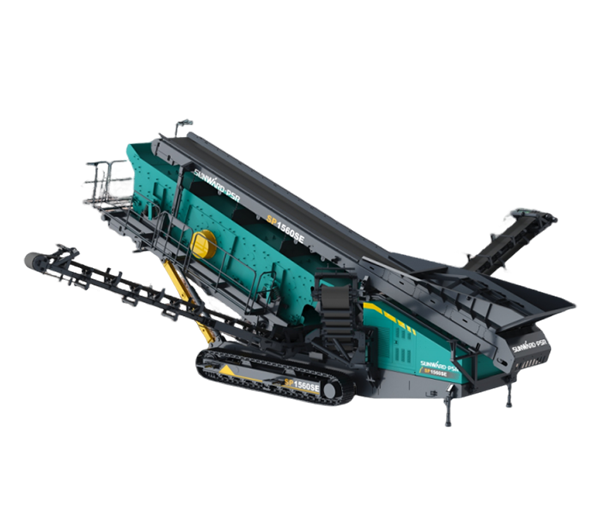
Quarrying is one of the most obvious applications for a mobile screening plant.
After crushing, the material often needs to be divided into different aggregate sizes. The SP1560SE can be used as a final screening stage or as part of a complete mobile crushing and screening line.
For example, crushed stone may need to be separated into coarse, medium, and fine fractions. With three screening decks and separate discharge conveyors, the machine can support this kind of multi-size classification.
Mining operations often deal with large material volumes and changing working conditions. A crawler screening plant can be useful when the screening operation needs to move together with the project.
However, mining materials vary widely. Before selecting the machine, I would want to know the material hardness, moisture, feed size, abrasiveness, required product sizes, and expected daily production.
Those details can make a bigger difference than simply looking at the machine's maximum capacity.
Road projects often require large quantities of correctly graded material.
A mobile screening plant can help process crushed aggregate closer to the project site. Instead of moving every truckload of raw material to a distant stationary plant, a mobile setup can sometimes reduce unnecessary material movement.
Whether that actually saves money depends on the site, transport distance, equipment layout, fuel cost, and local conditions. It should be calculated rather than assumed.
Construction waste is another useful application area.
After suitable breaking and sorting, concrete and other construction materials can be screened into different size fractions. The mobile design is especially useful when demolition and recycling work happens at different sites.
If metal contamination is present, the overall process may also need magnetic separation. The exact equipment arrangement should be selected according to the material being recycled.
Large infrastructure projects often create temporary material processing requirements. Roads, bridges, municipal works, and other earthmoving projects may need screened material at different stages.
The SP1560SE can be moved within the working area, making it suitable for projects where a stationary screening plant would be inconvenient.
Before discussing price, I like to collect the basic production information. It saves everyone time.
Start with the raw material.
Is it limestone, granite, construction waste, crushed concrete, recycled aggregate, or something else?
Material type affects the screening process. Moisture and clay content can also have a major effect, especially when the material tends to stick to the screen.
The official maximum feeding size for SP1560SE is 150 mm.
If your material is larger than that, you may need a crusher before the screening plant.
This is where a crushing and screening line becomes useful. For example, a jaw crusher or impact crusher can reduce the raw material first, and SP1560SE can then classify the crushed material.
Tell us whether your target is 100 t/h, 200 t/h, 300 t/h, or closer to the upper end of the machine's range.
The official capacity is 100–380 t/h, but the actual working output depends on the feed and product requirements.
If the customer requires very precise separation, the screening process may need to be adjusted rather than simply pushing more material through the machine.
This is one of the most important questions.
Do you need two products? Three products? Four fractions?
What size ranges do you need?
Once I know those details, I can better understand how the three-deck screen should be configured.
SP1560SE is an electric screening plant, so the site's power condition needs to be checked carefully.
Sunward also publishes mobile generator solutions and production-line power recommendations for crushing and screening combinations. The required generator size depends on the complete equipment combination, not just the screening plant itself.
SP1560SE has a listed transportation dimension of 14,950 × 3,660 × 3,600 mm. Its working dimensions are listed as 13,460 × 14,310 × 6,020 mm.
These numbers are important for both transportation and site layout.
Before shipping, I would check the road route, port requirements, loading restrictions, destination regulations, and available working space.
At Ganglong Heavy Industry Technology (Hefei) Co., Ltd., we understand that buying a screening plant is not simply a matter of choosing a model from a list.
Our group was founded in 2013 and works across construction machinery, mining machinery, agricultural machinery, and related equipment. Our international trade arm, Hefei Ganglong International Trade Co., Ltd., has experience serving customers in Asia, Africa, America, and other international markets.
For a product such as the SP1560SE electric crawler screening plant, we can work with the customer on equipment selection, commercial communication, inspection arrangements, documentation, packing, and delivery planning.
Production time depends on the selected model, configuration, order quantity, and any agreed customization requirements.
Rather than giving one fixed number for every order, the actual delivery schedule should be confirmed before production based on the specific equipment and order conditions.
Before shipment, the machine can be checked according to the agreed order requirements.
Our general inspection focus includes equipment appearance, main functions, hydraulic and electrical systems, and basic operating performance. Standard documents and accessories are prepared according to the order requirements.
For international customers, this step is useful because the machine is often travelling a long distance before reaching the jobsite. It is better to deal with obvious issues before shipment than after arrival.
International equipment orders commonly use T/T payment, such as a deposit before production and the balance before shipment. Exact payment terms are confirmed between the buyer and seller according to the individual order.
For complete screening plants, sea transportation is generally suitable for international delivery.
For suitable spare parts and accessories, air freight or express delivery may be considered when the package size, weight, urgency, and destination make it practical.
Heavy equipment needs secure packing and fixing for international transportation.
Machines are generally protected with film, fixed securely, and prepared according to shipping requirements. Loose accessories and spare parts can be packed separately in cartons or wooden cases.
The final packing method depends on the destination, route, transportation method, and customer requirements.
SP1560SE is an electric-driven crawler screening plant designed for mobile material classification. It uses a three-deck 1500 × 6000 mm screen box and has a listed processing capacity of 100–380 t/h.
The official maximum feeding size is 150 mm. Material larger than this may require suitable crushing or pre-processing before entering the screening plant.
The official processing capacity is 100–380 t/h. Actual production depends on material type, feed size, moisture, screen media, product requirements, and working conditions.
The machine has a three-deck vibrating screen box. The official screen size is 1500 × 6000 mm.
SP1560SE is an electric crawler screening plant. Its official drive mode is listed as electric, with a total working power of 55 kW.
Yes. Sunward states that SP1560SE can work independently or be linked with mobile crushers for final product screening and multi-size aggregate production.
Potential applications include crushed aggregate, quarry materials, mining materials, construction and demolition recycling materials, and other suitable materials that meet the machine's feed requirements.
The exact suitability should be checked according to material size, moisture, abrasiveness, grading, and required final products.
The current Sunward PSR specification lists the transportation dimensions as 14,950 × 3,660 × 3,600 mm.
The official product specification lists the total weight as 32 t.
Yes. The SP1560SE uses an adjustable screen angle, allowing the screening process to be adapted to different material conditions and product requirements.
Remote control is listed among the available configurations. Intelligent control, centralized lubrication, lighting, and other options are also available depending on the customer's working conditions.
For me, the main strength of the SP1560SE crawler screening plant is the balance between mobile design, three-deck screening, electric operation, and a useful 100–380 t/h processing range.
The machine has a 32 t total weight, 55 kW total working power, 150 mm maximum feed size, and 1500 × 6000 mm three-deck screen box according to the current official Sunward specifications.
But I would not choose a screening plant from capacity alone. The material, feed size, required product sizes, moisture, power supply, transport route, and complete crushing and screening process all need to be considered.
If your project already has a mobile crusher, SP1560SE can be discussed as a final screening stage. If you are starting a complete aggregate production line, we can also look at the crushing and screening equipment as a complete system instead of treating every machine separately.
At Ganglong Heavy Industry Technology (Hefei) Co., Ltd., our goal is to make that process practical. We can discuss the equipment requirement, check the working conditions, coordinate the commercial details, arrange inspection and documents, and support international transportation planning.
If you are looking for an SP1560SE crawler screening plant, electric mobile screening plant, three-deck crawler screen, or mobile aggregate screening plant, send us your raw material, feed size, required capacity, target product sizes, working location, and power conditions. With those details, we can work out whether SP1560SE fits your project and what equipment configuration makes sense.
Source note: Product specifications and technical descriptions in this page are based on current official Sunward and Sunward PSR product information. Actual configuration, optional equipment, production schedule, commercial terms, packing, and delivery arrangements should be confirmed for the individual order.
 RELATED
2435092534@qq.com
86 158 5511 9567


©2026 HKLOONG Heavy Industry Technology (Hefei) Co., Ltd. All Rights Reserved.

This website uses cookies to ensure you get the best experience on our website.
 Español
 Pусский
 Français
 العربية
 WhatsApp
 Phone
Phone E-mail
 Message