


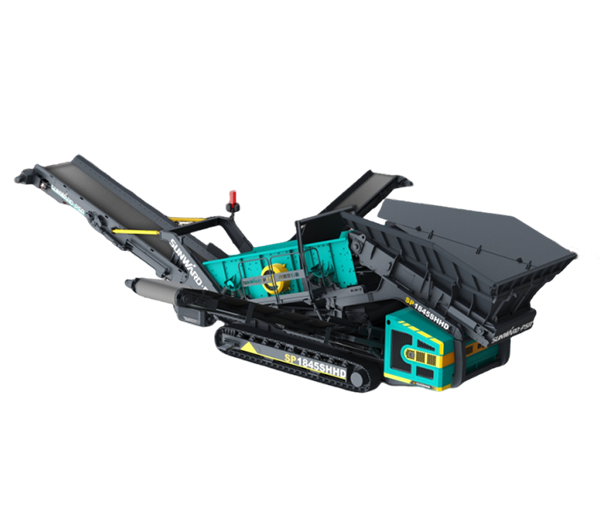
SP1845SHHD heavy duty screening plant
When I talk with customers about heavy-duty screening, I usually do not start with the machine price. I start with the material.
What are you screening? How large is the feed? How much material needs to be processed every hour? Do you need two product sizes or several? Is the site fixed, or does the equipment need to move? And perhaps most importantly, how difficult is the material?
These questions matter because a screening plant is not simply a large vibrating box. In a real quarry, mine, recycling yard, road project, or earthmoving job, the machine has to deal with continuous material flow, changing feed conditions, dust, vibration, impact, and long working hours.
The SP1845SHHD heavy duty screening plant is designed for exactly this kind of work. It is a fully hydraulic mobile screening plant with a two-deck 1800 × 4500 mm screen box, an 8.1 m³ hopper, a 1200 mm apron feeder, and a listed processing capacity of 200–600 t/h. The maximum feeding size is 500 mm, while the total machine weight is about 32.5 t.
From my point of view, one of the most useful things about this machine is its combination of heavy-duty material handling and mobile operation. It does not need an external power connection or a separate generator for normal operation because the machine uses a fully hydraulic drive system. That makes it particularly interesting for remote quarries, temporary projects, mobile aggregate production, and other sites where power supply is not always convenient.
At Ganglong Heavy Industry Technology (Hefei) Co., Ltd., we work with construction machinery, mining machinery, agricultural machinery, and related attachments. Together with Hefei Ganglong International Trade Co., Ltd., we support customers in Asia, Africa, America, and other overseas markets with equipment supply and international trade services.
So, if you are looking for an SP1845SHHD heavy duty screening plant, a fully hydraulic screening plant, or a mobile heavy-duty screening machine for quarrying and mining, I would suggest looking at the complete working process rather than focusing on one specification alone.
In simple words, the SP1845SHHD is a mobile machine used to separate large quantities of material into different size ranges.
The machine is built on a mobile chassis and uses a crawler travel system. Material enters through the large hopper, passes through the apron feeder, reaches the two-deck vibrating screen, and is then divided into different material fractions through the available discharge conveyors.
The important word here is heavy-duty.
This machine is not mainly designed for light screening work with clean, small material. Its official specifications show a maximum feed size of 500 mm and a processing capacity of 200–600 t/h. The machine is intended for demanding applications such as quarrying, mining, infrastructure, construction waste processing, road base production, backfilling material preparation, topsoil screening, pebbles, and Gobi gravel.
The machine uses a two-deck 1800 × 4500 mm screen box. According to the official product information, the effective screening area is 8.1 m². Different screen media can be installed, including grizzly bars, punched plate, and woven wire mesh. This gives the machine more flexibility when the material changes from one project to another.
I think that flexibility is important because no two screening jobs are exactly the same.
For example, a quarry may need to remove oversized stones before the next crusher. A road project may need screened material for backfilling. A recycling operation may need to separate construction waste into different fractions. A topsoil project may need a different screen media from a hard-rock quarry.
Using one fixed screen arrangement for all these jobs would not make much sense.
| Specification | SP1845SHHD |
|---|---|
| Machine Type | Heavy-Duty Screening Plant |
| Drive Mode | Fully Hydraulic |
| Total Working Power | 147 kW |
| Total Weight | 32.5 t |
| Processing Capacity | 200–600 t/h |
| Maximum Feeding Size | 500 mm |
| Screen Decks | 2 |
| Screen Size | 1800 × 4500 mm |
| Effective Screening Area | 8.1 m² |
| Hopper Capacity | 8.1 m³ |
| Feeding Equipment | Apron Feeder |
| Apron Feeder Width | 1200 mm |
| Maximum Climbing Angle | 20° |
Source: Sunward PSR official SP1845SHHD product specifications.
One thing I always tell customers is that the 200–600 t/h figure is a rated processing range, not a promise that every material will run at 600 t/h all day.
Actual production depends on the material type, moisture, feed grading, material density, screen media, required separation size, feeding consistency, and operating conditions. The machine gives you the working capability, but the complete process determines the real output.
The working principle is actually quite easy to understand.
Material is first loaded into the 8.1 m³ hopper. Instead of allowing a large pile of material to fall directly onto the screen, the apron feeder controls the material flow and sends it toward the screening unit.
The feeder is 1200 mm wide, which gives the machine a strong material-handling foundation. This is especially useful when the feed contains large or mixed pieces.
Once the material reaches the screen box, vibration causes the smaller particles to pass through the selected screen openings while larger particles continue moving across the screen surface.
The two-deck screen allows the material to be divided into different size fractions. The final sizes depend on the selected screen media and opening sizes.
That point is worth explaining because customers sometimes see “two-deck screen” and assume the machine automatically produces two exact product sizes. It does not work quite that simply.
The screen deck determines the separation process, while the screen opening determines what size material can pass through. The actual product grading also depends on the feed material and how the machine is operated.
For heavy-duty screening, the feeding system matters almost as much as the screen itself.
An apron feeder uses overlapping metal plates to carry material forward. It is well suited to heavy and irregular feed because the material is carried rather than simply dropped onto a thin belt.
The SP1845SHHD uses a 1200 mm apron feeder and is designed around large material handling. The combination of an 8.1 m³ hopper, apron feeder, and heavy-duty screening box allows the plant to accept feed up to the listed 500 mm maximum size.
In a quarry, that makes a real difference.
If the feeding system is too small for the incoming material, the screening box may spend much of its time waiting for material. If the feeding system is too aggressive, the screen can become overloaded.
A good screening plant needs a steady flow.
The SP1845SHHD uses a fully hydraulic drive system. The official Sunward information specifically highlights the advantage of independent operation without external power or a separate generator.
For a remote quarry, this can be a very practical feature.
Instead of first asking where to install a large external power supply, the operator can focus on the machine and the production site.
The hydraulic system also provides strong control over the feeder, screen, conveyors, and travel system. According to Sunward, the machine uses a load-sensing hydraulic system that allocates hydraulic flow according to operating demand. The aim is to reduce unnecessary hydraulic power loss and improve fuel efficiency.
In plain English, the system tries not to use more power than the job needs.
The official processing capacity of SP1845SHHD is 200–600 t/h.
That makes it suitable for projects where a small screening plant would simply be too slow.
But I would not select the machine just because the customer sees “600 t/h” on the specification sheet.
Suppose the project needs 300 t/h of screened limestone. In that case, the machine may have useful capacity reserve. If the project needs 580 t/h of wet clay-rich material with difficult separation, however, the situation is very different.
The material needs to be tested and the complete process needs to be considered.
The maximum listed feeding size is 500 mm.
This is one of the features that separates SP1845SHHD from many smaller mobile screening machines.
A screening plant with a 150 mm maximum feed size normally expects the material to be crushed first. SP1845SHHD can accept considerably larger feed, which makes it useful for scalping and pre-screening before crushing.
In a typical quarry process, the screen can remove fines before the primary crusher. That means the crusher does not have to spend time crushing material that is already small enough to pass through.
This is called pre-screening, and it can improve the overall process when the raw material contains a useful amount of natural fines.
The hopper has a listed capacity of 8.1 m³.
A larger hopper gives the feeding process more room to handle material from an Excavator or Wheel loader.
But hopper size alone does not determine production. The loading method matters too. If the operator constantly fills the hopper beyond its intended working condition, the feeder and screening system may become overloaded.
The goal is steady material flow, not simply filling the hopper as quickly as possible.
The two-deck 1800 × 4500 mm screen box provides an effective screening area of 8.1 m² per the official specification.
A larger screening area generally gives the material more opportunity to spread across the screen surface and separate.
Of course, bigger does not automatically mean better. The screen must still match the material, feed rate, screen opening, and final product requirements.
This is one of the features I would pay close attention to.
SP1845SHHD can be equipped with different screen media, including grizzly bars, punched plate, and woven wire mesh.
Why does that matter?
Because different materials behave differently.
Large rocks and heavy scalping work may need a robust bar-type arrangement. Other materials may require punched plate or woven mesh for more precise separation.
Instead of treating screen media as a small accessory, I see it as part of the production design.
The official information states that the speed of the conveyors, including the feeder, can be adjusted independently.
This gives the operator more control over material flow.
For example, if one discharge pile is filling faster than another, the conveyor speed can be adjusted according to the working situation. The goal is to keep the whole system balanced.
That sounds like a small thing until you spend eight or ten hours around a screening line. Then you realize that smooth material flow is a big deal.
Sunward states that SP1845SHHD uses a load-sensing hydraulic system that distributes power according to operating conditions. The purpose is to reduce unnecessary power consumption while maintaining screening performance.
This is especially useful for a machine that may work long shifts.
Fuel consumption is not only about the engine. Hydraulic losses, unnecessary running speed, material flow, and operator habits all affect operating cost.
SP1845SHHD supports two control modes: remote control and manual control. The official product information also mentions a high-definition touch screen and compatibility with the Sunward intelligent cloud system.
For the operator, this means there are different ways to interact with the machine depending on the working situation.
Remote control can be useful when the operator wants to stay away from the immediate material flow area. Manual controls provide another way to operate and inspect the equipment locally.
When I compare screening plants, I normally look at feed size, capacity, screening area, drive method, machine weight, and transport dimensions.
Those numbers tell me much more than a general statement such as “heavy duty” or “high efficiency.”
| Specification | SP1845SHHD | SP1560SE | SP2065SE |
|---|---|---|---|
| Machine Type | Heavy-Duty Screening Plant | crawler screening plant | Crawler Screening Plant |
| Drive Mode | Fully Hydraulic | Electric | Electric |
| Total Weight | 32.5 t | 32 t | 36.7 t |
| Processing Capacity | 200–600 t/h | 100–380 t/h | 180–450 t/h |
| Maximum Feed Size | 500 mm | 150 mm | 150 mm |
| Screen Decks | 2 | 3 | 3 |
| Screen Size | 1800 × 4500 mm | 1500 × 6000 mm | 2000 × 6500 mm |
Source: Sunward PSR and Sunward official product specifications for SP1845SHHD, SP1560SE and SP2065SE.
This comparison shows why I would not describe SP1845SHHD simply as another mobile screen.
Its maximum feed size of 500 mm is much higher than the 150 mm listed for the electric crawler screening models above. Its fully hydraulic drive also means it approaches power supply differently.
The three-deck electric models may be more appropriate when the project needs several precise product fractions from smaller feed material. SP1845SHHD, on the other hand, has a strong role in heavy-duty scalping, pre-screening, and large-material classification.
Another useful comparison is with the SP1560MSTD diesel-electric crawler screening plant. Both machines can be used in mobile screening applications, but their designs and intended operating ranges are different.
| Specification | SP1845SHHD | SP1560MSTD |
|---|---|---|
| Drive Mode | Fully Hydraulic | Diesel-Electric |
| Total Weight | 32.5 t | 48 t |
| Processing Capacity | 200–600 t/h | 120–350 t/h |
| Maximum Feed Size | 500 mm | 150 mm |
| Screen Decks | 2 | 3 |
| Screen Size | 1800 × 4500 mm | 1500 × 6000 mm |
Source: Sunward official product information for SP1845SHHD and SP1560MSTD.
Again, I would not use this table to say one machine is universally better.
The SP1560MSTD has three decks and a diesel-electric configuration, while SP1845SHHD has two decks, a larger feed size, and fully hydraulic operation. The correct model depends on the material and the process.
If the customer wants heavy scalping of large material before crushing, SP1845SHHD deserves serious consideration. If the customer needs several precise fractions from already-crushed material, a three-deck screening plant may make more sense.
Quarrying is one of the most natural applications for the SP1845SHHD.
In a quarry, raw material may arrive in large pieces and contain a mixture of coarse rock and smaller material. A heavy-duty screen can separate part of this material before it reaches the crusher.
This can reduce the amount of unnecessary material entering the crusher and help improve the overall production flow.
SP1845SHHD can also be used after crushing when the project needs to classify crushed aggregate into different sizes. The available screen media gives the operator flexibility for different materials and separation requirements.
Mining sites often deal with large quantities of material and difficult working conditions.
A fully hydraulic screening plant can be attractive for remote mining operations because it does not require an external power connection or separate generator under its standard operating concept.
The machine's 500 mm maximum feed size and 200–600 t/h processing range also make it suitable for heavy material handling.
Still, mining material can be extremely different from one mine to another. Abrasiveness, moisture, density, particle shape, and material hardness should all be checked before selecting screen media and planning production.
Construction waste processing is another important application.
After suitable breaking and removal of unwanted materials, concrete, masonry, asphalt, and other construction waste can be screened into different fractions.
Mobile screening is especially useful when the recycling work happens directly at demolition sites or temporary processing locations.
That reduces the need to move every load of raw material to a distant stationary screening plant, although the actual transport savings need to be calculated from the project conditions.
Road projects need properly sized material for different layers.
SP1845SHHD can be used for screening road base and backfilling materials, helping separate oversized material and prepare suitable fractions for the next construction stage.
The machine's mobile design is useful when the work area changes as the road project progresses.
Not every screening application involves hard rock.
The official Sunward product information specifically lists topsoil treatment among the application areas.
Topsoil can contain roots, stones, clumps, and other unwanted material. The appropriate screen media and machine settings can help separate these materials according to the final use.
The key here is to choose the screen configuration according to the soil condition. Wet sticky soil can behave very differently from dry loose soil.
Sunward also lists pebbles and Gobi desert gravel among the suitable application materials.
These materials can have different shapes and grading characteristics, so the screen media and operating settings need to be matched to the actual feed.
One reason I like looking at project data is that it puts catalogue numbers into context.
Sunward has published a real SP1845SHHD application in Mildura, Australia. The project involved a limestone and clay mixture with feed material up to 500 mm. The reported final product sizes were 0–75 mm, 75–150 mm, and material above 150 mm. The published production result was around 400–450+ t/h.
| Project Item | Published Information |
|---|---|
| Location | Mildura, Australia |
| Machine | SP1845SHHD Heavy-Duty Screening Plant |
| Raw Material | Limestone and clay mixture |
| Maximum Feed Size | ≤500 mm |
| Final Products | 0–75 mm, 75–150 mm, >150 mm |
| Reported Capacity | 400–450+ t/h |
| Application | Earthmoving, screening and backfilling material preparation |
Source: Sunward PSR published project case and Sunward news report.
I find this example useful because it shows the difference between a laboratory specification and a real jobsite.
The machine was dealing with a mixture of limestone and clay rather than one perfectly clean material. The feed was up to the machine's listed 500 mm limit, while the reported output was around 400–450+ t/h.
Sunward's published delivery report also states that the machine entered production operation in Australia after on-site assembly, commissioning, and trial operation, with field production data showing 400–450 t/h.
Of course, one project result should not be treated as a guarantee for every customer. Different materials and conditions produce different results. But it does give us a useful reference for what the machine can do under a documented working condition.
When I think about mobile screening equipment, I always come back to one practical issue: power.
A machine can have excellent screening performance, but if the site does not have suitable electricity, the project may need another solution.
SP1845SHHD approaches the problem differently. Its drive mode is fully hydraulic, and the official information states that it can operate without external power or a separate generator.
That can make the equipment easier to deploy at remote sites.
The machine is also designed with a load-sensing hydraulic system. Instead of running every hydraulic function at the same demand all the time, the system adjusts flow according to operating requirements. Sunward says this helps improve energy efficiency and reduce hydraulic power loss.
For long working hours, small improvements in power use can add up.
Another useful feature is independent conveyor speed adjustment. The feeder and conveyors can be controlled according to the actual material flow. This helps operators balance the entire line rather than treating the screen and conveyors as separate machines.
Heavy equipment maintenance is not something I would leave until the end of the discussion.
SP1845SHHD is equipped with safety ladders and walkways to support inspection and maintenance. Sunward also highlights remote and manual control, centralized lubrication, and other features designed around easier daily operation.
Screen media will eventually need attention. Hydraulic systems need inspection. Conveyors need checking. Bolts, wear parts, bearings, and other components need regular maintenance.
The goal is not to create a machine that never needs maintenance. No serious piece of heavy machinery works that way.
The goal is to make normal maintenance easier to plan and carry out.
Before discussing a quotation, I recommend preparing several basic pieces of information.
First, tell us what you want to screen.
Limestone, granite, basalt, clay, topsoil, river pebble, Gobi gravel, construction waste, recycled concrete, and mixed materials can behave very differently.
If possible, provide photos, videos, material test information, or a sample description.
SP1845SHHD has a listed maximum feed size of 500 mm.
If your material is significantly larger than this, you may need a primary crusher or another upstream process.
If the material is already small, however, the customer may need a different screening model rather than paying for a heavy-duty machine designed around large feed.
Tell us your real production target.
Is it 250 t/h? 350 t/h? 450 t/h? 550 t/h?
Also tell us whether the target is an average hourly production rate or a peak number.
That distinction matters.
Tell us exactly what you want to produce.
The Mildura project, for example, used 0–75 mm, 75–150 mm, and above 150 mm as the published product ranges.
Your project may require completely different sizes.
Once the target sizes are clear, we can discuss the screen media and complete process more realistically.
Tell us where the machine will work.
Quarry, mine, road project, recycling yard, construction site, agricultural land, and remote infrastructure project can all create different requirements.
Site access, slope, climate, dust, rainfall, local regulations, and transportation conditions should be considered before delivery.
The current Sunward PSR specification lists the transportation dimensions as approximately 13,300 × 3,450 × 3,460 mm. The working dimensions are approximately 15,400 × 14,620 × 4,220 mm.
These dimensions are important when checking the shipping route and final jobsite layout.
For overseas customers, we also need to consider port restrictions, road transport after arrival, loading arrangements, destination regulations, and available site space.
At Ganglong Heavy Industry Technology (Hefei) Co., Ltd., our role is not simply to give a machine model and stop there.
We were founded in 2013 and work across construction machinery, mining machinery, agricultural machinery, and matching attachments. Our international trade arm, Hefei Ganglong International Trade Co., Ltd., has experience serving customers in Asia, Africa, America, and other regions.
For a product such as the SP1845SHHD heavy duty screening plant, we can support customers through equipment communication, order coordination, inspection arrangements, documents, packing, and international delivery planning.
Production time depends on the selected model, configuration, order quantity, and customization requirements.
For that reason, I prefer to confirm the delivery schedule according to the actual order before production instead of giving every customer the same generic delivery time.
Before shipment, the equipment can be inspected according to the agreed order requirements.
Our general inspection focus includes appearance, main functions, hydraulic systems, electrical systems, and basic operating performance. Standard documents and accessories are prepared according to the order.
For an overseas customer, this is especially important because the machine may travel thousands of kilometres before reaching the final site.
International equipment orders commonly use T/T payment, such as a deposit before production and the balance before shipment. Specific payment terms are confirmed between the buyer and seller according to the individual order.
For complete heavy machinery, sea transportation is generally suitable for international shipments.
Spare parts and suitable accessories may be shipped by air or express when package size, weight, urgency, and destination make those methods practical.
Heavy machinery needs secure fixing and protection during transportation.
Machines are generally protected with film, fixed securely, and packed according to shipping requirements. Loose accessories and spare parts can be packed separately in suitable cartons or wooden cases.
The final packing and delivery method can be adjusted according to the destination, shipping route, and customer requirements.
SP1845SHHD is a fully hydraulic mobile heavy-duty screening plant designed for large and demanding material screening applications. It uses a two-deck 1800 × 4500 mm screen box and has a listed processing capacity of 200–600 t/h.
The official maximum feeding size is 500 mm. This makes the machine suitable for heavy-duty scalping and pre-screening applications where feed material is larger than what many conventional mobile screens can accept.
The listed processing capacity is 200–600 t/h. Actual production depends on material type, feed grading, moisture, screen media, product requirements, and operating conditions.
SP1845SHHD uses a fully hydraulic drive system. Sunward states that the machine can operate independently without external power or a separate generator.
The machine has two screening decks, with an 1800 × 4500 mm screen box and an effective screening area of 8.1 m².
The official product information lists grizzly bars, punched plate, and woven wire mesh as available screen media options. The appropriate type depends on the material and required screening result.
Yes. The machine can be used for pre-screening before crushing. This can help remove suitable fines from the feed before the material reaches the crusher. It can also be used after crushing for material classification.
Yes. The official information states that it can operate independently or work together with other crushing equipment. Its fully hydraulic drive allows operation without an external electrical power supply or separate generator.
Typical applications include quarrying, mining, infrastructure construction, aggregate screening, construction and demolition waste processing, asphalt and concrete batching applications, topsoil treatment, road base preparation, backfilling, pebble screening, and Gobi gravel screening.
The current Sunward PSR product specification lists the total weight at approximately 32.5 t.
The current Sunward PSR specification lists transportation dimensions of approximately 13,300 × 3,450 × 3,460 mm. Transportation arrangements should still be checked against the actual order configuration and destination requirements.
Yes. Sunward has published a Mildura, Australia project using SP1845SHHD to screen limestone and clay material. The published feed size was up to 500 mm, with reported production of around 400–450+ t/h and product sizes of 0–75 mm, 75–150 mm, and above 150 mm.
After looking at the machine from the practical side, I would describe the SP1845SHHD heavy duty screening plant as a machine built for customers who need serious material handling rather than simple light screening.
The combination of a 200–600 t/h processing range, 500 mm maximum feed size, 8.1 m³ hopper, 1200 mm apron feeder, two-deck 1800 × 4500 mm screen box, and fully hydraulic drive gives it a useful role in quarrying, mining, infrastructure, recycling, road base preparation, and other demanding screening work.
What I particularly like about the machine's concept is that it does not depend on one single application. It can be used for pre-screening before crushing, post-crushing screening, standalone screening, and combined operation with other mobile crushing equipment.
But I would still make one point very clear: the right screening plant is the one that matches the material and the process.
A 600 t/h capacity number looks impressive, but if the feed is wet and sticky, the screen media is wrong, or the target product is poorly defined, that number does not tell the whole story.
Likewise, a 500 mm maximum feed size does not mean every 500 mm piece should be continuously fed into the machine. The whole material flow needs to be controlled.
That is why we prefer to discuss the project before discussing the machine.
At Ganglong Heavy Industry Technology (Hefei) Co., Ltd., we can work with customers on equipment supply, model communication, order coordination, inspection, documentation, packing, and international transportation. For overseas projects, our international trade team can support customers across different markets and help organize the practical details from equipment selection to delivery.
If you are looking for an SP1845SHHD heavy duty screening plant, fully hydraulic mobile screening plant, heavy-duty screening machine for quarrying, mining screening plant, or mobile screening plant for construction waste, send us the raw material, maximum feed size, required capacity, final product sizes, working location, and site conditions.
With those details, we can look at the complete screening process rather than simply choosing a machine because one number looks good on paper.
Source note: Technical specifications and project information in this page are based on current Sunward PSR and Sunward official product information, including the published Mildura, Australia application. Actual equipment configuration, optional components, production schedule, commercial terms, inspection scope, packing, and delivery arrangements should be confirmed for the individual order.
info@hkloong.com
86 158 5511 9567


©2026 HKLOONG Heavy Industry Technology (Hefei) Co., Ltd. All Rights Reserved.

This website uses cookies to ensure you get the best experience on our website.
 Español
 Pусский
 Français
 العربية
 WhatsApp
 Phone
Phone E-mail
 Message