
 Español
 Pусский
 Français
 العربية


When I move from a smaller utility tractor into the 90-150HP class, I expect a clear change in working capability. I need more pulling force, more hydraulic capacity, larger implements, stronger traction, and enough engine reserve to keep the tractor working when the soil gets difficult. That is where I position the TD SERIES 90-150HP Platform Tractor.
This tractor range is designed around demanding agricultural work rather than occasional light-duty jobs. I can use a 90-150HP tractor for deep plowing, subsoiling, rotary tillage, planting, fertilizing, spraying, harvesting support, heavy transport, land preparation, and other high-load applications. Depending on the final configuration, the same tractor platform can also work with loaders, trailers, pumps, mowers, and other agricultural implements.
At HKLOONG Heavy Industry Technology (Hefei) Co., Ltd., I approach agricultural machinery from a practical engineering perspective. Our business covers equipment R&D, precision manufacturing, quality testing, customized modification, and global distribution. When I look at a tractor, I do not only ask how much horsepower the engine produces. I also ask how that power reaches the ground, how the hydraulic system handles implements, how the operator controls the machine, and how easily the tractor can be maintained after long hours in the field.
1. What Is the TD SERIES 90-150HP Platform Tractor?
The TD SERIES 90-150HP Platform Tractor is a heavy-duty wheeled agricultural tractor platform designed for medium and large farms, agricultural contractors, commercial crop production, and other operations that require substantial engine power and implement capacity.
The 90-150HP range covers a fairly wide group of applications. At the lower end, a 90HP tractor can handle general cultivation, planting, transport, spraying, mowing, and other medium-duty farm work. As I move toward 120HP, 130HP, 140HP, and 150HP, the machine becomes more suitable for deeper tillage, larger implements, heavier trailers, high-demand PTO equipment, and long working cycles.
Publicly available TD Series information shows 90HP through 150HP configurations, including models such as TD904, TD1004, TD1104, TD1204, TD1304, TD1404, and TD1504 in different product ranges. A published 90-150HP TD Series reference also lists 4×4 drive, a 16F+8R transmission, three-point linkage, hydraulic steering, 540/1000 PTO, and ground clearance around 405 mm for its referenced configuration. These figures are industry reference data rather than HKLOONG specifications. :contentReference[oaicite:0]{index=0}
Another current LOVOL TD Series reference identifies TD904, TD1054, and TD1304 models from 90HP to 130HP and describes their use for dry-land farming, sowing, intertillage, pesticide spraying, fertilization, and transportation. The same source describes mechanical 4WD, differential lock, wet multi-disc brakes, multiple PTO options, and a hydraulic lifting system. :contentReference[oaicite:1]{index=1}
For me, this shows why the TD platform is useful as a multi-purpose agricultural machine. I do not want a tractor that is good at only one operation. I want a machine that can move between field preparation, crop production, transport, and maintenance work without needing to be replaced every time the task changes.
2. How I Understand the Working System of a 90-150HP Tractor
The working principle of a heavy agricultural tractor is easier to understand when I break it into several systems. The engine produces power and torque. The transmission changes that power into a suitable combination of speed and pulling force. The axles transfer torque to the wheels. The hydraulic system operates the three-point linkage and hydraulic attachments. The PTO sends rotating mechanical power to compatible implements.
For heavy field work, I normally use a lower gear and a controlled ground speed. The tractor needs strong drawbar pull because the implement may be cutting, lifting, breaking, or moving soil. The engine supplies the power, but the transmission and tires determine how effectively that power becomes useful traction.
For transport work, the operating conditions are different. I need a higher travel speed and stable steering and braking performance. This is why a broad transmission range matters. A published TD Series reference uses a 16F+8R synchronized transmission, giving the operator more speed choices for different agricultural tasks. :contentReference[oaicite:2]{index=2}
The hydraulic system is equally important. When I connect a plow, cultivator, planter, or other mounted implement, the three-point hitch needs to lift and control the equipment. For hydraulic attachments, the tractor must also provide enough hydraulic flow and pressure for the implement.
The PTO is used when the implement needs rotary power. Rotary tillers, mowers, balers, pumps, sprayers, and other equipment may depend on PTO output. The TD Series reference data commonly list 540/1000 rpm PTO configurations, although the exact PTO specification should always be confirmed for the final tractor and implement combination. :contentReference[oaicite:3]{index=3}
Four-wheel drive is another important part of the working system. When I work on wet fields, slopes, loose soil, or heavy ground, 4WD can help transfer engine torque through all four wheels. Differential locking can further help when wheel slip becomes a problem. Public TD Series information describes mechanical 4WD and differential-lock systems on referenced configurations. :contentReference[oaicite:4]{index=4}
3. Main Features I Look for in the TD SERIES 90-150HP Tractor
Strong diesel power
The first thing I expect from a 90-150HP farm tractor is useful torque. Horsepower tells me about the overall power level, but torque tells me more about how the tractor can handle a heavy load at working speed.
Public TD Series references show different engine arrangements across the power range. A 90HP TD904 reference uses a four-cylinder diesel engine, while higher-power versions can use larger four- or six-cylinder engines depending on the model. One published TD Series specification lists 90HP, 100HP, 110HP, 120HP, 130HP, 140HP, and 150HP configurations, with rated power increasing from 66.1 kW to 110.2 kW. :contentReference[oaicite:5]{index=5}
That difference matters in the field. I would not expect a 90HP tractor and a 150HP tractor to perform the same job at the same implement size. The higher-power machine is designed to carry more working reserve for heavier implements and demanding soil conditions.
16F+8R transmission options
When I work with agricultural machinery, I want the operator to have enough gear choices without making the controls unnecessarily complicated. A 16-forward/8-reverse arrangement gives a useful spread of speeds for cultivation, transport, reversing, and other jobs.
Public TD Series documentation describes 16F+8R synchronized shifting on referenced configurations. The current LOVOL TD Series information also describes a 16+8 synchronized gearbox for applications ranging from low-speed tillage to higher-speed transport. :contentReference[oaicite:6]{index=6}
4WD traction
For heavy agriculture, traction is one of the areas I check first. Engine power does not help much if the tires simply spin in the soil. Four-wheel drive, tire selection, ballast, axle design, and weight distribution all influence actual field performance.
A published 90-150HP TD Series reference lists 4×4 drive, while other TD Series documentation describes mechanical 4WD and differential lock. :contentReference[oaicite:7]{index=7}
Hydraulic lifting capability
A larger tractor normally works with larger implements, so the hydraulic system must be sized accordingly. I look at hydraulic flow, pressure, lift capacity, valve configuration, and three-point hitch category before matching equipment.
One current TD Series reference describes lifting capacity of up to 2,000 kg on TD904/TD1054 and up to 2,500 kg on TD1304, with an optional high-flow hydraulic pump reaching up to 71 L/min for heavier attachments. These figures are specific to that published reference configuration and should not be treated as HKLOONG specifications. :contentReference[oaicite:8]{index=8}
Heavy-duty chassis
As tractor power increases, the chassis needs to handle higher loads. I pay attention to the frame, axle mounting, wheelbase, counterweights, hitch structure, and overall machine weight.
A published TD Series 90-150HP reference lists a wheelbase around 2,195 mm, ground clearance around 405 mm, and machine weights in the approximate 3.7-3.8 tonne range for its stated configuration. Other TD Series configurations vary considerably with engine, chassis, cab, and equipment. :contentReference[oaicite:9]{index=9}
Large agricultural tires
Large tires help the tractor transfer power to the ground and can provide useful flotation on softer farmland. Public TD Series reference information lists tire combinations such as 12.4-24 front and 16.9-34 rear, with larger tire options such as 14.9-24 and 18.4-34 available in some configurations. :contentReference[oaicite:10]{index=10}
I always treat tire selection as part of the tractor specification. A tractor working in dry soil may need a different tire setup from one operating in wet fields or grassland.
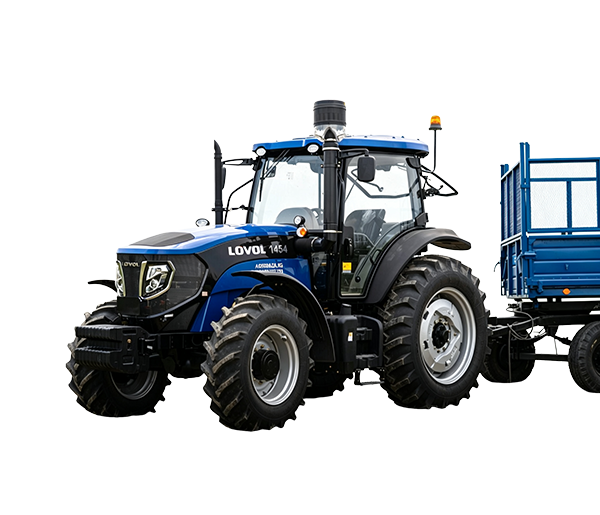
4. TD SERIES 90-150HP Power Range Comparison
Before selecting a tractor, I find it useful to compare the power levels inside the same platform. The following figures come from a publicly available TD Series 90-150HP reference. They are included for technical comparison only and are not HKLOONG-certified specifications.
| Reference Model | Rated Power | Rated Power kW | Drive | Transmission |
|---|---|---|---|---|
| TD904 | 90 HP | 66.1 kW | 4×4 | 16F+8R |
| TD1004 | 100 HP | 73.5 kW | 4×4 | 16F+8R |
| TD1104 | 110 HP | 80.88 kW | 4×4 | 16F+8R |
| TD1204 | 120 HP | 88.2 kW | 4×4 | 16F+8R |
| TD1304 | 130 HP | 95.5 kW | 4×4 | 16F+8R |
| TD1404 | 140 HP | 102.9 kW | 4×4 | 16F+8R |
| TD1504 | 150 HP | 110.2 kW | 4×4 | 16F+8R |
Source: Published TD Series 90-150HP tractor technical information. The table is an industry reference and does not define HKLOONG production specifications. :contentReference[oaicite:11]{index=11}
I would use the 90HP end of the range when the farm needs more power than a typical utility tractor but does not regularly operate very large implements. Around 100-120HP, the tractor becomes more suitable for demanding general farm work and heavier cultivation. At 130-150HP, I would consider larger implements, deep tillage, heavy transport, and commercial farming operations where engine reserve matters.
5. How I Compare This Tractor Class with Other Global Farm Tractors
I also look at established international tractor platforms because this helps me understand what professional buyers expect from the 90-150HP category. The following comparison uses current or published manufacturer information and is not intended to suggest that the tractors have identical designs.
| Reference Tractor | Power | Transmission | Hydraulic / Hitch Reference | PTO Reference |
|---|---|---|---|---|
| TD Series reference | 90-150 HP | 16F+8R reference | Three-point linkage; hydraulic options vary | 540/1000 reference |
| New Holland T5.120 | 117 HP | Model-dependent | Utility tractor platform | Model-dependent |
| New Holland T5.130 | 120 HP | Model-dependent | Utility tractor platform | Model-dependent |
| John Deere 6M 145 | 143 hp rated | 12F/12R standard; 24F/12R optional | 3,200 kg standard rear hitch; 3,600 kg optional | 540/540E |
Sources: TD Series published specifications, New Holland T5 Series official information, and John Deere 6M 145 official specifications. The figures are third-party industry references and are not HKLOONG specifications. :contentReference[oaicite:12]{index=12}
New Holland currently lists the T5.120 at 117 rated engine horsepower and the T5.130 at 120 horsepower, with PTO horsepower of 100 and 102 respectively. This gives a useful reference for where a professional utility tractor sits inside the broader 90-150HP market. :contentReference[oaicite:13]{index=13}
The John Deere 6M 145 provides another useful comparison. Its official specification lists 143HP rated engine power, 157HP maximum engine power, a standard 12F/12R PowrReverser transmission, an optional 24F/12R configuration, 3,200 kg standard rear hitch capacity, 3,600 kg optional capacity, and 94 L/min pump output. :contentReference[oaicite:14]{index=14}
These examples remind me that the tractor market is not simply about horsepower. Buyers also compare transmission type, hydraulic performance, hitch capacity, PTO configuration, tire options, cab design, service access, and compatibility with existing farm implements.
6. Where I Would Use a TD SERIES 90-150HP Platform Tractor
Deep plowing and soil preparation
Deep tillage is one of the clearest applications for this tractor class. When I pull a heavy plow or subsoiler, the tractor needs strong traction and enough torque reserve to keep moving through resistant soil. A four-wheel-drive configuration can be particularly useful in these conditions.
The exact implement size should always be selected according to soil type, working depth, terrain, moisture, and tractor specification. I would never determine implement capacity from horsepower alone.
Large-scale crop cultivation
Commercial farms often need to cover large areas within limited working windows. A 90-150HP tractor can support cultivators, disc harrows, planters, fertilizer spreaders, sprayers, and other implements used in crop production.
The advantage I see here is flexibility. Instead of keeping a separate tractor for every operation, a properly configured platform can handle several stages of the farming cycle.
Planting and fertilizing
Planting equipment often requires controlled ground speed, hydraulic functions, and enough hitch capacity. Fertilizer equipment may also require hydraulic or PTO power depending on the design.
I therefore check the implement requirements first and then match the tractor. A good tractor-implement combination is easier to operate and usually makes better use of the available engine power.
Spraying and crop protection
Large farms may use tractor-mounted or trailed sprayers for crop protection. In these applications, stable travel speed, hydraulic compatibility, PTO availability where required, and suitable tires are important.
Heavy farm transport
A 90-150HP tractor can also perform demanding transport work inside agricultural operations. It may pull trailers carrying crops, fertilizer, feed, water, equipment, or other materials.
For public-road use, I always separate field capability from road legality. Trailer brakes, lighting, registration, maximum speed, weight limits, and local regulations need to be confirmed before the tractor is used on public roads.
Livestock and mixed farms
Mixed farms need tractors that can change jobs quickly. I can use the tractor for mowing, feed transport, manure handling, pasture maintenance, trailer work, and general material movement.
Sugarcane and commercial crop production
The 90-150HP class is also relevant to commercial crops where long operating hours and heavy implements are common. Current LOVOL information specifically describes TD Series tractors for sugarcane-field applications in the Philippines, including dry-land farming, sowing, intertillage, spraying, fertilization, and transportation. :contentReference[oaicite:15]{index=15}
| Application | Typical Power Direction | Main Factor I Check |
|---|---|---|
| General cultivation | 90-120 HP | Traction and implement width |
| Deep tillage | 110-150 HP | Drawbar pull and ballast |
| Planting | 90-130 HP | Low-speed control and hitch capacity |
| Spraying | 90-120 HP | Travel stability and hydraulic compatibility |
| Heavy transport | 100-150 HP | Braking, transmission and trailer load |
| Sugarcane farming | 100-150 HP | Traction, clearance and long-hour operation |
Application note: This table is general selection guidance rather than certified operating capacity. Actual implement matching depends on the final tractor specification, implement requirements, terrain, soil, ballast, and local operating rules.
7. How I Approach Manufacturing, Testing and Customization
When I work with a heavy agricultural tractor, I treat the machine as a complete system. The engine, transmission, axles, hydraulic system, chassis, PTO, steering, braking, tires, and operator station all need to work together.
I start with the structural system because the tractor will experience repeated vibration and shock. The frame and major load-bearing components need suitable materials, accurate machining, consistent welding, and dimensional inspection.
The drivetrain receives the same attention. The transmission needs stable gear engagement, while the axles need to transfer torque reliably under load. For a 4WD tractor, I also consider axle alignment, differential operation, steering movement, sealing, lubrication, and protection from mud and water.
The hydraulic system is another key area. I check hose routing, fittings, valves, cylinders, oil cleanliness, pressure, flow, and leakage control. This is especially important when the tractor is expected to operate heavy hydraulic implements.
I also pay attention to braking. A powerful tractor may pull a large load, so the braking system must be considered together with the tractor's weight, trailer load, road conditions, and local regulations. Public TD Series information describes wet multi-disc brakes on referenced configurations, which is one example of the type of heavy-duty braking design used in this class. :contentReference[oaicite:16]{index=16}
Testing should cover more than a quick engine start. I want to verify steering, braking, hydraulic functions, PTO operation, transmission behavior, electrical systems, and basic machine controls before the tractor is released for its intended application.
At HKLOONG, our engineering capabilities cover R&D, precision manufacturing, quality testing, customized modification, and global distribution. This gives me a practical framework for handling agricultural machinery projects where the customer may need a particular tire configuration, operator station, hydraulic arrangement, implement interface, emission requirement, or regional specification.
I also understand that overseas agricultural machinery projects need clear communication. The final configuration should be confirmed against the customer's farm conditions, local regulations, service environment, and available implements rather than copied from a generic product sheet.
8. Why I Use the TD SERIES 90-150HP Platform for Demanding Agricultural Work
When I select a tractor in this power class, I start with the heaviest regular job. If the farm mostly performs light transport and mowing, a 90HP machine may already provide enough capacity. If deep tillage and large implements are part of everyday work, I would look toward the 120-150HP end of the range.
I also consider annual working hours. A tractor operating several hundred hours per year has different requirements from one running almost every day during a short planting or harvest window. Service access, fuel capacity, tire availability, operator comfort, and spare parts become more important as working hours increase.
Another factor is implement compatibility. I would rather have a well-matched 110HP tractor and implement than an oversized 150HP tractor pulling equipment that is too small for it. Matching power to the actual job can improve fuel use, working speed, and overall machine utilization.
For international customers, I also check the target market before finalizing a configuration. Emission requirements, road regulations, tire standards, operator protection, PTO requirements, hydraulic connections, and available fuel quality can vary from one country to another.
That is how I approach the TD SERIES 90-150HP Platform Tractor. I see it as a flexible heavy agricultural platform that can be configured around the farm rather than forcing every operation into one fixed specification.
FAQ About the TD SERIES 90-150HP Platform Tractor
What is the TD SERIES 90-150HP Platform Tractor designed for?
I would use this tractor class for medium and large-scale agricultural operations such as deep plowing, cultivation, planting, spraying, fertilizing, transport, mowing, livestock work, and PTO-driven implement operation.
What is the difference between a 90HP and a 150HP tractor?
The main difference is available engine power and torque reserve. A 90HP tractor is suitable for many general farming operations, while a 150HP tractor is intended for heavier implements, deeper tillage, higher loads, and demanding commercial agricultural work.
Is 4WD important for a 90-150HP Agricultural Tractor?
I consider 4WD particularly useful for heavy pulling, wet soil, slopes, soft ground, and difficult field conditions. It can improve traction and reduce wheel slip, although the correct configuration still depends on the actual farm environment.
What implements can I use with a 90-150HP tractor?
Depending on the final configuration, this tractor class can work with plows, subsoilers, cultivators, disc harrows, rotary tillers, planters, fertilizer spreaders, sprayers, mowers, balers, trailers, pumps, and other compatible agricultural equipment.
How do I choose between 90HP, 120HP and 150HP?
I look at the largest regular implement and the most difficult working condition. For general cultivation and transport, 90-110HP may be sufficient. For heavier field work, 120-130HP can provide more reserve. For deep tillage and large implements, 140-150HP may be more appropriate. The final decision should be based on the implement manufacturer's requirements and the tractor's certified specifications.
What PTO speed should I choose?
I check the implement first. Many agricultural implements use 540 or 1000 rpm PTO configurations, but the correct speed depends on the equipment. The tractor and implement PTO specifications must be matched before operation.
Can the tractor be used for road transport?
It can be configured for farm transport, but public-road use is subject to local laws. I would confirm tractor registration, lighting, braking, trailer requirements, maximum road speed, axle loads, and total combination weight before road operation.
Can HKLOONG provide customized agricultural machinery configurations?
Customization can be evaluated according to the target application and market. I would normally review engine requirements, power range, drivetrain, tires, hydraulics, PTO, operator protection, implement compatibility, emission requirements, and working environment before confirming the final configuration.
Final Thoughts
For me, the TD SERIES 90-150HP Platform Tractor represents a practical step into heavy-duty agricultural machinery. It gives farms a broad power range for jobs that demand more than a compact or light utility tractor can provide.
The real value of this tractor class is not simply the 90-150HP number. It comes from the complete working system: engine power, torque, transmission ratios, 4WD traction, hydraulic capacity, PTO output, hitch design, tires, braking, and operator control.
When I specify a tractor for a real farm, I always start with the work. I look at the soil, crop, implement, terrain, operating hours, transport needs, climate, and service conditions. Then I select the power and configuration that make sense for that job.
At HKLOONG, I use the same practical engineering approach across our agricultural and heavy equipment projects. Our experience in equipment R&D, precision manufacturing, quality testing, customized modification, and global distribution allows me to focus on the complete machine rather than one isolated specification.



 WhatsApp
 Phone
Phone E-mail
 Message