
 Español
 Pусский
 Français
 العربية

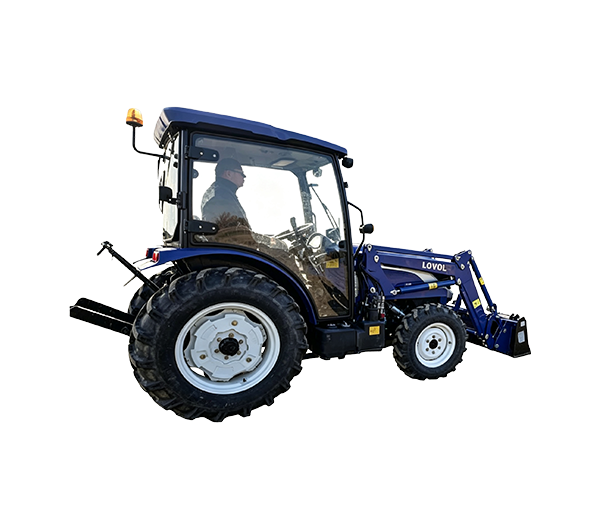
When I look at a 35-50HP tractor, I see a machine that sits in a very useful part of the agricultural equipment range. It has more working power than a small compact tractor, but it is still much easier to handle than a large high-horsepower farm tractor. For many farms, orchards, livestock operations, landscaping projects, and mixed agricultural businesses, that balance can make a real difference.
The TE SERIES 35-50HP Platform Tractor is designed around this idea of practical power. I would use this tractor class for cultivation, mowing, transport, spraying, rotary tilling, material handling, orchard maintenance, and many other daily farming jobs. The actual capability depends on the final tractor configuration and implement, but the 35-50HP range gives operators more room to handle demanding work while keeping the machine reasonably compact.
At HKLOONG Heavy Industry Technology (Hefei) Co., Ltd., I approach agricultural machinery from an engineering and application perspective. Our company specializes in equipment R&D, precision manufacturing, quality testing, customized modification, and global distribution. Our broader product range includes crawler excavators, Wheel loaders, Backhoe loaders, and amphibious wetland Excavators. When I work with agricultural machinery, I bring the same practical thinking into the process: understand the job first, then match the machine to the conditions.
I do not believe a tractor should be selected by horsepower alone. A 50HP tractor with the wrong implement, tire, transmission, or hydraulic setup can still be a poor match for a particular farm. I look at the complete package: engine, transmission, drivetrain, PTO, hydraulics, three-point hitch, tires, dimensions, weight, ground clearance, operator controls, and service requirements.
That is what makes the TE SERIES 35-50HP Platform Tractor interesting. It gives me a flexible platform for applications that need more working capacity than a small tractor, without immediately moving into the size and operating requirements of a much larger agricultural machine.
1. What Is a 35-50HP Platform Tractor and How Do I Choose the Right Model?
A platform tractor is an agricultural tractor with an open operator area around the driver's seat. The platform gives the operator direct visibility around the machine and keeps the overall structure relatively simple. Depending on the market and configuration, the tractor may be fitted with a ROPS structure or another approved operator protection system.
In the 35-50HP class, I normally think about three broad levels of work. Around 35HP, the tractor can be a useful step up from a small compact tractor for mowing, cultivation, transport, and general property maintenance. Around 40-45HP, I get more working capacity for medium-duty implements and mixed farm operations. At around 50HP, the tractor can handle a wider range of heavier implements and more demanding field work, provided the transmission, hydraulics, hitch, tires, and ballast are properly matched.
Public industry data gives a good picture of this range. New Holland's Boomer compact tractor family includes 35HP, 40HP, 45HP, 50HP, and 55HP models, showing how common this power band is for compact agricultural equipment.
Bobcat also offers compact tractors around the same range. Its CT2535 is listed at 35HP, while the CT4050 is listed at 50HP. Both are positioned for implement and attachment work, with four-wheel drive and three-point hitch systems.
For me, the right choice depends on the actual job. If the tractor will mainly mow grass and pull a light trailer, 35HP may provide enough capacity. If it will regularly operate a rotary tiller, heavier mower, loader, or other demanding attachment, moving toward 45-50HP may make more sense.
I also consider farm size and working area. A tractor that is too large can be difficult to maneuver around trees, buildings, fences, and narrow farm roads. A tractor that is too small may spend too much time operating at its limits. The goal is to find a useful middle ground.
2. How I Understand the Working Principle of the TE SERIES Tractor
The basic working principle of a tractor is quite simple. The engine creates mechanical power. The clutch and transmission control that power. The drivetrain transfers it to the wheels. The wheels create traction against the ground. At the rear, the PTO can transfer rotary power to an implement, while the hydraulic system can raise, lower, or operate compatible equipment.
The diesel engine is particularly important for agricultural work because tractor applications often require steady torque at relatively low engine speeds. When I pull a cultivator through soil or climb a loaded field road, I need controlled pulling force more than a high top speed.
The transmission gives the operator control over that power. Lower gears allow slower working speeds and higher wheel torque. Higher gears allow faster travel between work areas. A synchronized or shuttle-type transmission can also make direction changes easier during loader, transport, or implement work.
The drivetrain determines how engine power reaches the ground. A four-wheel-drive tractor can send power to both front and rear axles, which can improve traction in wet soil, loose ground, slopes, or other difficult conditions. I still pay close attention to tire selection because the tire is the actual contact point between the tractor and the ground.
The PTO is another key system. Many agricultural implements depend on PTO power. Rotary tillers, cutters, mowers, pumps, and other equipment can use PTO rotation to perform their work. The PTO speed and shaft specification must match the implement, so I always confirm those details before connecting equipment.
The three-point hitch gives the tractor another level of flexibility. It lets the operator mount and control a wide range of rear implements. A properly matched hitch allows the tractor to raise, lower, and position the implement while working in the field.
Hydraulics complete the system. Hydraulic oil carries pressure from the pump to cylinders or hydraulic motors. This allows the tractor to control lifting functions and, depending on the configuration, operate additional hydraulic equipment. Hydraulic flow, pressure, and lifting capacity must be matched to the attachment rather than estimated from horsepower alone.
3. Main Features I Look For in a 35-50HP Farm Tractor
The first feature I look for is a sensible power-to-size balance. A 35-50HP tractor should have enough power for its intended implements without becoming unnecessarily large or heavy. This is especially useful for farms where the tractor needs to move between fields, buildings, orchards, and storage areas.
Four-wheel drive is another feature I consider important for many agricultural applications. New Holland, for example, lists 4WD as standard across its WORKMASTER compact tractor range and describes the system as providing additional traction in wet, slippery, and sandy conditions.
I also look at the axle and steering system. A tractor used in an orchard or small farm may need frequent turns. A manageable turning radius reduces unnecessary movement at the end of each row and makes the machine easier to position around buildings and other obstacles.
Ground clearance matters as well. A tractor may need to cross uneven farm roads, crop residue, shallow ditches, or rough field surfaces. Adequate clearance can reduce the chance of the underbody contacting the ground.
Tire selection is closely connected to ground conditions. Agricultural tires, industrial tires, and turf tires have different tread patterns and operating characteristics. I would select the tire based on where the tractor will work rather than simply choosing the largest tire available.
The operator platform should also be straightforward. I want the gear lever, PTO control, hydraulic controls, three-point hitch controls, steering wheel, pedals, and parking brake to be easy to identify. Simple controls are useful when the operator spends several hours in the seat.
Maintenance access is another practical point. Dust, mud, crop residue, moisture, and long working hours are normal parts of agricultural work. I therefore look for reasonable access to filters, fluids, lubrication points, cooling components, belts, and other service areas.
| Feature | What I Check | Practical Reason |
|---|---|---|
| Engine | Rated power, torque, cooling and fuel system | Provides the working power needed by the tractor |
| 4WD System | Axles, engagement and traction | Helps transfer power in difficult ground conditions |
| Transmission | Gear range and shift arrangement | Matches travel speed and pulling requirements |
| PTO | Speed, shaft and control system | Drives compatible agricultural implements |
| Hydraulics | Flow, pressure and lift capacity | Supports mounted and hydraulic equipment |
| Three-Point Hitch | Category and lift capacity | Allows use of many rear implements |
| Tires | Size, tread and application | Controls the contact between tractor and ground |
4. TE SERIES 35-50HP Tractor Specification Comparison
When I compare tractors in this class, I want to see more than horsepower. Weight, hydraulic output, PTO, hitch capacity, ground clearance, transmission, and tire configuration can change how the tractor performs in real work.
The following table uses published third-party specifications as industry reference data. It is not a list of confirmed HKLOONG specifications. Actual HKLOONG parameters should be confirmed against the final model and configuration.
| Reference Tractor | Power | Drive / Transmission | 3-Point Hitch | PTO | Reference Application |
|---|---|---|---|---|---|
| Bobcat CT2535 | 34.9 HP | 4WD / 3-range hydrostatic | Category 1 | Rear 540 rpm | Mowing, hauling, digging |
| Yanmar YT235 | 34.2 HP | Selectable 2WD/4WD / hydrostatic | Category 1 | Rear 540 rpm | Mowing, loader work, property maintenance |
| Bobcat CT4050 | 50 HP | 4WD / hydrostatic or synchro shuttle | Category 1 | Rear PTO | Heavy-duty implement and attachment work |
| TE504 reference | 50 HP | 4WD / mechanical configuration | Category I reference | 540/1000 rpm reference | Farm and field operations |
Bobcat's published CT2535 data lists 34.9HP, standard 4WD, a three-range hydrostatic transmission, Category 1 three-point hitch, and 540-rpm rear PTO. Its CT4050 is listed at 50HP, standard 4WD, Category 1 three-point hitch, and rear PTO, with hydrostatic or manual synchro shuttle transmission options.
Yanmar's YT235 is another useful reference near the lower end of this class. It lists 34.2HP, selectable 2WD/4WD, a hydrostatic transmission, Category 1 three-point hitch, 27 PTO horsepower, and a 540-rpm rear PTO.
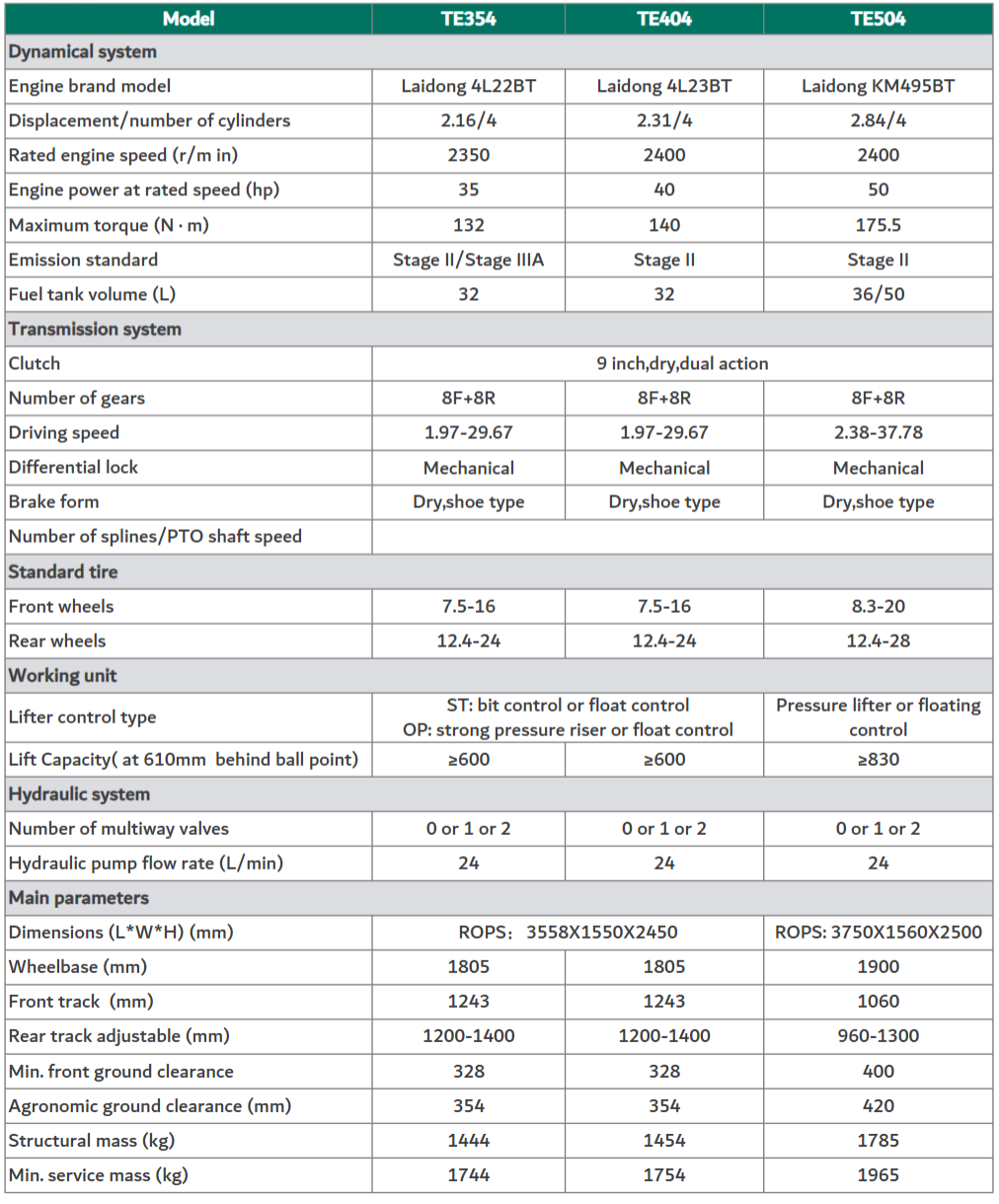
For a TE-series reference, published specifications from T.Y. Tractor and CAMCO list the TE504 at 50HP with a four-cylinder diesel engine, 4WD-related configuration, 24 L/min hydraulic flow, and a reference lift capacity of 827 kg measured 610 mm behind the hitch point. The same published table lists a 1,590 kg ROPS weight for the TE504. These figures are useful for understanding a comparable TE-series configuration, but they are not HKLOONG specifications.
| Work Type | Power Range I Would Consider | Important Tractor Features | Possible Implements |
|---|---|---|---|
| Grass mowing | 35-45HP | PTO, maneuverability, tire choice | Rotary mower, finish mower |
| Orchard work | 35-50HP | Compact dimensions, steering, 4WD | Mower, sprayer, tiller |
| Soil cultivation | 40-50HP | Traction, low-speed control, PTO | Rotary tiller, cultivator, harrow |
| Farm transport | 35-50HP | Transmission, brakes, hitch | Farm trailer, utility trailer |
| Loader work | 40-50HP | Hydraulics, front axle, ballast | Front loader, bucket |
| Livestock maintenance | 35-50HP | Versatility, PTO and hydraulics | Mower, trailer, loader |
5. Technical Advantages and Implement Compatibility
The main technical advantage I see in a 35-50HP tractor is flexibility. It has enough engine power to work with a useful range of implements while remaining relatively compact. This makes it suitable for farms where one tractor needs to perform several different jobs throughout the year.
Take mowing as an example. A suitable mower requires PTO power, and the tractor needs enough stability and traction to operate it safely. The right combination depends on mower width, vegetation density, terrain, and working speed. More horsepower gives me more room, but the implement still needs to be matched correctly.
For rotary tilling, I pay attention to PTO speed, tractor gearing, soil condition, tiller width, working depth, and tractor weight. Heavy soil can demand much more pulling power than light soil. A tractor that works easily in sandy soil may behave differently in wet clay.
For front loader work, hydraulic performance becomes more important. A loader can be useful for moving soil, manure, feed, fertilizer bags, logs, and other materials. However, the tractor needs suitable hydraulic capacity, front axle strength, ballast, and stability. Loader capacity should never be considered separately from the tractor's overall design.
Three-point implements provide another major advantage. A Category 1 hitch, for example, can be used with a broad range of compact tractor implements when the implement's dimensions and load requirements are compatible. Bobcat and Yanmar both use Category 1 three-point systems on their compact tractor references in this power range.
The PTO also expands the tractor's usefulness. New Holland's WORKMASTER compact tractor range, for example, uses a standard 540-rpm rear PTO for three-point implements such as rotary tillers and rotary cutters.
Hydraulic flow is another number I always check. More hydraulic flow can support certain hydraulic attachments, but it does not automatically mean that an attachment will work. Pressure, coupler type, cylinder size, oil temperature, and tractor lift capacity also matter.
In short, I treat the tractor and implement as one working system. The tractor provides the power, but the implement determines how that power is actually used.
6. Where I Would Use the TE SERIES 35-50HP Platform Tractor
I would consider the TE SERIES 35-50HP Platform Tractor for small and medium-sized farms that need more capability than a basic compact tractor can provide. It is especially interesting when the same machine needs to perform several different tasks rather than staying dedicated to one implement.
Orchards are one example. The operator may need to mow between tree rows, spray crops, carry materials, cultivate soil, and maintain vegetation. A tractor in the 35-50HP range can provide useful power while still being manageable around trees and farm buildings.
Vegetable farms can also benefit from a versatile tractor. Cultivation, bed preparation, mowing, fertilizer work, spraying, and trailer transport can all require different equipment. With suitable implements, one tractor can support several stages of the production cycle.
Livestock farms have another set of needs. Mowing grass, moving feed, transporting materials, cleaning areas, and maintaining farm roads are common support tasks. A front loader, mower, trailer, or other attachment can expand the tractor's role.
For greenhouse or protected agriculture, dimensions become especially important. The tractor needs to fit through the available access points and operate without damaging structures or crops. In such environments, I would check overall width, height, turning radius, tire selection, and implement dimensions before finalizing the tractor.
Landscaping and estate maintenance are also potential applications. A 35-50HP tractor can be useful for mowing large grass areas, moving materials, maintaining private roads, and handling seasonal work.
Municipal and utility maintenance can create similar requirements. The machine may be used for vegetation control, mowing, light transport, snow-related work in suitable climates, or property maintenance. The final equipment package should always reflect the specific task.
For export markets, I would add climate and terrain to the selection process. Hot and dusty areas may require careful attention to cooling and filtration. Wet regions may increase the importance of traction and corrosion protection. Hilly terrain requires attention to stability, tires, braking, and safe operating procedures.
7. How I Approach Manufacturing, Quality Control and Customization
When I approach a 35-50HP agricultural tractor project, I start by understanding the work. I want to know what the tractor will pull, what implements will be used, what the ground conditions are, how many hours the tractor will work each year, and where the machine will operate.
Once those requirements are clear, I look at the powertrain. Engine output needs to match the transmission and drivetrain. The axle, clutch, differential, brakes, and tires also need to be suitable for the expected load and terrain.
The hydraulic system is checked in the same way. I would compare required implement flow and pressure with the tractor's available hydraulic performance. For three-point implements, lift capacity should be considered at the actual hitch position rather than relying only on a maximum lift number.
The PTO is another point I verify early. If the customer already owns implements, I want to know their PTO speed, shaft type, working width, weight, and power requirement. This can prevent a common mistake: buying the tractor first and discovering later that an existing implement is not a good match.
During manufacturing and assembly, I focus on consistent component installation and inspection. Steering, brakes, hydraulic connections, electrical wiring, PTO controls, transmission operation, and three-point hitch functions all deserve practical checks.
For the operator platform, I look at control layout and access. The driver should be able to understand the main functions without searching for controls every time. ROPS or other approved protection equipment should also be appropriate to the final market and configuration.
Maintenance is another part of the design. Agricultural machinery gets dirty. Filters collect dust, cooling systems collect debris, and lubrication points need regular attention. Easy access to routine service areas can save time over the tractor's working life.
Customization can cover several areas depending on the project. Possible requirements may include tire configurations, PTO options, hydraulic outlets, hitch equipment, front loaders, agricultural implements, lighting, operator protection, transport equipment, and other market-specific options.
For international customers, I also pay attention to documentation. The final specification sheet, component information, inspection records, user documentation, packing details, and destination-market requirements should all describe the same machine.
8. Why I Choose HKLOONG for 35-50HP Agricultural Machinery Solutions
At HKLOONG, I take a practical approach to agricultural machinery because I know that farm equipment is judged in the field, not only in a showroom. Our company is headquartered in Hefei, China, and our wider engineering work covers equipment R&D, precision manufacturing, quality testing, customized modification, and global distribution.
Our main product portfolio includes crawler Excavators, wheel loaders, backhoe loaders, and amphibious Wetland excavators. These machines have taught us to think carefully about power transmission, hydraulic systems, structural strength, operating conditions, maintenance, and field performance.
When I apply that thinking to a 35-50HP platform tractor, I focus on the complete working system. I want the engine to match the transmission. I want the drivetrain to match the tires and terrain. I want the hydraulic system to match the attachments. I want the PTO to match the implements. Most importantly, I want the final configuration to match the customer's actual work.
International customers can have very different requirements. A farm in Europe may have specific emissions and safety requirements. A tropical farm may need strong cooling performance and good protection against moisture. A dry agricultural region may put more attention on filtration and dust management. Orchard operators may care about dimensions and turning ability more than maximum transport speed.
That is why I prefer a specification-led approach. Before finalizing a tractor, I would confirm engine power, transmission, drive configuration, PTO, hydraulic flow, hitch category, lift requirements, tires, dimensions, ROPS or cab arrangement, optional attachments, destination country, and documentation.
For distributors and fleet buyers, I would also discuss spare parts, maintenance support, warranty arrangements, shipping, packaging, and expected operating hours. These details are not as visible as engine horsepower, but they are important when equipment will work for years.
I also see customization as a controlled engineering process rather than simply adding accessories. If an attachment changes weight distribution, hydraulic demand, PTO load, or clearance, I want those effects considered before the final configuration is approved.
My goal is straightforward: make the tractor specification easy to understand, make the machine fit the application, and make the ownership process as practical as possible.
9. TE SERIES 35-50HP Platform Tractor FAQ
What is a 35-50HP platform tractor?
A 35-50HP platform tractor is a compact or utility agricultural tractor designed for farming, property maintenance, transport, mowing, cultivation, loader work, and other applications. The open platform provides a direct operating area and can be paired with ROPS or other approved protection equipment depending on the configuration.
What can I do with a 50HP farm tractor?
A 50HP tractor can potentially handle a broad range of agricultural work, including mowing, cultivation, rotary tilling, trailer transport, loader work, spraying, orchard maintenance, and livestock-farm support. The actual capability depends on the implement, terrain, tractor configuration, and operating conditions.
Is a 35HP tractor enough for an orchard?
It can be suitable for many orchard tasks when the tractor dimensions, turning radius, tires, PTO, and implements are correctly matched. I would pay particular attention to tractor width and height because orchard rows can be restrictive.
What is the advantage of 4WD on a 35-50HP tractor?
4WD can provide additional traction by driving both axles. It can be useful on wet soil, loose ground, slopes, grassland, and uneven surfaces. However, tires, ballast, ground conditions, and operator technique still have a major effect on actual traction.
Can this tractor work with a front loader?
A compatible front loader can be used when the tractor platform, hydraulic system, front axle, mounting structure, and stability requirements are suitable. Loader capacity should be confirmed against the final tractor configuration rather than estimated from engine horsepower alone.
What PTO speed should I choose?
The PTO speed should match the implement. Many agricultural implements use 540 rpm, while some equipment can require other speeds. I recommend checking the implement manufacturer's specifications before selecting the tractor PTO configuration.
What is the role of the three-point hitch?
The three-point hitch connects and controls mounted implements at the rear of the tractor. It allows the operator to raise, lower, and position equipment such as tillers, cutters, cultivators, and other compatible implements.
How do I select between 35HP, 40HP, 45HP and 50HP?
I would start with the heaviest regular job rather than the easiest one. Check the largest implement, soil condition, working width, slope, transport requirements, hydraulic needs, and expected workload. If several jobs sit close to the upper limit of a 35HP tractor, moving toward 40-50HP may provide more working margin.
What information do I need when requesting a customized tractor?
I would provide the destination country, required horsepower, farm type, acreage, crop, terrain, soil condition, main implements, PTO requirements, hydraulic requirements, preferred tires, 2WD or 4WD preference, operator protection requirements, and expected quantity. This gives the engineering team a much clearer starting point.
Final Thoughts on the TE SERIES 35-50HP Platform Tractor
When I choose a tractor in the 35-50HP class, I am looking for balance. I want enough power for demanding agricultural work, but I also want a machine that remains practical around farms, orchards, buildings, and field roads.
A 35HP tractor can make sense for lighter general work. Moving toward 40-45HP can provide additional capacity for mixed farming. At 50HP, I have more room for demanding implements, loader work, cultivation, and transport, provided the complete tractor configuration supports those jobs.
The important point is that horsepower is only one part of the equation. PTO performance, hydraulic flow, three-point hitch capacity, transmission, drivetrain, tires, ground clearance, steering, brakes, weight, and operator protection all influence how the tractor performs in real conditions.
That is why I approach the TE SERIES 35-50HP Platform Tractor as a working platform rather than simply a diesel engine with four wheels. The value comes from how well the complete tractor works with its implements and operating environment.
At HKLOONG, I apply the same practical engineering approach that guides our wider industrial equipment business. I start with the application, define the requirements, check the systems, consider customization carefully, and pay attention to quality and documentation.
For farms, orchards, livestock operations, landscaping projects, agricultural contractors, and international distributors, the right 35-50HP tractor can provide a useful combination of power and flexibility. The final decision should always be based on the actual work, not simply on the largest number in a specification sheet.



 WhatsApp
 Phone
Phone E-mail
 Message