

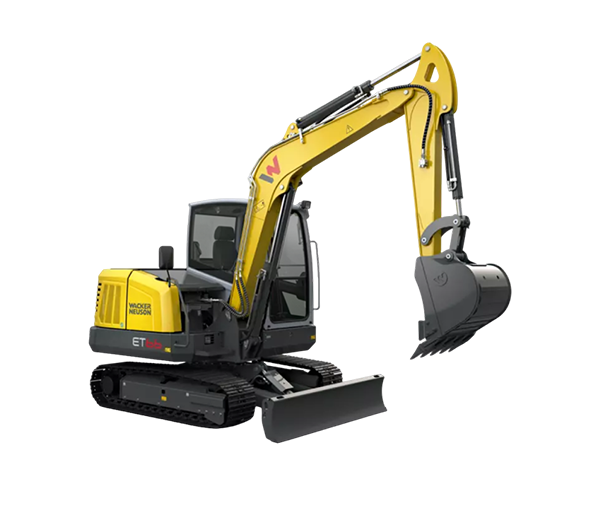
Tracked Conventional Excavator ET66:perfectly com-bining economic efficiency,power and durability
With the well-balanced LUDV hydraulic system,ET66 is best equipped for every application and every requirement.The ET66 offers iferentattachments based on requirement.Large rear flaps and side doors as well s quick spare part procurement make the maintenance and service easy.
Powerful drive system with LUDV
The powerful drive system combines with a load-sensing hydraulic system(LUDV)to deliver quick working cycles,greater applicationflexibility,and easier control for comfortable and fatigue-free operation ofofthe excavator.No matter what the load to be movedthe controlmovements on the joystick stay the same.Along with increasedoperating comfort,this resultsin a performance plus,whlesimultaneously reducing fuel consumption.
High degree of digging power
Exceptional digging power during excavation work saves time and money.
Optimal maintenance access
Service and maintenance are fast and easy,due to the extra large engine hood with large metal covers and convenient access to spare parts.
AUX I
The auxiliary hydraulics offer the possibility of using a powerful Hydraulic Breaker as well as converting to a swivel bucket or soil auger.
Choice of two movement directions or one with changeover for pressureless return
Optimized hydraulics or engine-pumpmanagement
An optimized drive concept of the latest generation enables precise,fast,and efficient work.The electronically controlled hydraulic pumppermanently adapts the required hydraulic power to the available powerof the diesel engine,taking into account the operating conditions.

Wacker neuson ET66 Tracked Excavator for Construction and Utility Work
When I look at a construction Excavator, I do not start with the price tag. I start with the job.
What does the customer need to dig? How deep is the trench? How much room is available? Will the machine work on soil, gravel, a building site, a road project, or a landscaping job? Does the customer need a Hydraulic Breaker or another attachment? And just as important, how will the machine get to the jobsite?
These questions are especially useful when I evaluate a machine such as the Wacker Neuson ET66.
The ET66 is a tracked conventional excavator in the 6–15 ton class. In the current technical information published by Wacker Neuson, the machine has an operating weight of approximately 6,030–6,250 kg, depending on configuration. Its maximum digging depth is 3,877 mm, overall width is 2,104 mm, and transport length is 6,105 mm. The published engine specification lists a 3,054 cm³ Yanmar diesel engine with 35.9 kW output.
For me, these numbers put the ET66 in a useful working range. It is clearly more substantial than a small Mini Excavator, but it does not move into the much larger machine class that can create more transport and space requirements.
That balance is one reason I would consider the ET66 for general construction, utility installation, landscaping, road work, earthmoving, drainage, and similar applications.
At Ganglong Heavy Industry Technology (Hefei) Co., Ltd., I work with customers looking for construction machinery, mining machinery, agricultural machinery, attachments, complete machines, and international supply services. Our group was founded in 2013 and works together with Hefei Ganglong International Trade Co., Ltd. on domestic and overseas machinery business.
When I supply a third-party brand such as Wacker Neuson, I keep the role very clear. Wacker Neuson is the equipment manufacturer. Ganglong handles the customer-side supply, trade coordination, inspection, documentation, logistics, and related services according to the confirmed order.
That may sound like a small distinction, but in international machinery purchasing, clear information matters.
The Wacker Neuson ET66 Excavator is a tracked excavator designed for practical construction work. It uses a crawler undercarriage, diesel engine, hydraulic working system, upper carriage, boom, arm, and bucket to carry out excavation and material handling operations.
The crawler design gives the machine a stable base while working. That is useful when the ground is uneven or when the machine needs to remain in one working area for a long period.
I think of a tracked excavator as a machine that spends most of its time working rather than traveling long distances.
It moves around the jobsite when necessary, but its real job is digging, lifting, swinging, loading, trenching, grading, and handling material.
The ET66 has a published operating weight range of 6,030–6,250 kg. Wacker Neuson lists a maximum digging depth of 3,877 mm and a machine width of 2,104 mm for the referenced configuration.
That gives me a useful starting point when I compare the machine with other excavator classes.
A very small excavator may be easier to fit into tight spaces, but it may not have enough working capacity for a larger trench or earthmoving job.
A much larger excavator may move more material per cycle, but it also requires more transportation capacity, more working space, and usually a larger project to justify its size.
The ET66 sits between those extremes.
That is why I see it as a machine for contractors who want practical digging performance without jumping straight into a heavy excavator.
The working principle is straightforward.
The diesel engine supplies mechanical power. The hydraulic system converts that power into controlled movement. Hydraulic pressure and flow operate the boom, arm, bucket, swing system, and travel system.
The operator controls the machine using joysticks and pedals from the cab.
During a normal digging cycle, I would position the machine, lower the boom, push the arm into the material, curl the bucket, lift the boom, swing the upper carriage, and empty the bucket.
Then the cycle starts again.
That sounds simple, but the quality of the hydraulic control makes a big difference to how the machine feels after several hours of work.
Whenever I receive an inquiry for an ET66 Tracked Excavator, I first check the technical configuration.
I do not assume that every machine carrying the ET66 name will have exactly the same equipment in every country. Wacker Neuson itself notes that product ranges, engines, options, equipment, and technical data can vary depending on the country and configuration.
So I use the published specifications as a technical reference, then confirm the actual machine before the order is finalized.
| ET66 Technical Item | Published Specification | Why I Check It |
|---|---|---|
| Operating weight | 6,030–6,250 kg | Helps determine machine class and transport requirements |
| Engine manufacturer | Yanmar | Confirms the engine configuration |
| Engine model | 4TNV94L-ZWWN | Useful for technical and spare-parts confirmation |
| Engine displacement | 3,054 cm³ | Shows engine size |
| Effective power | 35.9 kW | Indicates available engine output |
| Maximum digging depth | 3,877 mm | Important for excavation and trench work |
| Machine width | 2,104 mm | Important for site access |
| Machine height | 2,558 mm | Important for transport and working clearance |
| Transport length | 6,105 mm | Useful for shipping and transport planning |
| Fuel tank capacity | 109 L | Useful for operating planning |
| Hydraulic oil volume | 100 L | Important for maintenance planning |
| Hydraulic operating pressure | 250 bar | Important when checking hydraulic performance |
Technical data source: Wacker Neuson official ET66 technical data published for the tracked excavator. Actual specifications can vary according to market and equipment configuration.
The maximum published digging depth of the ET66 is 3,877 mm.
For me, this is one of the first numbers to compare with the actual project.
If the customer needs to install drainage pipes, utility lines, foundations, or underground infrastructure, I want to know the required trench depth before I recommend the machine.
A maximum specification is not the same thing as saying that every job should be performed at that depth. Soil conditions, working equipment, machine position, bucket type, and operating technique all affect the real result.
The published width is 2,104 mm.
This number is easy to overlook, but I consider it very important.
Before an ET66 arrives at a jobsite, I want to know the width of the entrance, road, gate, working corridor, and transportation equipment.
There is no point buying a machine that cannot comfortably reach the work area.
The ET66 uses a Yanmar 4TNV94L-ZWWN diesel engine in the referenced configuration. The published engine displacement is 3,054 cm³, with 35.9 kW effective power.
The published fuel tank capacity is 109 liters.
Fuel consumption will naturally change according to the workload. Digging hard soil all day is different from light landscaping work. Operator habits, idle time, attachment use, hydraulic demand, and site conditions also matter.
So I would never promise a fixed fuel consumption number without knowing the actual working conditions.
If I had to choose one area of an excavator to study carefully, I would choose the hydraulic system.
The engine gives the machine power, but the hydraulic system turns that power into the movement the operator actually uses.
The ET66 uses a load-sensing hydraulic system with LUDV control. Wacker Neuson describes this system as providing quick working cycles, flexible applications, and easier control. The company also explains that the hydraulic system is designed so that joystick control movements remain consistent under different loads.
That is useful because an excavator does not work under one fixed load.
One bucket may be nearly empty.
The next bucket may be full of wet soil.
Then the machine may need to lift, swing, and place material.
The hydraulic system has to respond to these changing conditions.
LUDV stands for load-independent flow distribution.
That sounds complicated, but the basic idea is easier to understand.
The hydraulic system manages flow so the operator can continue to control different machine functions smoothly even when the load changes.
Wacker Neuson states that the ET66's load-sensing hydraulic system supports quick cycles and easier control. The company also says that its optimized engine-pump management electronically adjusts the required hydraulic power according to available engine power and operating conditions.
From my point of view, the benefit is not just a technical term on a specification sheet.
The benefit is how the machine behaves when the operator works for hours.
The published ET66 hydraulic pump performance is 144 l/min.
This is particularly important when the customer wants to use hydraulic attachments.
For example, Wacker Neuson lists AUX I auxiliary hydraulics as an option. The company says this system can support applications such as a hydraulic breaker, swivel bucket, or soil auger.
But I always tell customers to confirm the attachment before ordering.
It is not enough to say, “The excavator has auxiliary hydraulics.”
I want to know the attachment's required flow, pressure, weight, mounting system, and return-line requirements.
The machine and attachment should be treated as one working package.
| Hydraulic Feature | ET66 Published Information | Practical Meaning |
|---|---|---|
| Hydraulic control | Load-sensing LUDV | Supports controlled hydraulic operation |
| Pump type | Variable displacement pump | Hydraulic output can respond to operating demand |
| Pump performance | 144 l/min | Provides hydraulic flow for machine functions and suitable attachments |
| Operating pressure | 250 bar | Important for hydraulic working capability |
| Auxiliary hydraulics | AUX I available | Can support suitable hydraulic attachments |
| Hydraulic control | Joystick pilot control | Allows precise operator control |
Technical data source: Wacker Neuson official ET66 technical and equipment information. Attachment compatibility depends on the actual machine and attachment configuration.
I do not judge an excavator by one feature.
I look at the combination of power, hydraulic response, operator comfort, maintenance access, stability, attachments, and daily usability.
As I mentioned earlier, the LUDV system is one of the main technical features I would look at.
Wacker Neuson describes the system as helping the ET66 achieve quick working cycles, easier control, and application flexibility.
For an operator who repeats the same digging cycle hundreds of times in a day, smooth control can make a noticeable difference.
The ET66's published configuration uses a four-cylinder Yanmar 4TNV94L-ZWWN diesel engine.
The engine has a 3,054 cm³ displacement and 35.9 kW output in the referenced technical data.
Wacker Neuson also describes the engine as having an ECU controller.
For customers, I recommend confirming the actual emission specification because engine and emissions configurations can differ between markets.
This is one of those features that does not always look exciting in a brochure, but I care about it.
Wacker Neuson highlights the large engine hood, large metal covers, and convenient access to service components.
Why does that matter?
Because a construction machine is not maintained once a year and forgotten.
Oil checks, filters, lubrication, hydraulic inspections, cooling-system checks, and other service work are part of normal machine ownership.
If the technician can reach the components easily, routine maintenance becomes more practical.
Wacker Neuson describes the ET66 cab as being designed for good all-round visibility. The published product information specifically mentions visibility of the attachment, right front track, side area, and part of the rear section.
For me, visibility is not just about comfort.
The operator needs to see the bucket, working area, machine edges, and nearby people or objects.
A clear view helps the operator work with more confidence.
The ET66 can be equipped with a FOPS protective grating, with Wacker Neuson listing a Class 1 configuration.
This type of protective equipment is especially relevant for jobs where there may be a risk of objects falling from above.
The exact protection package should always be confirmed according to the customer's application and machine configuration.
The ET66 is designed with an air-cushioned operator seat, joystick operation, a 3.5-inch multifunction display, and air-conditioning equipment in the referenced configuration.
Again, I think about the operator's whole day.
If someone is sitting in the cab for eight hours, small ergonomic details become much more important than they look in a product brochure.
The standard equipment information lists a dozer blade and 400 mm steel tracks for the referenced configuration.
The blade can help with machine stabilization and simple material-moving or grading work.
It does not turn the excavator into a bulldozer, of course. I see it as a useful extra function that helps the machine handle more everyday site work.
The ET66 is not a machine that I would limit to one industry.
Its size, tracked design, digging depth, hydraulic system, and attachment options make it suitable for a range of practical applications.
General construction is one of the first applications I think about.
The machine can be used for excavation, foundation preparation, trenching, backfilling, site preparation, and material handling.
For smaller and medium construction projects, the ET66 can provide a useful balance between machine size and working capacity.
Utility projects often require controlled excavation rather than simply moving a huge amount of soil.
Water pipes, drainage systems, electrical cables, communication lines, and other underground utilities may require trenches of different sizes and depths.
The ET66's 3,877 mm maximum published digging depth gives it useful reach for many trenching applications.
Before I supply one for utility work, I would still check the required trench depth, trench width, soil conditions, access restrictions, and attachment requirements.
Road projects involve much more than laying asphalt.
There may be drainage ditches, underground pipes, roadside excavation, culvert installation, earthmoving, and shoulder work.
A tracked excavator such as the ET66 can support these tasks when its dimensions and working range match the project.
Landscaping contractors often need a machine that can do several different jobs.
One day it may dig a pond.
The next day it may prepare drainage.
After that it may move soil or prepare a foundation for a garden structure.
With the correct bucket or attachment, the ET66 can support this kind of varied work.
Drainage projects are another good example.
The operator needs controlled excavation, accurate bucket movement, and enough digging depth for the planned installation.
The machine also needs to remain stable while working beside the excavation.
That is where a tracked excavator can be useful.
Large industrial properties sometimes need excavation without having a full-scale earthmoving project.
Drainage repair, utility maintenance, landscaping, foundation preparation, and site improvement can all require an excavator.
For these customers, I normally pay close attention to transportation, machine storage, attachment selection, and maintenance support.
One of the most common questions I hear is simple: “Why should I choose a 6-ton excavator instead of a smaller or larger machine?”
There is no single answer.
I always start with the actual workload.
| Excavator Class | Typical Strength | Common Applications | My Main Check |
|---|---|---|---|
| 1–3 ton mini excavator | Small footprint | Gardening, small utilities, landscaping | Access and available working space |
| 4–5 ton Compact Excavator | Good mobility and moderate capacity | Small construction, utilities, landscaping | Digging requirements and lifting capacity |
| 6–8 ton excavator | Balance of size and working capacity | Construction, utilities, road work, earthmoving | Working depth and site access |
| 10–15 ton excavator | Higher production capacity | Infrastructure and larger earthmoving jobs | Transport and project volume |
| 20+ ton excavator | Heavy digging and material handling | Large infrastructure, mining, quarrying | Production requirements and transport |
Comparison source: Excavator class ranges are a practical industry comparison. ET66 specifications are based on Wacker Neuson's published product data.
I would not automatically select the largest excavator.
If the job is inside a small urban site, a huge excavator may create access problems.
If the contractor is moving thousands of cubic meters of material every day, a 6-ton machine may not provide enough production capacity.
The correct machine is the one that matches the job.
A mini excavator has an obvious advantage when space is extremely limited.
But the ET66 offers a larger working platform, greater machine mass, deeper digging capability, and more hydraulic capacity than many small machines.
If the project involves larger trenches, heavier soil, longer working hours, or more demanding attachments, the ET66 may be more suitable.
The ET66 and ET75 are both in Wacker Neuson's tracked excavator range, and both use a 35.9 kW effective power rating in the referenced published data.
However, they are not identical machines.
The ET66 has a published maximum digging depth of 3,877 mm and width of 2,104 mm, while the ET75 is listed with a maximum digging depth of 4,097 mm and width of 2,252 mm.
This means I would not simply choose the ET75 because it is the larger model.
If site access is important, the narrower ET66 may make more sense.
If additional digging depth is required, the ET75 may deserve closer consideration.
When a customer asks me for a Wacker Neuson ET66 for sale, I do not want to send back only a price.
I first need to understand the complete order.
I ask about the customer's application, country, working environment, required quantity, preferred configuration, attachments, and delivery requirements.
If the customer is buying the ET66 for utility work, I want to know the required digging depth.
If it is for landscaping, I ask about the type of soil and attachment.
If it is for road work, I ask about access and transportation.
These questions help prevent the common mistake of choosing a machine based only on the model name.
This step is especially important for international orders.
Wacker Neuson states that its product range can vary from country to country. The company also notes that displayed equipment, technical data, engines, and optional equipment may differ from the current product range available in a specific market.
So before I finalize an order, I confirm the actual machine configuration.
I check the engine specification, emissions requirement, operating weight, standard equipment, auxiliary hydraulics, tracks, bucket, cab equipment, and other requested options.
Before shipment, we can arrange machine checks according to the confirmed order requirements.
I normally focus on:
Machine appearance
Engine condition
Hydraulic system
Electrical system
Cab controls
Travel functions
Working equipment
Attachments and accessories
Required documents
If the buyer has a third-party inspection company or a specific inspection checklist, that requirement should be discussed before the machine is prepared for shipment.
For our international machinery supply process, payment is commonly arranged by T/T.
A typical structure may include a deposit before production or order processing and the balance before shipment.
However, I do not treat this as a fixed Wacker Neuson company policy. The actual payment arrangement is confirmed between the buyer and seller according to the specific order.
The same principle applies to delivery time.
Production or preparation time depends on the selected model, configuration, quantity, and availability. The delivery schedule should be confirmed before the order is executed.
For international orders, complete machines are generally transported by sea.
The machine needs to be properly positioned and secured for transportation.
Loose parts, accessories, and suitable spare parts can be packed separately in cartons or wooden cases.
For smaller spare parts, air or express transportation may be more practical when the weight, dimensions, urgency, and cost make it reasonable.
| Supply Stage | My Main Work | Customer Confirmation |
|---|---|---|
| Project discussion | Understand application and working conditions | Job requirements |
| Configuration | Confirm model, engine, options and attachments | Final machine specification |
| Quotation | Calculate machine and related supply costs | Commercial terms |
| Inspection | Arrange machine and document checks | Inspection requirements |
| Payment | Process order according to agreed terms | Deposit and balance schedule |
| Packing | Prepare machine and loose parts | Packing requirements |
| Shipping | Coordinate loading and transportation | Destination and delivery arrangements |
Supply process source: Ganglong Heavy Industry Technology and Hefei Ganglong International Trade's international machinery supply process based on the confirmed order.
Ganglong Heavy Industry Technology (Hefei) Co., Ltd. was founded in 2013.
Together with Hefei Ganglong International Trade Co., Ltd., we operate across equipment R&D, manufacturing, testing, customization, sales, leasing, and international trade.
Our own HKLOONG product range includes Excavators, loaders, Backhoe loaders, and swamp excavators.
At the same time, we supply complete machines and provide leasing services involving domestic and international brands such as Hitachi, SANY, Lonking, Hyundai, XCMG, SHANMON, and LOVOL.
Our product coverage also includes construction machinery, mining machinery, agricultural machinery, and matching attachments.
That wider product range is useful when a customer needs a complete equipment package.
For example, a contractor may need an ET66 for excavation, a loader for moving soil, and attachments for breaking or drilling.
I prefer to understand the whole project rather than quote a machine in isolation.
I also want to make the relationship clear.
Ganglong does not manufacture the Wacker Neuson ET66.
Wacker Neuson is the original equipment manufacturer.
Our role is to help customers arrange the purchase and international supply of the requested machine, including configuration confirmation, inspection coordination, documentation, payment coordination, packing, and transportation.
This approach is particularly important for overseas customers because a machinery purchase involves much more than the machine itself.
The buyer needs to know exactly what is being purchased, how it will be inspected, which documents will be supplied, and how it will reach the final destination.
If someone sends me a message saying, “Please quote Wacker Neuson ET66,” I usually need a little more information.
I want to know:
Destination country
Required quantity
New or specific configuration requirements
Intended application
Required bucket
Hydraulic attachment requirements
Emission standard
Shipping port or destination
Required delivery schedule
Inspection and document requirements
Once these points are clear, I can work toward a much more useful quotation.
The Wacker Neuson ET66 is a tracked conventional excavator in the 6–15 ton excavator range. It is designed for excavation, earthmoving, utility work, landscaping, construction, road work, and other applications requiring a tracked Hydraulic Excavator.
The published operating weight is approximately 6,030–6,250 kg, depending on configuration.
The referenced technical configuration uses a Yanmar 4TNV94L-ZWWN four-cylinder diesel engine with 3,054 cm³ displacement and 35.9 kW effective power.
The published maximum digging depth is 3,877 mm. Actual working depth depends on machine configuration, working equipment, ground conditions, and operating method.
The published overall width is 2,104 mm for the referenced configuration. I recommend checking the final configuration before planning transportation or site access.
The published pump performance is 144 l/min, with hydraulic operating pressure listed at 250 bar.
Yes. Wacker Neuson lists AUX I auxiliary hydraulics as an available option for suitable hydraulic attachments. The company specifically mentions applications such as hydraulic breakers, swivel buckets, and soil augers. Exact compatibility should be confirmed before ordering.
Depending on configuration, suitable attachments can include buckets, hydraulic breakers, swivel buckets, soil augers, and other compatible equipment. I always check hydraulic flow, pressure, attachment weight, mounting dimensions, and the intended application before confirming an attachment.
Yes. Its tracked design and working size make it suitable for many landscaping tasks, including soil removal, drainage preparation, terrain work, pond excavation, and material handling.
Yes. It can support trenching, drainage, underground pipe installation, cable work, and other utility applications when the machine's dimensions and digging range match the project.
Wacker Neuson publishes a 109-liter fuel tank capacity for the referenced configuration, but actual fuel consumption depends on the workload, operating conditions, attachment, soil, idle time, and operator behavior.
The published travel speeds are approximately 2.6 km/h in the first stage and 4.5 km/h in the second stage.
For international complete-machine orders, sea transportation is generally used. The machine is secured according to shipping requirements, while loose parts and accessories can be packed separately. Final logistics depend on the destination and confirmed order.
Yes. According to the confirmed order, we can arrange checks covering appearance, major functions, hydraulic and electrical systems, operating performance, accessories, and required documentation.
Yes. Wacker Neuson states that its product range and technical information may vary according to country, configuration, options, and delivery program. This is why I confirm the exact market version before finalizing an international order.
When I evaluate the Wacker Neuson ET66 Excavator, I see it as a practical machine for customers who need more working capacity than a small compact excavator but do not necessarily need a much larger heavy excavator.
The published figures tell me quite a lot.
The machine has an operating weight of approximately 6,030–6,250 kg, 35.9 kW effective engine power, 3,877 mm maximum digging depth, 2,104 mm width, 6,105 mm transport length, 144 l/min hydraulic pump performance, and 109 liters of fuel capacity in the referenced configuration.
But I do not make a purchasing decision from those numbers alone.
I look at the job.
If the customer needs utility trenching, drainage work, landscaping, construction excavation, road work, earthmoving, or general site preparation, I ask whether the ET66's size and working range fit the actual conditions.
I also look at the hydraulic attachment requirements.
If the customer wants to use a breaker, auger, swivel bucket, or another hydraulic attachment, the flow and pressure requirements need to be checked before the machine is ordered.
Then I look at transportation.
The published machine width is 2,104 mm and transport length is 6,105 mm. Those dimensions may be perfectly practical for one project and inconvenient for another.
This is why I always prefer to discuss the complete project before giving a final machinery recommendation.
For customers searching for a Wacker Neuson ET66 for sale, Wacker Neuson ET66 Excavator, ET66 Tracked Excavator, or ET66 Hydraulic Excavator, I suggest looking beyond the basic machine price.
Confirm the exact configuration.
Confirm the engine and emission standard.
Confirm the operating weight.
Confirm the bucket and attachments.
Confirm the hydraulic requirements.
Confirm the inspection.
Confirm the documents.
And finally, confirm how the machine will be packed and transported.
At Ganglong, this is how I approach construction machinery supply. I do not want the customer to receive a machine that simply looks right in a quotation. I want the final configuration to match the actual work as closely as possible.
The ET66 is ultimately a working tool. Its real value comes from how well its size, hydraulic system, digging range, attachments, and operating environment fit together.
That is the way I prefer to evaluate it: not just as a 6-ton-class excavator, but as a machine that needs to work reliably and practically every day on the jobsite.
2435092534@qq.com
86 158 5511 9567


©2026 HKLOONG Heavy Industry Technology (Hefei) Co., Ltd. All Rights Reserved.

This website uses cookies to ensure you get the best experience on our website.
 Español
 Pусский
 Français
 العربية


 WhatsApp
 Phone
Phone E-mail
 Message