

Powerful drive system with LUDV
The powerful drive system combines with a load-sensing hydraulic system (LUDV)to deliver quick working cycles,greater applicationflexibility,and easier control for comfortable and fatigue-free operation offthe Excavator.No matter what the load to be moved,the controlmovements on the joystick stay the same.Along with increasedoperating comfort,this results in a performance plus,whilesimultaneously reducing fuel consumption.
Optimal maintenance access
The high productivity of the excavator is not only due to the robust technology.Quick and easily accessible maintenance points mean thatmost service work can be completed in a short time.
Optimal maintenance access
The high productivity of the excavator is not only due to the robust technology.Quick and easily accessible maintenance points mean thatmost service work can be completed in a short time.
High degree of digging power
Exceptional digging power during excavation work saves time and money.
AUXI
The auxiliary hydraulics offer the possibility of using a powerful Hydraulic Breaker as well as converting to a swivel bucket or soil auger.
Choice of two movement directions or one with changeover for pressureless return
2 operating modes,ECO/POWER
The two preset operating modes ECO and POWER differ from each other in engine speed and pump power.They allow easy adjustment ofthe excavator to the activity to be performed in order to work in theoptimal fuel consumption range.In ECO mode,the focus is on economy,while in POWER mode,the focus is on work performance.
High-performance diesel engine
The powerful diesel engine with ECU controller ensures power and performance of the machine in its area of application.Requiring minimalmaintenance,it fulfills exhaust emission guidelines with littleffort.

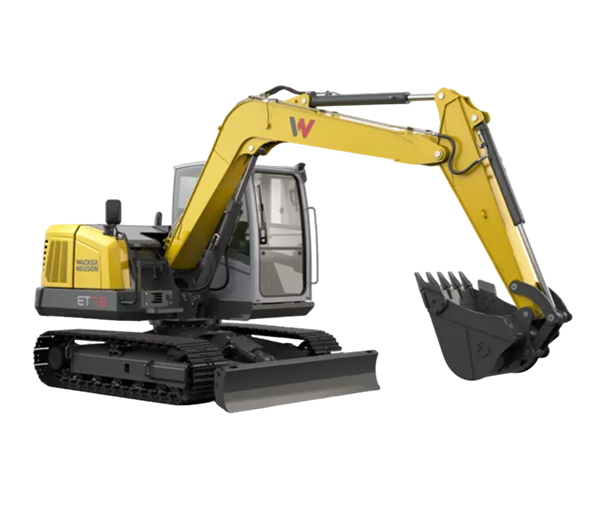
Wacker neuson ET75 Excavator for Construction, Utility and Landscaping Work
When I talk about the Wacker Neuson ET75, I do not look at it as just another 7-ton excavator. I look at what kind of work the machine is expected to do, how often it will work, where it will operate, and what the customer needs to move every day.
That sounds obvious, but it matters. An excavator can have good specifications on paper and still be the wrong machine for a particular site. Maybe the machine is too wide for the access road. Maybe the digging depth is not enough. Maybe the customer needs a higher hydraulic flow for an attachment. Or maybe the machine is simply larger than necessary for the work.
The Wacker Neuson ET75 Excavator sits in a useful middle range for construction machinery. Wacker Neuson's published technical data lists an operating weight of approximately 6,800–7,320 kg depending on configuration, a maximum digging depth of 4,097 mm, a width of 2,252 mm, and a transport length of 6,270 mm. The published engine data lists a 35.9 kW Yanmar diesel engine with 3,054 cm³ displacement.
For the China-market version shown by Wacker Neuson, the published page lists 7,300 kg operating weight, 35.9 kW engine output, China IV emissions, 144 l/min hydraulic flow, and a 145-liter fuel tank.
From my point of view, these figures make the ET75 worth considering for general construction, earthmoving, utility work, landscaping, road work, and other jobs where a Compact Excavator may not provide enough working capacity.
At Ganglong Heavy Industry Technology (Hefei) Co., Ltd., I handle construction machinery supply from the buyer's side. Our business covers construction machinery, mining machinery, agricultural machinery, attachments, equipment sales, leasing, inspection, and international trade.
When we supply a third-party brand such as Wacker Neuson, our role is to arrange supply and related trade services. We do not describe the Wacker Neuson ET75 as our own manufactured product. I think that distinction is important when a customer is comparing machinery suppliers.
The easiest way I explain the ET75 is as a tracked conventional excavator designed for everyday construction work where a machine needs useful digging power, stable crawler movement, and enough flexibility to handle more than one type of job.
The ET75 uses a crawler undercarriage. Instead of traveling on road wheels, the machine moves on steel tracks. This gives it a stable working platform and makes it suitable for construction sites, earthmoving areas, landscaping projects, utility work, and other locations where ground conditions can change.
Above the crawler system is the upper carriage. This houses the engine, hydraulic components, cab, counterweight, and swing system. At the front, the boom, arm, and bucket form the main working equipment.
From the operator's seat, the job looks simple. Move the joystick, lower the boom, push the arm forward, fill the bucket, lift it, swing, and unload.
Behind those simple movements is the hydraulic system.
When I compare Excavators, I pay close attention to the hydraulic system because it controls how the machine actually feels during work.
The ET75 uses a load-sensing hydraulic system with LUDV control. Wacker Neuson describes the system as helping provide quick working cycles, flexible application performance, and easier control. The company also states that the joystick movement remains consistent under different loads, which can make operation more comfortable.
In simple terms, the machine tries to give the operator the hydraulic response needed for the task instead of simply pushing maximum flow all the time.
That matters when an operator is working with different loads during the same day.
I would not buy the ET75 simply because I need to dig holes.
I would consider it when I need one machine that can handle excavation, trenching, site preparation, landscaping, drainage, material handling, and similar work.
Wacker Neuson also offers different attachments and equipment options for its excavators. That gives contractors the possibility of adapting the machine to different tasks instead of purchasing a separate machine for every small job.
Of course, attachment compatibility must be checked before ordering. Hydraulic flow, pressure, attachment weight, mounting dimensions, and the actual work all need to match.
When a customer asks me about an ET75 Excavator, I start with the specification sheet.
Not because numbers tell the whole story, but because they quickly show whether the machine is in the right size range for the project.
Wacker Neuson's published international technical data gives the ET75 an operating weight range of 6,800–7,320 kg, depending on configuration. It lists 35.9 kW engine power, 3,054 cm³ engine displacement, 144 l/min hydraulic flow, 285 bar hydraulic operating pressure, and a 145-liter fuel tank.
| ET75 Specification | Published Data | Why I Check It |
|---|---|---|
| Operating weight | 6,800–7,320 kg | Shows the machine's working class and transport requirements |
| Engine power | 35.9 kW | Shows available engine output |
| Engine | Yanmar 4TNV94L-ZWWN | Identifies the engine configuration |
| Engine displacement | 3,054 cm³ | Useful when checking engine specifications |
| Hydraulic flow | 144 l/min | Important for hydraulic functions and attachments |
| Hydraulic pressure | 285 bar | Helps evaluate hydraulic working capability |
| Fuel tank | 145 L | Useful for daily operating planning |
| Maximum digging depth | 4,097 mm | Important for trenching and excavation |
| Maximum digging radius | 6,264 mm | Shows the working reach |
| Travel speed | 2.5 / 4.8 km/h | Useful for moving around the jobsite |
Source: Wacker Neuson published ET75 technical data. Specifications may vary by market, configuration, and optional equipment.
The published ET75 dimensions are approximately 6,270 mm in transport length, 2,252 mm in width, and 2,559 mm in height.
When I discuss an excavator with a customer, I always ask about the entrance to the site.
Can the machine pass through the gate?
Is there enough space for a truck to deliver it?
Can the machine turn around once it arrives?
These questions may sound boring, but they can save a lot of trouble later.
Wacker Neuson also publishes a 450 mm track width for the referenced ET75 dimensional configuration.
The maximum published digging depth is 4,097 mm, while the maximum digging radius is 6,264 mm. Maximum reach at ground level is listed at 6,106 mm.
For normal excavation, these numbers give me a quick idea of what the machine can physically reach.
But I do not treat maximum digging depth as a promise that every job can be excavated to exactly that depth. Bucket design, ground conditions, boom and arm configuration, machine position, and operator technique all affect actual work.
Specifications are useful, but I think an excavator makes much more sense when you imagine a normal working cycle.
Let us say I am using an ET75 for a drainage project.
I position the machine next to the work area. The dozer blade helps stabilize the machine and can also assist with light surface work. I lower the boom, move the arm into the soil, and use the bucket to remove material.
After filling the bucket, I raise the boom and swing the upper carriage toward the truck or stockpile.
The bucket opens.
The material is released.
Then I swing back and start again.
That cycle repeats for hours.
The ET75 uses a Yanmar diesel engine. Wacker Neuson's published data identifies the 4TNV94L-ZWWN engine, with 3,054 cm³ displacement and 35.9 kW effective power at 2,000 rpm on the referenced technical page.
The engine provides the energy needed to run the machine, but that energy becomes useful work through the hydraulic and mechanical systems.
That is why I never compare excavators using horsepower alone.
A machine with high engine power still needs a well-matched hydraulic system, working equipment, undercarriage, and control system.
Wacker Neuson describes the ET75's LUDV load-sensing hydraulic system as helping provide quick working cycles and easier control. The company specifically notes that joystick control movements remain the same regardless of the load being moved.
From an operator's point of view, that is useful.
If the bucket is empty, loaded, or working against different soil conditions, the operator still needs predictable control.
Good hydraulic control does not mean the machine magically digs through everything. It simply helps turn operator input into controlled machine movement.
The ET75 has two published travel speeds, 2.5 km/h and 4.8 km/h.
That is enough for moving around a construction site, but I would not think of the ET75 as a road transportation machine.
For international delivery or long-distance movement, I arrange transportation separately. That is especially important because the machine's transport dimensions and weight need to be considered before shipment.
When I inspect construction equipment, I try to focus on features that affect the operator's normal day.
The ET75's load-sensing hydraulic system is one of the features I pay attention to.
Wacker Neuson describes the system as LUDV, or load-independent flow distribution. In practical language, it helps manage hydraulic flow according to the machine's operating demand.
This can be especially useful when the operator combines movements.
For example, digging is not just one movement. The boom, arm, bucket, and swing may all need to work together during a normal cycle.
The hydraulic system needs to coordinate those movements without making the controls feel unpredictable.
Wacker Neuson describes the ET75 as being constructed with high-grade steel and heavy-duty components, with a focus on durability and stability. The company also highlights increased lift capacity and an optional dozer blade.
I consider stability especially important when an excavator is lifting material or working with the machine positioned close to an excavation.
The operator needs a stable base to work from.
The dozer blade is another practical feature.
It can help stabilize the excavator during certain digging operations and can also be useful for light grading, backfilling, and moving loose material.
Wacker Neuson's standard component information lists a dozer blade for the ET75 configuration shown on its website.
The ET75 has an automatic two-speed travel system in the referenced standard equipment information.
That gives the operator a lower-speed setting for controlled movement and a higher-speed setting when moving around the jobsite.
Again, I see this as a practical feature rather than something dramatic. Operators use these small conveniences many times every day.
The published fuel tank capacity is 145 liters. Wacker Neuson specifically describes the large diesel tank as helping provide longer working periods between refueling.
For a contractor, reducing unnecessary refueling stops can be useful.
Of course, actual fuel consumption depends on the working load, operator habits, hydraulic demand, idle time, ground conditions, and maintenance.
The ET75 is designed around joystick operation. The hydraulic pilot control allows the operator to control the working equipment from the cab.
I like simple controls.
When a machine is used every day, an operator should not need to fight with the controls just to perform a normal digging cycle.
| ET75 Feature | Published Information | What I See in Daily Use |
|---|---|---|
| LUDV hydraulic system | Load-sensing, load-independent flow distribution | Helps maintain predictable control |
| Hydraulic flow | 144 l/min | Provides hydraulic capacity for machine functions |
| Hydraulic pressure | 285 bar | Supports working hydraulic functions |
| Dozer blade | Listed as standard equipment in referenced configuration | Useful for stabilization and light grading |
| Two-speed travel | 2.5 / 4.8 km/h | Useful for controlled site movement |
| Fuel tank | 145 L | Supports longer working intervals |
Source: Wacker Neuson ET75 official technical data and standard equipment information. Equipment can vary by market and configuration.
When I look at the ET75's size and working range, I see a machine that fits a wide range of everyday construction jobs.
Building sites often require excavation before the actual structure begins.
The ET75 can be used for foundation preparation, soil removal, trenching, drainage, material handling, and general site preparation.
Its approximately 4.1-meter maximum digging depth gives it useful working range for many building and utility applications.
I would still check the actual foundation depth and site layout before selecting the machine.
Utility work is a natural application for a tracked excavator.
Water pipes, drainage, electrical cables, communication lines, and other underground infrastructure all require controlled excavation.
The ET75 can be useful for trenching and backfilling when the site has enough room for the machine.
For narrow urban areas, I would first check machine width and tail swing. The published ET75 width is 2,252 mm and tail swing radius is 1,777 mm.
Landscaping contractors often need more than a small digging machine.
They may need to remove soil, prepare drainage, shape terrain, dig ponds, move material, and prepare foundations for landscaping structures.
The ET75 provides a useful middle ground between small compact excavators and much larger construction machines.
With suitable attachments, the machine can also support tasks beyond standard bucket excavation.
Road projects can involve drainage, ditch excavation, earthmoving, shoulder preparation, and material handling.
The ET75 can support these tasks when its size and working range match the project.
I would especially look at access and transportation on road projects because the machine may need to move between several work areas.
Municipal work can include drainage repairs, pipe installation, road maintenance, landscaping, and property improvement.
These jobs often require a machine that can perform different tasks rather than one machine designed for only one operation.
That is where an ET75-type excavator can be useful.
Industrial facilities and large properties may also need regular excavation and material handling.
Drainage improvements, underground utility repairs, foundation work, and site preparation can all require an excavator.
For this kind of customer, I usually look closely at transportation, storage, attachment options, and service support.
I often get questions such as, “Why should I use a 7-ton excavator instead of a 3-ton or 15-ton machine?”
My answer is that each class has a different job.
A Mini Excavator is excellent when access is difficult. A larger excavator can move more material per cycle. A machine around seven tonnes sits between these two needs.
| Excavator Class | Main Advantage | Typical Applications | What I Check |
|---|---|---|---|
| 1–3 ton compact excavator | Very small working footprint | Gardening, landscaping, small utilities | Access and lifting capacity |
| 5–8 ton excavator | Balance of size and working capacity | General construction, utilities, landscaping | Digging depth, width and attachment needs |
| 10–15 ton excavator | Higher material handling capacity | Road construction, earthmoving, infrastructure | Transport and site size |
| 20+ ton excavator | High digging and production capacity | Heavy infrastructure, quarrying, large earthmoving | Production volume and transport |
Source: General construction machinery class comparison. ET75 specifications are based on Wacker Neuson's published technical data.
I would not say that the largest excavator is automatically the right choice.
If a contractor is working in a backyard or narrow municipal area, a 20-ton excavator can be difficult to use.
If the contractor is loading hundreds of truckloads of material every day, a smaller excavator may simply take too many cycles.
The ET75 makes sense when the customer wants more capacity than a compact excavator but still wants to remain in a relatively manageable machine size.
The biggest difference is working capacity and physical size.
A mini excavator can enter spaces where the ET75 cannot. But once the job requires deeper digging, more material movement, or longer working cycles, the larger machine can become more practical.
A 10–15 ton excavator generally offers more weight and working capacity, but it also needs more space and transportation planning.
If the job does not require that extra capacity, an ET75 may be easier to handle.
That is the kind of decision I prefer to make from the jobsite backward.
When I supply a Wacker Neuson ET75 to an overseas customer, I treat the machine itself and the supply process as one complete project.
The customer needs more than a machine model and a price.
I ask what the machine will be used for.
Construction? Landscaping? Utilities? Road maintenance? Industrial work?
I also ask about soil conditions, working hours, required attachments, site access, destination country, quantity, and delivery schedule.
This gives me a much clearer idea of the correct configuration.
This is important because Wacker Neuson states that its product range can vary by country. The company also notes that equipment, data, optional features, and engines shown on its website may differ from the current delivery program in a particular country.
For example, the international technical page gives an operating weight range of 6,800–7,320 kg, while the China page lists 7,300 kg for its referenced configuration.
So I confirm the exact market version instead of assuming that every ET75 has identical equipment.
Before shipment, we can arrange checks based on the confirmed order.
I normally check the machine's appearance, major functions, hydraulic system, electrical system, working equipment, controls, accessories, and required documents.
If the buyer has a specific inspection checklist, I prefer to receive it before the machine is prepared for shipment.
For our international supply process, payment is commonly arranged by T/T, such as a deposit before production or order processing and the balance before shipment.
The exact payment terms are agreed between both parties according to the confirmed order.
I recommend confirming the exact machine configuration, attachments, inspection requirements, documents, shipping terms, and payment schedule before the order moves forward.
Complete machines are generally transported by sea for international orders.
Before loading, the machine is prepared and secured according to shipping requirements. Loose parts and suitable accessories can be packed separately in cartons or wooden cases.
For smaller spare parts, air or express delivery can be considered when the size, weight, urgency, and cost make it practical.
| Supply Stage | What I Confirm | Why It Matters |
|---|---|---|
| Project discussion | Application, working conditions and site | Helps select the suitable configuration |
| Machine confirmation | Market version, engine, options and attachments | Avoids configuration misunderstandings |
| Inspection | Appearance, functions and systems | Provides clearer pre-shipment control |
| Documents | Commercial and machine documents | Supports international shipment and customs procedures |
| Packing | Machine securing and loose parts | Protects equipment during transportation |
| Shipping | Loading, route and destination | Helps organize the delivery process |
Source: Ganglong Heavy Industry Technology and Hefei Ganglong International Trade international machinery supply process.
Ganglong Heavy Industry Technology (Hefei) Co., Ltd. was founded in 2013. Together with Hefei Ganglong International Trade Co., Ltd., our business covers equipment R&D, manufacturing, testing, customization, sales, leasing, and international trade.
Our self-branded HKLOONG product range includes excavators, loaders, Backhoe loaders, and swamp excavators.
At the same time, we provide complete machine sales and leasing services involving domestic and international brands including Hitachi, SANY, Lonking, Hyundai, XCMG, SHANMON, and LOVOL.
Our international trade team focuses on construction machinery, mining machinery, agricultural machinery, and matching attachments. We have experience serving markets across Asia, Africa, America, and other regions.
That broader experience helps when a customer needs more than one machine.
For example, a road contractor may need an ET75 excavator for drainage work, a Wheel loader for material handling, and additional attachments for different stages of the project.
I prefer to understand the complete project rather than simply quote one machine.
When someone searches for a Wacker Neuson ET75 for sale, it is easy to focus only on price.
I think the more useful questions are:
Which market version is available?
What engine and emission configuration does it have?
What operating weight does the final machine have?
Which attachments are included?
What is the hydraulic flow?
What documents are supplied?
How will the machine be inspected?
How will it be packed and shipped?
These details can affect the real value of the order much more than a small difference in the initial quotation.
I also want to keep one point clear.
Wacker Neuson is the equipment manufacturer. Ganglong is handling the supply and international trade side for customers who purchase through us.
We do not present the ET75 as an HKLOONG-manufactured machine.
Our job is to help the customer identify the suitable machine, confirm the configuration, arrange inspection, coordinate documents and logistics, and support the international supply process.
The ET75 is a tracked conventional excavator designed for construction and other applications requiring stable digging and material handling. Wacker Neuson places it in the 6–15 tonne tracked excavator range.
Wacker Neuson's published technical data gives an operating weight range of 6,800–7,320 kg depending on configuration. The China-market page lists 7,300 kg for its referenced configuration.
The published ET75 data identifies a Yanmar 4TNV94L-ZWWN four-cylinder diesel engine with 3,054 cm³ displacement and 35.9 kW effective power for the referenced configuration.
The published maximum digging depth is 4,097 mm. Actual digging performance depends on the working equipment, ground conditions, machine position, and configuration.
The published hydraulic flow is 144 l/min, with hydraulic operating pressure listed at 285 bar. Attachment compatibility should always be confirmed according to the exact machine configuration and attachment requirements.
The published fuel tank capacity is 145 liters. Wacker Neuson highlights the large diesel tank as supporting longer working periods between refueling.
The published maximum digging radius is 6,264 mm, while maximum reach at ground level is 6,106 mm for the referenced configuration.
Yes. Its size and tracked design make it suitable for many landscaping tasks such as soil removal, terrain preparation, drainage work, pond excavation, and material handling, provided the machine dimensions match the site.
Yes. The ET75 can be used for trenching, drainage, pipeline installation, cable work, and other utility projects. Before selecting it, I check trench depth, working width, access, and required attachments.
Yes, suitable attachments can expand the excavator's working range. However, I always confirm hydraulic flow, pressure, attachment weight, mounting dimensions, and the actual application before including an attachment in an order.
Yes. According to the confirmed order, we can arrange checks covering machine appearance, major functions, hydraulic and electrical systems, operating performance, accessories, and required documents.
Complete machines are generally transported by sea for international orders. The final loading, securing, packing, and delivery arrangements depend on the destination, shipping route, and confirmed order requirements.
When I look at the Wacker Neuson ET75, I see a machine that sits in a practical part of the excavator market.
It is small enough to remain manageable for many construction and landscaping projects, but it has more working capacity than a typical mini excavator.
The published specifications give a useful picture: approximately 6,800–7,320 kg operating weight, 35.9 kW Yanmar diesel power, 144 l/min hydraulic flow, 4,097 mm maximum digging depth, 6,264 mm maximum digging radius, and 145-liter fuel capacity in the referenced configuration.
The LUDV load-sensing hydraulic system is another feature I would pay attention to, especially for operators who spend long days performing repeated digging and loading cycles. Wacker Neuson describes it as supporting quick working cycles, application flexibility, and easier control.
But I would not choose an ET75 only because the specification sheet looks good.
I would start with the job.
If I need an excavator for utility construction, landscaping, drainage, general building work, road maintenance, or site preparation, I would check whether the ET75's size, digging depth, hydraulic system, and attachment options fit the project.
I would also check access before ordering.
The published width is 2,252 mm, and the transport length is 6,270 mm. Those numbers need to fit the customer's loading, transportation, and jobsite conditions.
For customers searching for a Wacker Neuson ET75 Excavator, ET75 Tracked Excavator, ET75 Hydraulic Excavator, or Wacker Neuson ET75 for sale, my advice is simple: compare the complete machine package, not just the machine price.
Confirm the market version. Confirm the engine. Confirm the operating weight. Confirm the hydraulic requirements. Confirm the attachments. Confirm the inspection. Confirm the documents. Then confirm the shipping plan.
At Ganglong, this is how I approach international construction machinery supply. I want to understand the project first, match the machine to the actual work, confirm the exact configuration, and then handle the practical details of inspection, payment, documentation, packing, and delivery.
The ET75 is ultimately a working machine. Its value comes from how well it fits the operator, the attachment, the jobsite, and the daily workload.
That is the way I prefer to evaluate it: not simply as a seven-ton excavator, but as a practical tool that needs to earn its place on the jobsite every working day.
2435092534@qq.com
86 158 5511 9567


©2026 HKLOONG Heavy Industry Technology (Hefei) Co., Ltd. All Rights Reserved.

This website uses cookies to ensure you get the best experience on our website.
 Español
 Pусский
 Français
 العربية


 WhatsApp
 Phone
Phone E-mail
 Message