

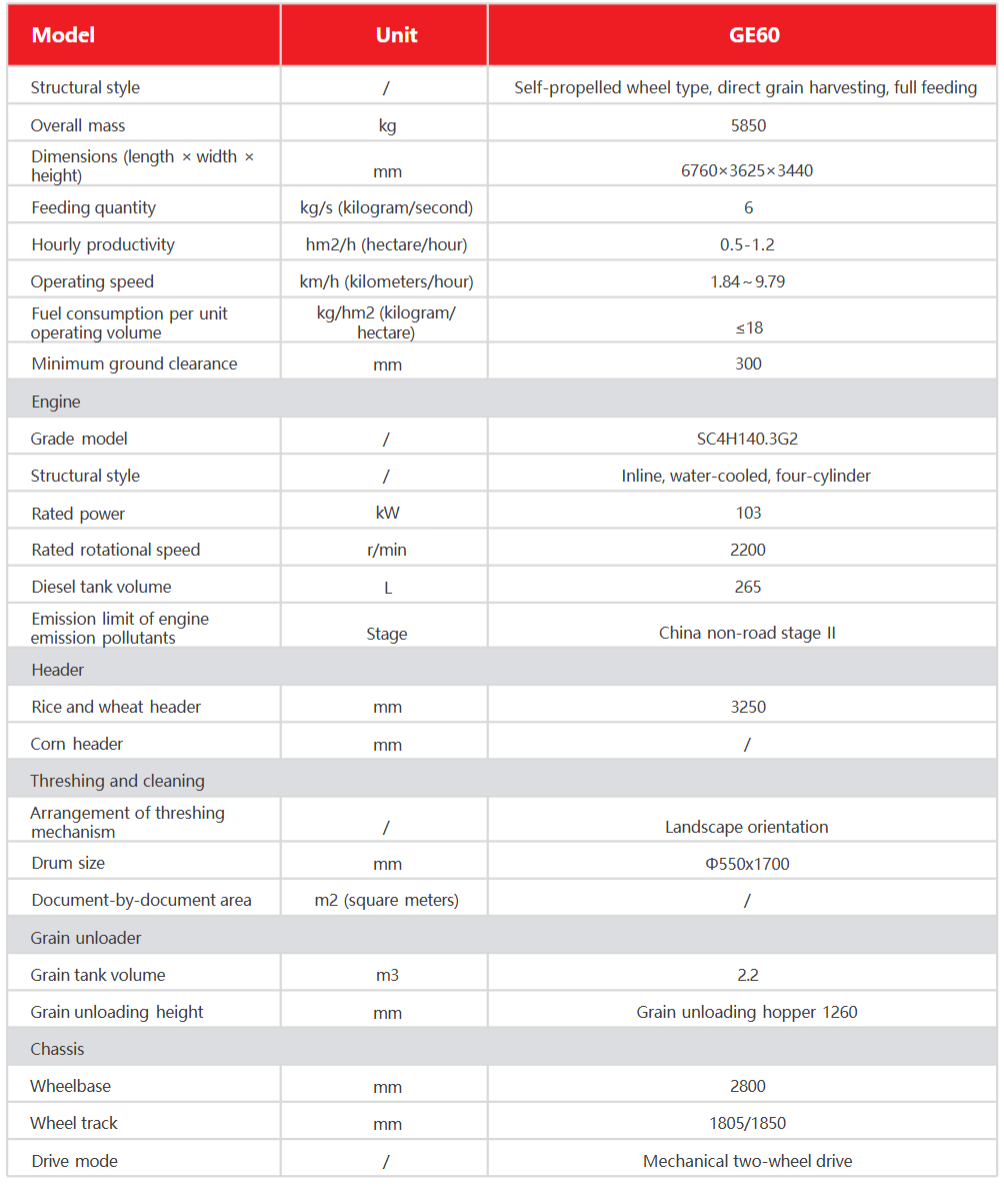
Wheel Harvester GE60: A Practical Combine Harvester for Rice and Wheat
When I talk about a Wheel Harvester GE60 with an agricultural machinery buyer, I usually avoid starting with a long list of numbers.
I first ask a much simpler question: what kind of field are you working in?
That question sounds basic, but it matters. A combine harvester can look very impressive on paper and still be the wrong machine for a particular farm. Field size, crop type, soil condition, crop moisture, transportation distance and daily harvesting requirements all affect the right choice.
The LOVOL GE60 Wheel Harvester is a machine I would normally discuss with customers looking for a practical wheeled combine harvester for grain harvesting, especially rice and wheat. The GE60 name has been used across different market and production configurations, so specifications can vary by version. Published data for different GE60 variants shows feeding capacity around 6 kg/s, with different engine, header and grain-tank configurations depending on the model and market.
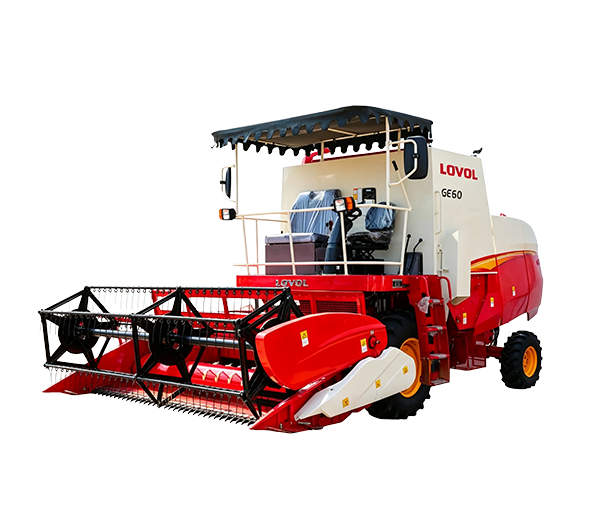
For example, one published GE60 4LZ-6E7 specification lists a wheeled, full-feed combine with a 103 kW engine, a 2,650 mm header, 6 kg/s feeding capacity, 2.2 m³ grain tank and 0.5–1.2 hm²/h working efficiency. Another GE60 research specification identifies the 4LZ-6E3 version with a 107 kW rated engine, 2,510 mm header and 0–6 kg/s feeding range.
That is why, at Ganglong Heavy Industry Technology (Hefei) Co., Ltd., I prefer to confirm the exact GE60 configuration before discussing a final international order.
We are an industrial and international trading group founded in 2013. Together with Hefei Ganglong International Trade Co., Ltd., we work with construction machinery, mining machinery, agricultural machinery and matching attachments. Our international trade team has experience serving customers across Asia, Africa, America and other markets.
So when I introduce the GE60 Wheel Combine Harvester, I am not looking at it as just a machine sitting in a brochure. I look at the complete job: harvesting, transportation, inspection, preparation, shipment and the customer's actual working conditions.
The Wheel Harvester GE60 is a wheeled, self-propelled combine harvester designed to bring several harvesting operations together in one machine.
In simple terms, the machine cuts the crop, feeds it into the harvesting system, threshes the crop, separates the grain, cleans the grain and stores it in the grain tank. When the tank is full, the grain can then be unloaded into a trailer, truck or other receiving vehicle.
That sounds straightforward, but there is quite a lot happening inside the machine.
The GE60 is mainly associated with rice and wheat harvesting in published product information. Earlier GE60 product data also identifies it as a full-feed combine harvester suitable for rice and wheat, with a 6 kg/s feeding capacity.
For buyers looking for a LOVOL GE60 Wheel Harvester, the wheeled chassis is one of the main points to understand. Unlike a crawler combine, the GE60 uses wheels for movement. That gives the machine a different balance between field mobility, road travel and operating conditions.
I normally see this type of machine making sense when the customer has relatively accessible fields and also needs to move the combine between different plots or working areas.
The machine is not designed around one single number. Its usefulness comes from how the header, feeding system, threshing system, cleaning system, grain tank and chassis work together.
Another point is worth mentioning before we go deeper: GE60 is not necessarily one identical specification worldwide.
Current LOVOL overseas pages also use the GE60 name for a newer compact axial-flow configuration, with published figures that differ significantly from older Chinese-market GE60 versions. This is a good example of why international buyers should confirm the exact model code, destination-market configuration and specification sheet before ordering.
For our customers, I treat that confirmation as part of the normal purchasing process rather than a small detail.
The working principle of a combine harvester is actually quite easy to understand if we break it into several steps.
The process starts at the header.
The header reaches the standing crop and cuts it before guiding the material toward the feeding area. The reel helps bring the crop into the cutting and feeding system.
The exact header width depends on the GE60 configuration. Published 4LZ-6E7 data lists a 2,650 mm header, while another published GE60 version lists a 2,510 mm header.
This difference is not something I would ignore when preparing a quotation. A customer may have a particular field width, transport restriction or crop condition that makes one header configuration more suitable than another.
After cutting, the crop enters the feeding system.
The feeding system has a simple but important job: move the harvested crop into the threshing section at a steady rate.
Published GE60 specifications commonly show a feeding capacity around 6 kg/s.
Of course, 6 kg/s should not be understood as a guaranteed field output. Real harvesting performance changes with crop density, moisture, crop height, travel speed and operator settings.
Once the crop enters the machine, the threshing system separates grain from the harvested plant material.
Different GE60 configurations use different threshing arrangements. Published GE60 4LZ-6E7 data describes a cutting-flow plus transverse axial-flow arrangement, while other technical material identifies GE60 variants with transverse axial-flow threshing.
The basic goal remains the same: separate the useful grain while reducing unnecessary grain loss and damage.
After threshing and separation, the grain still contains unwanted material such as chaff and lighter crop residue.
The cleaning system uses airflow and screening to separate the grain from lighter material. Published GE60 data identifies a wind-screen cleaning system on the 4LZ-6E7 version.
Cleaned grain is transferred into the grain tank.
A published GE60 4LZ-6E7 specification lists a 2.2 m³ grain tank.
For a harvesting operation, this tank is more important than it may first appear. A larger tank can reduce the number of interruptions caused by unloading, although the actual working rhythm depends on crop yield and the transport vehicle working alongside the combine.
When the grain tank reaches the required level, the grain is transferred out of the combine.
This creates a small but important teamwork problem in the field: the combine and the receiving vehicle need to work together. If the truck arrives too late, the combine may have to stop. If the receiving vehicle cannot keep up, the harvesting system loses some of its potential efficiency.
That is why I always recommend looking at the combine and the complete harvesting operation together.
The wheeled design is the first feature I would discuss with a customer.
A wheel harvester is different from a crawler harvester. Wheels are particularly useful when the machine needs to move between fields or travel over suitable roads. They also give the machine a familiar layout for customers who already operate wheeled agricultural equipment.
That does not mean a wheel harvester is automatically better for every field. If the farm regularly deals with very soft paddy soil, deep mud or difficult wet-ground conditions, a crawler combine may deserve more attention.
For relatively accessible fields, however, the wheel configuration can be a practical choice.
The published 6 kg/s feeding figure is one of the most commonly reported specifications for the GE60 family.
I use this number mainly as a way to understand the machine's harvesting class. It tells us that the GE60 is not simply a small Cutting machine. It has a complete feeding, threshing and cleaning system designed for continuous combine harvesting.
Still, I would never promise that every farm will achieve a fixed area per hour based only on the feeding number.
Real life is messier than that.
A dense wheat crop behaves differently from a lighter crop. Wet rice behaves differently from dry wheat. A flat rectangular field is easier to work than a small field divided by irrigation channels or obstacles.
For the published GE60 4LZ-6E7 version, the grain tank is listed at 2.2 m³.
This gives the operator a useful amount of temporary grain storage while continuing to harvest.
Rice and wheat are two of the main crops associated with GE60 configurations.
For rice, the combine needs to handle crop moisture and field conditions carefully. For wheat, the machine needs to manage cutting, feeding, threshing and cleaning efficiently while maintaining acceptable grain quality.
Some GE60 configurations and overseas materials also describe broader crop capability, but I recommend confirming the exact header and harvesting configuration when a customer plans to use the machine for crops beyond the main applications.
One thing I have learned from international machinery sales is that product specifications should never be copied blindly from one market page to another.
GE60 is a good example.
Different published materials identify different GE60 versions, including 4LZ-6E3 and 4LZ-6E7. Their specifications are not exactly the same. The current LOVOL overseas GE60 page also lists a newer configuration with significantly different published dimensions and power figures.
For that reason, I use the following table as a configuration reference, not as a promise that every GE60 sold in every country has identical specifications.
| GE60 Version / Published Data | 4LZ-6E3 | 4LZ-6E7 |
|---|---|---|
| Machine type | Wheel combine configuration | Wheel, full-feed combine |
| Rated power | 107 kW | 103 kW |
| Feeding capacity | 0–6 kg/s | 6 kg/s |
| Header width | 2,510 mm | 2,650 mm |
| Minimum ground clearance | 350 mm | 300 mm |
| Typical application | Grain harvesting | Rice and wheat harvesting |
Source: International Journal of Agricultural and Biological Engineering technical paper for GE60 4LZ-6E3; published GE60 4LZ-6E7 technical data.
The important lesson here is simple: ask for the model code before comparing prices or specifications.
If two suppliers both write “GE60” but one is offering 4LZ-6E3 and the other is offering 4LZ-6E7, the machines may not have exactly the same specifications.
For international orders, I would also confirm the destination market because export configurations can be different from domestic configurations.
Customers sometimes ask me whether they should choose a wheel combine, a crawler combine or a larger high-capacity wheel combine.
There is no universal answer. The field should make the decision.
| Feature | Wheel Harvester GE60 | Crawler Harvester | Larger Wheel Combine |
|---|---|---|---|
| Running system | Wheels | Crawlers | Wheels |
| Field mobility | Good on suitable fields | Strong focus on soft and wet fields | Good on suitable large fields |
| Road movement | Practical for suitable roads | Usually less convenient | Practical for suitable roads |
| Typical harvesting position | Small to medium farming operations | Wet-field and paddy applications | Higher-output large-field operations |
| Typical crop focus | Rice and wheat | Rice and other suitable crops | Wheat, rice, corn, soybeans and other crops depending on configuration |
| Purchase consideration | Balance between harvesting and mobility | Ground condition is a major factor | Higher output and larger field requirements |
Source basis: published LOVOL GE60 data, LOVOL crawler combine product information and current LOVOL agricultural machinery specifications. The table describes general equipment characteristics rather than a fixed performance ranking.
For a customer with normal field access and a need for a wheeled machine, the GE60 can be a practical option to consider.
For very soft paddy fields, I would look more closely at a crawler combine.
For very large farms where daily harvesting output is the main concern, I would compare the GE60 with a larger combine in the same market.
That is a much more useful way to compare agricultural machinery than simply asking which machine has the biggest engine.
When we handle an international agricultural machinery order, I do not want the process to stop after the customer says, “I need one GE60.”
There are several things I want to confirm first.
I ask what the machine will harvest.
Is it rice? Wheat? Both? Is the land flat? Are there irrigation channels? Is the soil normally dry or wet? How large is each field?
These questions help us understand whether the wheel configuration is appropriate.
This is particularly important for GE60.
As mentioned above, different GE60 versions have different published specifications. Therefore, I confirm the model code, engine configuration, header, grain tank, dimensions and other important equipment before the commercial order is finalized.
Before delivery, we can arrange checks covering the engine, hydraulic system, electrical system, tires, harvesting functions, attachments and required documents.
I prefer to treat inspection as a normal part of the order rather than something that only happens when a customer specifically asks for it.
For agricultural machinery, small parts can matter a lot during harvest season.
Depending on the order, suitable accessories and spare parts can be prepared separately. We can discuss the customer's operating environment and help identify practical spare parts requirements before shipment.
Complete harvesting machines are generally shipped by sea for international orders.
Before loading, the machine needs to be properly secured and protected. Loose accessories can be packed separately in cartons or wooden cases depending on the product and transportation requirements.
The actual shipping arrangement depends on the destination port, machine dimensions, shipping schedule and order details.
Let me make one thing clear first.
Ganglong does not claim to manufacture every agricultural brand that we supply.
Our role is broader. We work as an industrial machinery and international trade supplier, providing our own HKLOONG equipment while also supplying complete machines and related services for selected domestic and international brands, including LOVOL.
Ganglong Heavy Industry Technology (Hefei) Co., Ltd. was founded in 2013. Together with Hefei Ganglong International Trade Co., Ltd., our business covers equipment R&D, manufacturing, testing, customization and global sales.
Our product range includes construction machinery, mining machinery, agricultural machinery and matching attachments.
For customers buying a LOVOL GE60 Wheel Harvester, our job is therefore not simply to quote a machine price.
We can help coordinate:
Model and configuration confirmation
Agricultural application discussion
Machine availability checking
Commercial quotation
Order and payment arrangements
Pre-delivery inspection
Accessories and document checking
Export preparation
Machine loading and transportation coordination
International shipping arrangements
Our international trade team has served customers across Asia, Africa, America and other regions. That experience is useful because overseas machinery orders usually involve more questions than a domestic purchase.
The customer may need to understand shipping dimensions, port arrangements, machine configuration, spare parts, inspection requirements, payment terms and delivery preparation.
I would rather answer those questions before shipment than discover them after the machine has already left the port.
The Wheel Harvester GE60 is a wheeled self-propelled combine harvester associated with LOVOL's GE60 product family. Different GE60 versions exist, so the exact model code should be confirmed before ordering.
Rice and wheat are the main crops commonly associated with published GE60 configurations. Some newer LOVOL market materials describe additional crop capability, but the correct header and harvesting configuration should be confirmed for the intended crop.
No. The GE60 configuration discussed on this page is a wheel harvester. Its running system uses wheels rather than crawler tracks.
Published GE60 specifications commonly list a feeding capacity of around 6 kg/s. Some technical materials show this as a 0–6 kg/s operating range.
The answer depends on the version. Published GE60 specifications include header widths such as 2,510 mm and 2,650 mm. We recommend confirming the exact model code and configuration before placing an order.
A published GE60 4LZ-6E7 specification lists a 2.2 m³ grain tank. Other GE60 market configurations can have different specifications, so the final capacity should be confirmed on the quotation.
Yes. Rice is one of the main crops listed for GE60 configurations. However, field moisture and soil condition should be considered carefully because a wheeled combine and a crawler combine behave differently in wet paddy fields.
Yes. Published GE60 product information identifies wheat as one of its main applications. The header and machine configuration should be selected according to the intended working conditions.
The main difference is the running system. The GE60 uses wheels, while a crawler combine uses tracks. A wheel combine can be attractive where field access and road movement are important, while a crawler machine may be more suitable for particularly soft or wet ground.
Yes. Through our international trade business, we can coordinate LOVOL agricultural machinery supply for overseas customers, including model confirmation, inspection, export preparation and shipping arrangements.
There is no single fixed lead time. Preparation depends on the exact GE60 model, configuration, quantity, machine availability, inspection requirements and shipping schedule. We confirm the delivery arrangement for each order.
International orders are commonly arranged by T/T, with a deposit before order processing and the balance before shipment. Exact payment terms are agreed between the buyer and seller according to the order.
Complete agricultural machines are generally transported by sea. Smaller suitable accessories or spare parts may be shipped by air or express. The final method depends on the destination and shipping requirements.
When I look at the Wheel Harvester GE60, I see a machine that should be evaluated from a practical farming point of view.
It is not simply about horsepower.
The important questions are whether the wheel chassis suits the field, whether the header matches the crop, whether the feeding capacity matches the expected workload, whether the grain tank fits the harvesting rhythm and whether the machine can be transported and supported properly in the destination market.
Published GE60 data shows why configuration confirmation is important. Different versions use different engine power, header width, ground clearance and other specifications. Current overseas LOVOL materials also show a newer GE60 configuration with specifications that differ from older GE60 versions.
For that reason, I would never tell an international buyer to make a decision from the words “GE60” alone.
I would first confirm the exact model.
Then I would confirm the crop.
Then the field.
Then the configuration.
Then the shipping requirements.
That simple process can prevent many misunderstandings later.
For customers searching for a LOVOL GE60 Wheel Harvester, GE60 Wheel Combine Harvester, GE60 Rice Harvester, GE60 Wheat Harvester or LOVOL GE60 Agricultural Harvester, Ganglong can help with model confirmation, configuration communication, machine inspection, export preparation and international delivery.
Our goal is straightforward: make sure the machine being quoted is clearly understood before the order moves forward, and make the journey from agricultural machinery supplier to overseas delivery as smooth and practical as possible.
info@hkloong.com
86 158 5511 9567


©2026 HKLOONG Heavy Industry Technology (Hefei) Co., Ltd. All Rights Reserved.

This website uses cookies to ensure you get the best experience on our website.
 Español
 Pусский
 Français
 العربية
 WhatsApp
 Phone
Phone E-mail
 Message