

An Excavator can start its engine on a freezing morning yet damage a Hydraulic Pump when thick oil cannot reach the inlet fast enough during immediate high-speed boom operation. In our field testing, we track starting, fluid flow, controlled warm-up, and loaded response as separate phases. This article defines the evidence needed to specify cold-weather operation without treating a successful engine start as proof of hydraulic readiness.
A battery and starter turn the engine, which then drives hydraulic pumps. The pumps draw fluid from a reservoir and deliver it to valves, cylinders, and motors. At low temperature, fluid viscosity generally rises, increasing resistance through suction lines, filters, valves, and narrow passages. The pump inlet must receive adequate fluid while the rotating group is moving. If demand increases before the fluid and components reach the approved condition, inlet starvation, abnormal noise, slow response, or wear can result. The relevant limits are specific to the actual pump, fluid, filtration, and ambient condition.
The engine and hydraulic circuit do not warm at the same rate. An engine may run smoothly while remote cylinders, travel motors, hoses, and oil in the reservoir remain cold. Cycling functions under the manufacturer's approved method moves fluid and gradually changes temperature, but excessive load during this phase can create pressure drops and stress seals. Local hot spots can occur while the bulk reservoir is still cold. Measure the operating state at defined locations and follow the machine's documented warm-up sequence rather than relying on elapsed idle time alone.
Cold exposure also changes the starting chain. Battery output, cable resistance, fuel condition, engine lubricant, heater function if installed, and control-system diagnostics affect cranking and initial engine stability. A weak battery can cause low-voltage faults that look unrelated to starting. Ice and packed snow can restrain tracks, hoses, or guards. Verify cold-start capability, approved fluids, starting aids, pump inlet criteria, and permissible function sequence from current manufacturer reports for the exact configuration. The supplied inputs contain no verified numerical appendix, named technical standard, or certificate.
When cold oil restricts supply, commanding full pressure or travel speed is not a diagnostic shortcut. Relief operation may heat fluid locally while the pump inlet remains poorly supplied. Stop on abnormal noise or warning, record temperature and operating state, and follow the manufacturer's approved recovery procedure before testing further.
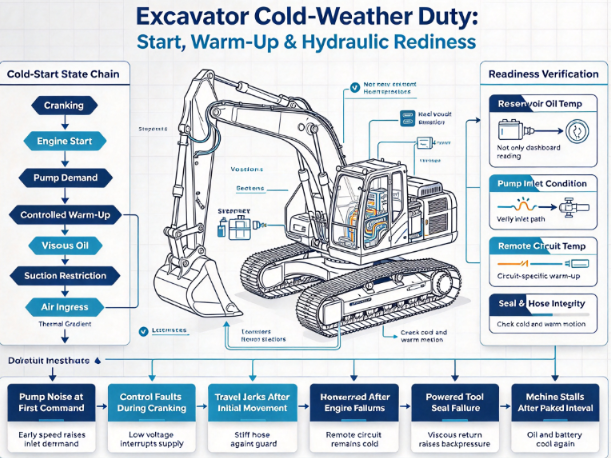
The selected machine's specifications govern every material and limit below. Confirm installed heaters and sensors rather than treating optional cold-weather equipment as standard.
| Component | MaterialSpec | Function | Failure Risk if Compromised |
|---|---|---|---|
| Battery, starter, and electrical cables | Verify installed capacity, cable condition, connection method, and cold-start maintenance criteria. | Deliver cranking energy and stable control power. | Low voltage causes failed start or misleading diagnostics. |
| Engine fuel and lubricant circuits | Verify approved fuel, lubricant, filter, heater if fitted, and operating temperature window. | Support stable combustion and engine lubrication. | Flow restriction or weak lubrication delays readiness. |
| Hydraulic reservoir and suction line | Verify fluid grade, line size, seals, strainer, air-entry protection, and approved inlet condition. | Supply pump with sufficient fluid under changing viscosity. | Restriction or air ingress contributes to inlet starvation. |
| Main pump and control valves | Verify rotating-group material, inlet and pressure criteria, spool response, and warm-up method. | Deliver and meter Hydraulic Flow to actuators. | Cold high-load command accelerates wear or sticking. |
| Cylinders, hoses, and seals | Verify seal and hose material compatibility, bend condition, and approved cold motion. | Move working equipment without leakage or line damage. | Stiff seals or hoses leak or crack under early movement. |
| Temperature indication and heaters if fitted | Verify sensor location, calibration, heater type, power source, and fault indication. | Provide evidence of readiness and controlled warming. | False reading or failed heater invites premature loading. |
Verify all parameters against current test reports and applicable standards before use in specifications.
Inspect the machine before attempting movement. Frozen mud can bond track shoes to the ground; ice can block the cooler face or pull on a hose guard. Observe leaks at joints after the first approved movements because a cold seal problem may appear only under pressure.
No named standard or verified numerical values were provided. State allowable temperature, fluid, pressure, speed, and warm-up limits only after obtaining current manufacturer documents. Test conditions must identify the machine's overnight exposure, installed fluid and heaters, and actual temperature at start.
| Parameter | Standard | Test Method | Acceptable Range | Implication if Out of Range |
|---|---|---|---|---|
| Cranking and electrical stability | Verify current engine and machine procedure. | Log starting behavior, supply state, heater operation, and fault codes. | Within documented starting and control limits. | Failed start or false sensor states. |
| Fluid identity and initial temperature | Verify manufacturer fluid specification. | Confirm batch, fill, service record, and readings at defined points. | Approved fluid and starting window for final build. | Excessive restriction or inadequate lubrication. |
| Pump inlet condition | Verify pump manufacturer criterion. | Measure approved inlet parameter during specified warm-up and first duty. | Within current pump-specific operating limit. | Inlet starvation and component damage. |
| Warm-up function response | Verify machine operating method. | Record controlled boom, stick, travel, and swing response as permitted. | Progresses to normal function without unapproved noise or faults. | Sticking, pressure spikes, or excessive delay. |
| Seal and hose integrity | Verify current component service criteria. | Inspect after cold cycling and at working temperature. | No unapproved leakage, cracking, or interference. | Fluid release or loss of control. |
| Loaded duty after warm-up | Verify final-build test report. | Repeat representative excavation or tool cycle once approved condition is achieved. | Within documented sustained hydraulic and engine envelope. | Cold-start test masks later production fault. |
Verify all parameters against current test reports and applicable standards before use in specifications.
Capture a temperature history rather than a single dashboard reading. Reservoir oil, pump housing, return line, and engine coolant may warm differently. A display may represent one sensor only; document its location and compare it with the criterion it is supposed to support. Preserve fault events during cranking and note whether they disappear after voltage and temperature recover.
Repeat the trial after a representative overnight exposure, not only after a brief outdoor parking period. Identify wind, enclosure, heater operation, and prior machine activity. If a heater is used, record its power supply and functioning state rather than assuming the equipment was preheated. The acceptance result should specify which condition was demonstrated and what work is prohibited below the verified starting envelope.
Pump inlet protection is a flow-availability problem. High viscosity increases friction losses in a suction path, and a partially blocked strainer adds more resistance. Air can enter through a compromised seal even when no external oil leak is visible. If fluid does not fill pump chambers as intended, the rotating parts can experience damaging conditions while the outlet gauge still shows pressure during brief commands. Evaluate the inlet and source path directly under the manufacturer's method. Increasing engine speed before supply is established raises demand and can worsen the fault.
Warm-up is a controlled energy-transfer process. Moving a permitted circuit produces flow and heat, gradually reducing viscosity, but the circuit must be exercised within its approved load and speed. Holding a stalled actuator against relief generates heat and may leave other components cold. Use the documented sequence for engine, pump, cylinders, travel and swing, checking abnormal noise, response, and temperature. Define readiness by verified operating state rather than a convenient fixed waiting period. An optional automatic warm-up feature must be confirmed on the actual machine and tested for its own fault response.
Thermal gradients affect seals and structures. Metal housings, rubber seals, hydraulic fluid, and flexible hoses change temperature at different rates. A connector can seal at ambient temperature yet leak after pressure and temperature rise, or a stiff cold hose may rub a new point in the equipment's movement. Inspect through the initial motion envelope and again at normal operating condition. A small early seep deserves investigation before the machine enters sustained work, especially near soil or water where fluid release has consequences.
Customization changes cold-weather readiness. A longer hydraulic hose run, larger auxiliary tool, added cooler, different reservoir guard, or altered fluid can change suction loss, warming rate, operating mass, and stability. Obtain the final build drawing and weight, stability assessment, measured pump inlet and auxiliary pressure-flow response, and factory acceptance after a representative cold soak where required. Link the test to the serial machine, fluid batch, tool, and heater configuration. A base model's cold-start statement cannot validate a modified circuit. Verify each numerical threshold against current manufacturer reports.
Cross-brand comparison should normalize exposure. Compare actual overnight temperature, fluid, battery condition, heater state, time from start to permitted duty, pump inlet behavior, and loaded response. One machine may start its engine quickly yet require a longer hydraulic sequence; another may differ because its fluid or preheating equipment is different. Assess the delivered configurations, including self-branded and other-brand options, under the same documented trial rather than ranking them by one advertised cold-start temperature.
Host and attachment compatibility is temperature-dependent as well as geometric. Verify coupler retention, tool mass and final lift chart, auxiliary pressure and flow, return condition, and the attachment's approved fluid and cold-start method. A tool motor may have a different permitted startup state from the host pump. Its case drain or return line can be especially sensitive to viscous cold oil. Begin powered-tool testing only after both host and tool conditions are satisfied; matching quick connections cannot establish cold-duty compatibility.
Cross-border delivery may change fluids, batteries, and heater connections. Record packing dimensions, disassembly scope, sealed hydraulic openings, installed fluid identification, battery handling, heater parts, spares, and the destination recommissioning sequence. After reassembly, verify fill, filters, hose routes, electrical connections, coolant, and fault codes. Repeat an approved cold-start and warm-up trial at the destination conditions, followed by loaded duty. Sign a serial-numbered handover identifying the exact ambient and fluid state. The factory trial may have occurred under a different climate and cannot be silently generalized.
Diagnostic sequence matters when the machine starts slowly. Determine whether the first constraint is cranking voltage, engine fuel, hydraulic pump drag, frozen travel gear, or a control fault. Isolate the systems under approved service procedures instead of repeatedly cranking or commanding full hydraulic motion. Preserve fluid samples and event logs before changing them. If a fault disappears after warming, it still needs a root cause; the warm state may merely hide a cold restriction or intermittent electrical connection.
A cold-weather specification should also define stop conditions and restart after a long idle interval. A machine can cool while parked on a windy site even after it passed a morning warm-up. Check whether a new controlled sequence is required before operating a loaded tool. Record any restriction on travel across frozen ground that may thaw unevenly later in the shift; machine readiness and support-platform readiness are separate approvals.
Keep the prior shift's shutdown record with the next start. An unresolved leak, low fluid level, or wet electrical connector can worsen during freezing exposure and confound the trial.
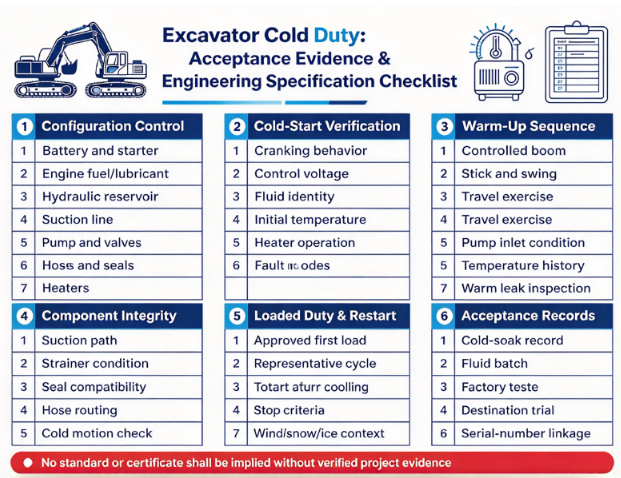
When we examine low-temperature failures, we reconstruct the temperature and command sequence. The immediate failed component often differs from the first restriction in the power or fluid path.
| Failure | Root Cause | Engineering Consequence | Prevention |
|---|---|---|---|
| Pump becomes noisy at first command | Viscous oil and suction restriction limit inlet filling when speed rises too early. | Accelerated rotating-group wear. | Verify fluid, inlet path, and approved warm-up sequence. |
| Engine cranks but control faults appear | Low-voltage event during cold start interrupts controller or sensor supply. | Misleading diagnostic and delayed operation. | Test battery and connections in the actual cold state. |
| Hose leaks after initial movement | Stiff cold hose bends against a guard while pressure rises at the fitting. | Fluid loss and tool malfunction. | Check route cold and warm through full approved motion. |
| Travel jerks after engine warms | Remote travel circuit remains cold although engine coolant reaches normal indication. | Uncontrolled motion near obstacles. | Follow circuit-specific warm-up and controlled travel test. |
| Powered tool seal fails | Cold viscous return flow raises backpressure above the tool's approved condition. | Seal leakage and lost output. | Verify tool-specific starting and return requirements. |
| Machine stalls after parked interval | Oil and battery cool again while restart assumes morning warmed state persists. | Poor response or fault under load. | Define restart assessment after significant cooling. |
Verify all parameters against current test reports and applicable standards before use in specifications.
Repeat the same cold exposure and startup sequence after correction where practicable. A warm workshop repair followed by an immediate test does not demonstrate that a cold-only failure has been removed. Document fluid, battery, heater, and ambient state in both trials.
Complete these clauses using exact final-build fluids and manufacturer limits.
Structural: Identify hose routing, reservoir, suction path, installed heaters, guards, and cold-exposed joints.
Structural: Verify final tool mass, working geometry, and support conditions on frozen or thawing ground.
Drive specifications: State approved fluid, pump inlet condition, cranking state, and circuit-specific warm-up sequence.
Drive specifications: Test first loaded duty after verified hydraulic readiness.
Environmental: Define overnight exposure, wind, storage, snow, ice, and operating-temperature changes.
Environmental: Include leak inspection, fault logging, stop criteria, and restart after cooling.
Safety standards: No named standard or company certification is confirmed; verify requirements before asserting compliance.
Acceptance: Link fluids, heater state, cold-soak record, factory test, and destination trial to serial number.
Share your project parameters for a technical review.
Ganglong Heavy Industry Technology (Hefei) Co., Ltd. describes R&D, manufacturing, testing, and customization; its product page should identify the exact cold-weather options and validation record for each configured excavator.
For any manufacturer, ask for approved fluid windows, pump inlet criteria, heater configuration, startup sequence, cold-soak test, and tool-specific restart instructions. Verify how changes to the auxiliary circuit affect the test. No certification or named standard is established in the supplied inputs.
No; remote circuits and reservoir oil may still be cold. Follow the current manufacturer's circuit-specific warm-up method. Confirm the approved operating condition before full load.
The pump inlet may not be supplied adequately at the commanded speed. Brief outlet pressure does not prove full chamber filling. Verify the inlet path and fluid against the current pump criteria.
No; availability and behavior depend on the installed configuration. Confirm its operation and fault response on the actual unit. Retain a documented manual procedure where permitted.
Its approved flow, return, drain, and seal conditions must be met alongside the host's limits. Cold oil can raise return restriction. Test the exact host-tool combination after controlled warm-up.
Verify fluid, battery, heaters, caps, filters, and hydraulic connections. Repeat the approved cold-start and loaded trial at destination. Record the actual exposure and serial configuration.
Share your winter temperature profile, fluids, installed tool, and startup records for a cold-duty review.
2435092534@qq.com
86 158 5511 9567


©2026 HKLOONG Heavy Industry Technology (Hefei) Co., Ltd. All Rights Reserved.

This website uses cookies to ensure you get the best experience on our website.
 中文
 Español
 Pусский
 Français
 العربية


 WhatsApp
 Phone
 E-mail
 Message
Comment
(0)