

An Excavator may finish a riverbank shift without an obvious fault while water enters a stick joint and an unsealed connector, producing corrosion and intermittent control failures weeks later. In our field reviews, we follow the ingress path and the delayed damage rather than equating temporary operation with durability. This article specifies wet-site boundaries, sealing checks, fluid sampling, and final-build evidence for water-adjacent work.
Hydraulic Pumps and valves move cylinders and motors, while fabricated structures, pins, bearings, hoses, and electrical circuits transmit forces and commands. In a wet environment, water interacts with each system differently. It can enter a pin joint and displace grease, pass a damaged hydraulic reservoir breather, intrude into a connector, accumulate in a hollow structural cavity, or remain trapped beneath a damaged coating. The consequence depends on the entry path, exposure time, water chemistry, and whether the component was designed for that wetting condition.
A joint alternates between pressure and suction as it moves and cools. Contaminated water can pass a damaged seal or open grease path, carrying particles into the bearing contact. Loss of lubricant film accelerates wear and may corrode the pin or bushing after the machine leaves the water. Moisture in hydraulic fluid can alter lubrication and promote corrosion or filter loading. At an electrical connector, water and dissolved ions can create leakage paths or corrode contact surfaces, sometimes causing intermittent faults rather than immediate loss of function.
Specify the actual exposure: occasional splash, repeated washdown, standing water around tracks, operation with a portion of the work equipment submerged, or salt-bearing water. These are not equivalent. The level and duration of exposure, spray direction, and cleaning procedure must be recorded. Verify allowable immersion boundaries, coating system, sealing, lubrication, fluid sampling, and electrical protection against current manufacturer documents for the delivered machine. No verified numerical appendix, company certification, or named standard was supplied.
A wet joint can move normally during an acceptance demonstration while moisture remains inside it. The test must include post-exposure inspection and a return to working temperature, not just motion during immersion. If the water level exceeds the documented limit or a lubricant sample shows abnormal contamination, stop and follow the manufacturer's recovery instructions.
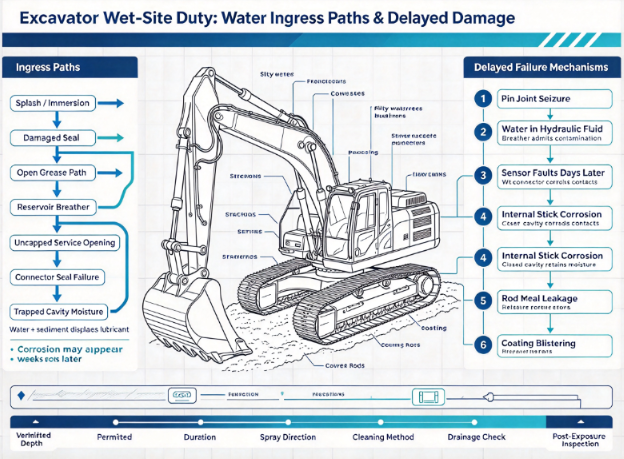
Different wet-site designs use different details. Check the materials and test methods on the actual final build instead of assuming every excavator has marine protection or sealed hollow sections.
| Component | MaterialSpec | Function | Failure Risk if Compromised |
|---|---|---|---|
| Pin joints, bushings, and seals | Verify pin finish, bushing material, seal design, grease compatibility, and allowable exposure. | Transmit load while excluding water and grit. | Ingress displaces grease and causes wear or corrosion. |
| Boom and stick cavities | Verify plate, coating, closure, drain, and inspection provision. | Carry bending and torsion while controlling trapped moisture. | Internal corrosion or retained water changes mass and condition. |
| Hydraulic reservoir and breather | Verify vent design, water exclusion, fluid specification, sample access, and seal condition. | Supply clean oil while accommodating fluid-level changes. | Water contamination damages pumps, valves, and bearings. |
| Hoses and cylinder rod seals | Verify hose construction, fittings, rod finish, scraper, and seal compatibility. | Carry pressure and exclude grit from sliding surfaces. | Abrasion or water entry accelerates leakage and scoring. |
| Electrical harnesses and connectors | Verify insulation, connector seals, cable route, strain relief, and diagnostic method. | Maintain power and signals in splash-exposed areas. | Corrosion produces intermittent or wrong control inputs. |
| Coatings and exposed fasteners | Verify surface preparation, coating repair method, fastener material, and inspection access. | Limit corrosion on structural and service surfaces. | Damaged coating hides pitting or seizes fasteners. |
Verify all parameters against current test reports and applicable standards before use in specifications.
Photograph waterline marks, coating damage, and any grease or oil leakage before washing the machine. Water trapped in a cavity or guard can remain after the visible surface dries. Record where it drains and whether discharge might contaminate the worksite.
No technical standards or numerical limits were supplied. Establish acceptance from current manufacturer reports and the project water exposure profile. The sample location and timing are as important as the result; a water sample from the reservoir does not directly reveal moisture trapped in a pin joint.
| Parameter | Standard | Test Method | Acceptable Range | Implication if Out of Range |
|---|---|---|---|---|
| Permitted water exposure | Verify final-build manufacturer criterion. | Map depth, duration, splash, washdown, and component location. | Within documented exposure boundary for every fitted part. | Unvalidated immersion and delayed failure. |
| Joint sealing and lubrication | Verify current service method. | Inspect seal damage, grease supply, water purge, and pin condition after duty. | Within joint-specific sealing and wear criteria. | Corrosion and abrasive joint wear. |
| Hydraulic fluid water condition | Verify manufacturer sampling procedure. | Sample approved port after documented operation and inspect reservoir and breather. | Within current approved fluid-condition limit. | Loss of lubrication and component damage. |
| Electrical connection integrity | Verify installed electrical test method. | Inspect seals and connectors; compare live signals before and after exposure. | No unapproved fault or intermittent state. | Uncommanded response or hidden warning. |
| Coating and cavity condition | Verify coating and inspection criteria. | Inspect damage and drainage at identified structure and fasteners. | Within final-build corrosion-control plan. | Internal corrosion or seized service joints. |
| Post-exposure functional response | Verify machine acceptance method. | Run controlled movement, holding, travel, swing, and tool functions after cleaning. | Within documented final-build behavior. | Delayed malfunction after apparent normal wet duty. |
Verify all parameters against current test reports and applicable standards before use in specifications.
Record the water type, turbidity, salinity if relevant, temperature, immersion depth, duration, machine position, and whether the tool stirred sediment. Wet clay can pack around seals and guards differently from clear water. Retest after the machine has drained and dried; an intermittent connector fault may emerge during this transition. Keep pre-exposure baseline readings for comparison.
Do not open a sealed component casually in the field merely to inspect it. An uncontrolled inspection can introduce contaminants and invalidate the original sealing state. Use accessible sampling or service points and the manufacturer's authorized procedure. If an abnormal result is found, isolate the ingress path before changing all fluids or parts; otherwise the same water source can contaminate the replacement immediately.
Water protection depends on boundaries, paths, and drainage. A seal reduces ingress only when its mating surface, installation, and lubrication remain sound. Pressure washing aimed at a seal lip can create a different exposure from ordinary splash. Water that enters a structural pocket can remain against a weld or plate after the exterior dries. Define where the machine may contact water, where fluid can collect, and where it exits. Inspect drain openings and protect them from sediment while following the actual machine's instructions.
At a pin joint, motion repeatedly redistributes grease and contact pressure. If grit-laden water reaches the bushing, particles abrade the mating surfaces and the removed material further contaminates the lubricant. Surface corrosion can create roughness that accelerates seal wear. Inspect the grease path and purge condition, measure clearance using the approved method, and evaluate both sides of a joint. A squeak or small external rust streak should prompt inspection of internal fit, not merely application of more grease over a failed seal.
Hydraulic contamination is a fluid-integrity issue. Water can enter through a vent, a damaged line, an uncapped opening during service, or a component submerged beyond its approved boundary. A reservoir sample needs a documented operating state because water and oil may distribute differently after motion or rest. Test with the manufacturer's method and investigate the source if abnormal. Replacing fluid without repairing the breather or open port does not establish durable protection. Keep the filtration, sampling, and refill record tied to the machine.
Electrical corrosion often creates a time-delayed fault. Moisture can bridge conductors while wet or corrode contact plating after drying; vibration can then make a marginal contact intermittent. Record the waterline relative to each connector, inspect seals and cable entry, compare sensor readings to independent measurements, and preserve event logs before resets. Never assume an illuminated display proves all submerged control paths remain correct. A protected function must be verified through the actual command-to-motion chain.
Customization requires its own wet-site validation. Added flotation, long-reach equipment, altered guards, or a special Dredging Bucket changes mass, stability, water exposure, and possibly hose and connector routing. Request final weight and balance, stability checks, measured Hydraulic Flow and pressure, sealing and drainage inspection, and serial-numbered factory acceptance under the defined exposure. A base excavator's dry-yard test cannot validate a modified submerged stick. Verify each numerical claim and permitted waterline against the manufacturer's current report.
Cross-brand comparison should start with one exposure map. Define water depth, chemistry, duration, cleaning, work cycle, and the components that enter splash or immersion. Compare the actual delivered protection and accessible test evidence for self-branded and other-brand machines. A machine advertised for wetland work may have different sealed components than a general excavator with wide tracks; track flotation does not prove electrical or hydraulic water resistance. Document which component is validated for which exposure rather than declaring a universal wet-site rating.
Host and attachment compatibility includes wet connectors and loads. Confirm quick-coupler lock, attachment mass and revised lift chart, auxiliary pressure and flow, return and drain condition, hose sweep, and the tool's own immersion limit. A powered grapple may have a motor or sensor positioned below the host's normal waterline. A hydraulically compatible tool can still corrode at its electrical connector or overload a soft riverbank when full. Test the complete host-tool assembly under the stated exposure.
Cross-border delivery can compromise sealing before the machine reaches water. Record package dimensions, disassembly scope, capped ports, protected connector ends, coating touch-up areas, supplied seals and spares, and destination reassembly steps. Inspect pin seals, grease lines, vents, hoses, cavities, and electrical connectors after arrival. Perform a controlled wet-site acceptance and a later post-exposure inspection tied to serial number. A factory water check before a boom or hose was detached does not verify the final installed seal.
Water adjacent work also changes ground support. Soft sediment can carry less reaction after repeated tracking; buoyancy of immersed attachments may change the felt load during operation but disappears as the tool rises. Do not infer that an easily moved immersed load is safe to lift clear of water. Check actual retained material, lifting chart, and ground bearing in the final dry and wet positions. Stop if unexpected settlement, water ingress warning, or loss of controlled motion occurs.
Corrosion inspection needs a time history. Record coating damage at delivery, after transport, after initial exposure, and at planned intervals. Small chips at pin bosses and fasteners can reveal recurring mechanical contact. If a repair is made, document preparation and acceptance, then revisit the same area after duty. A uniform exterior photograph is insufficient for a cavity that may retain water internally.
Separate rain exposure from machine washing in the inspection record. A directed cleaning jet may reach seals and connectors that remain dry during normal rainfall. If water is found behind a guard, inspect whether drainage was blocked by the guard, mud, or a later modification. Correct the path before repeating the same cleaning practice.
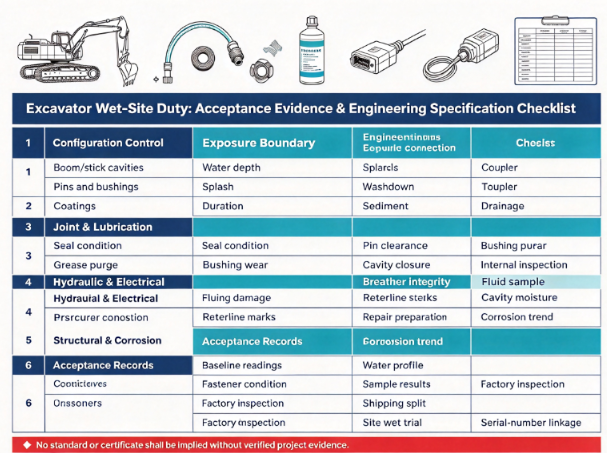
When we examine wet-site failures, we identify the entry point and the delayed progression. The visible failed component may be downstream of a damaged seal or uncapped opening.
| Failure | Root Cause | Engineering Consequence | Prevention |
|---|---|---|---|
| Pin joint seizes after wet duty | Damaged lip seal admits silty water that displaces grease and abrades bushing. | Heat, wear, and loss of articulation. | Inspect sealing, purge, and clearance after exposure. |
| Hydraulic sample shows water | Reservoir breather or service opening is exposed beyond its approved splash boundary. | Reduced lubrication and valve damage. | Identify ingress path and restore protection before refill. |
| Sensor faults appear days later | Wet connector corrodes after intermittent immersion and drying cycles. | False reading or lost function. | Verify connector sealing and post-exposure signals. |
| Stick plate corrodes internally | Water enters a cavity through damaged closure and remains trapped without drainage. | Hidden section loss and changed mass. | Inspect closure, drainage, and internal condition by approved method. |
| Cylinder rod seal leaks | Fine sediment accumulates at scraper and scores rod during repeated strokes. | Fluid release and accelerated seal wear. | Control exposure, clean by approved method, inspect rod. |
| Repaired coating blisters | Surface was coated over retained moisture or contamination near a weld. | Corrosion propagates beneath film. | Follow approved preparation and verify repair condition. |
Verify all parameters against current test reports and applicable standards before use in specifications.
Retest the original exposure path after repair where safe. A new connector without corrected cable entry, or new oil without a sealed vent, repeats the cause. Store photographs, water profile, sample results, service actions, and final functional readings together.
Specify boundaries for each component rather than describing the entire machine as simply water resistant.
Structural: Identify boom and stick cavities, pins, seals, coatings, guards, coupler, and tool construction.
Structural: Check final mass, stability, support soil, and lifting as the attachment enters and leaves water.
Drive specifications: Verify lubricant, hydraulic fluid, breather, sealing, auxiliary pressure and flow, and post-wet function.
Drive specifications: Record baseline and post-exposure pin clearance and hydraulic samples.
Environmental: Define water depth, chemistry, duration, sediment, spray, washdown, and drainage.
Environmental: State inspection timing, corrosion repair, and abnormal ingress response.
Safety standards: No named technical standard or confirmed certification is supplied; verify project requirements before claims.
Acceptance: Link final build, sealed connections, factory inspection, shipping split, and site wet trial to serial number.
Share your project parameters for a technical review.
Ganglong Heavy Industry Technology (Hefei) Co., Ltd. describes R&D, manufacturing, testing, and swamp excavators; its product page should identify the actual wet-exposure limits and final-build sealing records.
For any manufacturer, ask for component-specific immersion boundaries, pin and breather details, connector and coating inspections, sampling methods, and destination retest instructions. Verify that the installed tool shares the machine's documented wet duty. No certification or named standard is established in the inputs.
No; water can remain inside joints and connectors without immediate failure. Inspect after exposure and after drying. Compare fluid and functional results with the baseline.
No; they address ground contact, not water entry into pins, hydraulic fluid, or wiring. Verify each exposed component's limit. Assess soft-ground support separately.
Water can enter through vents or service openings and affect lubrication. Use the manufacturer's defined point and operating state. Trace abnormal water to its source before replacing fluid.
It may occur during wetting, drying, or later vibration. Retain event logs and inspect connector seals and contacts. Test the actual sensor-to-motion chain.
Inspect closure, pin seals, grease supply, hose caps, connector routing, and coating repairs. Run a controlled wet-duty and post-exposure check. Record results by serial number.
Share the water profile, machine configuration, fluid samples, and joint records for a wet-site review.
2435092534@qq.com
86 158 5511 9567


©2026 HKLOONG Heavy Industry Technology (Hefei) Co., Ltd. All Rights Reserved.

This website uses cookies to ensure you get the best experience on our website.
 中文
 Español
 Pусский
 Français
 العربية


 WhatsApp
 Phone
 E-mail
 Message
Comment
(0)